







Triceps brachii
The triceps brachii is a surprisingly large elbow extensor muscle with three main heads (long, lateral, and medial) that have unique anatomical features. There are valuable research studies that allow us to understand the best ways to train each region.
.
#1. Elbow extension internal moment arms – elbow angle
The three heads of the triceps brachii have different origins but similar insertions. The origin of the medial head is on the medial, posterior side of the humerus, while the origin of the lateral head is on the lateral, posterior side of the humerus (the origin of the medial head is also lower on the humerus than the origin of the lateral head). As a two-joint muscle, the origin of the long head is on the infraglenoid tubercle of the scapula. The lateral and medial heads can be subdivided into proximal and distal regions, which have different leverages depending on the elbow joint angle. Exercises that involve peak forces in full elbow extension (like close grip bench presses against bands or chains) will preferentially develop the proximal lateral head and the distal medial head, while exercises that involve peak forces in elbow flexion (like close grip bench presses with weight) will preferentially develop the distal lateral head and the proximal medial head.
.
#2. Elbow extension internal moment arms – shoulder angle
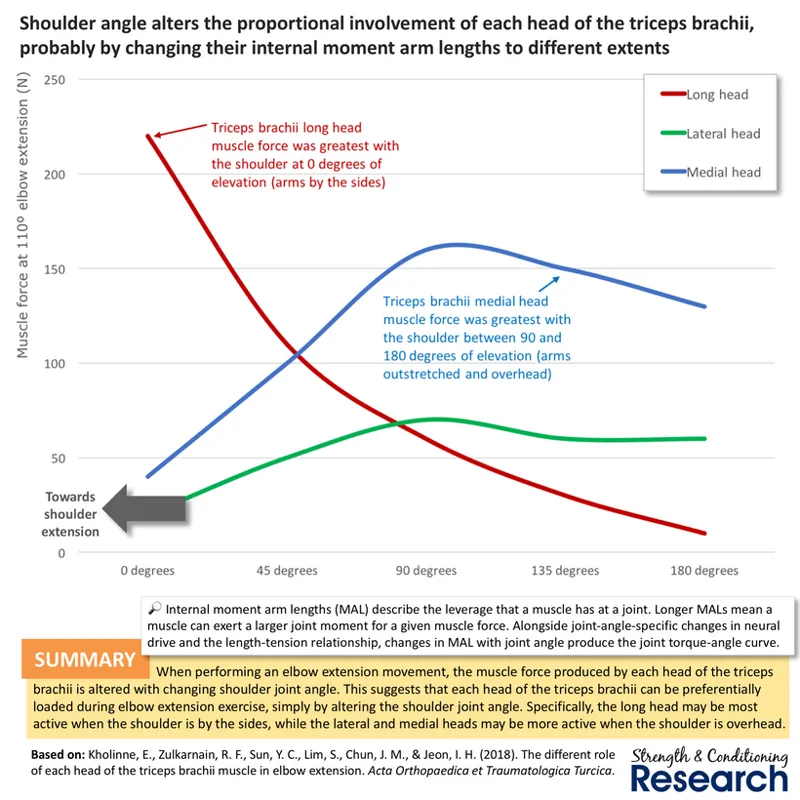
Shoulder angle also affects the leverages of each of the triceps brachii heads. As a result, exercises that involve different shoulder positions will produce greater hypertrophy in different parts of the triceps brachii. When the arms are close to the sides of the body (as in standing triceps cable pushdowns), the long head will be preferentially activated. In contrast, when the arms are overhead (such as in overhead presses and overhead triceps extensions), the medial and lateral heads will be preferentially activated.
.
These results are supported by studies that have measured the muscle activation of the long head and lateral head of the triceps brachii during isometric contractions with different shoulder positions. The long head is more active when the arms are by the sides of the body (and also with the wrist in supination, curiously), while the lateral head is more active when the arms are at shoulder height (and with the wrist in neutral).
.
#3. Shoulder extension internal moment arms – shoulder angle
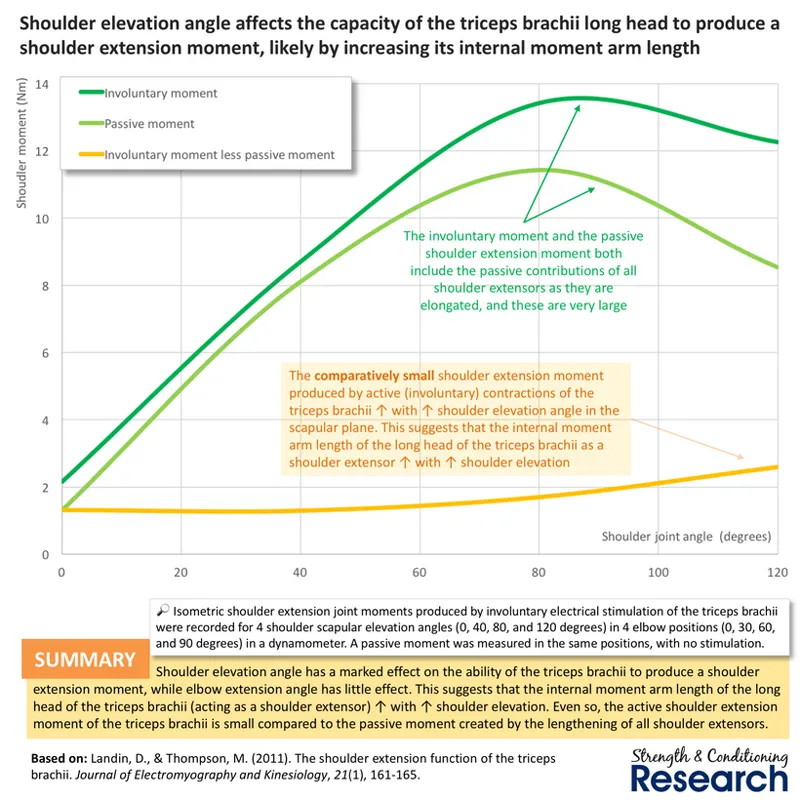
The triceps brachii long head is an effective shoulder extensor. Its leverage increases as the arm is elevated and reaches a maximum level when the arm is horizontal and parallel to the ground. Even so, it continues to have very good leverage so long as the arm is overhead.
.
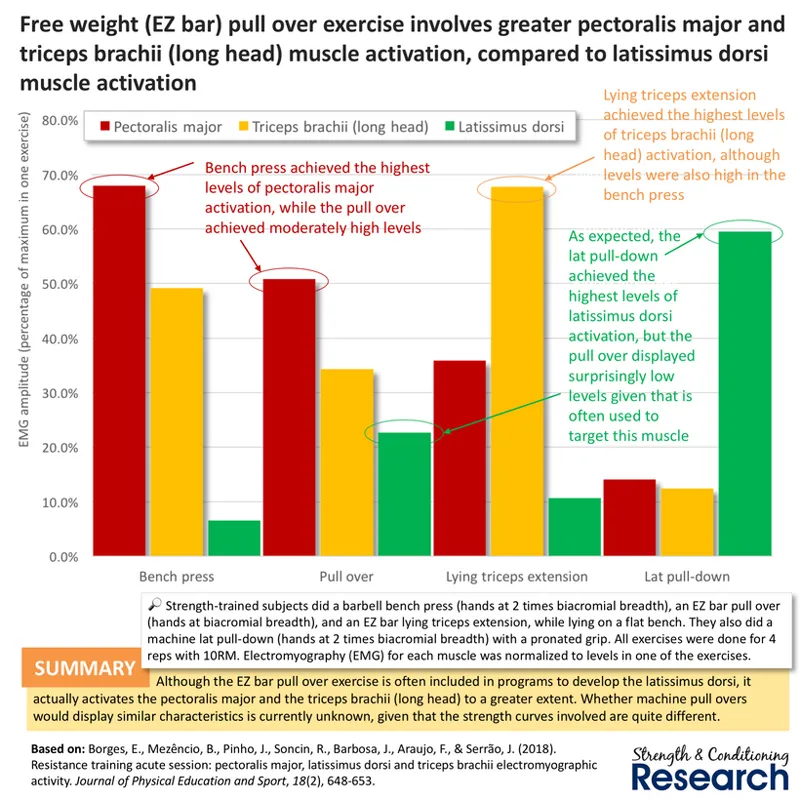
This is a very different profile from the latissimus dorsi, which has much better leverage when the shoulder is working below shoulder height rather than when it is above shoulder height. For this reason, we should only treat the triceps brachii long head as a major contributor to shoulder extension in the sagittal plane when the peak effort in the exercise is overhead.
.
Indeed, the pullover exercise involves peak efforts when the shoulder is elevated overhead and it tends to display relatively high degrees of triceps brachii muscle activation.
.
#4. Antagonist inhibition
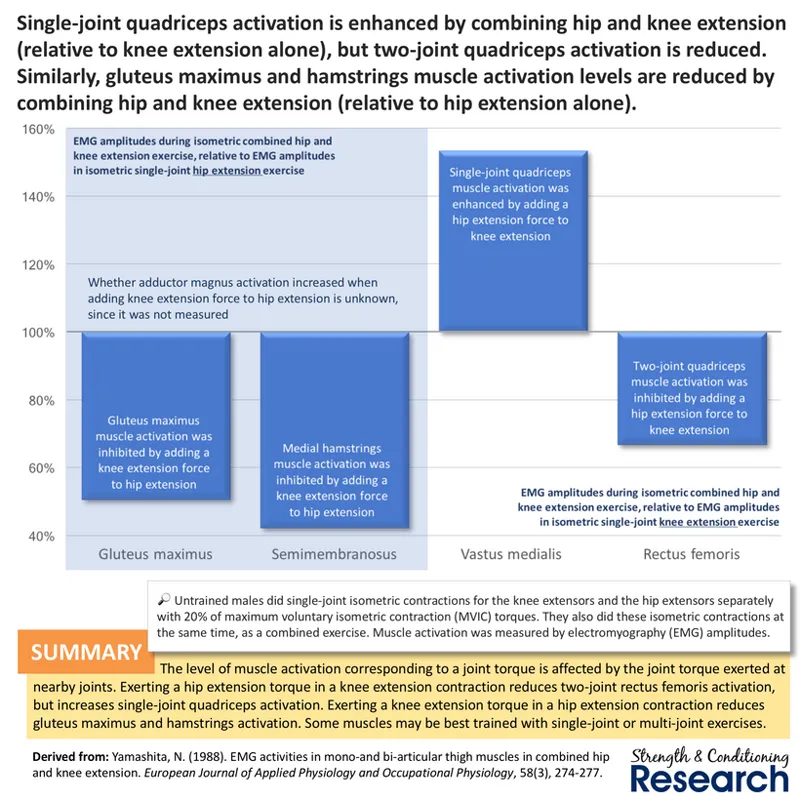
The activation of two-joint muscles is reduced during multi-joint exercises when they carry out an agonist function at one joint but an antagonist function at the other joint. This was first discovered in relation to the rectus femoris and hamstrings during combined hip extension and knee extension exercise.
.
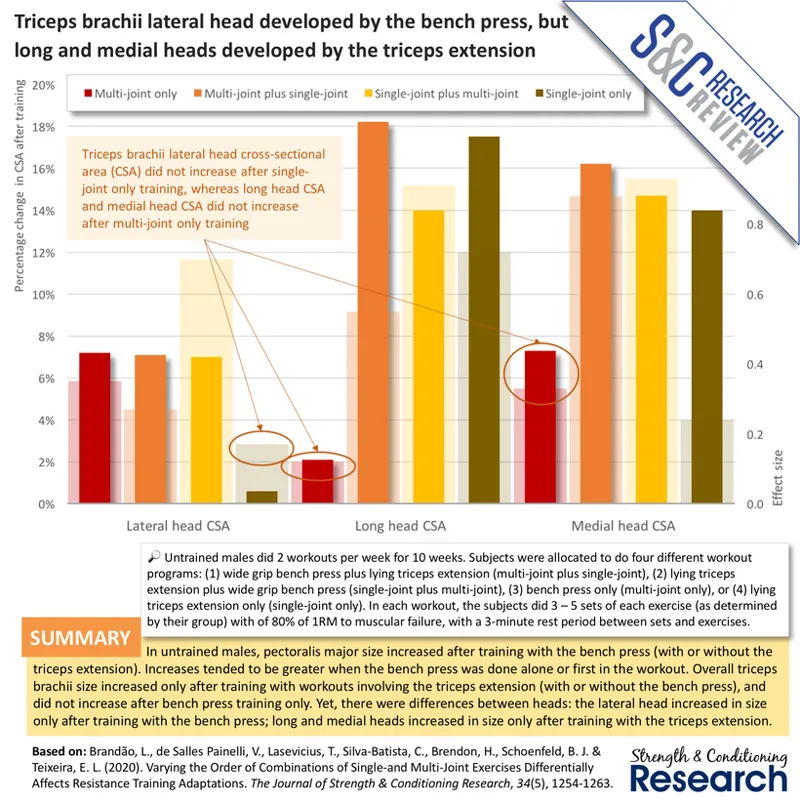
Indeed, recent long-term strength training studies have largely confirmed this phenomenon exists in the triceps brachii long head since they have reported that the lateral head is preferentially developed by multi-joint pressing exercises, while single-joint triceps extensions are better for the long head.
.
#4. Stretch-mediated hypertrophy
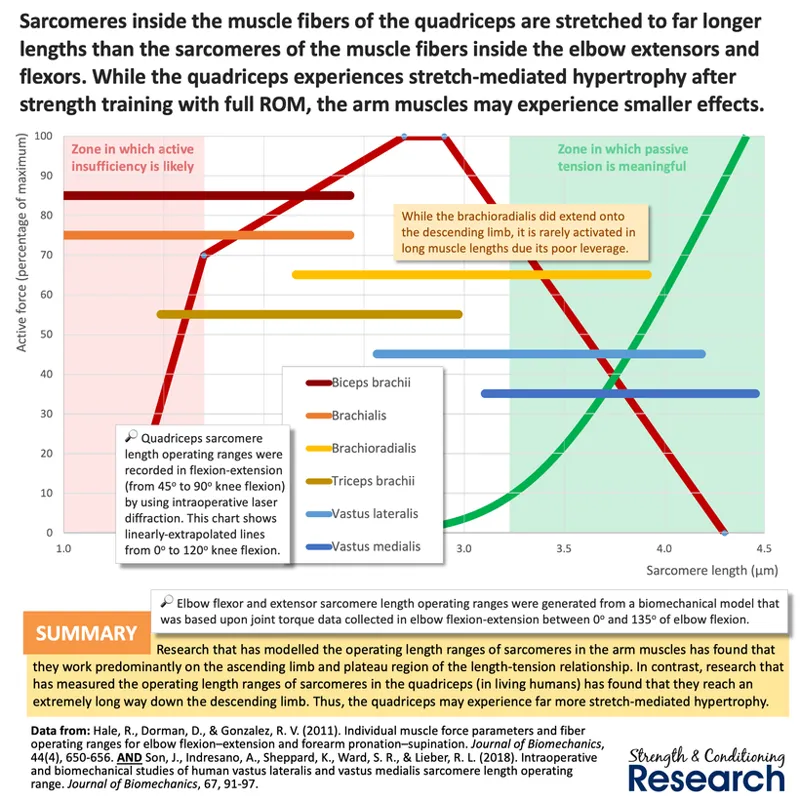
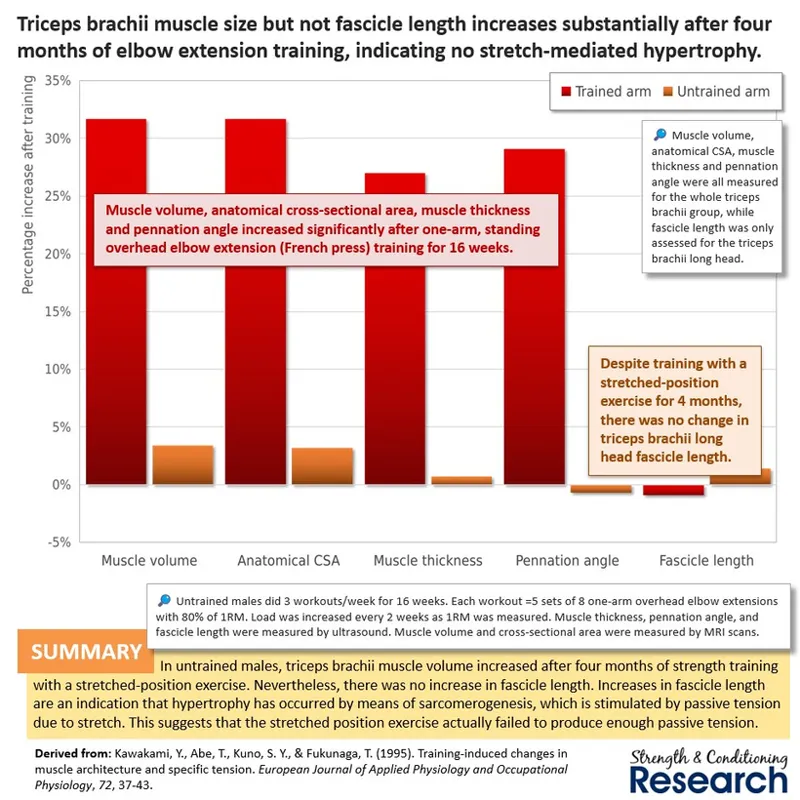
The triceps brachii has a very limited operating sarcomere length range and appears to stay firmly on the plateau over the majority of its muscle lengths and joint angles. For this reason, we should not expect it to display any stretch-mediated hypertrophy.
.
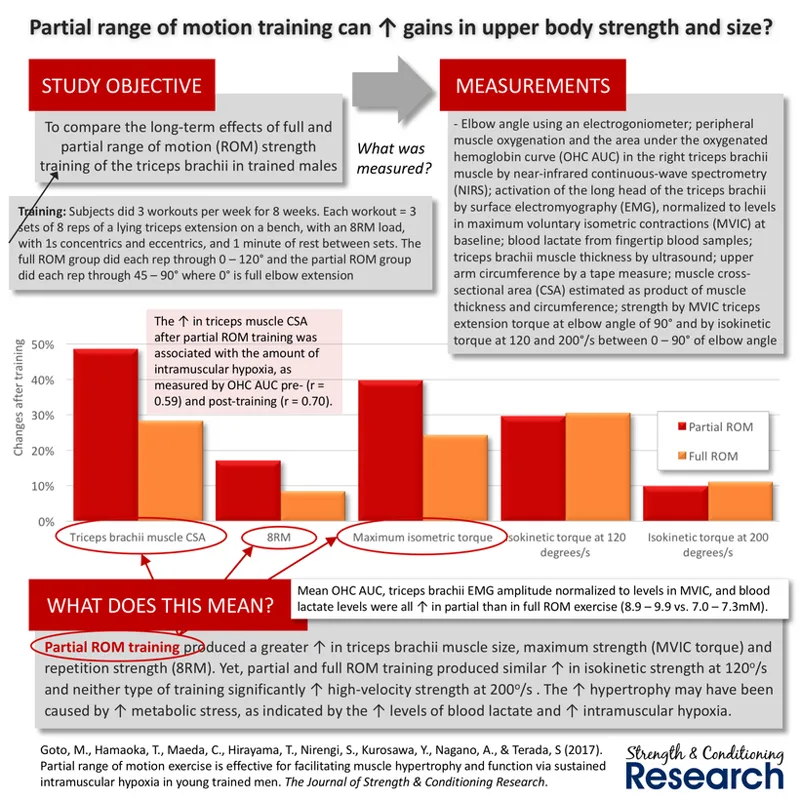
Indeed, in line with this expectation, research has found that the triceps brachii consistently fails to display any greater gains in muscle size when trained with a larger range of motion.
.
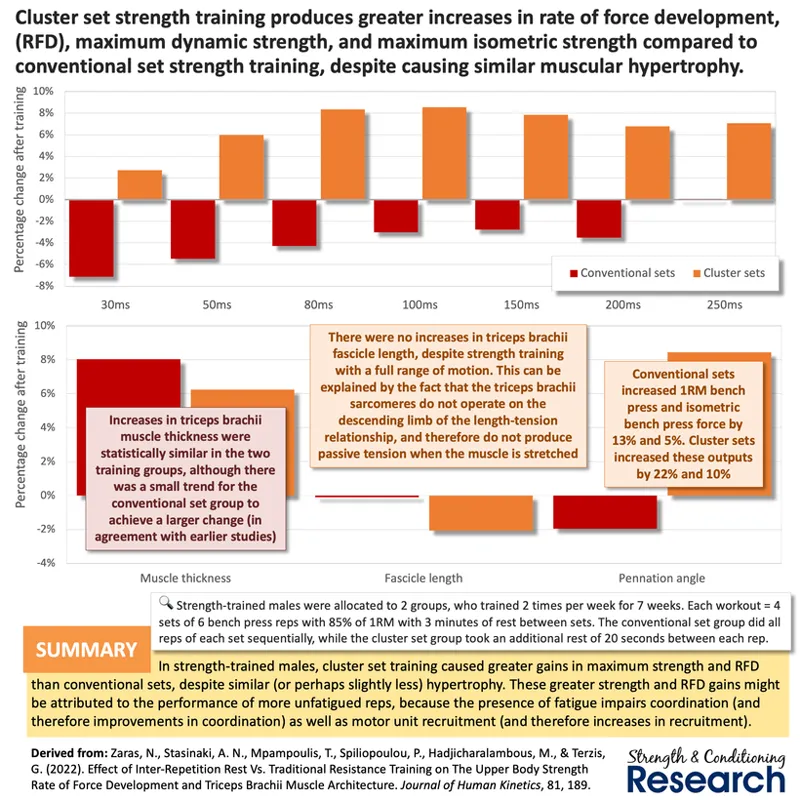
Moreover, it also fails to produce any increases in muscle fascicle length, which is the current proxy marker for the addition of sarcomeres in humans.
.
Multiple studies have reported exactly the same observation, indicating that the finding is not simply a matter of one study using a design that is not sufficient to produce the adaptation.
.
Indeed, the observation that the triceps brachii fails to display any increases in muscle fascicle length after strength training is one of the most repeatable findings in the entirety of the strength training literature.
.
#7. Recovery
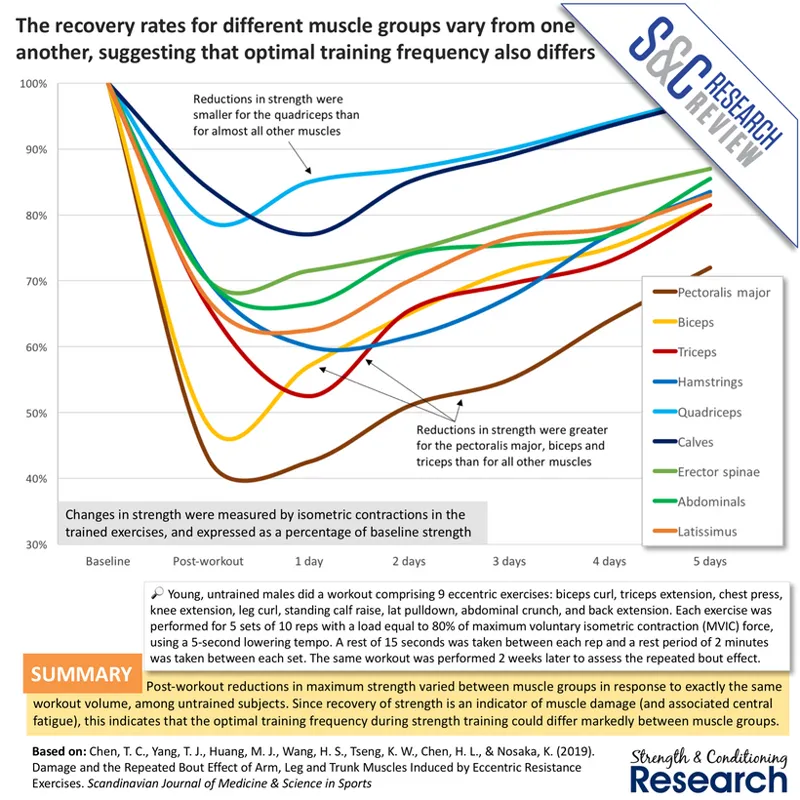
The triceps brachii recovers much more slowly than most of the other muscles in the body.
.
The triceps brachii likely recovers slower than most other muscles partly due to the extremely high proportion of fast twitch muscle fibers that it contains. Fast twitch muscle fibers are more easily damaged after exercise because they have fewer mitochondria. Thus, they experience greater damage from the calpains (proteases) that are released in response to the influx of calcium ions during exercise.
.
Also, the high voluntary activation capacity of the muscle means that more of the fast twitch fibers that are present inside the muscle can actually be activated during maximal efforts.
.
Conclusions
The triceps brachii is a large elbow extensor comprising three heads (long, lateral, and medial). Additionally, the long head is a shoulder extensor. It has best leverage for shoulder extension when the shoulder is elevated, in contrast to the latissimus dorsi. Thus, it works well in pullover variations. As an elbow extensor, the long head is preferentially activated [1] in shoulder extension (since its internal moment arm is greatest when the arms are at the sides of the body), and [2] in single-joint exercises (since it is a shoulder extensor and its activation is therefore suppressed during multi-joint pressing exercises). As elbow extensors, the medial and lateral heads are preferentially activated [1] in shoulder flexion (because their internal moment arms are greatest when the arms are elevated), and [2] during multi-joint pressing exercises (because this is where the long head is less active). The lateral and medial heads can be subdivided into proximal and distal regions, and the point in the elbow joint angle range of motion where peak force is produced affects which region is targeted. Exercises that involve peak forces in full elbow extension (like close grip bench presses against bands) target the proximal lateral head and the distal medial head, while exercises that involve peak forces in elbow flexion (like overhead presses with weight) target the distal lateral head and the proximal medial head. Nevertheless, using exercises that involve an elevated shoulder is not essential, as the triceps does not display more hypertrophy when being trained at a long muscle length, likely because its sarcomeres work on the plateau of the length-tension relationship even when the muscle is stretched.
Comments (5)
hey Chris, I'm sure you have seen the study Maeo(2022) PMID: 35819335. it showed greater long head growth in the overhead tricep extension vs a neutral position extension. what do you think is going on here? I do agree that there seems to be overwhelming evidence that the long head should grow more in a flexed shoulder position, but this study seems to contradict that.
Hi chris hope you are doing great. I got a question regarding the infographic about the recovery capacity of a muscle (in this case the triceps brachi). You are saying « the optimal training frequency for a given amount of workout volume will be lower than for workouts that target other muscle groups. » Taking that into account, wouldn’t it be a good strategy to adapt the number of series to muscular faillure based on the muscle trained in a workout and in order to maintain the same frequence as other muscle group ? Or there are too many inter-individual variations to be a good strategy ? Thanks in advance. Really appreciate your contents. It helps me a lot
Yes, we can of course alter either volume or frequency for a muscle group to fit with the way that other muscles are being trained in a program. Depending on the workout split being used, either is certainly possible.
Chris, we know how to train a lot of muscles according to their origin and insertion points also according to the principal of neuromechanical matching. But this is only relevant in vacuum. But how do we count volume if muscle groups overlap in exercise. Particularly I am interested in training gluteus maximus and medius. For example: if we do squats, we also stimulate gluteus maximus, but from your posts it seems that gluteus maximus have a very bad leverage training at long muscle lengths, so should we count the volume from squats or back extensions towards gluteus maximus? And what about other glute muscles like medius that can be trained in abduction and rotation - is that necessary? I also read that upper glutes mainly are trained in hip extensions at short muscle lengths together with abduction and rotation and lower glutes with hip extensions at long muscle lengths. Does that still hold true? Once again a long question, but the more I dive into bodybuilding, the more complicated it gets. Thanks!
Yes, I do tend to count squats as gluteus maximus exercises, because we know from training studies that the gluteus maximus does experience hypertrophy after squat programs. I haven't done a full analysis of the gluteus medius, so I can't really provide detailed commentary on that muscle group. It does have very distinct regions, however, so I would expect multiple exercises to be necessary for its complete development. As regards the upper and lower glutes, the main differentiator between the regions is the plane of motion, since the lower glutes are mainly hip extensors, while the upper glutes act as both hip extensors and also hip external rotators/abductors.