





Junk volume
Currently, strength training volume is widely regarded as the most important training variable for hypertrophy. Yet, there are good reasons to believe that adding more sets to a strength training workout may not always stimulate more hypertrophy. Consequently, it is entirely possible that many high-volume strength training programs contain "junk volume" that does not stimulate muscle growth.
.
#1. More strength training sets need not always stimulate more hypertrophy
Strength training volume displays a non-linear dose-response with hypertrophy, with many modern studies showing a plateau above a certain number of sets per workout. Indeed, it seems likely that when we remove those studies that use very short rest periods (which skew the resulting data, since short rest periods lead to reduced muscle growth per set), hypertrophy stops increasing beyond 6-8 sets.
.
Interestingly, this non-linear dose-response fits with the rodent data that also shows a plateau in hypertrophy occurring somewhere between 5-10 sets/workout.
.
#2. Calcium ion-related fatigue inhibits the hypertrophy stimulus
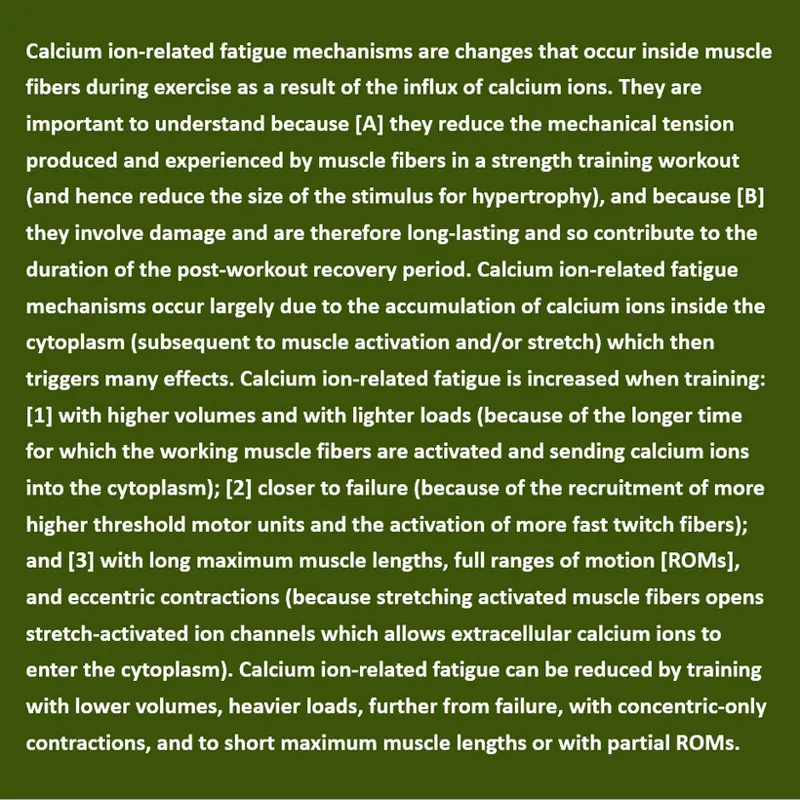
Junk volume during strength training workouts can arise if the later sets are done when too much calcium ion-related fatigue is generated in the earlier sets of the workout or if calcium ion-related fatigue is still present from a previous workout. This will inevitably occur after a certain number of sets, but is more likely to happen when the workout involves more stretched-position exercises (read more).
.
#3. Supraspinal CNS fatigue inhibits the hypertrophy stimulus
Junk volume during strength training workouts can arise if the later sets are done when too much supraspinal CNS fatigue is caused in the earlier sets of a workout.
.
Supraspinal CNS fatigue builds up over a workout due to the gradual accumulation of inflammatory signaling molecules that are formed during any exercise bout.
.
Supraspinal CNS fatigue can also be caused by previous workouts, when muscle damage has been generated. Muscle damage causes an inflammatory response that leaks into the bloodstream and travels to the brain, where it increases the perception of effort by creating perceptions of fatigue and tiredness (read more).
.
#4. Muscle damage inhibits the hypertrophy stimulus
Junk volume during strength training workouts can arise if the sum of the earlier and later sets cause too much muscle damage. Indeed, muscle damage takes the myofibrillar protein synthesis rate elevations away from the production of extra myofibrils and directs them towards the repair of existing myofibrils.
.
#5. Inflammation inhibits the hypertrophy stimulus
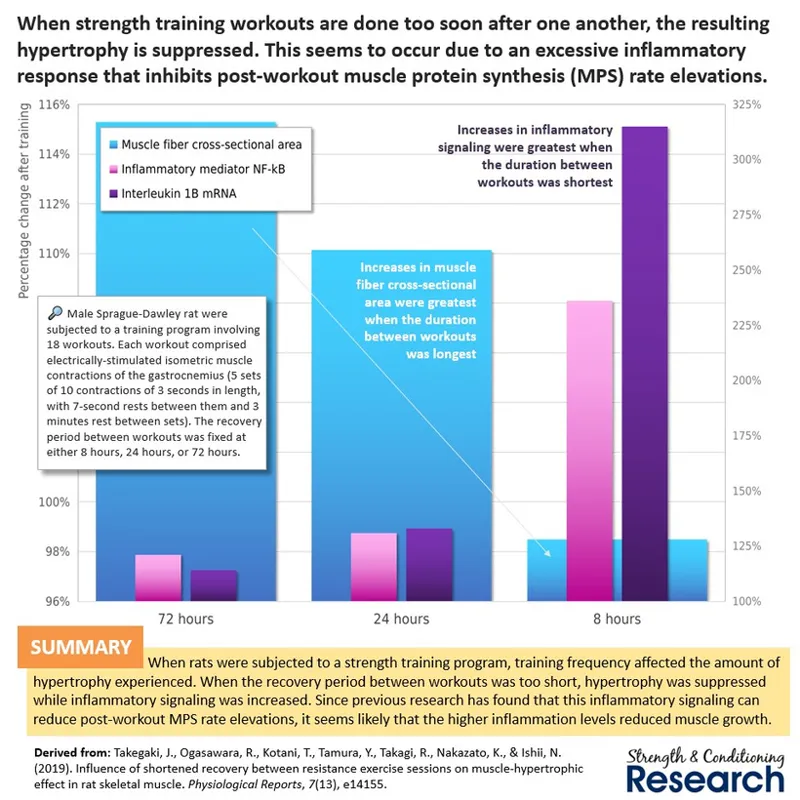
Junk volume during strength training programs can arise if post-workout fatigue does not recover in time for the next workout. Indeed, the inflammatory response that is generated inside muscles after each training session can actually totally block the hypertrophy stimulus from the next workout if it is still present.
.
#6. Insufficient muscle glycogen inhibits the hypertrophy stimulus
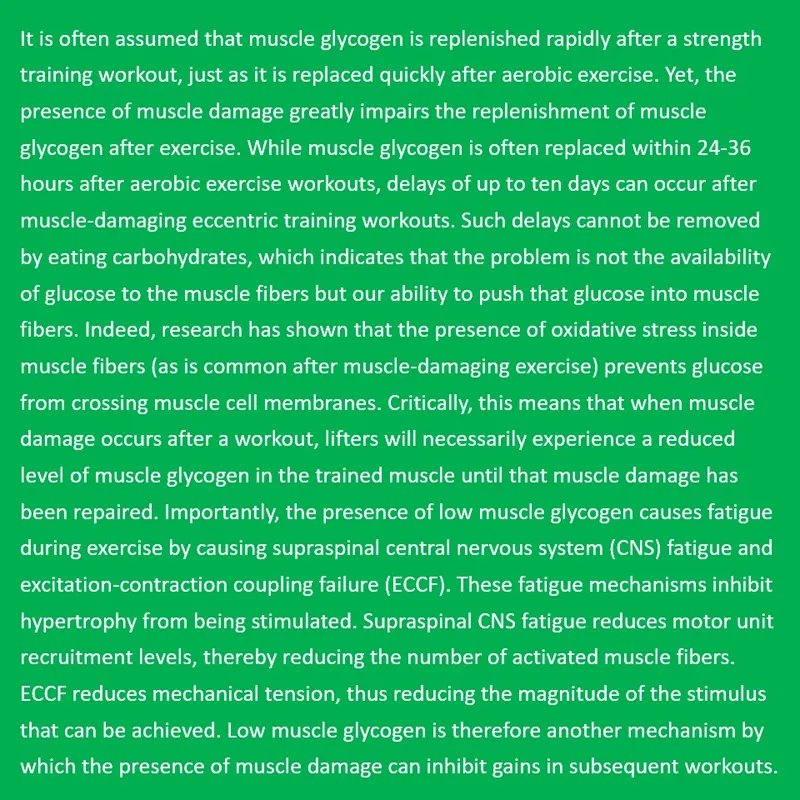
Junk volume during strength training programs can arise if post-workout fatigue does not recover in time for the next workout such that muscle glycogen does not replenish fully. Indeed, glucose cannot enter damaged muscle fibers in order to replace the muscle glycogen that was used during exercise, so whenever muscle damage is present, muscle glycogen cannot be replenished. Insufficient muscle glycogen causes both supraspinal CNS fatigue and calcium ion-related fatigue to occur, inhibiting the hypertrophy stimulus of subsequent workouts (read more).
.
Conclusions
Strength training volume is widely regarded as the most important training variable for hypertrophy. Yet, there are good reasons why adding more sets to a program may not always stimulate more hypertrophy. Many sets at the end of a high-volume workout and many workouts in a high-volume program are probably classifiable as "junk volume" for various physiological reasons. Indeed, the hypertrophy stimulus generated by later sets of a high-volume workout can be greatly reduced by the presence of: [1] calcium ion-related fatigue caused by earlier sets in the workout (because this reduces mechanical tension), [2] supraspinal central nervous system (CNS) fatigue produced by the earlier sets in the workout (since this reduces the level of motor unit recruitment), and [3] muscle damage produced by the early and later sets (since this diverts myofibrillar protein synthesis [MYOPS] rate elevations from hypertrophy and directs them toward repair processes). Also, the hypertrophy stimulus of any workout in a high-volume training program is reduced when the workouts are done while fatigue is still present in the trained muscle from previous workouts, because: [1] calcium ion-related fatigue and myofibrillar damage from a previous workout reduce mechanical tension, [2] supraspinal CNS fatigue from a previous workout reduces motor unit recruitment levels, [3] the inflammatory process associated with muscle damage stops the mechanical tension stimulus from causing an elevation in MYOPS rates even if it can be created, and [4] the same inflammatory process prevents glycogen replenishment, and low muscle glycogen accelerates the development of supraspinal CNS fatigue and calcium ion-related fatigue, which both impair the hypertrophy stimulus during strength training sets.


Comments (5)
In the first point. The number of set per muscle per workout are to task failure? Or with Rir? Thanks
I've seen some coaches suggest that chest pressing movements and back pulling movements are likely junk volume for the triceps and biceps, respectively, because those compound exercises cause fatigue build up and/or muscle damage in the arms but without also giving adequate hypertrophy stimulus. What do you think about that take?
I think it depends on [1] the exact moment arms of the individual and what their limiting factors are (for example, all pressing exercises are absolutely triceps exercises for me because my triceps leverage is better than my pec/delt leverages) and [2] the training status of the individual (beginners definitely get full stimulus and intermediates may well get a reasonable amount of stimulus but advanced lifters may not, again depending on their personal leverages).
From a fatigue point of view, there is no difference between 4 RIR and 2 RIR so the only difference is the reduced stimulus with 4 RIR.
Hi Chris. Do you think that the variation of exercises can contribute to limit junk volume? For example. Classic Split Chest day. 5x5 Bench press RIR 4, incline dumbbell press 5x8 RIR 2, Cable crossover 5x15 RIR 0. Subsequent sets are indeed high, maybe too high, but I think that changing the type of exercises and their RIR, can kind of help to reach the "appropriate" volume without distrupting the stimulus.