



Volume and training status
It is generally assumed that more advanced lifters need higher workout volumes to cause hypertrophy. But is this idea actually valid? Let's look at the physiology.
.
#1. CNS fatigue increases gradually over a workout
CNS fatigue builds up gradually over the course of any exercise session that involves repeated, intermittent muscular contractions. Indeed, this has been observed during workouts of multiple isometric contractions, for example.
.
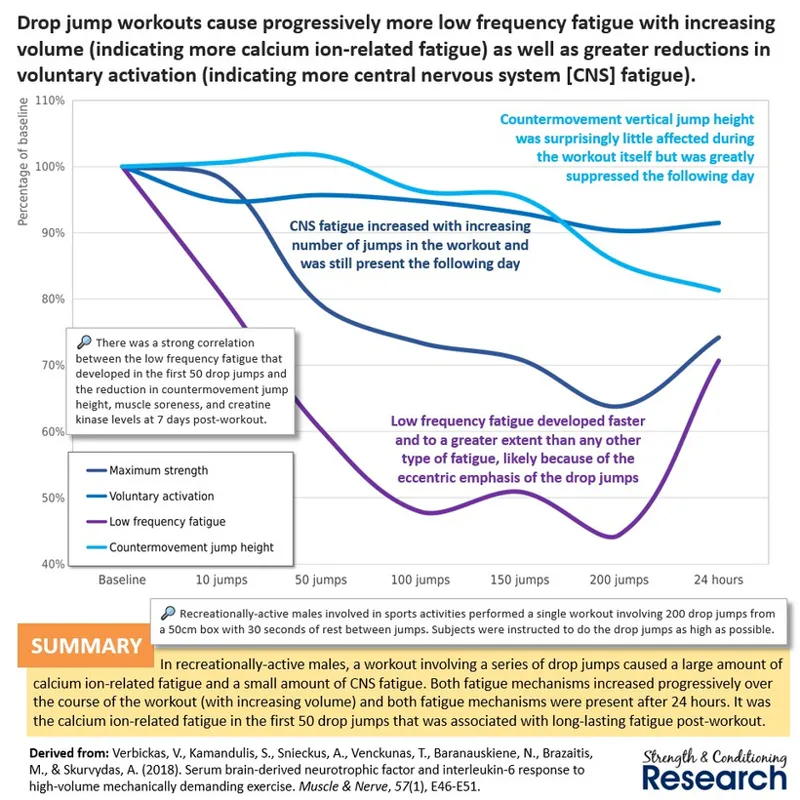
It has also been observed after workouts involving repeated drop jumps as well. This suggests that is also occurs during normal strength training workouts. Clearly, this will reduce the amount of hypertrophy that is stimulated in the later sets of a workout by reducing the access that we have to the highest high-threshold motor units of any muscle that is being trained.
.
#2. Calcium ion-related fatigue increases over a workout
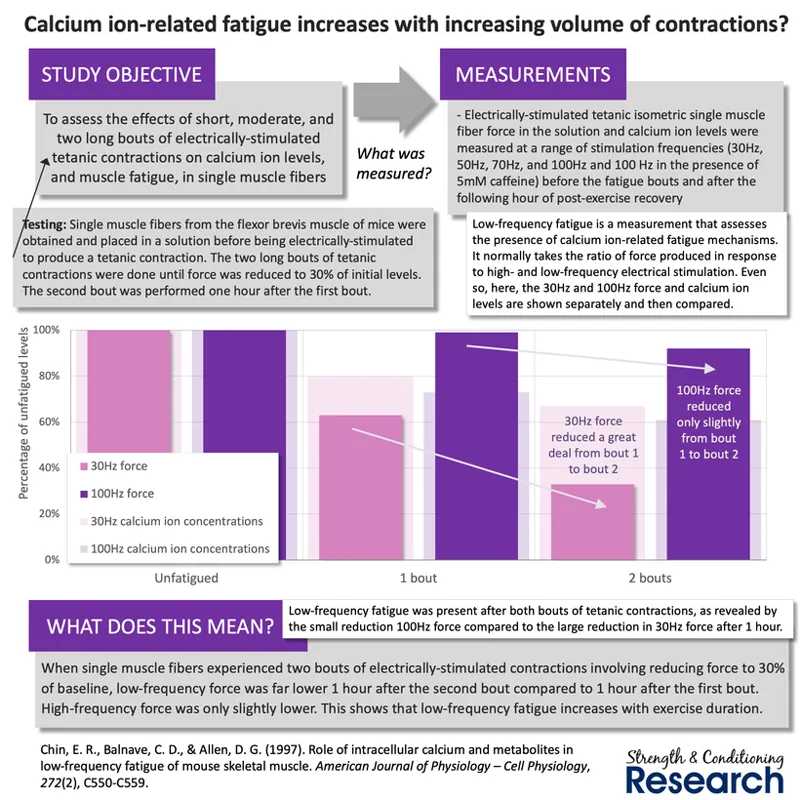
Just like CNS fatigue, calcium ion-related fatigue also builds up over the course of any exercise bout involving repeated, intermittent muscular contractions, and this is especially the case when the contractions involve high efforts, as this activates the more susceptible, fast twitch muscle fibers.
.
Calcium ion-related fatigue will necessarily reduce the amount of hypertrophy that is stimulated in the later sets of a workout by reducing the magnitude of mechanical tension that can be generated by the affected muscle fibers. Since the susceptibility of muscle fibers to calcium ion-related fatigue is determined by their oxidative capacity, this will always produce the greatest effect in the muscle fibers of the highest high-threshold motor units.
.
#3. Training status probably affects which muscle fibers can still grow
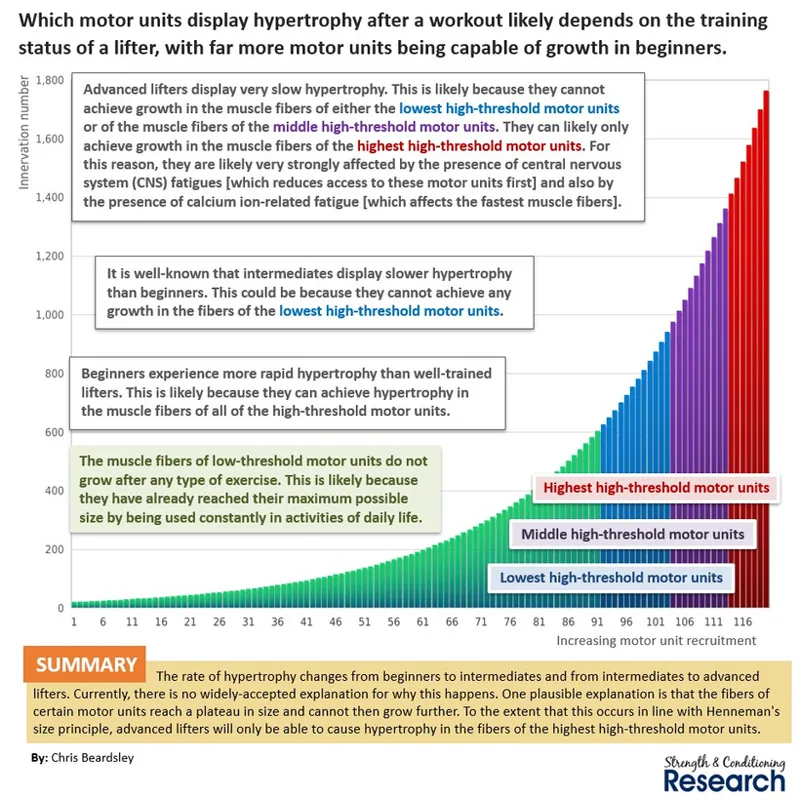
It is very well-known that muscle growth occurs more rapidly in beginners than in intermediate or advanced lifters. However, the exact reasons for this are still not well-established. One possibility is that beginners can stimulate growth in all of the muscle fibers of the high-threshold motor units, while intermediates and advanced lifters are limited to causing growth in a smaller proportion of those same muscle fibers.
.
Conclusions
It is generally assumed that advanced lifters need higher workout volumes to cause hypertrophy. But is this true? During any strength training workout, central nervous system (CNS) fatigue builds up gradually. So, the later sets cannot achieve as high levels of motor unit recruitment as the earlier sets. Calcium ion-related fatigue also builds up gradually, preferentially affecting the least oxidative fast twitch fibers of the highest high-threshold motor units. So, the later sets cannot achieve as high levels of mechanical tension in those fast twitch muscle fibers. The progression of these fatigue mechanisms over a workout is one of the reasons why the dose-response of hypertrophy to training volume is not linear (such that 3 sets do not cause 3 times as much hypertrophy as 1 set). Yet, it is also possible that training status affects which muscle fibers in a muscle are capable of growth. It is known that even untrained people cannot cause growth in the muscle fibers of low-threshold motor units, as they have already reached their maximum possible size. Thus, when beginners become intermediates, they could display a reduction in the rate of hypertrophy because the lowest group of high-threshold motor units reaches a plateau in size. When intermediates become advanced, they could similarly reach a plateau in the middle group of high-threshold motor units, leaving them only with the ability to cause growth in the highest group. Since the highest group is the most susceptible to CNS fatigue and calcium ion-related fatigue, it suggests that high volumes are unlikely to be useful for advanced lifters. Finding ways to maximize motor unit recruitment levels is likely to be a far more valuable strategy.
Comments (5)
Hi Chris, I was wondering if you have any references related to the idea of advanced trainees not being able to grow well the lower threshold fibers? I did find a study that showed somewhat contradicting data: https://journals.physiology.org/doi/full/10.1152/japplphysiol.00464.2021 . It clearly showed slow twitch fiber growth in a relatively large group of people with an average ~5 years resistance training experience (atleast once a week). I would be really interested if you could share literature on this topic.
So, the more advanced u are, the smarter u should train. Possibly more volume, but definitely "smart volume"
Reading this and researching on my own incorporating bands into the lift along with the weights itself and hitting the entirety of the muscle strength curve is an absolute must in a low set routine. Remember reading one of your other pieces of biceps being largely activated at the 90 degree elbow flex and up is example of where bands come into play to work the entirety of the muscle and keep the stress off the smaller joints.
Fantastic 👏🏻 Also ties well into your podcast episode. So strategies for maximising MU recruitment: 1. Heavier loads (4-6 reps) 2. Managing rest periods - including cluster sets: 4-5 minutes between sets, and/or cluster sets of 1-3 reps. I’m even thinking that to ensure progression has occurred, do a straight set of 4-6 reps first, 4-5 minutes of rest, then 2-3 sets of 2-3 cluster reps. 3. Explosive training or plyometrics (?) - also sets of 2-3 reps to minimise fatigue, elastic resistance (potentially more muscle damage and fatigue, so should limit volume and frequency of this type of training). 4. Only use maximally stable exercises and machines.
Arent plyos before strength training to fatiguing?