




What is training volume?
Training volume is a very contentious topic in the online bodybuilding community. Given these disagreements, it is important for us to define exactly what the term "training volume" actually means in the context of hypertrophy.
.
#1. The only metric of "training volume" that has been definitively related to hypertrophy is the number of sets to failure
When we are referring to the measurement of training volume that is related to increases in muscle size, training volume refers to the number of sets to failure. Indeed, many studies have shown that increases in the number of sets to failure in a training program is associated with more rapid hypertrophy.
.
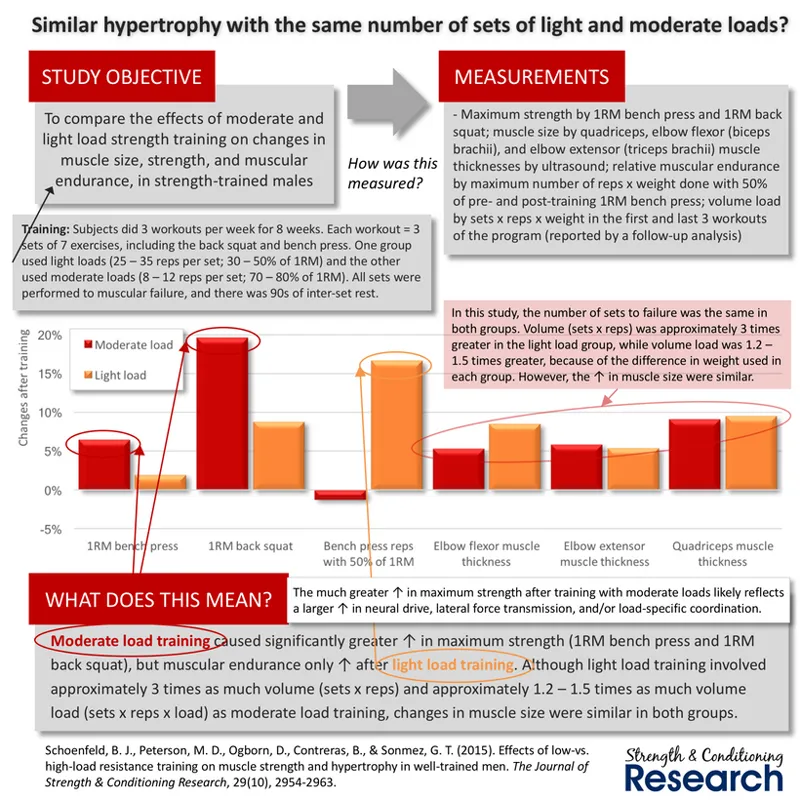
In contrast, training volume never refers to the volume load (the number of sets x the number of reps x the weight on the bar). It is possible to alter the volume load quite substantially and produce no changes in the amount of hypertrophy that is stimulated. For example, if we compare two training programs with the same number of sets to failure in different rep ranges, the volume and the hypertrophy are the same (since the number of sets to failure is the same) but the volume load is completely different (the light loads involve greater volume load).
.
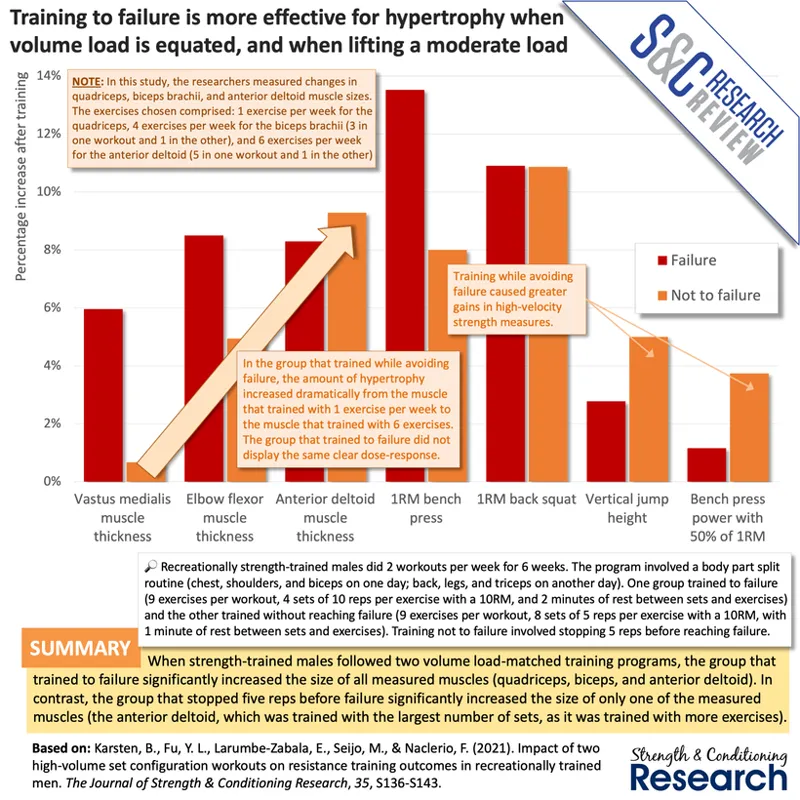
Similarly, it is possible to keep the volume load the same while producing large changes in the amount of hypertrophy that is stimulated. For example, if we compare two different training programs with the same volume load but with two different proximities to failure, the training program that involves sets performed closer to failure produces far more hypertrophy. This effect can be produced by altering the repetition range.
.
It can also be generated by introducing intra-set rest periods so that one program involves training closer to failure than the other program. Again, the volume load can be maintained identical while still greatly altering the amount of hypertrophy.
.
#2. Within each set to failure are some reps that are capable of stimulating hypertrophy (and some which are not)
In the previous section, we identified that when we define "training volume" as the number of sets to failure in a training program, this is related to the amount of hypertrophy produced. In contrast, the volume load (sets x reps x weight) is not at all related to the muscle growth since training programs involving sets that are stopped too far from failure can easily fail to produce any hypertrophy. This tells us that only the reps that are performed within a certain proximity to failure can be classified as "stimulating reps."
.
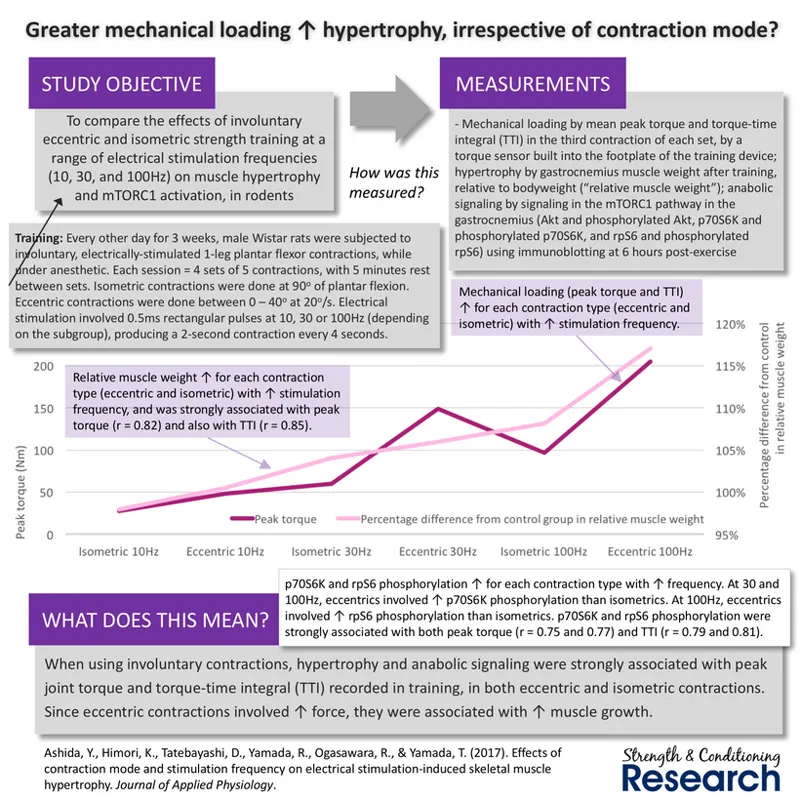
Why might these reps be classified as stimulating while the earlier reps in the set cannot be similarly classified? In animal models that use electrically-stimulated contractions to produce maximal motor unit recruitment in every repetition, the force-time integral of the muscular contractions is predictive of hypertrophy. This tells us that when the majority of the muscle fibers in a muscle are activated (as is the case in the reps close to failure in a conventional strength training set), the mechanical tension experienced by those muscle fibers predicts muscle growth.
.
We can identify the approximate number of reps in reserve that will prevent any muscle growth from happening by looking at a variety of sources. Most obviously, we can look at studies showing the force thresholds at which full motor unit recruitment occurs. Typically, it occurs at 85-90% of maximum force, which corresponds to approximately 5RM. This tells us that the final five reps of a set are those that produce hypertrophy, while those preceding this level cannot.
.
Conclusions
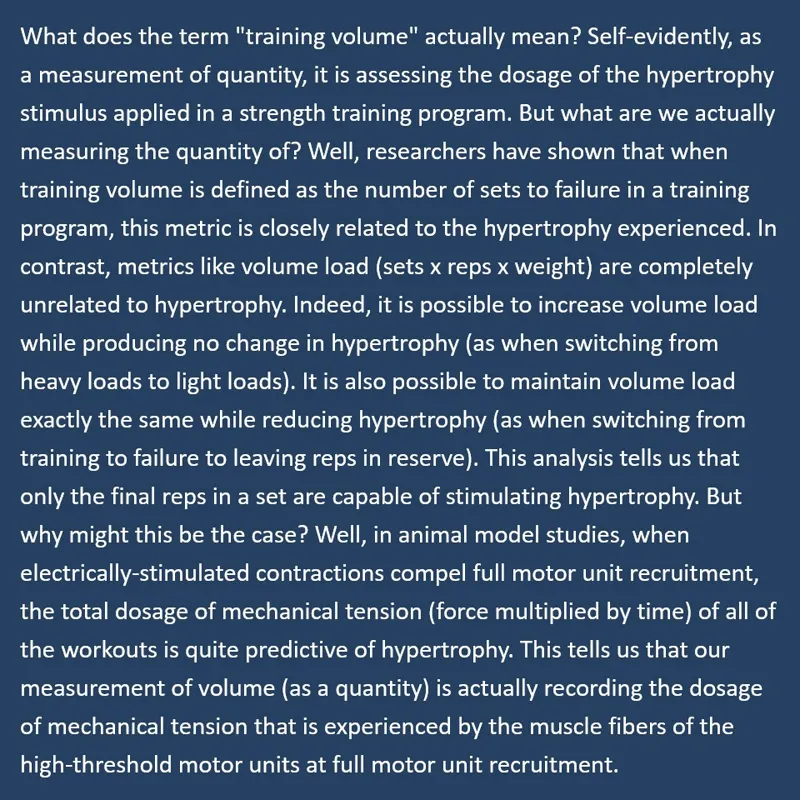
What does the term "training volume" actually mean? Self-evidently, as a measurement of quantity, it is assessing the dosage of the hypertrophy stimulus applied in a strength training program. But what are we actually measuring the quantity of? Well, researchers have shown that when training volume is defined as the number of sets to failure in a training program, this metric is closely related to the hypertrophy experienced. In contrast, metrics like volume load (sets x reps x weight) are completely unrelated to hypertrophy. Indeed, it is possible to increase volume load while producing no change in hypertrophy (as when switching from heavy loads to light loads). It is also possible to maintain volume load exactly the same while reducing hypertrophy (as when switching from training to failure to leaving reps in reserve). This analysis tells us that only the final reps in a set are capable of stimulating hypertrophy. But why might this be the case? Well, in animal model studies, when electrically-stimulated contractions compel full motor unit recruitment, the total dosage of mechanical tension (force multiplied by time) of all of the workouts is quite predictive of hypertrophy. This tells us that our measurement of volume (as a quantity) is actually recording the dosage of mechanical tension that is experienced by the muscle fibers of the high-threshold motor units at full motor unit recruitment.