




Effects of training to failure on hypertrophy
Recently, it has become popular to claim that performing sets to muscular failure causes exactly the same amount of hypertrophy as performing sets while stopping short of failure, so long as the number of repetitions in reserve (RIR) is quite small. Given what we know about how hypertrophy works, why might this be the case?
.
#1. Hypertrophy is stimulated by certain types of muscular contraction
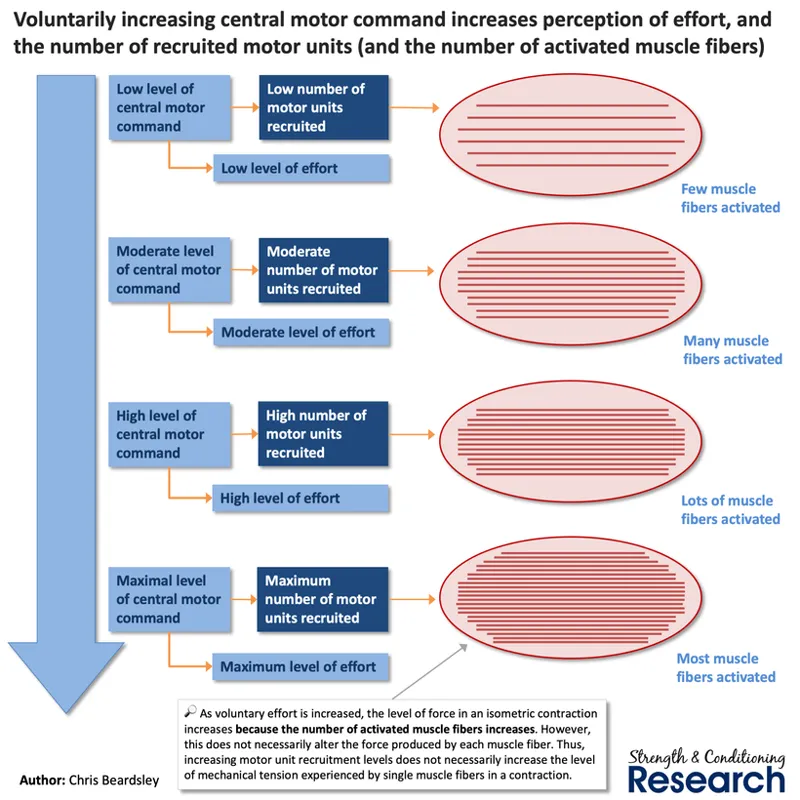
It is important to note that the muscle fibers of high-threshold motor units tend to increase in size after they experience sufficient levels of either active or passive mechanical tension. Therefore, when a muscular contraction involves a sufficiently high level of [1] motor unit recruitment, and [2] a sufficiently high level of active or passive mechanical tension, it should stimulate muscle growth to happen. We know that high levels of effort are necessary to cause high levels of motor unit recruitment, so the reps at the start of a strength training set will generally not cause hypertrophy (unless we are lifting heavy loads).
.
Therefore, we can see that only the muscular contractions (repetitions) at the end of a strength training set are able to stimulate hypertrophy. So how might sets performed to muscular failure produce the same hypertrophy as sets stopped just short of muscular failure, since they involve more of these muscular contractions that appear to fit the necessary criteria for stimulating muscle growth?
.
#2. The maximum dose of stimulating muscular contractions could be small
Why might training to failure appear to produce the same hypertrophy as training while stopping just short of failure? Well, one possibility is that we could reach our maximum stimulus after only a couple of stimulating muscular contractions. In this case, once we have performed a couple of repetitions within a certain proximity of failure, this would be sufficient to generate maximum muscle growth for that workout and any further repetitions are essentially superfluous. Of course, we can immediately dismiss this possibility because we know from meta-analyses that there is a very strong dose-response of hypertrophy to training volume.
.
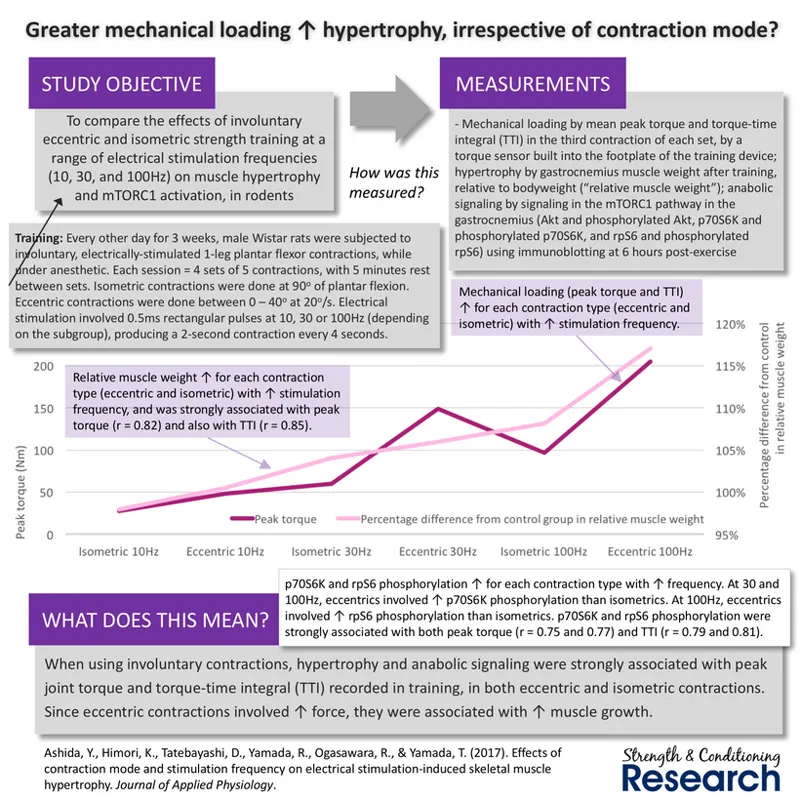
Indeed, when researchers control conditions carefully for the two key features that are needed to stimulate hypertrophy (high levels of motor unit recruitment and sufficiently high levels of mechanical tension), there is an extremely close relationship between the dosage of strength training provided and the resulting muscle growth that happens.
.
#3. The muscle-damaging effects of the final repetitions could be large
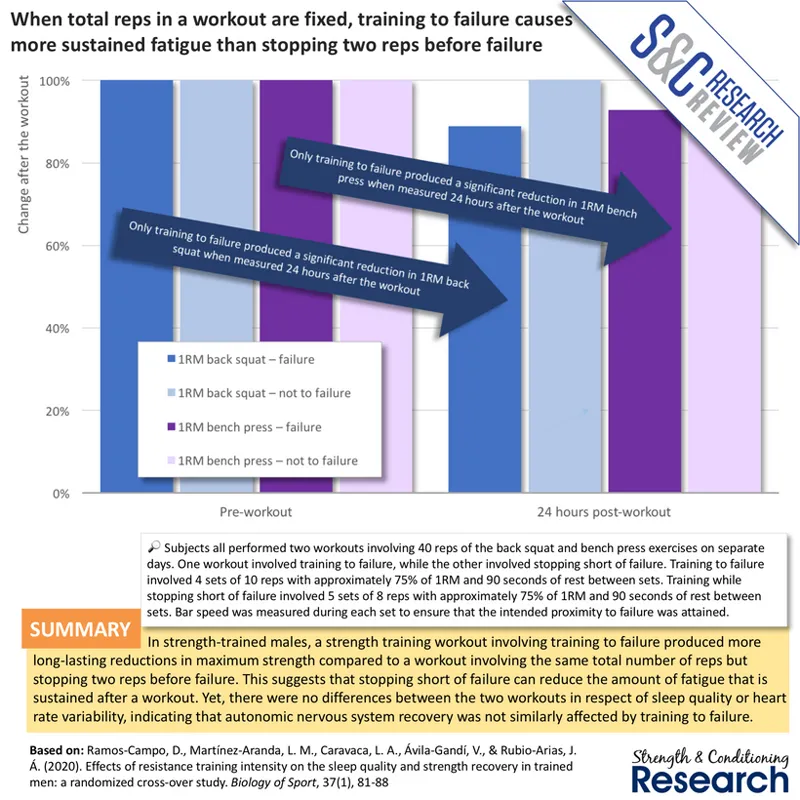
Why might training to failure appear to produce the same hypertrophy as training while stopping just short of failure? Well, another possibility is that the final reps could produce so much muscle damage that they produce a net zero effect on hypertrophy. Indeed, we know that training to muscular failure does cause much more post-workout fatigue (and therefore also more muscle damage) compared to training while stopping short of muscular failure.
.
We also know that muscle damage detracts from the hypertrophy stimulus by taking away part of the muscle protein synthesis rate elevation that would be used to increase muscle size, and sending that to do damage repair work instead.
.
#5. Calcium ion-related fatigue in the final repetitions could be excessive
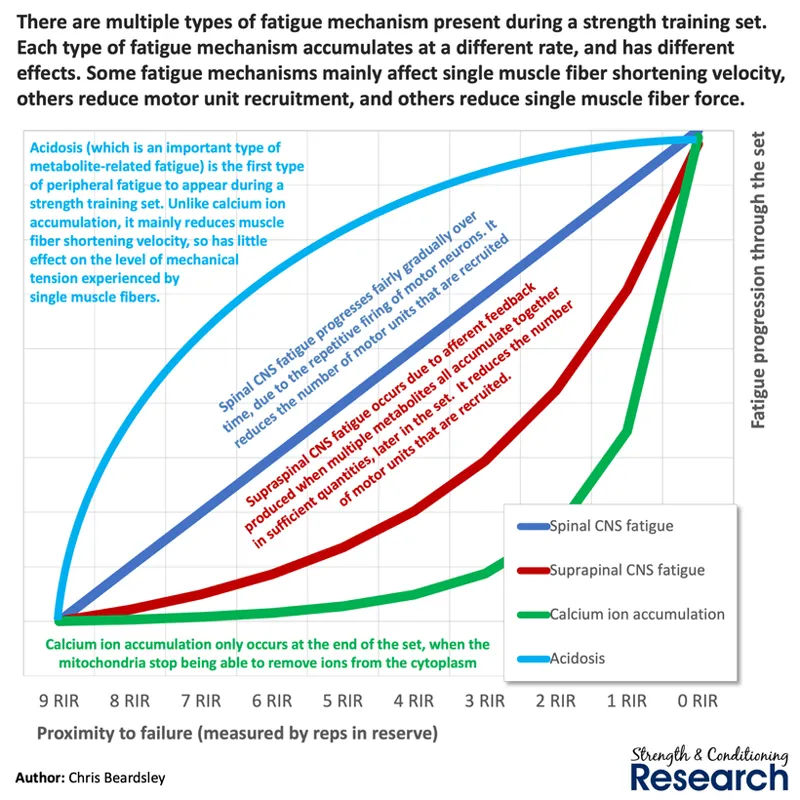
Why might training to failure appear to produce the same hypertrophy as training while stopping just short of failure? Well, one possibility is that the final reps of the set could involve so much calcium ion-related fatigue that they prevent the muscle fibers of high-threshold motor units from experiencing the levels of active and passive mechanical tension that are necessary to stimulate hypertrophy. Indeed, we know that calcium ion-related fatigue builds exponentially during a set to failure and only reaches very high levels in the final couple of reps of a set.
.
#6. CNS fatigue in the final repetitions could be excessive
Why might training to failure appear to produce the same hypertrophy as training while stopping just short of failure? Well, one possibility is that the final reps of the set could involve so much supraspinal or spinal central nervous system (CNS) fatigue that they stop the muscle fibers of high-threshold motor units from being activated. Indeed, we know that CNS fatigues also build over the course of a set to failure and only reach high levels in the final couple of reps of a set. Supraspinal CNS fatigue in particular tends to be nonlinear in its development due to its links with the negative feelings that we experience during exercise.
.
#7. It is just a lack of statistical significance
Why might training to failure appear to produce the same hypertrophy as training while stopping just short of failure? Well, the most likely possibility is just that we are not currently detecting the small difference in hypertrophy produced by the two training programs (indeed, this is what recent meta-analyses suggest).
.
Conclusions
Recently, it has been suggested that training to failure causes the same hypertrophy as training while stopping short of failure, so long as the number of reps in reserve (RIR) is small (up to 3RIR). Since muscle hypertrophy is stimulated when motor unit recruitment and mechanical tension are simultaneously high, this result could happen for one of four reasons. Firstly, if the maximum effective volume of stimulating reps is extremely low, such that doing only a couple of stimulating reps per set is sufficient to maximize hypertrophy (unlikely, given what we know about the dose-response of hypertrophy to volume). Secondly, the muscle damaging effect of the final reps could be very large, such that these reps cause a net zero effect on hypertrophy by using post-workout myofibrillar protein synthesis rate elevations for repair (unlikely, as it would cause extremely large amounts of post-workout fatigue after single sets to failure, which does not happen). Thirdly, either central nervous system (CNS) or calcium ion-related fatigue mechanisms in the final reps could be so high such that those reps cannot simulate hypertrophy (unlikely, given that these fatigue mechanisms also increase with increasing rep ranges, and this would preclude light loads from causing hypertrophy). Fourthly, the difference between training to failure and stopping a couple of reps in reserve could just be too small to reach statistical significance (likely, as many volume studies also fail to show differences between 1 and 3 sets).
Comments (7)
What is the general consensus of programming task failure to a beginner? If the extra gains are potentially minuscule, is the added fatigue worth it? Would the fatigue be enhanced in beginners? However, if RIR is hard to judge subjectively, (PMID: 30747900) particularly in new lifters, would task failure give us a better chance of “sufficient levels of either active/passive tension in muscle fibres of high-threshold motor units”? As velocity devices are not common, is there any other way to work around this? I thought of asking clients to guess an RIR mid-set before continuing a set to failure. Although not perfect, if they still aren’t sure, ask them to send videos for me to evaluate. Or even show them examples of RIR and task failure. From a safety POV, you could perhaps mitigate the risk of safety by programming stable and easier-to-learn exercises, with high load. I will appreciate anyone's time and perspective on this, thank you.
the hardest thing for me about NOT going all the way to failure is if the next week I'm trying to add a +1 rep on the same exercise, it's hard to know whether I really added a rep, while still leaving 1 in the tank, or whether I just trained closer to failure the following week.
Interesting Patrick. I also faced similar challenges, particularly in the early stages of my career. Over time, I've found that training to task failure has become easier for me to do than using RIR. Both for psychological reasons and as a personal preference for maintaining some form of objectivity in my progress.
soo...putting this on the ground, then training all the way to failure is likely not worth it since the gains are not that significant compared to leaving 1 or 2 in the tank?
Most of the time, yes. But some people may find that fatigue is minimal when training to failure so long as the rep range is heavy
The last 1-2 reps not only decrease rate of recovery but also "steal" part of precious MYOPS...seems like we shouldn't go to failure even occasionally. And I guess the necessary evil is testing your RMs. But how often?
I definitely prefer to rely on progressive overload with 1-2RIR sets and heavy loads (the heavier load makes the influence of calcium ion-related fatigue smaller) rather than testing RMs