



Muscle glycogen and muscle damage
Exercise often depletes muscle glycogen and recovery from exercise subsequently involves replenishment of those glycogen stores. It is often assumed that muscle glycogen is replaced relatively quickly after a strength training workout. However, when muscle damage is experienced, the situation changes quite dramatically.
.
#1. Muscle damage decelerates muscle glycogen replenishment
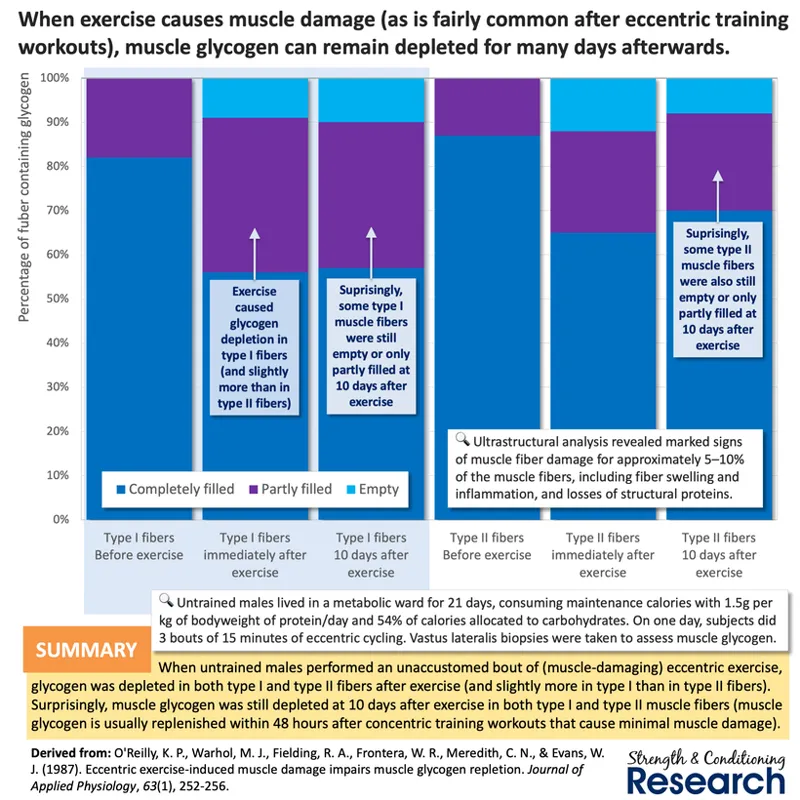
It is usually assumed that muscle glycogen is always replenished relatively quickly after a bout of exercise (within 24-36 hours). Indeed, this is the case after aerobic exercise workouts and those that do not involve very much muscle damage. Yet, eccentric training workouts (and likely any other strength training workout that causes substantial amounts of muscle damage display slower glycogen recovery).
.
Some studies have shown that muscle glycogen can remain depleted for up to 10 days after an eccentric training workout that damages the exercised muscle fibers.
.
#2. Carbohydrate consumption does not affect the rate of replenishment
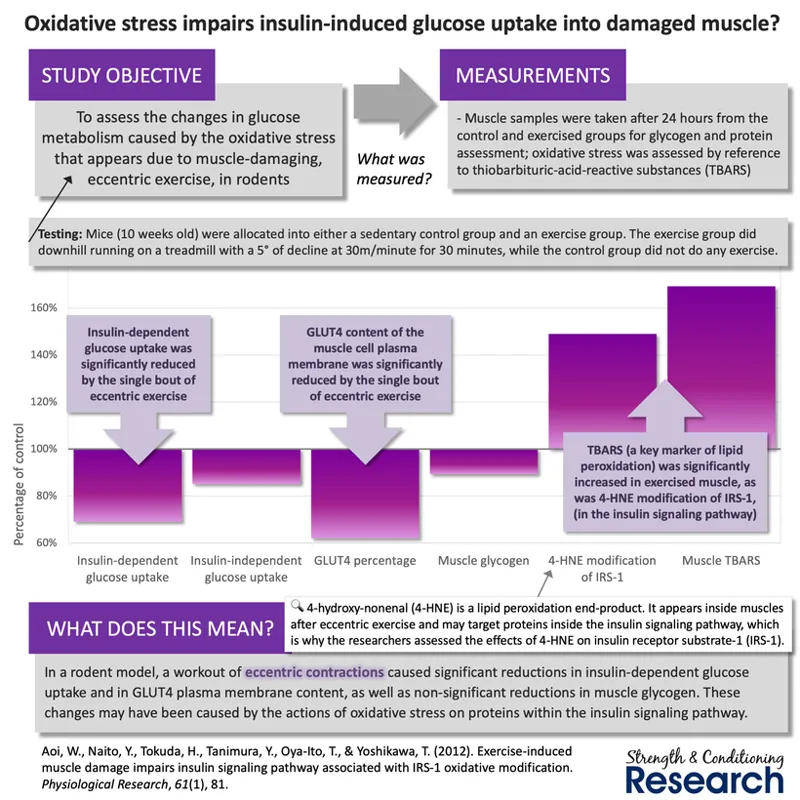
These delays in muscle glycogen replenishment after muscle-damaging eccentric training workouts cannot be removed by the consumption of extra carbohydrates, which indicates that the problem is not the supply of glucose to the muscle fibers but the demand for glucose by the muscle fibers.
.
Research has shown that when muscle fibers are experiencing oxidative stress, this prevents glucose from entering muscle fibers by crossing the cell membranes. This may therefore be the demand-side mechanism that slows muscle glycogen replenishment after eccentric training workouts (and other workouts that involve a large amount of muscle damage).
.
#3. Low muscle glycogen causes fatigue through two mechanisms
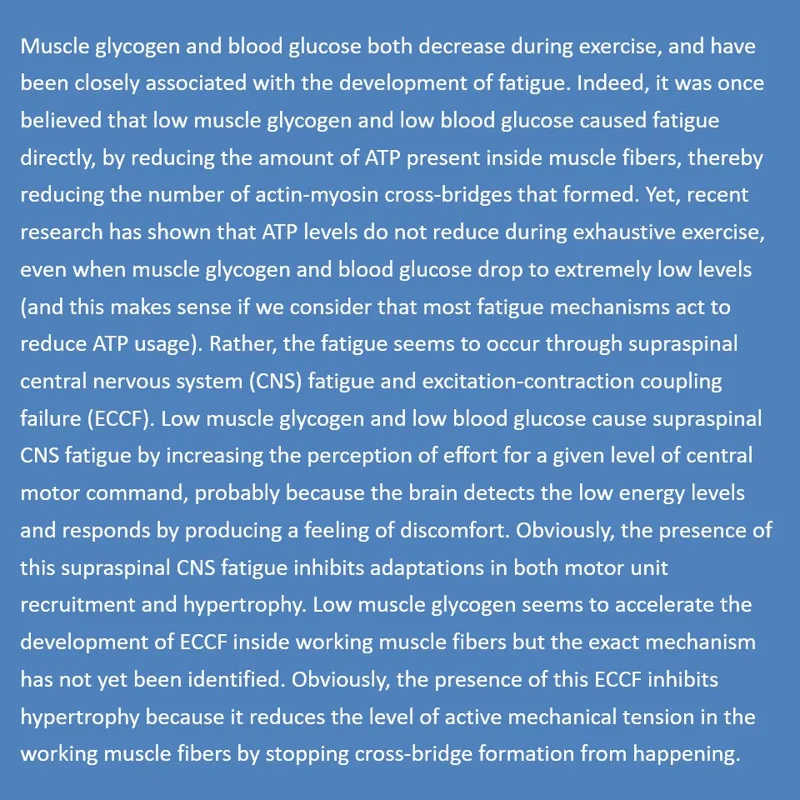
During exercise, low muscle glycogen levels cause fatigue by accelerating both supraspinal central nervous system (CNS) fatigue and excitation-contraction coupling failure (ECCF). These fatigue mechanisms are very important because they both inhibit hypertrophy from being stimulated. Supraspinal CNS fatigue reduces motor unit recruitment levels, thereby reducing the number of activated muscle fibers. ECCF reduces mechanical tension, thus reducing the magnitude of the stimulus that can be achieved by any single working muscle fiber (read more).
.
Conclusions
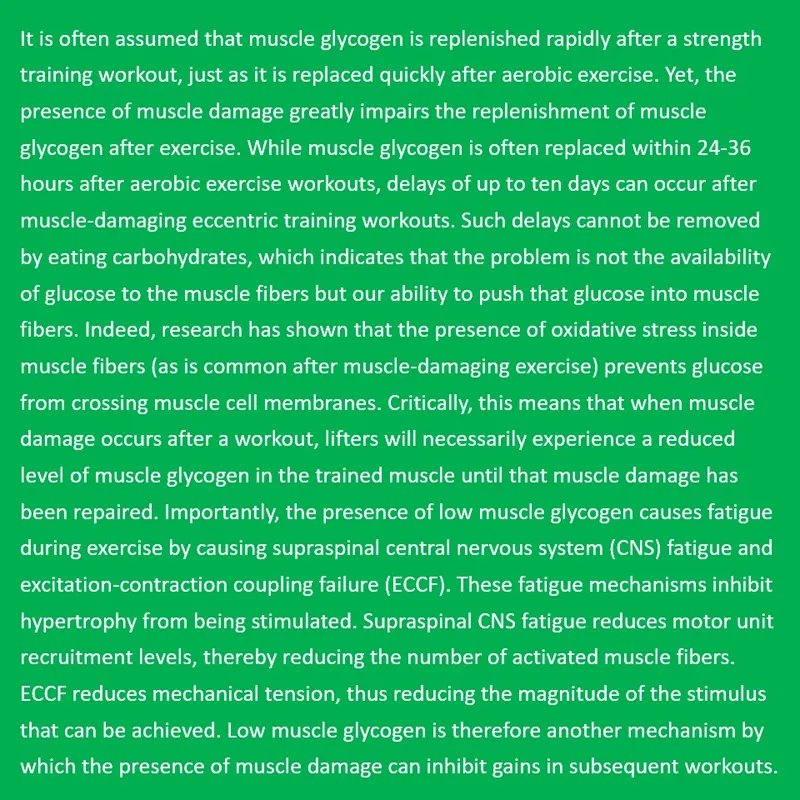
It is often assumed that muscle glycogen is replenished rapidly after a strength training workout, just as it is replaced quickly after aerobic exercise. Yet, the presence of muscle damage greatly impairs the replenishment of muscle glycogen after exercise. While muscle glycogen is often replaced within 24-36 hours after aerobic exercise workouts, delays of up to ten days can occur after muscle-damaging eccentric training workouts. Such delays cannot be removed by eating carbohydrates, which indicates that the problem is not the availability of glucose to the muscle fibers but our ability to push that glucose into muscle fibers. Indeed, research has shown that the presence of oxidative stress inside muscle fibers (as is common after muscle-damaging exercise) prevents glucose from crossing muscle cell membranes. Critically, this means that when muscle damage occurs after a workout, lifters will necessarily experience a reduced level of muscle glycogen in the trained muscle until that muscle damage has been repaired. Importantly, the presence of low muscle glycogen causes fatigue during exercise by causing supraspinal central nervous system (CNS) fatigue and excitation-contraction coupling failure (ECCF). These fatigue mechanisms inhibit hypertrophy from being stimulated. Supraspinal CNS fatigue reduces motor unit recruitment levels, thereby reducing the number of activated muscle fibers. ECCF reduces mechanical tension, thus reducing the magnitude of the stimulus that can be achieved. Low muscle glycogen is therefore another mechanism by which the presence of muscle damage can inhibit gains in subsequent workouts.
Comments (6)
Might be a stupid question but if the eccenctric phase is that damaging wouldn't it be best to make it as fast as possible to get it over with opposed to a slow and controlled eccentric?
Generally, during normal strength training, the level of muscle activation that is generated in the eccentric phase is quite low, so few of the easily-damaged fast twitch muscle fibers are actually activated. This means that there is a big difference between eccentric training (with maximal efforts) and normal strength training. Researchers use eccentric training so that they can create a large amount of muscle damage in a study and observe the effects easily. We can assume that high-volume strength training workouts would be needed to produce a similar effect in the gym.
It sounds like this is a primary influence on time to recover from higher intensity strength training to supercompensate by the next session? Adequate glycogen makes CNS more efficient while less ECCF is present and the muscle damage is recovered. This means the chance of greater strength. Am I interpreting this right?
Adequate glycogen means that there is less supraspinal CNS fatigue (CNS can produce a high level of motor unit recruitment) and less ECCF (so muscle fiber can produce higher forces and experience higher mechanical tension). Therefore, adaptations in motor unit recruitment and adaptations in muscle fiber size (hypertrophy) can be greater, underpinning greater strength gains.
So, we just need to give a muscle region enough time to recover from inflammation and in the first place, try not to damage it excessively I've never understood those post workout "carb windows" but now it seems quite logical to have carbs prior to workout when inflammation is more likely to be resolved
Yes, definitely. I also think that pre-workout carbs are likely to be more helpful than post-workout carbs since they should help minimize calcium ion-related fatigue from forming in the first place.