



Excessive volume and/or frequency
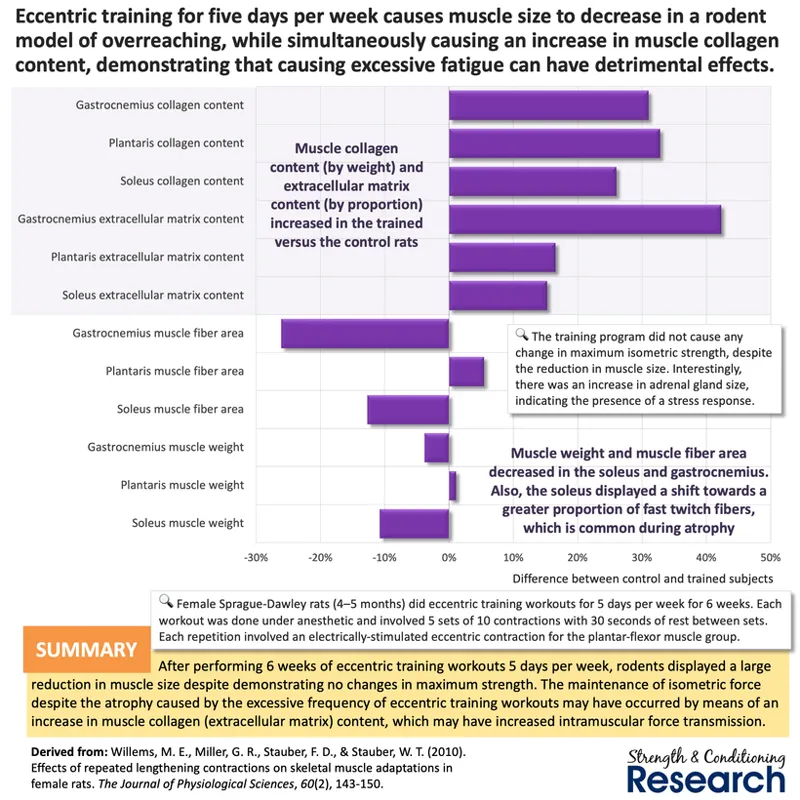
Currently, extremely high volume strength training programs are very popular, even when they cause overreaching. Overreaching blocks are defined as periods of training that involve reduced levels of exercise performance. While such reductions in exercise performance are commonly attributed to the presence of fatigue, the research into repetitive strain injury (RSI) suggests that they may actually involve negative changes, such as the loss of muscle mass and fibrosis.
.
#1. Excessive volume and/or frequency cause strength losses
Since RSI is a large problem in the workplace, many animal studies have been performed in order to understand it better. These studies tend to involve either extremely high volumes or extremely high frequencies of exercise training for several weeks, which is a very useful model for understanding the potentially negative effects of extremely high volumes of strength training. Importantly, many of these studies have reported that strength often reduces when the volume and frequency are excessive (and this is a common finding during overreaching blocks). While such losses in strength are usually attributed to the accumulation of fatigue, the animal studies have revealed that the reductions in strength are frequently accompanied by reductions in muscle size as well.
.
#2. Excessive volumes of strength training can cause fibrosis (through inflammation)
Alongside the decreases in maximum strength and the decreases in muscle size, these excessively high volumes and frequencies of strength training also tend to cause the build-up of intramuscular collagen (fibrosis). Importantly, research has also shown that when the inflammatory responses are suppressed, the strength losses and the fibrosis are prevented. This implicates the large amount of local inflammation that tends to arise after high volumes of exercise in causing the build-up of collagen inside the muscle.
.
#3. Excessive volumes of strength training can cause peripheral nerve compression and central sensitization
Pain and increased sensitivity to touch are common features of RSI. Research has shown that excessively high volumes and frequencies of strength training cause [1] inflammation in the peripheral nerves of the trained muscles as well as [2] reductions in peripheral nerve conduction velocity, both of which have been previously associated with compressive nerve injuries. Also, some research has found that the spinal cord displays changes in neurochemicals in response to the peripheral nerve inflammation, which may increase central sensitization.
.
#4. Excessive volumes of strength training can block hypertrophy through the post-workout inflammatory response
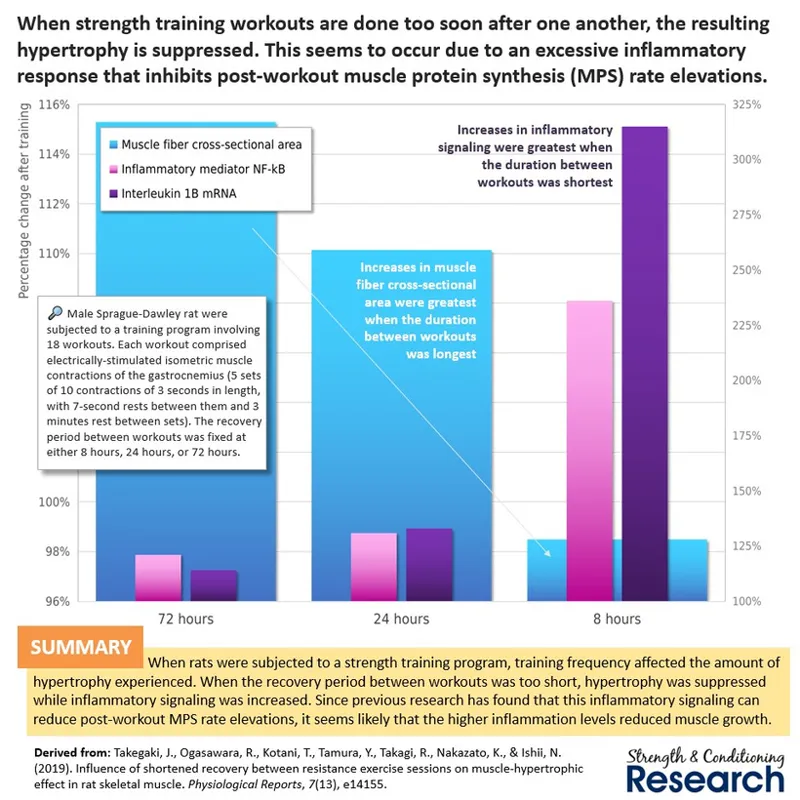
Recent research has shown that when workouts are done while a post-workout inflammatory response is still present from the previous workout, the normal elevation in myofibrillar protein synthesis (MYOPS) rates does not occur.
.
This failure to elevate MYOPS post-workout then leads to reduced hypertrophy.
.
Conclusions
When a strength training program involves an excessively high frequency and/or volume, it often fails to cause strength gains and even causes strength losses. In the strength and conditioning community, such plateaus or losses in strength are usually described as overreaching and are normally attributed to the accumulation of too much post-workout fatigue. However, medical research into repetitive strain injury (RSI) and exercise science have considered other explanations. The study of RSI typically involves repeating high volumes of the same task for several weeks, and a subset of those investigations uses high loads, which is a useful model for strength training. Such studies have shown that an excessively high volume and/or frequency of training can lead to strength losses by means of negative adaptations such as [1] losses in muscle size, [2] increases in intramuscular collagen (fibrosis), and [3] peripheral nerve inflammation and reduced nerve conduction velocity (likely indicative of nerve compression injury). These negative adaptations appear to mediated in some way by an inflammatory response. In addition, exercise science studies have found that when inflammation is still present from a previous workout, strength training workouts cannot stimulate hypertrophy despite producing anabolic signaling responses to the exercise bout. Together, these findings indicate the potential for high-volume, high-frequency, muscle-damaging exercise to produce losses in strength and exercise performance through a number of mechanisms in addition to fatigue, some of which involve the prevention of key muscular adaptations.
Comments (2)
I'm curious also whether higher frequency vs. lower frequency would tend to have more long-term risk on joint health and overuse. Is that also more highly individual, or could you speculate on how spreading volume over 1, 2, or 3x per wk impacts joint inflammation and health? While I'm definitely interested in optimizing hypertrophy, I'm also willing to take a suboptimal approach if it protects my joints. Also, I heard you mention on the frequency podcast that you only really take upper lower and full body programs seriously now. Is that because for you personally, higher frequency has been better? Are you willing to share a sample week of training that you've used based on how you've applied your knowledge practically?
There's literally no data on the effects of strength training in healthy subjects on joint health (or even any objective, measurable outcomes of that, as far as I know) so we're probably years away from knowing the answer to the effects of training frequency on that.