




Muscle force ≠ mechanical tension
While it well-known that "mechanical tension" is the only mechanism by which we can stimulate muscle hypertrophy, it is not a well-understood that whole muscle force is unrelated to single muscle fiber mechanical tension.
.
#1. What do we mean by mechanical tension?
Mechanical tension refers to a physical pulling force. In the context of hypertrophy science, it means the pulling force that a single muscle fiber produces and experiences. It does not mean muscle force.
.
Single muscle fiber mechanical tension can be produced through two mechanisms. Firstly, it can be produced by the formation of actin-myosin crossbridges in response to muscle fiber activation. When a muscle fiber is activated, calcium ions are dropped into the cytoplasm at the triadic junction and this signals myosin and actin to bind with one another, pulling the muscle fiber to a shorter length. This is called "active mechanical tension". When the muscle fiber detects this type of mechanical tension, it signals itself to add more myofibrils in parallel, thereby increasing in diameter. Secondly, it can be produced by the passive stretching of titin molecules that run alongside the actin and myosin. This is called "passive mechanical tension" and it signals itself to add more sarcomeres in series.
.
We know that the signal for hypertrophy is the mechanical tension detected by individual muscle fibers because the mechanoreceptors are located inside muscle fibers and not outside of them (read more).
.
#2. What determines active mechanical tension?
Active mechanical tension is produced by actin-myosin crossbridge bindings, which are primarily affected by the force-velocity relationship (read more).
.
#3. What determines passive mechanical tension?
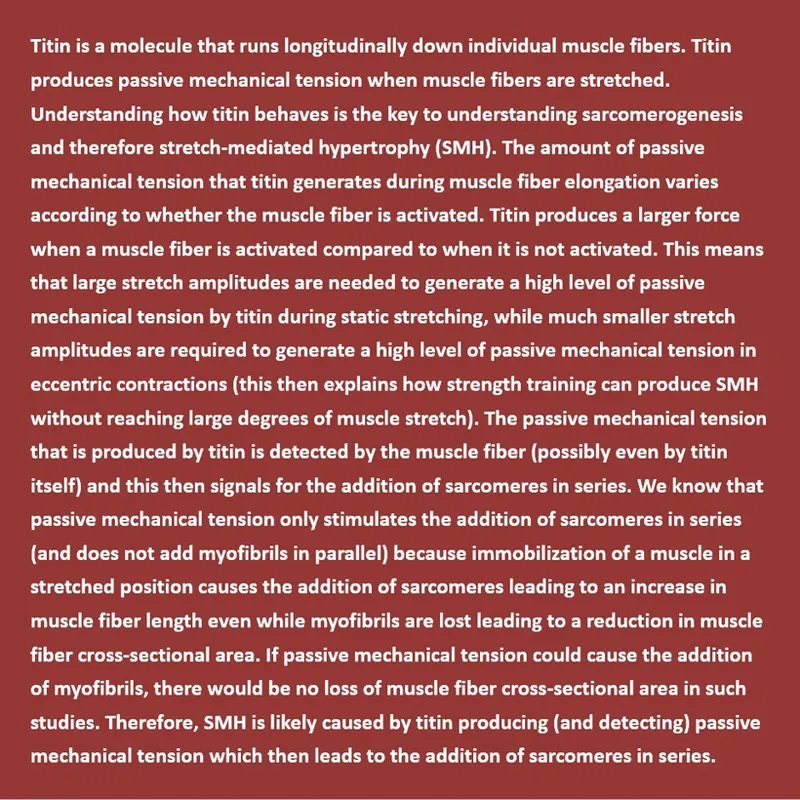
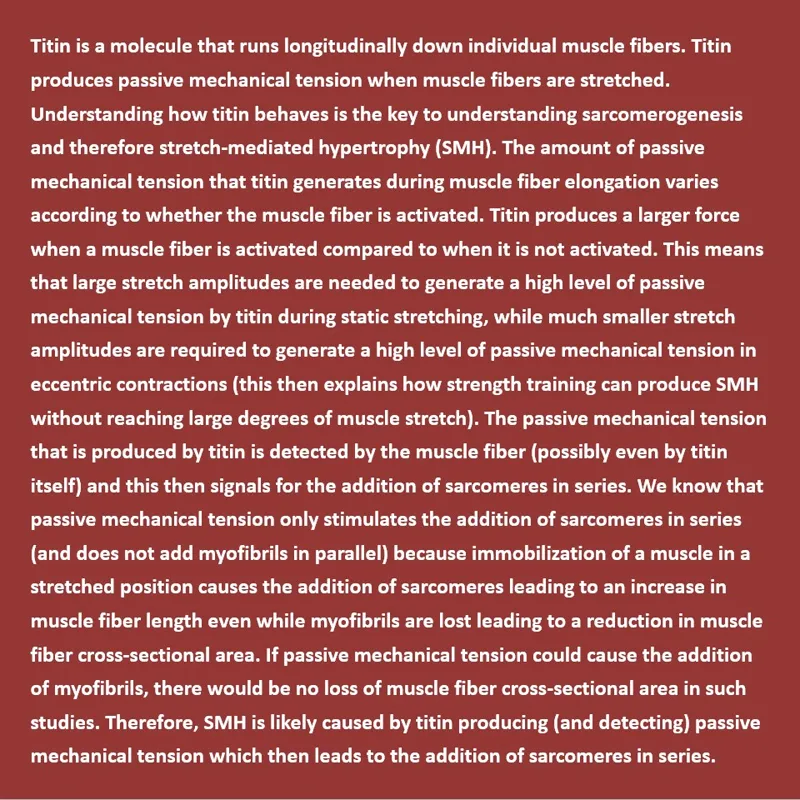
Passive mechanical tension is produced by the lengthening of the giant molecule titin, which is affected by both muscle fiber stretch and muscle fiber activation (read more).
.
#4. How can muscle force increase without increasing muscle fiber mechanical tension?
When we lift a light weight, we can choose to move that weight as fast as possible (with a maximal effort) or slowly and under control. When we move the weight as fast as possible, the external force is greater than when we move the same weight slowly and under control. However, the faster speed means that the single muscle fibers produce a lower magnitude of active mechanical tension. The greater external force is produced by a greater whole muscle force, which arises due to a greater number of activated muscle fibers (and not due to greater level of mechanical tension).
.
This is why maximal effort (or electrically-stimulated) muscular contractions at high velocities do not produce very much hypertrophy by means of active mechanical tension, while similar contractions at slow velocities do cause substantial muscle growth.
.
Conclusions
Mechanical tension refers to a physical pulling force. However, in the context of hypertrophy science, it always means the pulling force that a single muscle fiber produces and experiences that stimulates muscle fibers to grow. It cannot mean muscle force. Indeed, when referring to mechanical tension as signal for muscle fibers to grow, we must always be referring to the mechanical tension detected by individual muscle fibers because the mechanoreceptors that detect and transmit this signal are located inside muscle fibers. It is important to distinguish between single muscle fiber mechanical tension and whole muscle force because whole muscle force can be greatly increased or decreased by altering our level of motor unit recruitment. In contrast, muscle fiber mechanical tension can be greatly increased or decreased by altering our movement velocity, which affects the number of actin-myosin crossbridges by means of the force-velocity relationship. Consider the following example: when we lift a light weight, we can choose to lift that weight as fast as possible (with maximal effort) or slowly and under control. When we lift the weight as fast as possible, whole muscle force is greater than when we lift the weight slowly. However, this increase in whole muscle force occurs by means of an increase in the number of muscle fibers that are activated (which is produced by the higher level of motor unit recruitment as a result of the greater effort applied). In contrast, the faster speed that we achieve means that the single muscle fiber mechanical tension is greatly reduced and therefore cannot experience a hypertrophy stimulus.

Comments (4)
Hi Chris! I hope you're doing well. I have a question regarding a specific exercise scenario and its impact on mechanical tension in single muscle fibers. I greatly appreciate your expertise, so I was wondering if you could share your insights on this matter with me. In the context of using a resistance high enough to elicit maximal motor recruitment regardless of the speed of the movement, (for example, using a weight greater than 85% of 1RM), I'm curious to know if choosing to move that weight as fast as possible, exerting maximal effort, compared to choosing to move it at a slower pace with less than maximal effort, would result in an increase or decrease in the level of mechanical tension experienced by single muscle fibers. Thank you so much for considering my question. Your thoughts and knowledge are always immensely valuable and deeply appreciated!
If the bar speed does actually increase slightly (and the change will be small), there will be a reduction in the force produced by all muscle fibers due to the force-velocity relationship but an opposing increase in the force exerted by the fast twitch muscle fibers due to an increase in the motor unit firing rate. I don't think that the effect would be substantial, however, and I think we can largely ignore it for practical purposes.
tremendous article Chris - then would load micro progression be the best approach - so start by flexing my arm unloaded slowly - then add 1 pound every 96 hours - eventually I have to achieve full motor unit recruitment with a slow muscle fiber shortening velocity - so 100% of the fibers experiencing the mechanical tension stimulus - it might only take longer however it would seem far safer in terms of less risk of arthritis, bursitis, tendinitis, impingement - and the process is finite so I have to achieve maximal development - or where am I wrong? Thanks
this made me laugh thanks