


Proximal-to-distal sequences
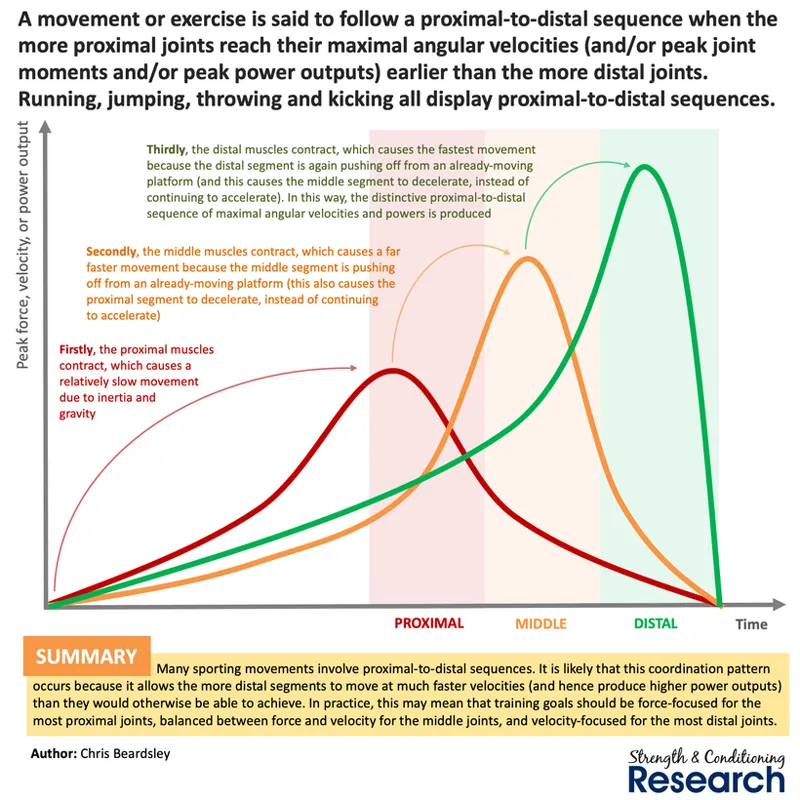
A multi-joint movement is said to follow a proximal-to-distal sequence when the more proximal joints reach their maximal angular velocities and/or peak joint moments and/or peak power outputs earlier than the more distal joints. As explained in this article, proximal-to-distal sequences have been observed in many key human movements and for good reason.
.
#1. Vertical jumping
Several studies have shown that vertical jumping displays a clear proximal-to-distal sequence, with the hip reaching its peak moment first, then the knee, and lastly the ankle. In this way, the more proximal joints reach their peak angular velocities, moments, and power outputs earlier than the more distal joints.
.
#2. Running
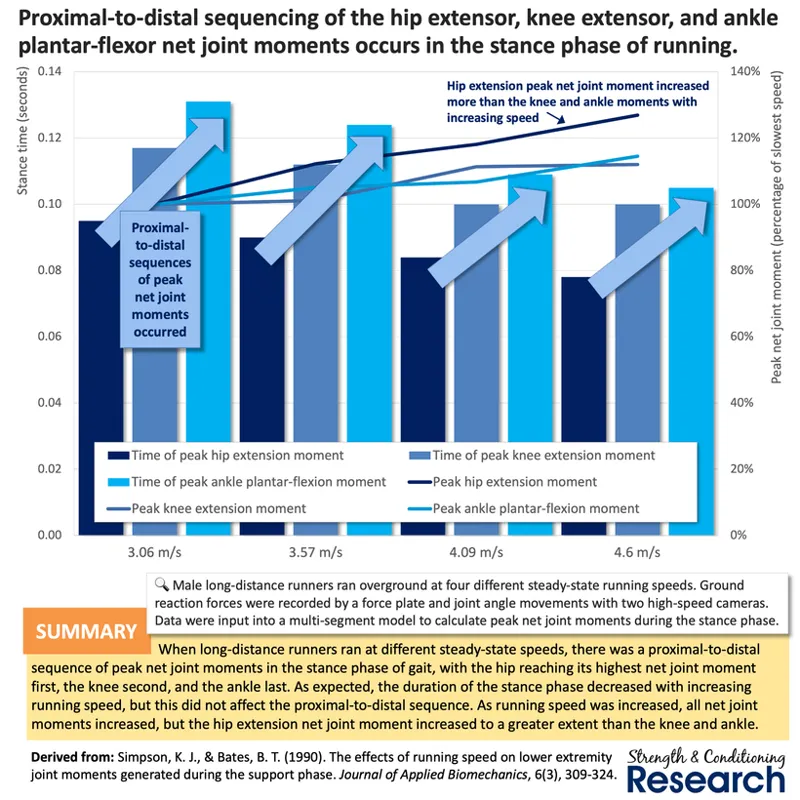
Running displays a clear proximal-to-distal sequence in the stance phase, with the hip reaching its peak moment first, then the knee, and lastly the ankle. In this way, the more proximal joints reach their peak moments earlier than the more distal joints.
.
#3. Overarm throwing
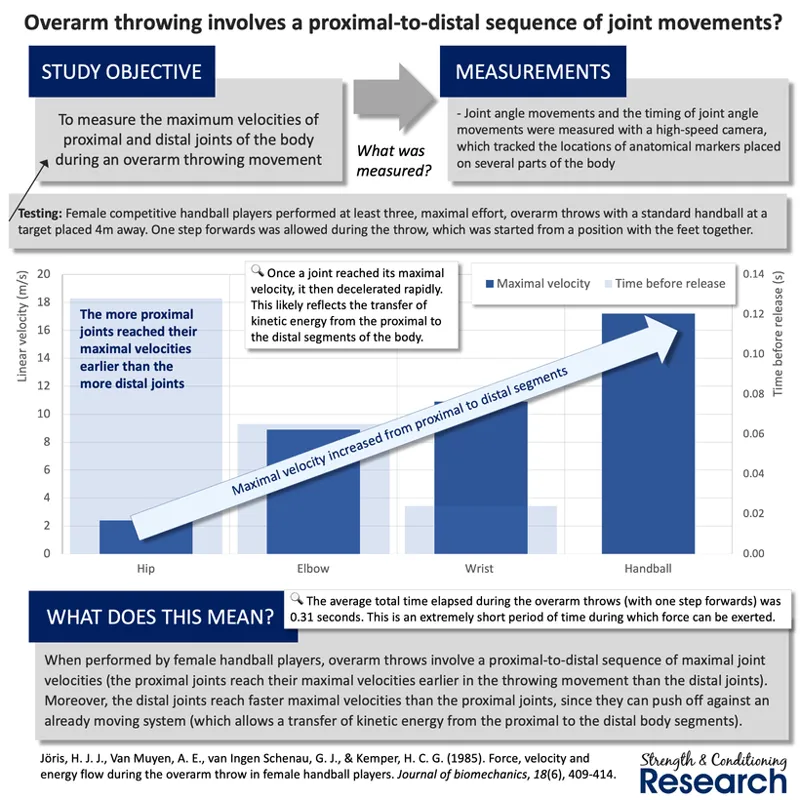
Overarm throwing also displays a proximal-to-distal sequence. The more proximal joints reach lower maximum angular velocities earlier than the more distal joints.
.
#4. Kicking
When martial artists do roundhouse kicks, the movement involves a proximal-to-distal sequence. This can be seen not only from the order of peak velocities reached by the segments but also by the relative importance of force and velocity at each segment. Isometric force-producing capacity of the most proximal segment (the hips) was associated with the performance of the kick (which is logical, as this segment reaches only a comparatively low peak velocity). Peak power-producing capacity in a vertical countermovement jump of the middle segment (the knees) was associated with the performance of the kick (since this segment reaches a moderate peak velocity). Neither the isometric force-producing capacity nor the peak power-producing capacity were associated with foot velocity, however, since this segment likely relies mainly on its maximal speed qualities.
.
#5. Rationale
Multi-joint exercises performed with maximal effort naturally involve a proximal-to-distal sequence, and this is likely because it is always the most efficient way of performing the movement.
.
#6. Effects of fatigue
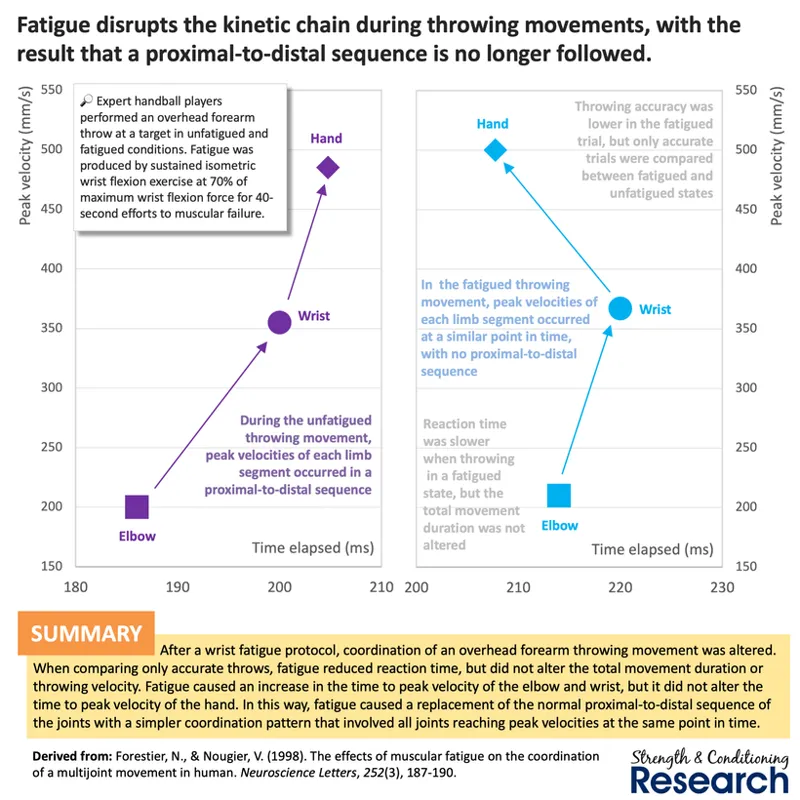
Importantly, fatigue disrupts the normal coordination pattern that we use to produce proximal-to-distal sequences. In this way, the efficiency of the movement (and likely also the performance) is greatly reduced. This means that multi-joint movements likely always involve an element of coordination disruption within overall fatigue, in addition to local muscular mechanisms and the more well-known supraspinal and spinal central nervous system fatigue mechanisms.
.
Conclusions
A movement is said to follow a proximal-to-distal sequence when the more proximal joints reach their maximal angular velocities (and/or peak joint moments and/or peak power outputs) earlier than the more distal joints. Jumping, running, throwing, and kicking all display proximal-to-distal sequences. It seems very likely that all multi-joint movements make use of this basic coordination pattern because it permits the smaller, more distal muscles to achieve much higher angular velocities (and therefore power outputs) than they would otherwise be able to attain. Firstly, the proximal muscles contract, which causes a relatively slow joint action due to inertia and gravity. Once the proximal joint reaches a sufficiently high angular velocity, the middle muscles start to contract, which causes the middle segment to accelerate, using the proximal segment as a platform to push against. By pushing against the already-moving proximal segment, the middle segment reaches a much faster maximum angular velocity. Yet, it also makes the proximal segment decelerate, which produces the distinctive proximal-to-distal sequence of maximum angular velocities. The same thing then occurs as the distal muscles contract, making the distal segment accelerate, using the middle segment as a platform to push against.