



"Hard sets" is a useless term
Not long after I described the concept of stimulating reps as a way to express the dosage of the hypertrophy stimulus caused during strength training, the internet responded by inventing the term "hard sets" and argued that this was just as good if not better than my stimulating rep model. Here is why it is just an imprecise version of the previous model (the number of sets to failure).
.
#1. How does the scientific literature currently measure the hypertrophy stimulus?
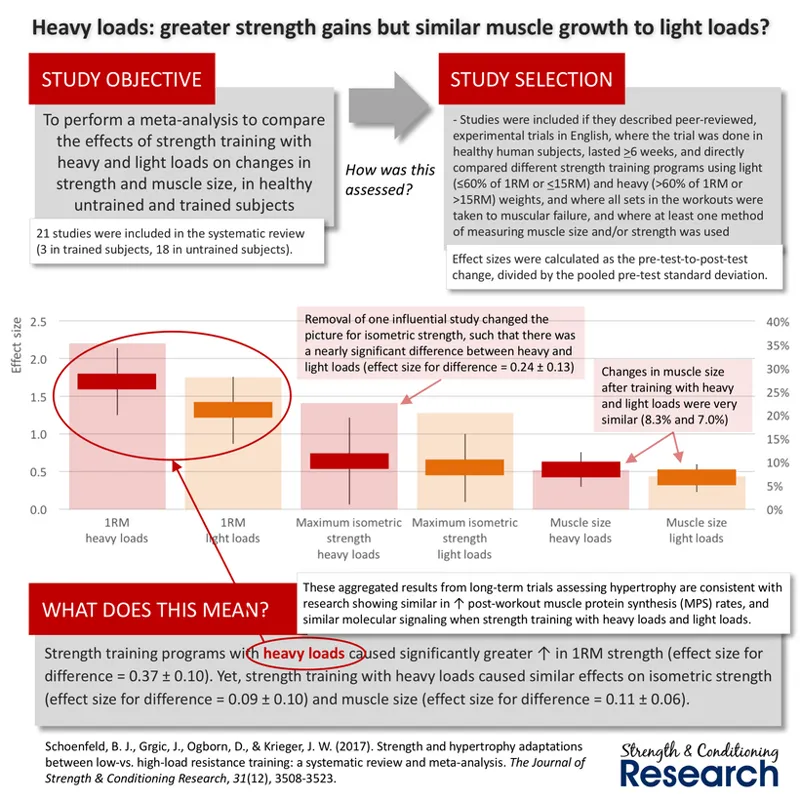
Currently, exercise scientists only have one strength training metric for quantifying a hypertrophy stimulus, and that is the number of sets to muscular failure. The literature makes no mention of the term "hard sets" and only refers to sets taken to muscular failure instead. For example, we know that we can cause the same amount of hypertrophy by doing the same number of sets to failure with any repetition range between approximately 6-30RM. Of course, the problem here is that this system does not allow us to talk about sets with repetitions in reserve.
.
#2. Why is it a problem that exercise science cannot quantify the hypertrophy stimulated by sets with reps in reserve?
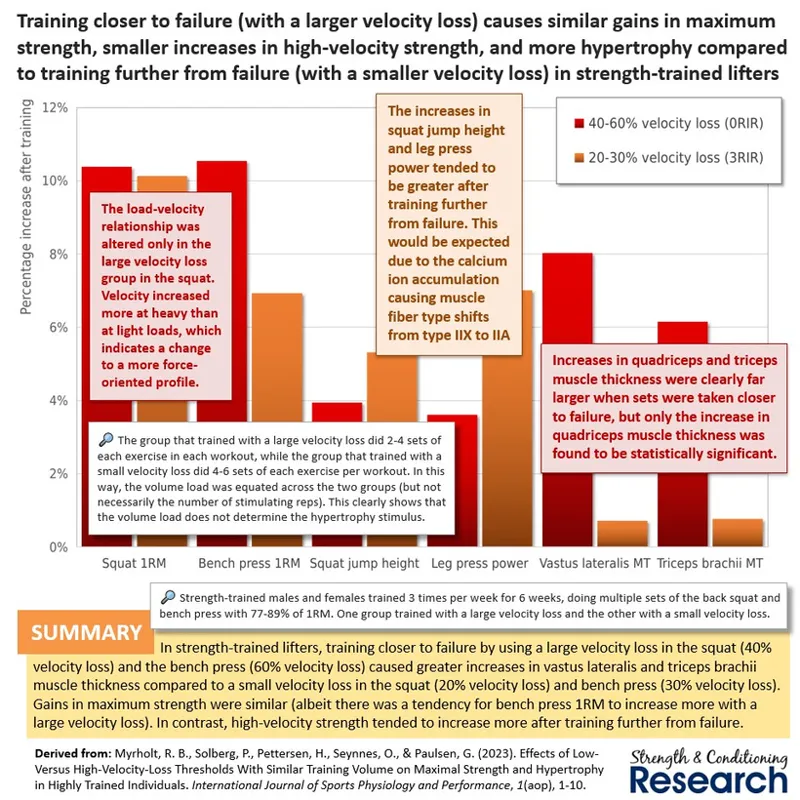
Multiple studies have made it very clear that the amount of hypertrophy stimulated by a set closer to muscular failure is very different from the amount of hypertrophy stimulated by a set further from muscular failure, even when the same total volume load (total reps x weight) is achieved. For this reason, we cannot say that sets with different proximities to failure produce the same amount of hypertrophy stimulus even if they are equated in other ways (such as by matching total reps). Here, we can see that occurring during a velocity-based training program.
.
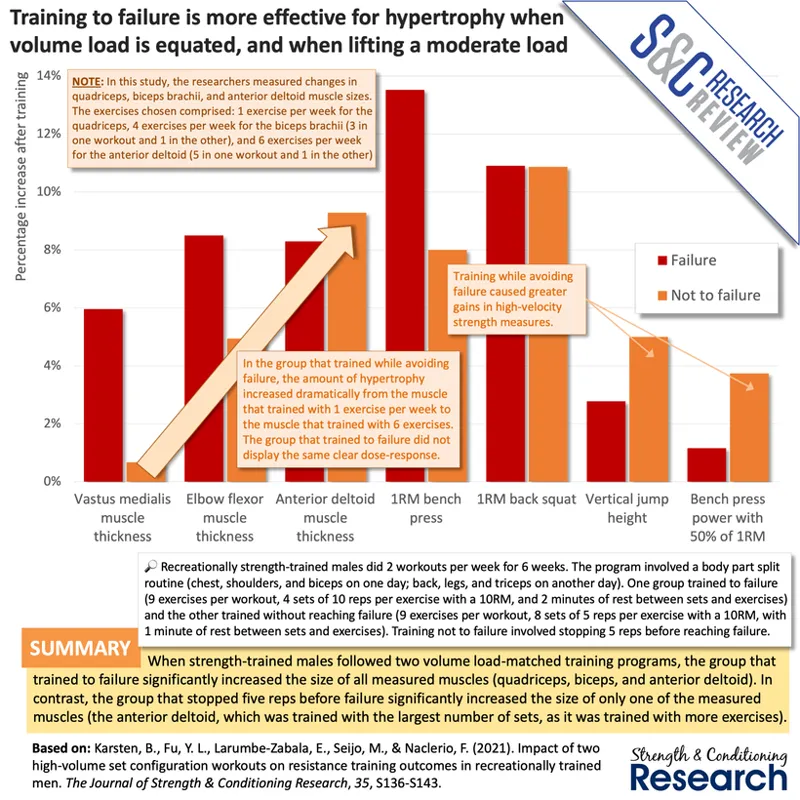
And here we can see exactly the same thing happening when comparing sets to failure with sets that involve a cluster formation to reduce proximity to failure while keeping volume load the same. This means that we really need a way to calculate the hypertrophy stimulus caused by reps with different proximities to muscular failure within the set (which is clearly what the stimulating reps model attempts to achieve).
.
#3. What exactly does muscular failure mean?
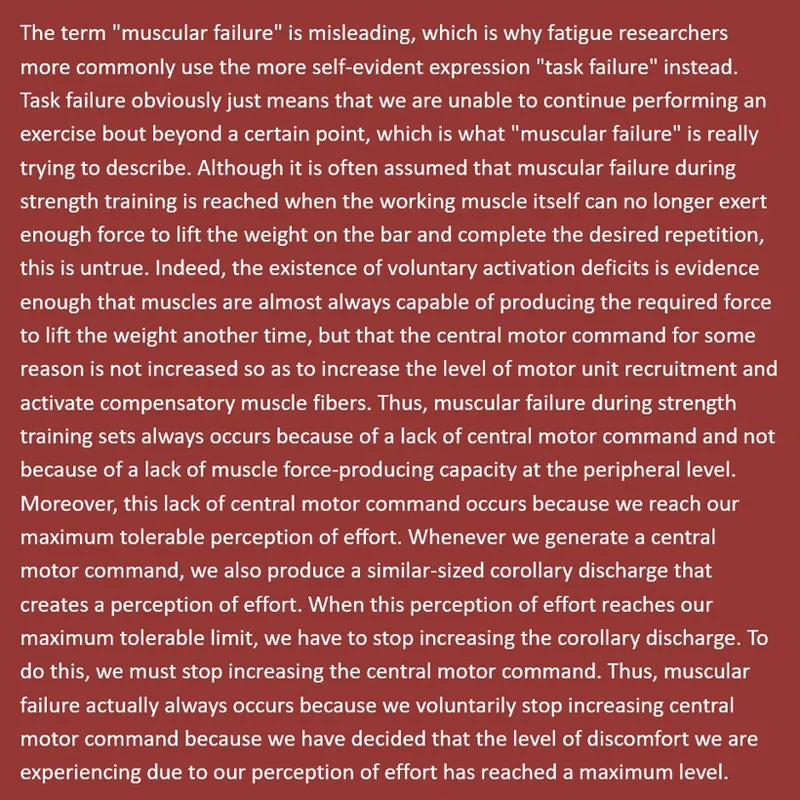
While the internet tries repeatedly to convince us that muscular failure involves the muscle failing to produce sufficient force (which sounds true until you read some physiology), the reality is that muscular failure always occurs when we reach our maximum tolerable perception of effort during an exercise task. Indeed, we know well that effort perception rises over the course of a strength training set because that is why some researchers have tried to link the perception of effort scale with the repetitions in reserve scale (read more).
.
#4. What exactly is a stimulating rep?
While fitness influencers repeatedly claim that stimulating reps are just the final five reps before reaching muscular failure (which would equate the reps in reserve system and its associated effort scale with the stimulating reps model), this is not strictly true. Muscular failure always occurs relative to the maximum tolerable perception of effort, while stimulating reps are defined by reference to [1] the level of motor unit recruitment, and [2] the movement speed (which governs the amount of single muscle fiber mechanical tension) (read more).
.
Indeed, it is very important to note that stimulating reps are not necessarily those that involve near maximal levels of effort. We can perform high effort exercise without reaching high levels of motor unit recruitment if there are other sources of pain or discomfort (read more).
.
#5. What exactly is a hard set?
We can see immediately that a "hard set" is referring to the perception of effort. That is what the term "hard" means in this context. Hence, it could be expressed by reference to the reps in reserve system, which is a well-validated and reliable system that exercise scientists use all the time to quantify effort perception relative to the proximity to failure in the set.
.
Indeed, we could simply define a "hard set" as any set that is performed either to failure or with either one or two reps in reserve. Yet, the inventors and users of this terminology will almost certainly never do this because it would reveal that the phrase adds literally no value that cannot be obtained from the reps in reserve system. Moreover, providing a definition like this would also make it clear that the stimulating reps model does some things that the term "hard set" cannot do, which is to connect the underlying physiology of muscle growth with the strength training reps that are being performed.
.
Conclusions
Fitness influencers frequently make use of the term "hard sets" when attempting to quantify the hypertrophy stimulus achieved by a workout. However, this terminology adds no value since it is [1] a more vague, less precise way of talking about repetitions in reserve, and [2] fails to connect the underlying physiology of hypertrophy with the stimulus provided by the strength training set. Evidently, the term "hard" in this context references the perception of effort. We have an existing, validated scale for effort perception during strength training that is related to the proximity to failure, which is the repetitions in reserve system. Therefore, a "hard set" must necessarily be one that is taken to muscular failure or within a certain number of reps in reserve. So why not specify the exact range of reps in reserve instead of being imprecise? Instead of saying "hard sets" we could just say "two reps in reserve or closer to failure" if that is what we mean. Moreover, since the term "hard set" just references effort perception, it does not allow us to quantify the dosage of the hypertrophy stimulus because effort can become disconnected from motor unit recruitment under certain circumstances. For example, whenever we feel pain or discomfort during a strength training set (such as when we get out of breath or feel burning sensations in the muscles due to the metabolite accumulation), this increases effort perception without increasing levels of motor unit recruitment. This is why the stimulating reps model is superior, since it specifies that reps must be [1] high in motor unit recruitment, and [2] slow in movement speed such that single fiber mechanical tension is high.


Comments (2)
Incredible information Chris - thanks - however why not just start any exercise with 3 sets of 5 repetitions and then just micro progress with your patient lifter model? you and Paul have already stated this is a finite process - why not just naturally evolve into the stimulating repetition zone? if I perform 3 sets of 10 load for 5 repetitions today and then slowly move to my genetic potential - so maybe a year from now my program is 3 sets of 25 load for 5 repetitions - eventually I will be stuck - but would that not maximize my muscle mass?
Any idea on why there is a discrepancy between non-failure and failure for bench press but not for squat?