


Myofibrillar addition and sarcomerogenesis
Muscle fibers can increase in diameter (by adding myofibrils in parallel) and they can also increase in length (by adding sarcomeres in series). Unfortunately, many hypertrophy researchers ignore the extremely detailed research that has been performed into sarcomerogenesis and believe that these adaptations are produced by similar conditions. However, the literature is very clear that they are unique adaptations that are caused by totally different stimuli.
.
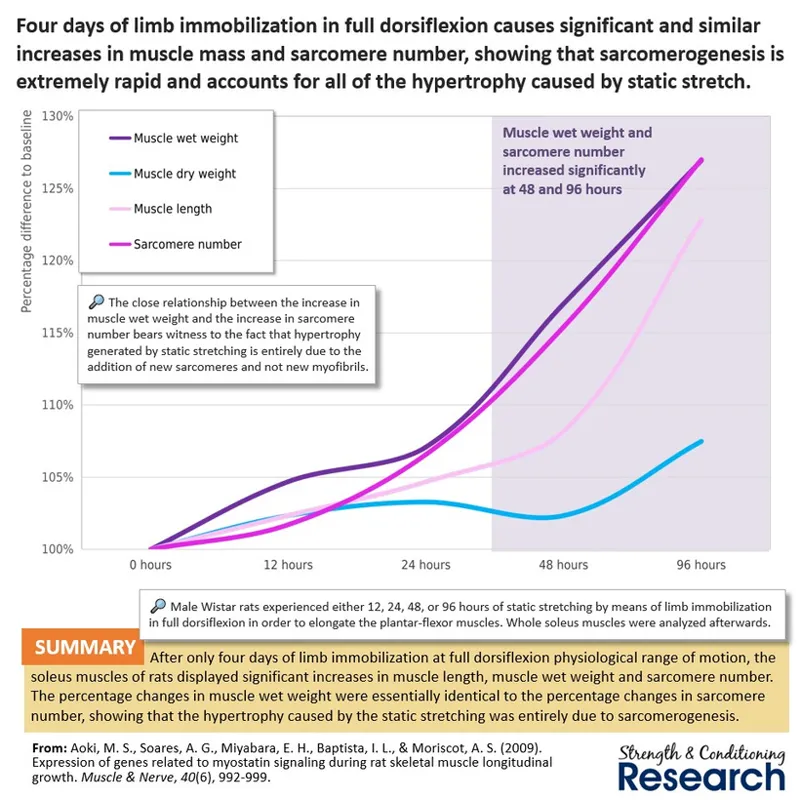
#1. Limb immobilization at a long muscle length causes sarcomerogenesis without also causing myofibrillar addition
Limb immobilization is a common way of producing increases and decreases in sarcomere number. Typically, the number of sarcomeres increases when limbs are immobilized at long muscle lengths, and decreases when they are immobilized at short muscle lengths. This study showed that the increase in muscle weight after immobilization at a long muscle length was explained entirely by the addition of new sarcomeres, implying that there was no simultaneous myofibrillar addition.
.
Moreover, the exact same observation appears to occur after surgical limb lengthening, which is a similar experimental model used by sarcomerogenesis researchers.
.
#2. Static stretching causes sarcomerogenesis without also causing myofibrillar addition
After limbs are immobilized at short muscle lengths, the recovery process afterwards typically leads to an increase in sarcomere number. This study showed that when static stretching was applied during a recovery period after limb immobilization at a short muscle length, this caused a more rapid increase in sarcomeres in series but without any increase in muscle fiber cross-sectional area.
.
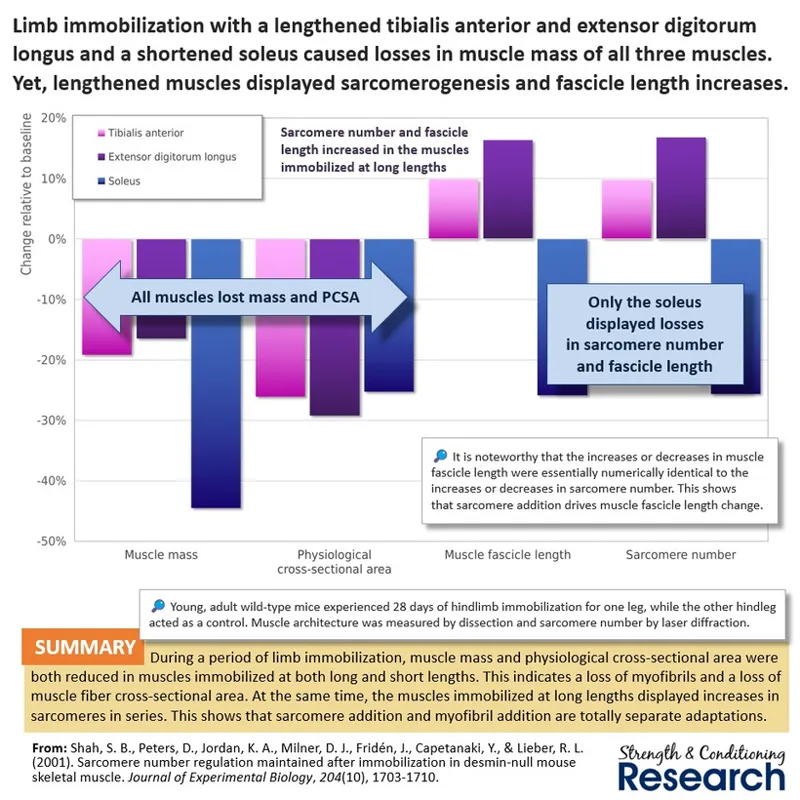
#3. Limb immobilization at a long muscle length causes sarcomerogenesis even while myofibrils are lost due to atrophy
This important study showed that limb immobilization at a long muscle lengths caused a significant increase in the number of sarcomeres in series by means of sarcomerogenesis despite reductions occurring in muscle mass and physiological cross-sectional area. Meanwhile, when muscles were immobilized at short muscle lengths, there was no such increase in sarcomeres in series.
.
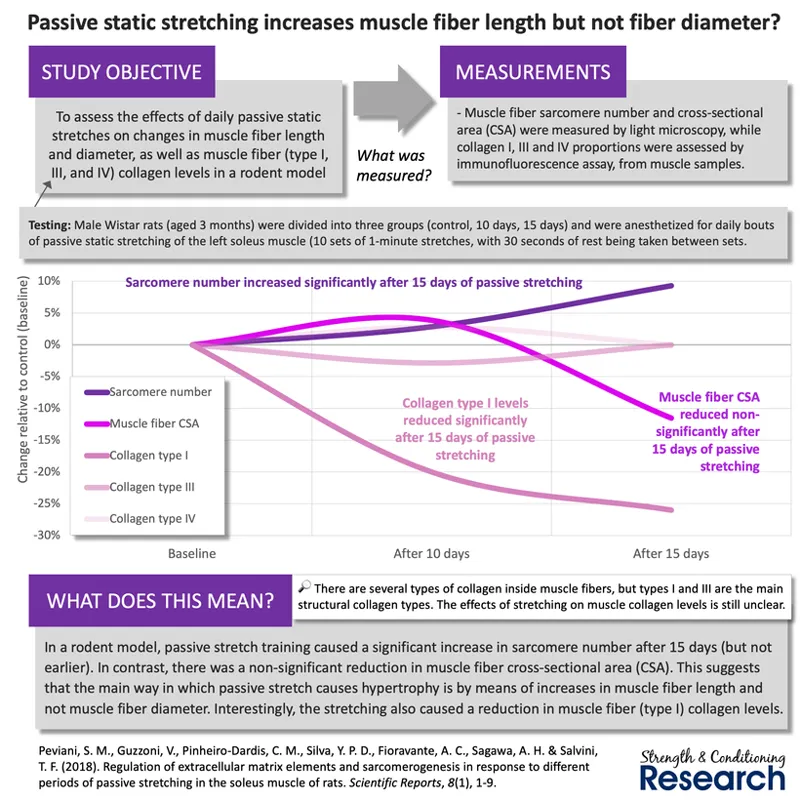
#4. Static stretching causes sarcomerogenesis while myofibrils are lost due to atrophy
This very important study showed that passive static stretching caused a significant increase in the number of sarcomeres in series by means of sarcomerogenesis despite a non-significant decrease in muscle fiber cross-sectional area over the same period of time. This clearly shows that sarcomere addition and myofibrillar addition are completely separate adaptations, since one can increase while the other can simultaneously decrease.
.
#5. Titin elongation is what generates the passive mechanical tension that causes sarcomerogenesis
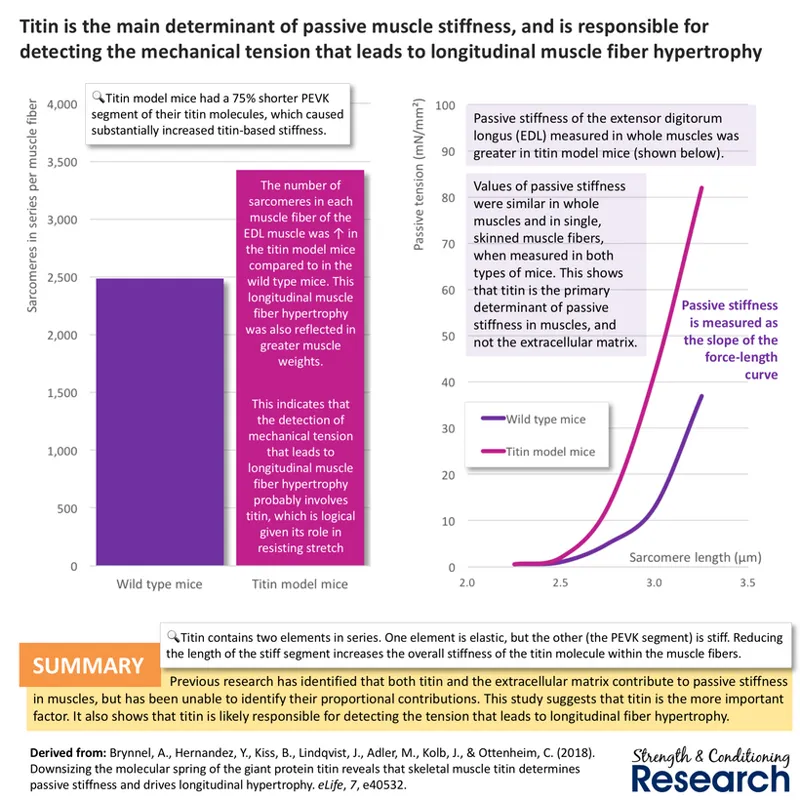
When mice are genetically modified to possess stiffer titin molecules, this causes them to display large increases in muscle size due to an increase in sarcomeres in series. This shows that titin is responsible for producing the passive mechanical tension that stimulates sarcomere addition.
.
Conclusions
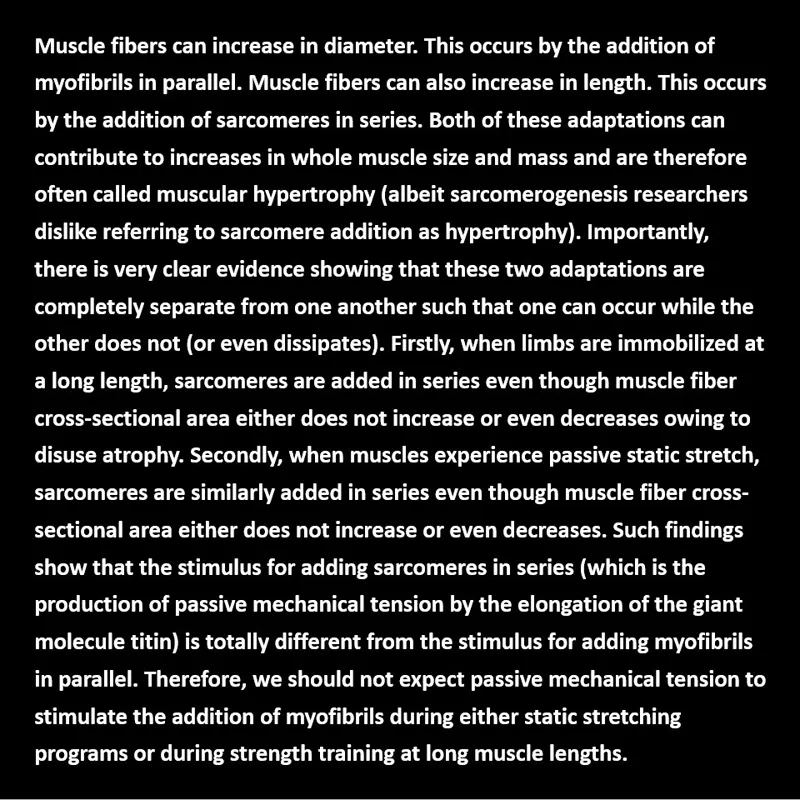
Muscle fibers can increase in diameter. This occurs by the addition of myofibrils in parallel. Muscle fibers can also increase in length. This occurs by the addition of sarcomeres in series. Both of these adaptations can contribute to increases in whole muscle size and mass and are therefore often called muscular hypertrophy (albeit sarcomerogenesis researchers dislike referring to sarcomere addition as hypertrophy). Importantly, there is very clear evidence showing that these two adaptations are completely separate from one another such that one can occur while the other does not (or even dissipates). Firstly, when limbs are immobilized at a long length, sarcomeres are added in series even though muscle fiber cross-sectional area either does not increase or even decreases owing to disuse atrophy. Secondly, when muscles experience passive static stretch, sarcomeres are similarly added in series even though muscle fiber cross-sectional area either does not increase or even decreases. Such findings show that the stimulus for adding sarcomeres in series (which is the production of passive mechanical tension by the elongation of the giant molecule titin) is totally different from the stimulus for adding myofibrils in parallel. Therefore, we should not expect passive mechanical tension to stimulate the addition of myofibrils during either static stretching programs or during strength training at long muscle lengths.