


Neuromechanical matching and strength gains
The principle of neuromechanical matching is a well-established physiological observation that has very important implications for how strength gains occur, especially in advanced lifters and strength athletes.
.
#1. The principle of neuromechanical matching governs where hypertrophy happens
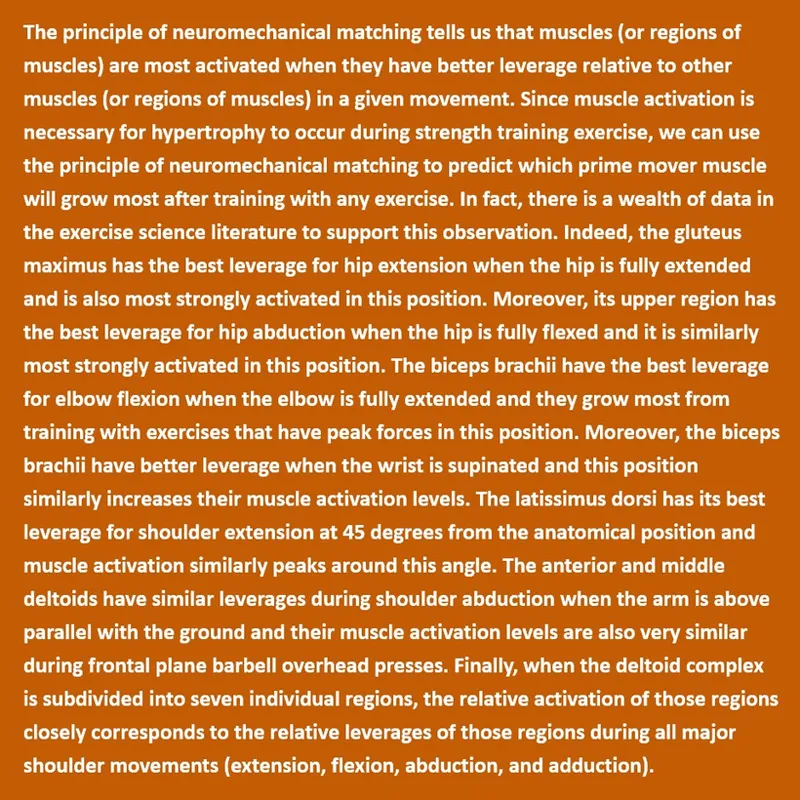
The principle of neuromechanical matching is a well-established physiological observation that governs which muscles (and regions of muscles) are most activated during any given movement, including strength training exercises. There are a wealth of data points showing that whichever muscle (or region of a muscle) has the best leverage for a strength training exercise will be the muscle (or region of a muscle) that receives the most central motor command and is therefore most strongly activated during that exercise, such that it experiences the most hypertrophy after training with that exercise (read more).
.
#2. Muscle size affects muscle leverage
The size of a muscle is a key determinant of its leverage during an exercise. Therefore, when we perform single-joint accessory exercises for a multi-joint exercise such as the bench press, we are not only increasing the strength of the target muscles but also the extent to which those target muscles will contribute during the main lift. Indeed, research has shown that when triceps extensions are performed in training, this increases the involvement of the triceps brachii (relative to the anterior deltoid and pectoralis major) in the bench press.
.
By deduction, we can see that whenever a multi-joint exercise involves one muscle or region of a muscle being more strongly activated than another, that muscle or region will experience more growth due to the principle of neuromechanical matching. Having experienced more growth, it will then become a bigger contributor to the same multi-joint exercise, again due to the principle of neuromechanical matching. This is essentially a positive feedback loop. In time, the multi-joint exercise becomes very dependent upon this one muscle or region and all of the other muscles and regions are not anywhere near as stimulated because they receive quite little of the central motor command. Indeed, there are data showing that squats cause very strongly regionalized growth in certain parts of the quadriceps.
.
When this one muscle or muscle region reaches its maximum possible size, we can no longer achieve growth in it, and consequently the exercise will stop progressing. Nevertheless, the CNS will continue to send the larger part of the central motor command to that same muscle or muscle region because it is still the most efficient way to perform the exercise successfully. At this point, the exercise will stop stimulating much muscle growth and a plateau will occur.
.
#3. We can use the principle of neuromechanical matching to solve this problem
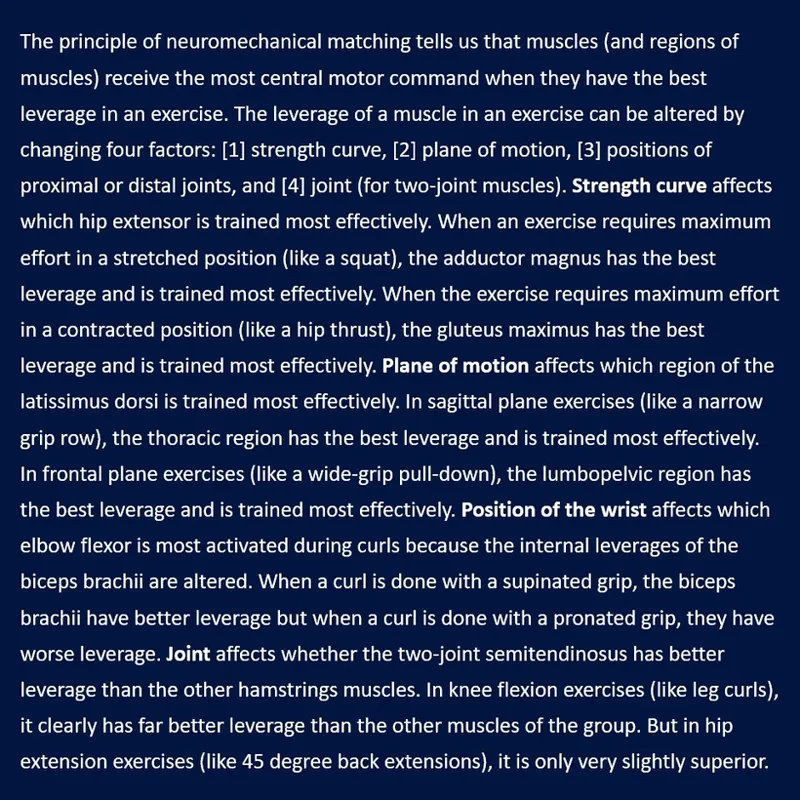
From the literature, we can see that there are four main ways to alter the region of the muscle that is stimulated: [1] altering the strength curve, [2] altering the plane of motion, [3] altering the positions of proximal and distal joints, and [4] altering the joint used in the exercise for two-joint muscles (read more). In practice, we can therefore use multi-joint exercise variations as well as accessory exercises to make progress on lifts when they reach a plateau (read more).
.
Conclusion
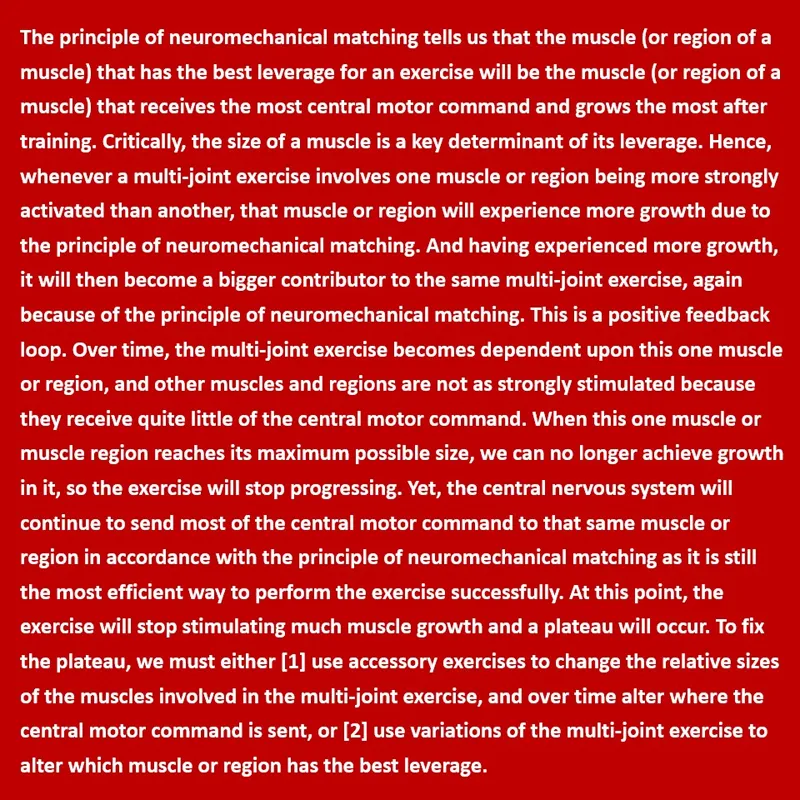
The principle of neuromechanical matching tells us that the muscle (or region of a muscle) that has the best leverage for an exercise will be the muscle (or region of a muscle) that receives the most central motor command and grows the most after training. Critically, the size of a muscle is a key determinant of its leverage. Hence, whenever a multi-joint exercise involves one muscle or region being more strongly activated than another, that muscle or region will experience more growth due to the principle of neuromechanical matching. And having experienced more growth, it will then become a bigger contributor to the same multi-joint exercise, again because of the principle of neuromechanical matching. This is a positive feedback loop. Over time, the multi-joint exercise becomes dependent upon this one muscle or region, and other muscles and regions are not as strongly stimulated because they receive quite little of the central motor command. When this one muscle or muscle region reaches its maximum possible size, we can no longer achieve growth in it, so the exercise will stop progressing. Yet, the central nervous system will continue to send most of the central motor command to that same muscle or region in accordance with the principle of neuromechanical matching as it is still the most efficient way to perform the exercise successfully. At this point, the exercise will stop stimulating much muscle growth and a plateau will occur. To fix the plateau, we must either [1] use accessory exercises to change the relative sizes of the muscles involved in the multi-joint exercise, and over time alter where the central motor command is sent, or [2] use variations of the multi-joint exercise to alter which muscle or region has the best leverage.


Comments (5)
This is a follow up to my previous question here, and again might be a stupid question. Are peak force and peak effort independent from each other? The reason I’m asking is because I know you said before that most of the barbell compound movements have peak force occurring at the start of the lift, yet the sticking point (peak effort?) for virtually every compound I can think of is not at the bottom of the lift.
I have a question about neuromechanical matching, in some articles I found IMAL to detect the leverage in a different hip angles, and I haven’t seen the force of single muscle (that affect the torque). The question is, do you consider only the IMAL, to predict activation of fiber in specific ROM?
Yes, only the IMAL determines muscle activation because the purpose is to maximize efficiency, not joint torque
This might be a stupid question, but for machines how can you figure out the resistance profile? For example, plate loaded incline press machine has ascending profile but machine preacher curls have a descending profile. I only know this from following Paul, but I was wondering how I can determine this myself.
The resistance profile of an exercise just means how the difficulty changes over the range of motion. Look at where the sticking point is to determine the joint angle at which peak effort is produced. The terminology (ascending, descending) isn't really that important. What's important is the joint angle at which peak effort is required.