







CNS fatigue myths
Central nervous system (CNS) fatigue is extremely poorly understood in the fitness industry but well-described in the fatigue physiology literature. Here are four myths that persist in the fitness industry that have long been known to be myths by exercise physiologists.
.
Myth #1. CNS fatigue plays no role in reducing the hypertrophy stimulus
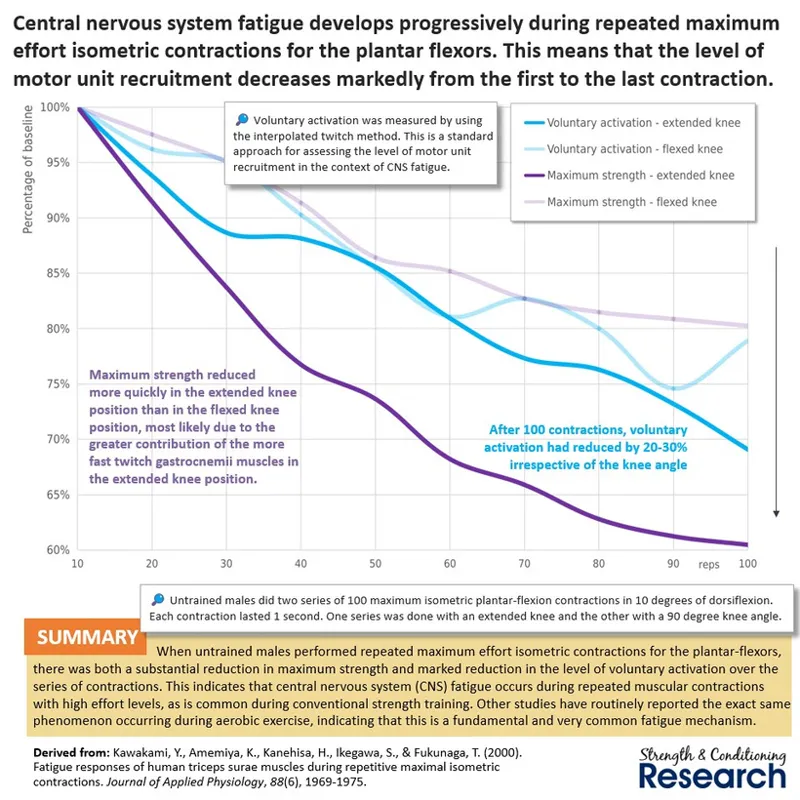
Motor unit recruitment is essential for hypertrophy. Without being able to recruit high-threshold motor units, we cannot activate their muscle fibers, and this means that we cannot stimulate them to grow. CNS fatigue reduces the level of motor unit recruitment by reducing the level of central motor command that reaches the muscle. In this way, it stops us from activating the muscle fibers at the top end of the high-threshold motor unit pool and this blunts the hypertrophy stimulus. This effect is very large during strength training analogues like maximal effort isometric contractions.
.
Indeed, one study showed that a workout comprising one hundred repetitions in total can cause a reduction in the ability to activate a muscle by 20-30%. In practice, this most probably means that the final repetitions are not stimulating any hypertrophy whatsoever.
.
Another study showed that 3-minute contractions can cause a reduction in the ability to activate a muscle by up to 40%. Again, this suggests that the final repetitions of later sets in a workout do not stimulate any hypertrophy whatsoever.
.
Myth #2. CNS fatigue only lasts for a very short time
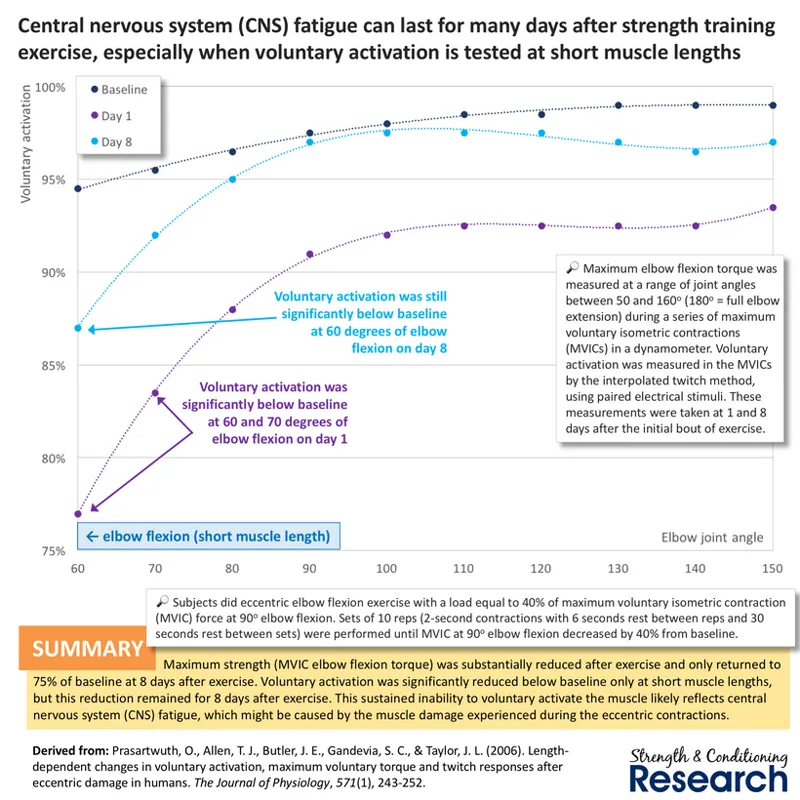
This claim is repeated frequently in the fitness industry. Indeed, my subscribers often send me articles written by other fitness industry influencers which suggest that we can essentially ignore post-workout CNS fatigue because peri-workout CNS fatigue only lasts for a few minutes. Leaving aside the fact that the mechanisms of post-workout and peri-workout CNS fatigues are completely different (post-workout CNS fatigue is caused by inflammation and peri-workout CNS fatigue is largely the result of afferent feedback and pain), the data is clear that post-workout CNS fatigue can last for up to eight days after an eccentric training workout.
.
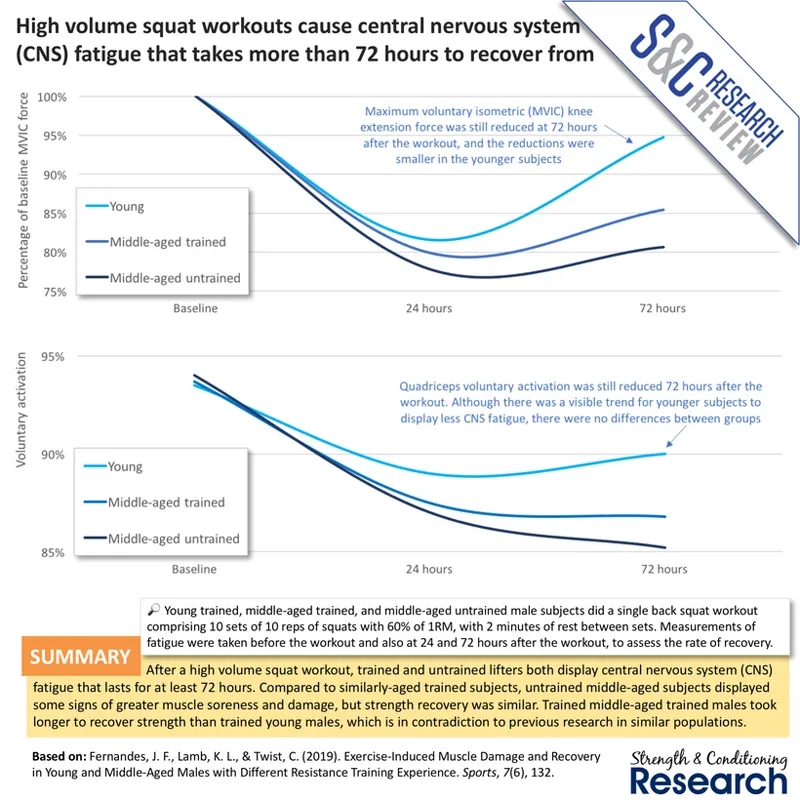
Nevertheless, after conventional strength training workouts, 2-3 days is a more common duration.
.
Myth #3. CNS fatigue is produced by reaching a high level of motor unit recruitment
This claim is repeated very frequently in the research literature but is very easy to refute. Several studies have shown that CNS fatigue observed both during and after a workout can be created by electrically-stimulated muscle contractions. Such contractions are produced by electrodes placed on the muscle itself and do not involve the production of any central motor command by the motor cortex to generate motor unit recruitment. Therefore, we can deduce that CNS fatigue does not need central motor command to be produced in order to occur. Here is one example of CNS fatigue during a workout being generated by electrically-stimulated muscular contractions.
.
And here is an example of CNS fatigue after a workout being generated by electrically-stimulated muscular contractions. Thus, we can see that despite repeated claims to the contrary, CNS fatigue (either during or after a workout) is not created by high levels of central motor command.
.
Myth #4. CNS fatigue is greater after training with heavy loads than with light loads
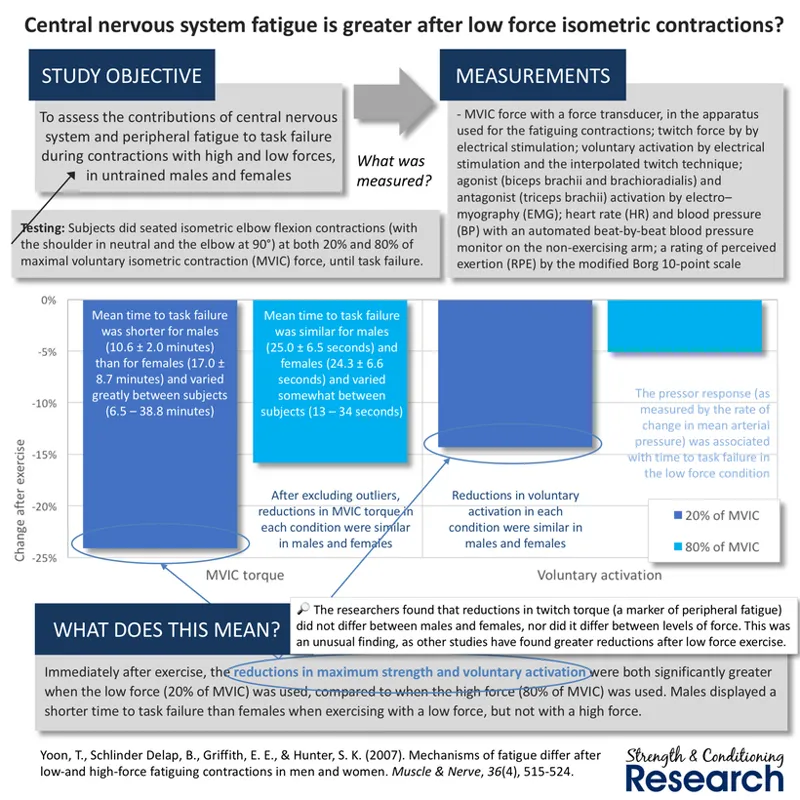
Perhaps the most pervasive myth about CNS fatigue is that heavy loads are the primary culprit. Rather, light loads are much better at producing peri-workout CNS fatigue (due to the greater afferent feedback and pain) and post-workout CNS fatigue (due to the greater muscle damage). As always, this has been explored primarily using isometric contractions.
.
Nevertheless, the literature are very consistent. Regardless of how the studies are set up, the CNS fatigue mechanisms during the workout are much more apparent when using lighter loads.
.
In addition, post-workout CNS fatigue is also greater when using light loads than when using heavy loads because of the greater muscle damage that lighter loads generate (muscle damage is caused by calcium ion accumulation and longer durations of activation cause more calcium ion influx).
.
Conclusions
Central nervous system (CNS) fatigue is poorly understood in the fitness industry but very well-described in the fatigue physiology literature. Here are four myths that persist in the fitness industry. Myth #1: the presence of CNS fatigue does not greatly affect the hypertrophy stimulus. This myth is refuted by the observation that motor unit recruitment is essential for stimulating muscle growth and CNS fatigue suppresses motor unit recruitment. Indeed, reductions in voluntary activation of 20-30% have been observed in studies examining CNS fatigue during repeated isometric contractions. Myth #2: CNS fatigue only lasts for a short time so we can disregard it during the post-workout period. This myth is refuted by studies reporting large reductions in voluntary activation for up to 8 days after eccentric training workouts and for up to 3 days after normal strength training workouts. Myth #3: CNS fatigue is caused by workouts that involve very high levels of motor unit recruitment. This myth is refuted by studies showing that CNS fatigue can be generated without central motor command by using electrically-stimulated contractions. Myth #4: CNS fatigue is greater after heavy load strength training than after light load strength training. This final, extremely popular myth is refuted by the studies that have reported much greater peri-workout CNS fatigue (owing to the greater afferent feedback from metabolite accumulation) and far greater post-workout CNS fatigue (owing to the greater calcium ion accumulation, muscle damage, and inflammation) after strength training with light loads.
Comments (2)
Would CNS fatigue within a full body workout compromise how many "arbitrary units" of hypertrophy stimulus you should count for exercises performed later in the workout? If you do a row after a quad exercise and a chest press, I can't imagine that row being as stimulating as if it was first in the workout. Same for any sets done on a workout that occurs the day after another workout, I imagine. What do you think?
Yes, this is the exercise order effect: https://www.patreon.com/posts/exercise-order-86133376