




Neuromechanical matching factors
The principle of neuromechanical matching states that muscles (and regions of muscles) receive the most central motor command during an exercise when they have the best leverage for contributing to overall force production in that exercise. The leverage of a muscle during an exercise can be altered by changing four key factors.
.
#1. Strength curve
During hip extension exercises, the strength curve affects which muscles are most activated because the internal leverages of the hip extensors differs between joint angles. When the exercise requires maximum effort in a stretched position (like a squat), the adductor magnus has the best leverage and therefore contributes most and is trained most effectively. When the exercise requires maximum effort in a contracted position (like a hip thrust), the gluteus maximus has the best leverage and hence contributes most and is trained most effectively.
.
It is noteworthy that the muscle activation data track this trend perfectly. So the gluteus maximus displays its highest activation at the fully-extended hip position, while the hamstrings muscle activation is more even across multiple hip joint angles.
.
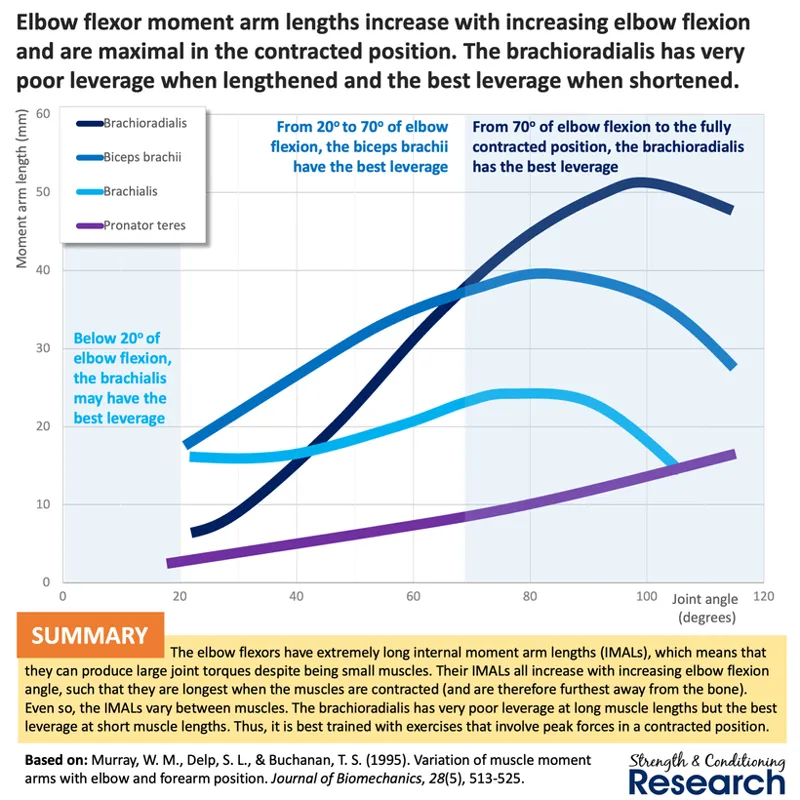
Similarly, in elbow flexion exercises, the strength curve also affects which muscles are most activated because the internal leverages of the elbow flexors differs between joint angles. When the exercise requires maximum effort in a stretched position (like a preacher curl), the biceps brachii have the best leverage and therefore contribute most and are trained most effectively. When the exercise requires maximum effort in a contracted position (like an EZ bar curl with elastic resistance), the brachioradialis has the best leverage, contributes most and is trained most effectively.
.
#2. Plane of motion
When training the latissimus dorsi the plane of motion affects which region of the muscle is most activated because the internal leverages of the thoracic and lumbopelvic regions differs between joint angles. When the exercise is done in the sagittal plane (like a narrow grip row), the thoracic region has the best leverage and therefore contributes most and is trained most effectively. When the exercise is done in the frontal plane (like a wide-grip pull-down), the lumbopelvic region has the best leverage, contributes most, and is trained most effectively.
.
#3. Positions of proximal and distal joints
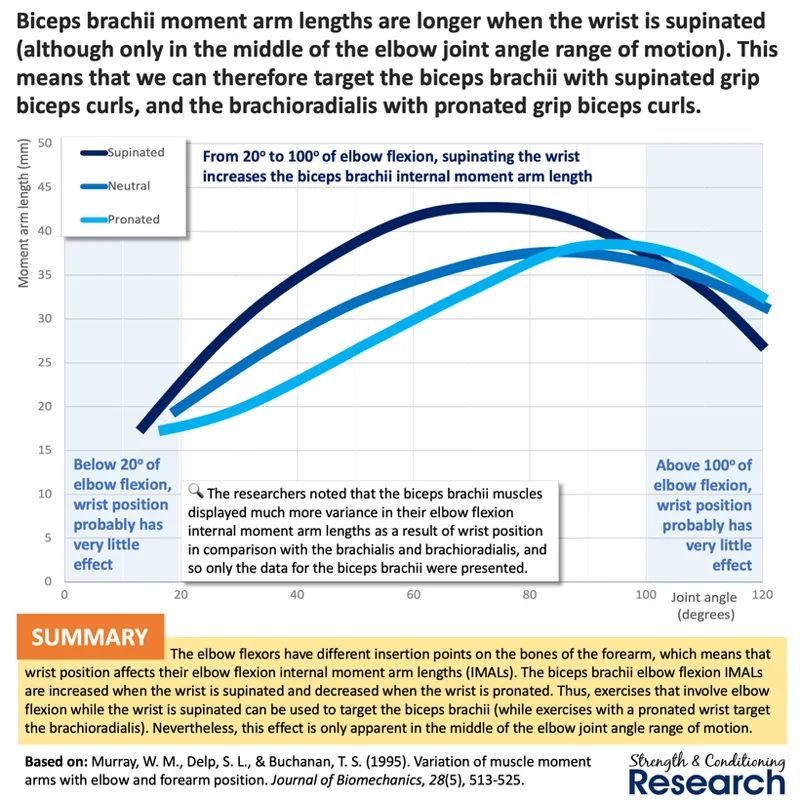
When training the elbow flexors with curls, the position of the wrist affects which muscle is most activated because the internal leverages of the biceps brachii and brachioradialis differ between wrist joint angles. When a curl is done with a supinated grip, the biceps brachii have better leverage but when a curl is done with a pronated grip, they have worse leverage.
.
#4. Joint (for two-joint muscles)
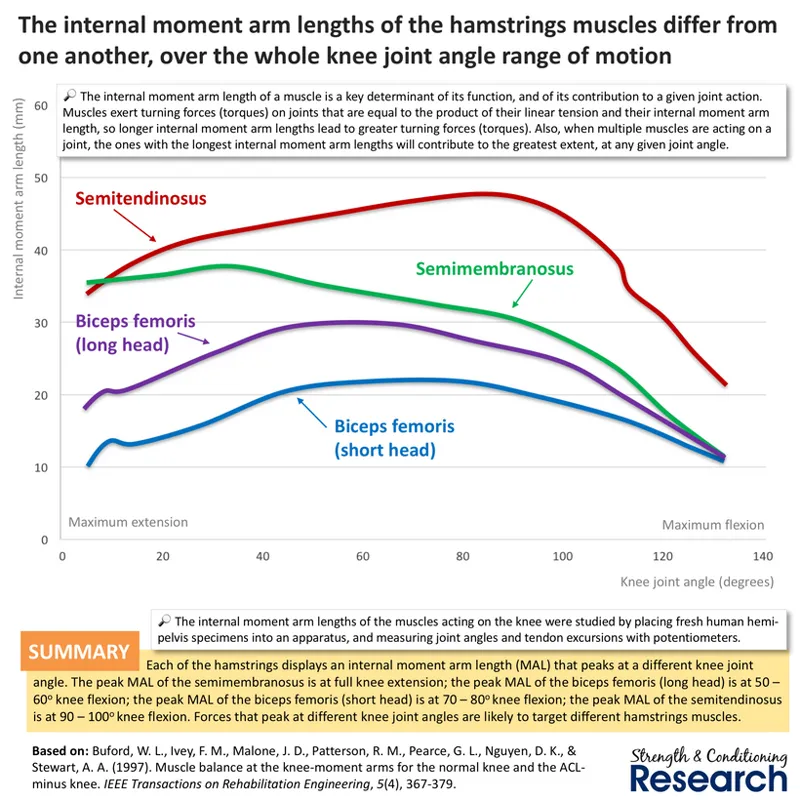
When training the hamstrings with leg curls, the semitendinosus has the best leverage and is therefore likely trained most effectively out of the whole hamstrings muscle group.
.
In contrast, when training the hamstrings with hip extensions, the three two-joint muscles all have very similar leverages and therefore likely receive very similar central motor command.
.
Conclusions
The principle of neuromechanical matching tells us that muscles (and regions of muscles) receive the most central motor command when they have the best leverage in an exercise. The leverage of a muscle in an exercise can be altered by changing four factors: [1] strength curve, [2] plane of motion, [3] positions of proximal or distal joints, and [4] joint (for two-joint muscles). Strength curve affects which hip extensor is trained most effectively. When an exercise requires maximum effort in a stretched position (like a squat), the adductor magnus has the best leverage and is trained most effectively. When the exercise requires maximum effort in a contracted position (like a hip thrust), the gluteus maximus has the best leverage and is trained most effectively. Plane of motion affects which region of the latissimus dorsi is trained most effectively. In sagittal plane exercises (like a narrow grip row), the thoracic region has the best leverage and is trained most effectively. In frontal plane exercises (like a wide-grip pull-down), the lumbopelvic region has the best leverage and is trained most effectively. Position of the wrist affects which elbow flexor is most activated during curls because the internal leverages of the biceps brachii are altered. When a curl is done with a supinated grip, the biceps brachii have better leverage but when a curl is done with a pronated grip, they have worse leverage. Joint affects whether the two-joint semitendinosus has better leverage than the other hamstrings muscles. In knee flexion exercises (like leg curls), it clearly has far better leverage than the other muscles of the group. In hip extension exercises (like 45 degree back extensions), it is only very slightly superior.