




Advanced lifters
Advanced lifters are not very well-served by the fitness industry in general. Let us here consider how advanced lifters differ from less well-trained lifters and how we might alter their bodybuilding training programs in order to help them continue to grow.
.
#1. Advanced lifters likely cannot experience stretch-mediated hypertrophy
It seems likely that stretch-mediated hypertrophy does not occur in advanced lifters during normal strength training with familiar exercises. Stretch-mediated hypertrophy is generated by passive mechanical tension and the ability to produce passive mechanical tension is dependent upon the number of sarcomeres in series inside a muscle fiber. Advanced lifters have already added a great many sarcomeres in series such that each sarcomere no longer elongates very much when the muscle lengthens and consequently cannot produce a sufficiently high level of passive mechanical tension for stretch-mediated hypertrophy to occur. For this reason, they can choose to focus more on exercises with peak forces in contracted positions instead.
.
Three findings provide evidence to support this physiological prediction. Firstly, advanced lifters do not usually display increases in muscle fascicle length after strength training programs that contain stretched-position exercises.
.
Secondly, advanced lifters do not display distal region hypertrophy after strength training with stretched-position exercises. When stretch-mediated hypertrophy occurs, it tends to produce a preferential increase in the size of the distal region of the muscle.
.
Thirdly, when researchers have taken multiple measurements of muscle fascicle length over the course of a strength training program, they have noted that the increases plateau after only a few months of training, while increases in anatomical cross-sectional area continue increasing.
.
#2. Advanced lifters likely cannot achieve growth in as many muscle fibers
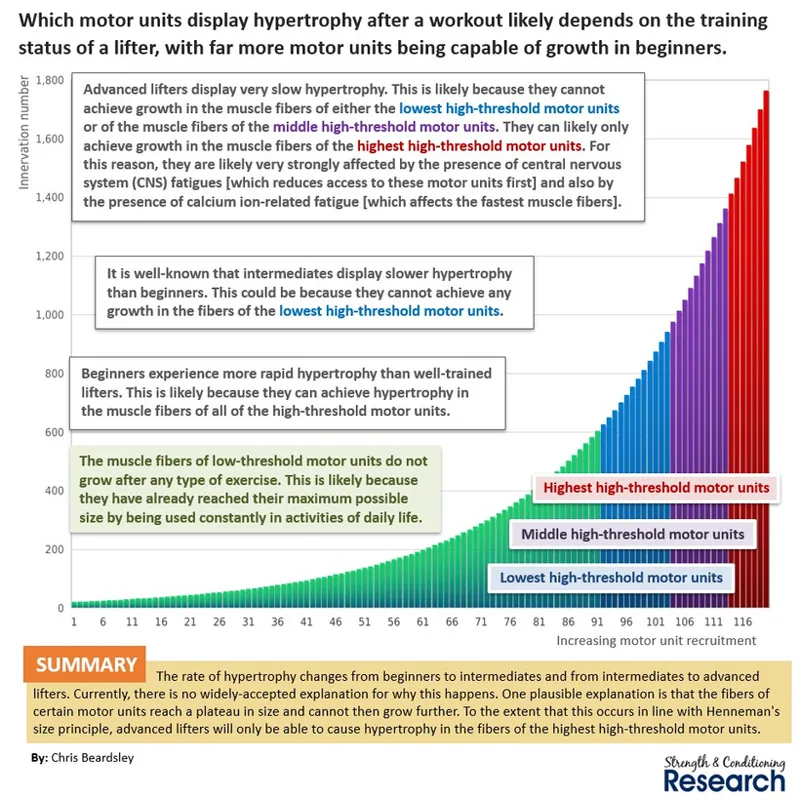
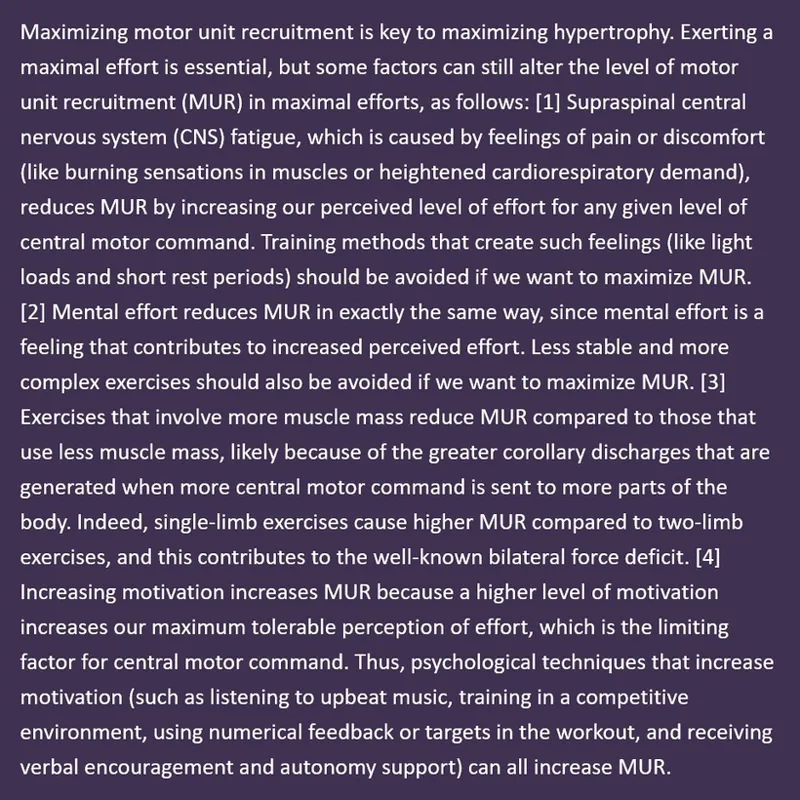
While it is well-known that advanced lifters experience a slower rate of muscle growth than less well-trained lifters, the reasons for this are rarely outlined. While the absence of sarcomerogenesis is certainly one key factor, another key factor is likely that plateaus are reached in individual muscle fibers after a certain diameter is reached (in accordance with the size principle of striated muscle). This means that achieving a very high level of motor unit recruitment is critical for advanced lifters.
.
Various strategies are available for targeting a high level of motor unit recruitment (read more).
.
Also, since a higher level of motor unit recruitment is necessary for advanced lifters, this tells us that the maximum effective volume for the workout will be lower due to the gradual onset of CNS fatigue due to the inflammatory mediators produced by muscular contractions.
.
#3. Advanced lifters are more likely to hit plateaus
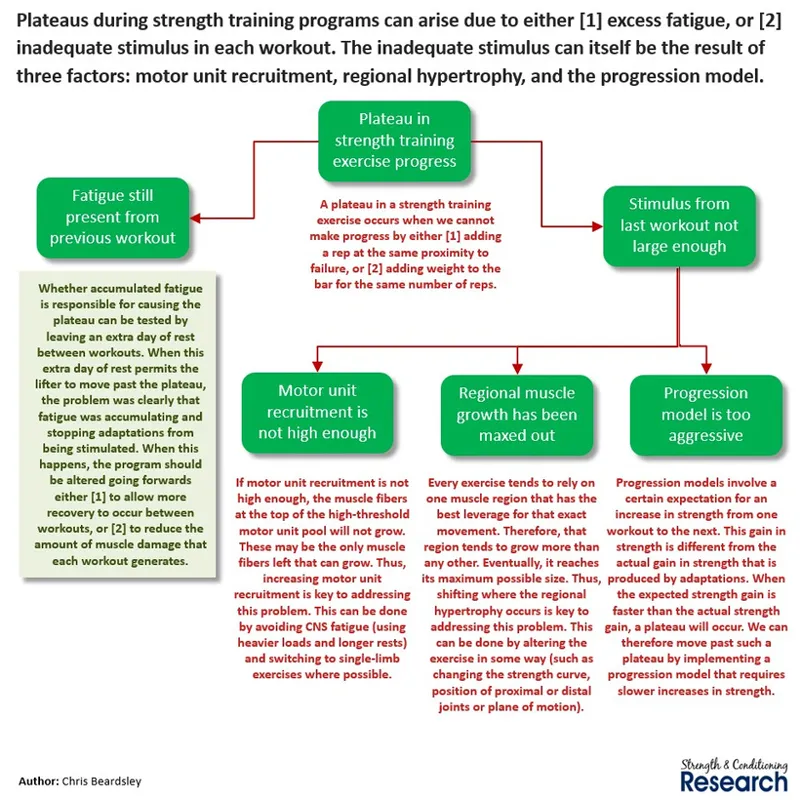
Since advanced lifters experience a slower rate of muscle growth than less well-trained lifters, they can more easily reach plateaus in strength in the exercises they are using. Such plateaus can occur due to either [1] excess fatigue from the last workout, or [2] inadequate stimulus from the previous workout. Moreover, we can identify multiple reasons why the stimulus might be inadequate.
.
#4. Advanced lifters will likely require a higher frequency of stimulus
Since advanced lifters experience a smaller amount of muscle growth after each workout than less well-trained lifters, they need to train a muscle more frequently. Otherwise, the growth that they cause in each workout will be cancelled out by the time they reach the following workout.
.
Clearly, this means that volume must be reduced otherwise the frequency cannot be increased. Even so, this does not mean that a muscle must be targeted for growth multiple times per week. While this is feasible, an alternative strategy is simply to include the muscle as a primary contributor once per week and as a supporting muscle one or two more times per week. For example, a lifter might do three days of pressing exercises per week, but each pressing variation could involve a different muscle as the primary contributor (a wide grip flat bench press for pectoralis major, a steep incline press for the anterior deltoid, and dips for the triceps brachii).
.
Conclusions
Advanced lifters differ from less well-trained lifters in four key ways. [1] They likely cannot experience stretch-mediated hypertrophy (SMH). [2] They display smaller increases in muscle size after each workout, likely because they cannot cause growth in as many muscle fibers, since some have already reached plateaus in size. [3] They experience plateaus in strength more easily than less well-trained lifters (partly due to the far smaller increases in muscle size after each workout). [4] They will usually need to train a muscle more frequently than less well-trained lifters (since the smaller increases in muscle size after each workout mean that the atrophy between workouts can cancel out all of their gains). We can now design bodybuilding training programs for the advanced lifter with these observations in mind. Since SMH is likely impossible, there is no need for an excessive focus on stretched-position exercises, which are more fatiguing due to the extra calcium ion-related fatigue caused by the opening of stretch-activated ion channels. Since growth is probably only possible in the muscle fibers of the highest high-threshold motor units, we must focus on maximizing motor unit recruitment in each set (by using heavier loads, longer rests, more stable exercises that involve less muscle mass, and using motivational techniques) and not on higher training volumes. Since plateaus in strength are more common among advanced lifters, we need to be aware of the main reasons why plateaus occur and how we can address them. Finally, since a higher frequency is necessary, we can structure training programs to involve training a muscle more often, even if that is only as a supporting muscle when another muscle is the primary contributor to an exercise.

Comments (5)
Hi Chris. Aren't the following 2 claims at odds with each other? Firstly, "...This does not mean that a muscle must be targeted for growth multiple times per week. ...An alternative strategy is simply to include the muscle as a primary contributor once per week and as a supporting muscle one or two more times per week." Secondly, "Advanced lifters will likely require a higher frequency of stimulus." Let's follow your example from the article about the 3 pressing variations. Let A denote the set of pec fibers recruited by the flat press, B the pec fibers recruited by the incline press, and C the pec fibers recruited by the dip. The intersection of A, B, and C will receive the benefits of high frequency, but the symmetric difference of the sets will be trained with a measly 1 set 1x per week. In other words, the symmetric difference would be effectively trained like a bro split with negative weekly net stimulus. Right? What accounts for the differences in these sets, in my understanding, is: - Regional hypertrophy: For example, the incline and flat presses will target different regions of the pecs. - MUR: Inherently, a muscle serving as the non-primary contributor to a movement will never be activated as well as when it's serving as the primary contributor. E.g. surely the pecs won't be recruited maximally by a dip. - The Matthew Effect: The more advanced you get, the more leverage the primary contributor will have over the other contributors, right? Furthermore, also specific regions of the primary contributor will have better and better leverage over other regions of the same muscle. For this reason, I would expect the symmetric difference to grow bigger and bigger for the most advanced guys, exacerbating the problem. Of course, beginners shouldn't worry about this symmetric difference problem. But for advanced guys, the focus of training should be to eke out last remaining gains. Am I correct that there is a contradiction here, or am I missing/misunderstanding something? And thank you, Chris, for the great article :-)
Listening to your latest pod with paul a question came to mind, when an advanced lifter trains, is it possible that he needs less volume do to (a) increased MUR so he can stimulate way more fibers, (b) way less possible fibers to improve upon, (c) an increase in tha damage capabilities and sensibility of such fibers???, so that the only volume an advance trainee would be able to recover is in fact lower than the averaga 1-3 sets every 48h or 2-5 sets every 72-96h, counting that he does 1RiR, 4-8 reps, not lengthening movements?? And would this also apply to people whom are more naturally prone to higher levels of MUR, that they cant or dont need the end range of the dosage continuum of sets per workut according to frequency??
Hi Chris, I just have a couple of questions regarding the results of the 2nd and 3rd infographics; 2nd infographic shows that fascicle length didn't change for the vastus lateralis, however, distal growth occurred. With the note indicating that due to this we cannot use distal region growth as an indicator of SMH. 3rd infographic states that when SMH occurs, there is preferential for distal growth. This seems to contradict one another. Is it methodological differences? In the 3rd infographic there seems to be a reference to the rec fem. Are you able to clarify what I am missing?
Tremendous post Chris - thanks - have been listening to your show with Paul - it is obviously superior to any other content - both of you have commented on steroids leading us astray - my question is it seems like the real issue with progress is a strength increase - I think steroids has also confused the strength equating to size issue - I have never made appreciable hypertrophy without a concomitant strength increase - so do you agree that the two are one in the same or is the still a way to increase size without getting stronger? Thanks!
I agree, I don't think that there is any way to increase muscle size without that causing a concomitant increase in strength. That's why I think progressive overload is so important to focus on, especially in unassisted lifters.