



Hamstrings
What is the best way to train the hamstrings for maximum muscle size? Here are the various observations to be aware of when selecting exercises for the hamstrings muscles.
.
#1. The individual hamstrings muscles are quite different from one another
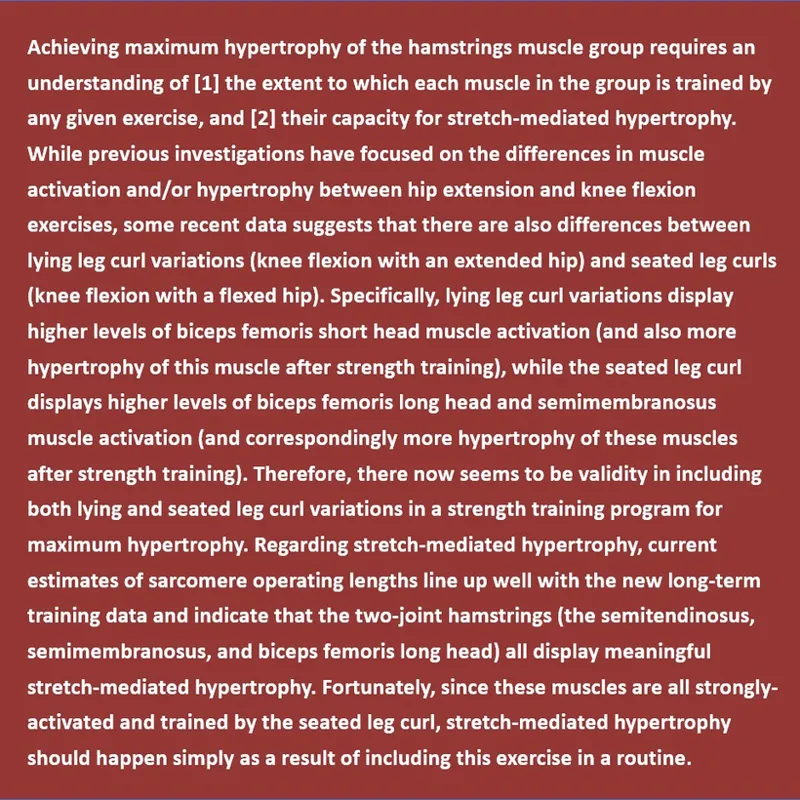
Interestingly, unlike the quadriceps (which display very similar muscle architecture, internal moment arm lengths, and sarcomere operating lengths), the individual hamstrings muscles are very different from one another (read more).
.
#2. Hamstrings muscles display very similar hip extension internal moment arm lengths
Even though the individual hamstrings muscles display very different muscle architecture from one another (unlike the quadriceps), they display fairly similar internal moment arm lengths for hip extension, with peak leverage occurring at 45 degrees of hip flexion. This makes the 45-degree back extension an ideal option for training this muscle group.
.
#3. Hamstrings muscles display slightly different knee flexion internal moment arm lengths
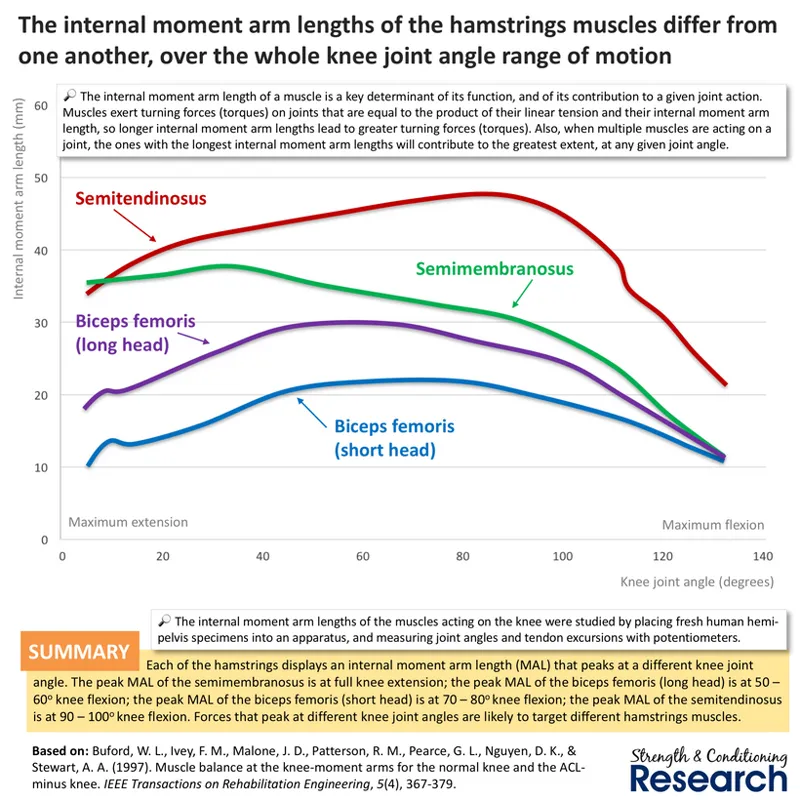
The hamstrings display slightly different internal moment arm lengths for knee flexion. The semitendinosus (a medial hamstring) displays the best leverage for most of the joint range of motion, while the semimembranosus (a medial hamstrings) displays slightly better leverage in full knee extension. The biceps femoris long head has the worst leverage of the three two-joint hamstrings muscles, suggesting that it will be trained better by hip extension exercise.
.
#4. Hamstrings muscle activation is decreased during hip extension movements when the quadriceps are active
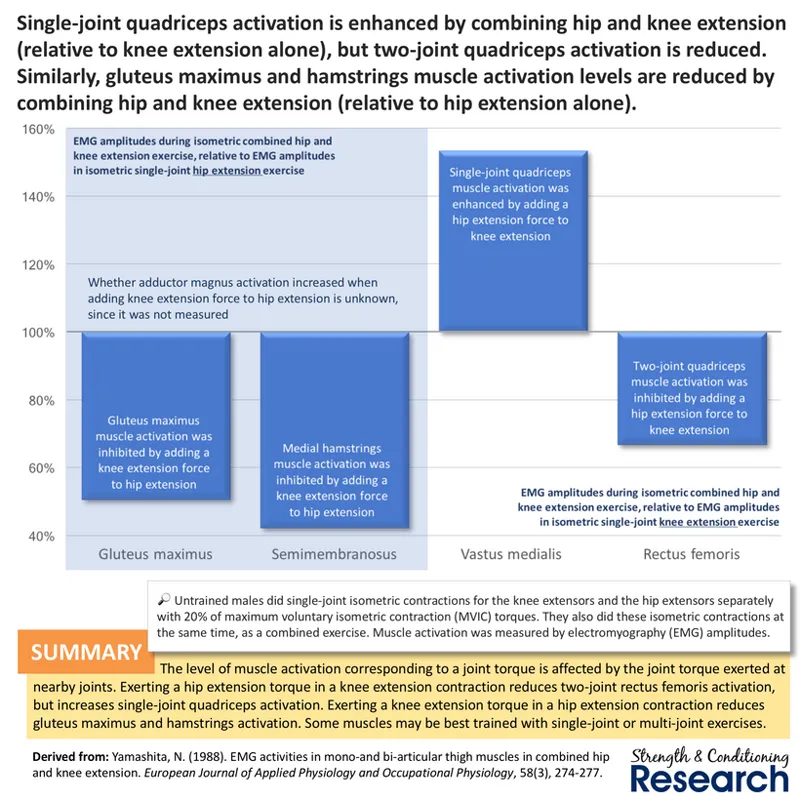
Hip extension exercise can be used to train the hamstrings. Some hip extension exercises (like back extensions) do not involve any quadriceps activation. In contrast, other hip extension exercises (like squats, deadlifts, and hip thrusts) do involve substantial quadriceps activation. Importantly, the activation of the quadriceps reduces the level of hamstrings activation (probably because adductor magnus activation is simultaneously increased).
.
Indeed, this phenomenon may also help explain why the 45-degree back extension exercise seems to be superior to deadlift variations for activating and training the hamstrings.
.
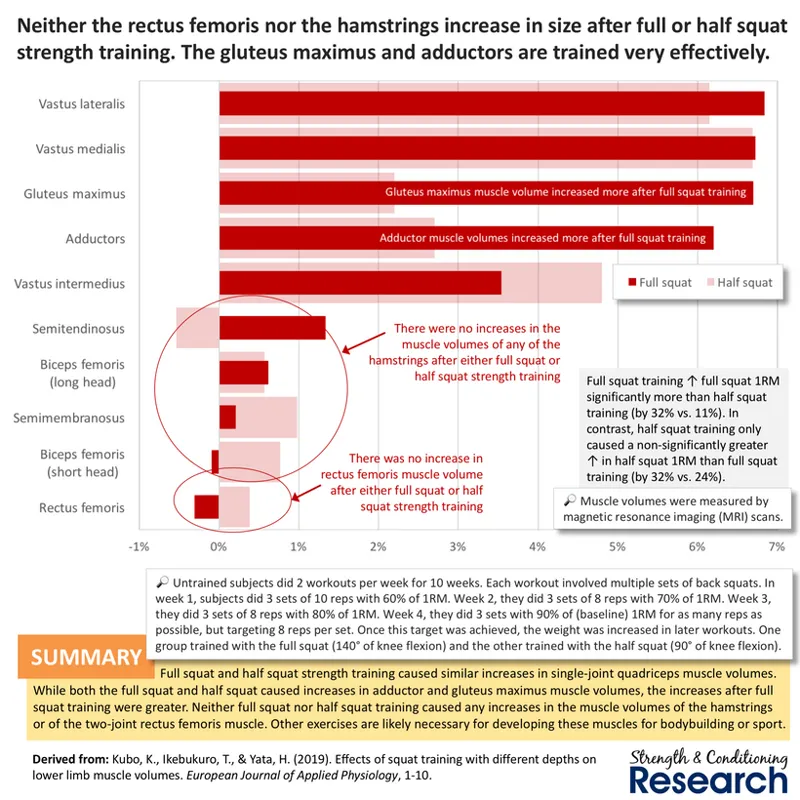
Naturally, this is why the hamstrings are not strongly activated or trained by squat variations or by leg presses.
.
#5. Hip extension preferentially activates upper hamstrings, while knee flexion preferentially activates lower hamstrings
When comparing hip extension and knee flexion exercises, research has shown that hip extension exercises tend to target the proximal region of the medial and lateral hamstrings. In contrast, knee flexion exercises tend to produce a more consistent response across the proximal and distal regions. This also suggests that both hip extension and knee flexion exercises may be helpful for maximizing hypertrophy of the hamstrings.
.
#6. Hamstrings muscles can be preferentially activated by altering ankle rotation angle
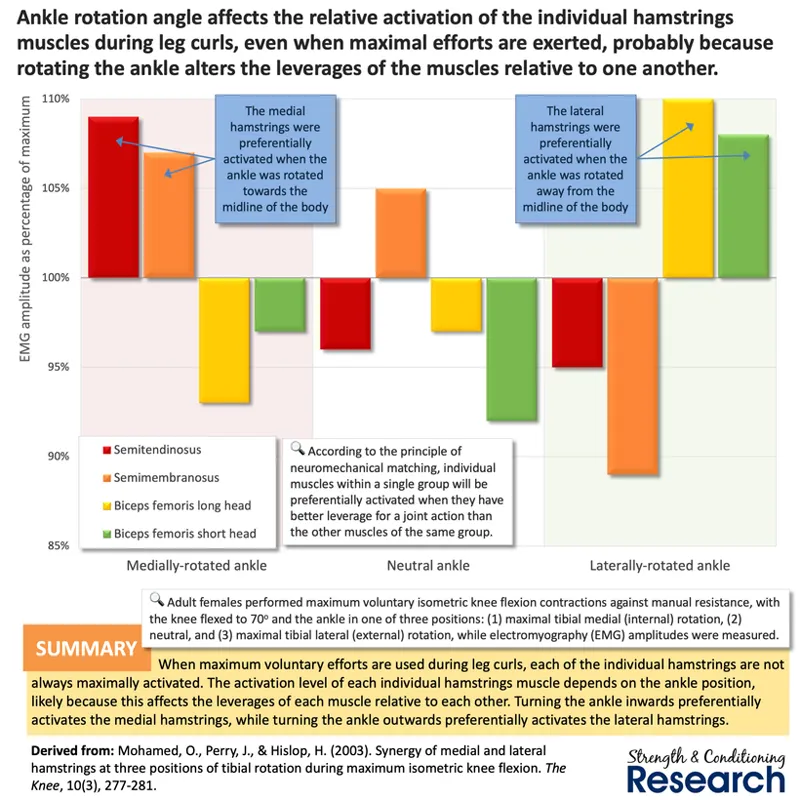
One very small observation that could be valuable for advanced bodybuilders is that ankle position affects the relative activation levels of the lateral and medial hamstrings groups. By turning the ankle in different directions, a bodybuilder can preferentially activate different hamstrings muscles, targeting hypertrophy to specific regions.
.
Conclusions
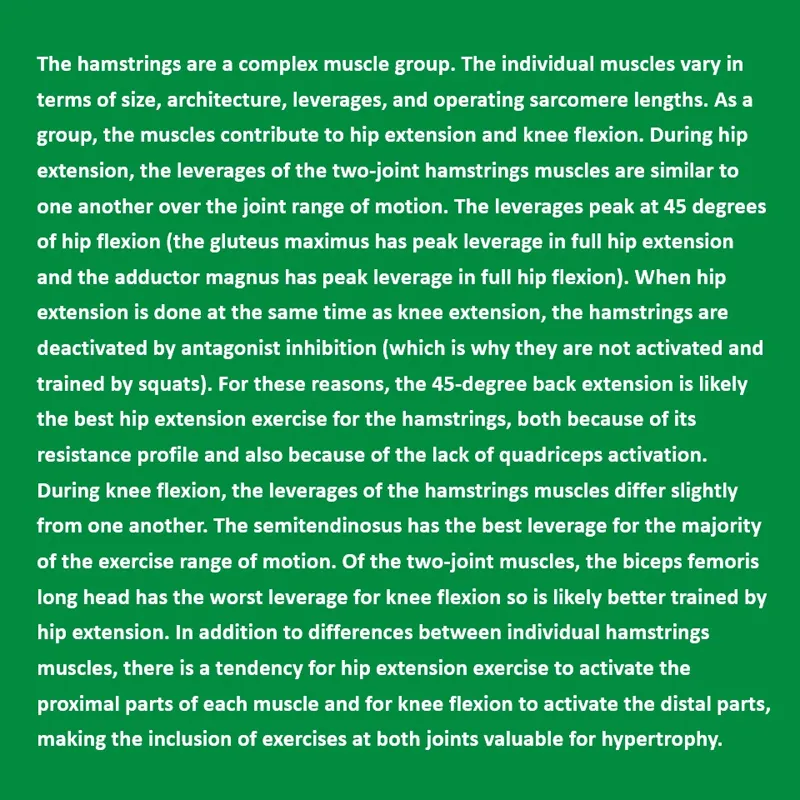
The hamstrings are a complex muscle group in which the individual muscles vary greatly in terms of their size, architecture, leverages, and operating sarcomere lengths. As a group, the muscles contribute to both hip extension and knee flexion. During hip extension, the leverages of the two-joint hamstrings muscles are relatively similar to one another over the joint range of motion. Their leverages peak at 45 degrees of hip flexion (while the gluteus maximus displays peak leverage in full hip extension and the adductor magnus displays peak leverage in full hip flexion). Also, when hip extension is performed at the same time as knee extension, the hamstrings muscles are deactivated by antagonist inhibition (which is why they are not activated and trained by squats and leg presses). For these reasons, the 45-degree back extension is likely the best hip extension exercise for the hamstrings, both because of its resistance profile and also because of the lack of quadriceps activation. During knee flexion, the leverages of the hamstrings muscles differ slightly from one another with the result that the semitendinosus has the best leverage for the majority of the exercise range of motion. Of the two-joint muscles, the biceps femoris long head has the worst leverage for knee flexion so is likely better trained by hip extension. Interestingly, in addition to differences between individual hamstrings muscles, there is a tendency for hip extension exercise to activate the proximal parts of each muscle and for knee flexion to activate the distal parts, making the inclusion of exercises at both joints valuable in a training program.

Comments (5)
In the infographic for "#6. Hamstrings muscles respond to being trained at long maximal muscle lengths," you note that "The sartorius grew more after training with a shorter maximum muscle length." This is not true. The sartorius has a hip flexion moment arm and lengthens as the hip joint position changes from hip flexion to hip extension. The hip joint is in a position of greater extension in the prone leg curl exercise compared to the seated leg curl exercise. Therefore, the sartorius maximum muscle length is greater in the prone leg curl than in the seated leg curl. The sartorius grew more after prone leg curl training compared to seated leg curl training. Therefore, the sartorius grew more after training with a longer maximum muscle length.
Your take on the Nordic curl to achieve full hamstring activation and development at length?
As an eccentric-only exercise, the Nordic curl will not produce as high levels of muscle activation as a normal strength training exercise (because eccentrics usually involve lower voluntary activation). As a knee flexion exercise performed in full hip extension, the Nordic curl will not challenge the hamstrings at long lengths, although obviously as an eccentric-only exercise it will produce similar adaptations to long muscle length strength training due to the high levels of passive tension that are generated.
Tremendous article Chris - thanks! Any chance for a similar one on the abdominals?
Thanks! The next ones scheduled are the major muscle groups of the upper body. But I will see what research is available for the abdominals for later in the year.