









Volume for hypertrophy
Much ink has been spilled and millions of pixels have been moved around in a range of (largely futile) attempts to identify the relationship between training volume and hypertrophy. Even so, we can draw certain important conclusions about training volume and how it relates to muscle growth.
.
#1. Many studies show progressively increasing gains with increasing volume
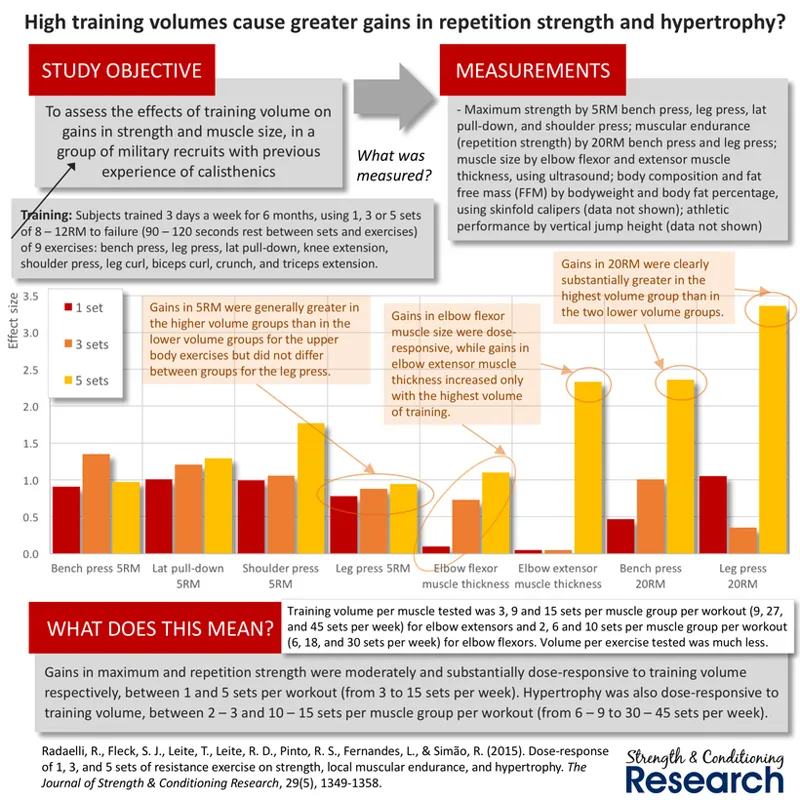
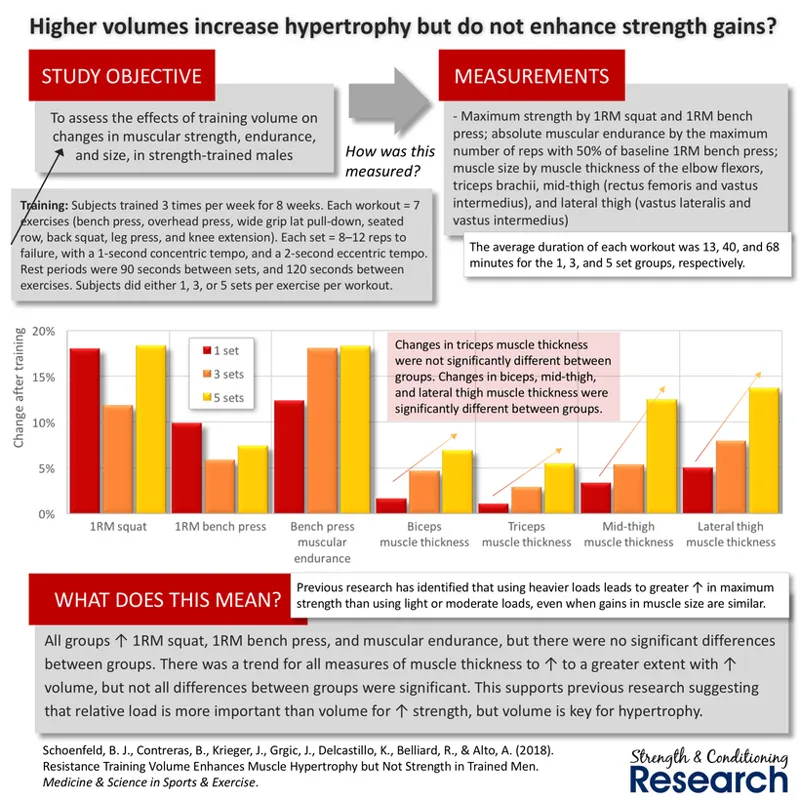
Support for extremely high training volumes was originally reported many years ago, when this study reported increases in the rate of hypertrophy in a group of lightly strength-trained subjects up to 10–15 sets per upper body muscle group per workout.
.
When the study was replicated in more well-trained subjects and with additional measurements for the lower body musculature as well as for the upper body muscles, similar results were reported. There was a steadily increasing dose-response between volume and hypertrophy up to 10 sets per workout for the upper body muscles and up to 15 sets per workout for the lower body muscles.
.
Even so, studies using other designs have also reported similar effects, with the rate of hypertrophy increasing up to and including 16 sets per muscle per workout. This suggests that if there is a confounding factor causing the result, it is not inherent to the study design.
.
#2. Some studies have identified a plateau after a low or moderate volume of training
In contrast to the studies that have reported a steadily increasing rate of hypertrophy with increasing volume up to 15 sets per muscle per workout, other research has found different results. One very early study found that there was no effect of volume whatsoever, even when comparing very low and relatively high volumes. While this finding was likely due to a lack of statistical power (since it is unlikely that there is no difference between 1 set and 4 sets), the numerical differences between the lower body muscle group tested (which compared 1, 2 and 4 sets) and the upper body muscle group tested (which compared 7, 14 and 28 sets across two workouts) do suggest that there is a plateau somewhere around 7 sets per muscle per workout (14 sets per week).
.
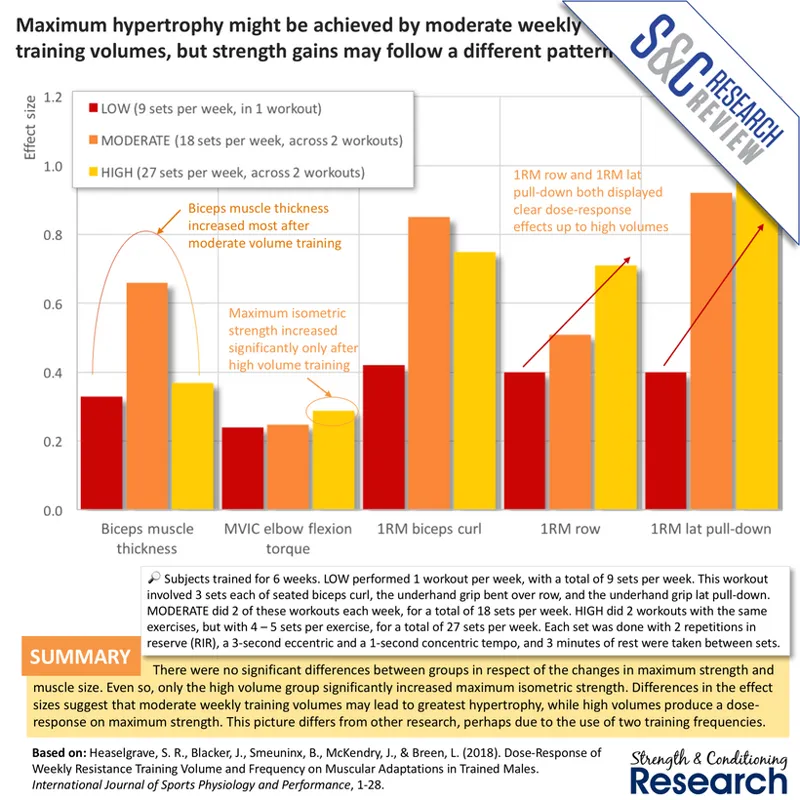
Similarly, more recent research has suggested that there might be a plateau above 9 sets per muscle per workout (or 18 sets per week distributed across two workouts). Taken together with the previous study, this indicates that plateaus might commence between 7 and 9 sets per muscle, per workout.
.
Additionally, the latest research indicates that there might even be a plateau above 6 sets per muscle per workout. Together, these studies suggest that the incremental effect of additional sets on the rate of hypertrophy begins to plateau between 6–9 sets per muscle per workout. In all honesty, this makes much more sense to me that the idea that the rate of hypertrophy can be increased up to and including 15–16 sets per muscle per workout.
.
#3. Most importantly, there are clear indications of diminishing returns
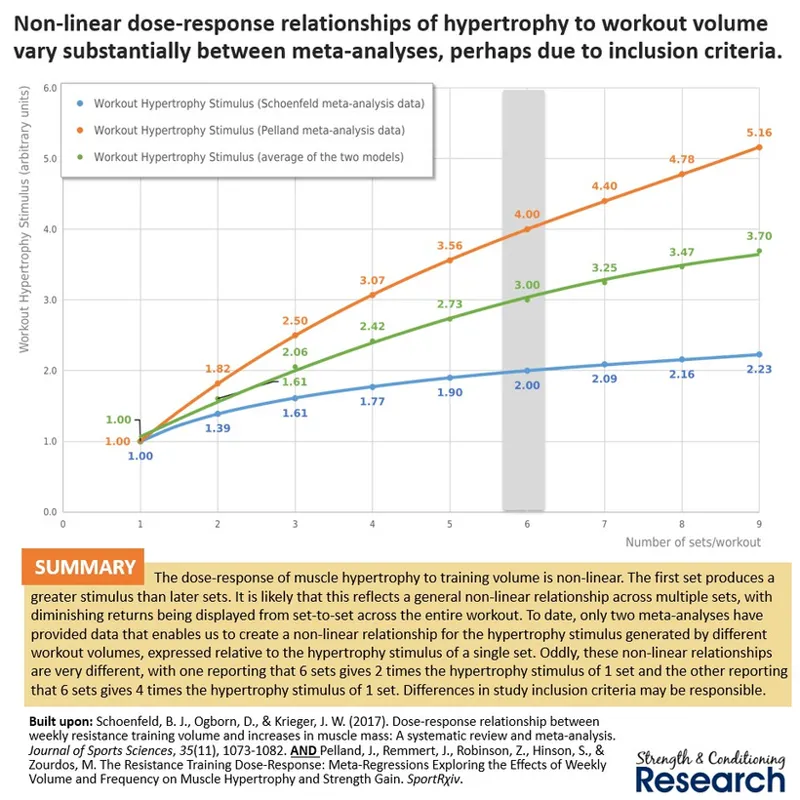
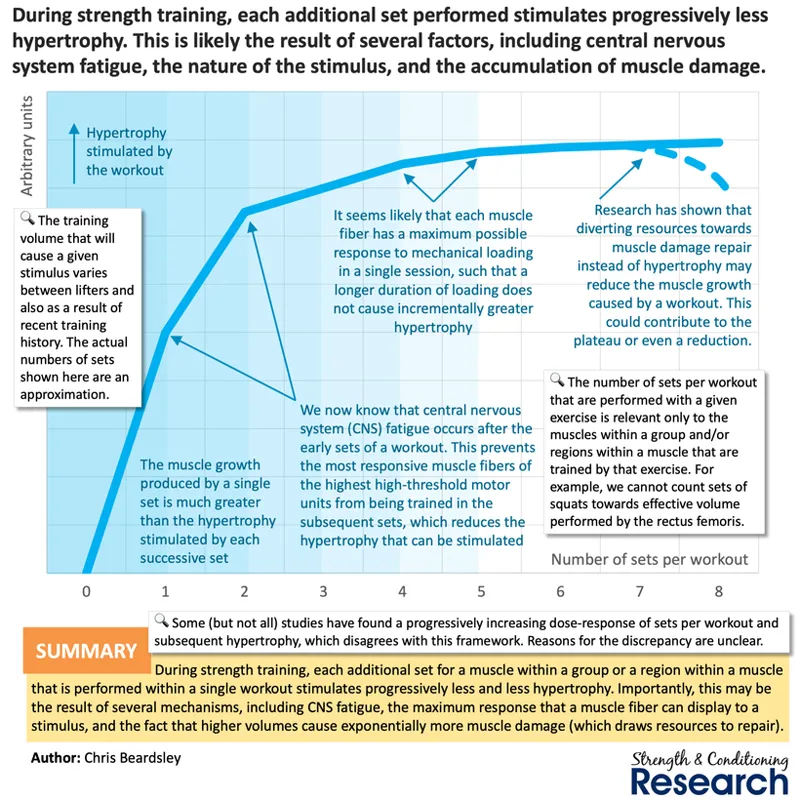
Perhaps the most important observation that is shared across the majority of these studies (despite their obvious differences), is that there are clear indications of diminishing returns, with the later sets of a workout producing a much smaller hypertrophy stimulus than the earlier sets.
.
Indeed, this diminishing returns phenomenon has now been demonstrated in at least two different meta-analyses that incorporate fairly large numbers of studies (in both trained and untrained lifters).
.
#4. Animal models of hypertrophy also indicate diminishing returns
In addition to the human studies, there are animal studies that support the idea of diminishing returns producing a limit to the number of sets that will cause an additional stimulating effect after a strength training workout. In this study, muscle protein synthesis rates were increased only up to 5 sets per workout. Thereafter, additional sets did not cause any further increase in muscle protein synthesis rate.
.
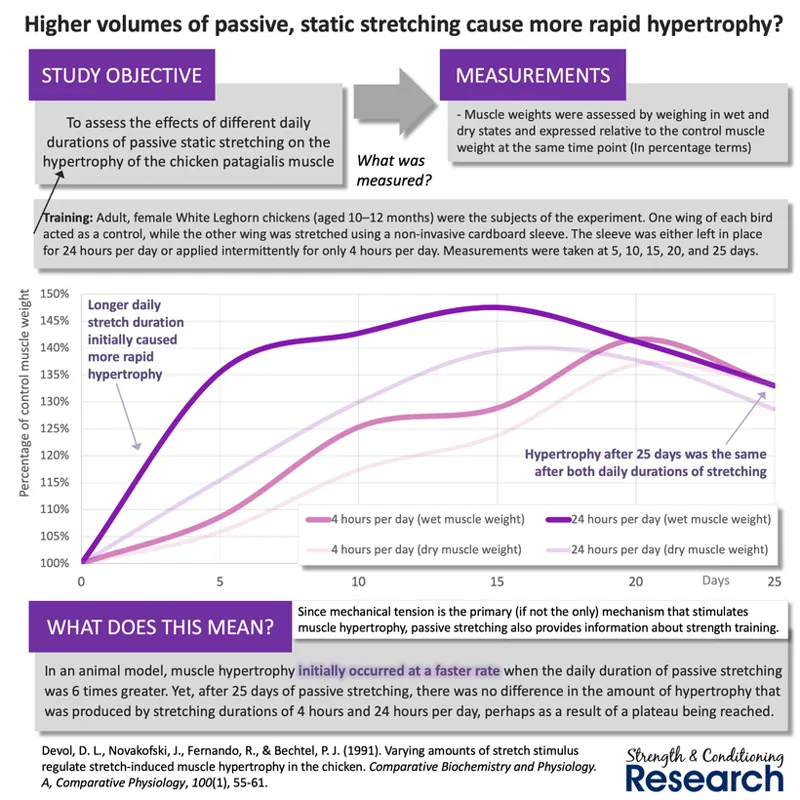
Also, some research suggests that the beneficial effects of increased volumes of mechanical loading only increase the rate of hypertrophy and do not affect the amount of hypertrophy that is achievable over a training program, if the training program is long enough.
.
#5. Why might there be an upper limit? (maximum stimulus reached)
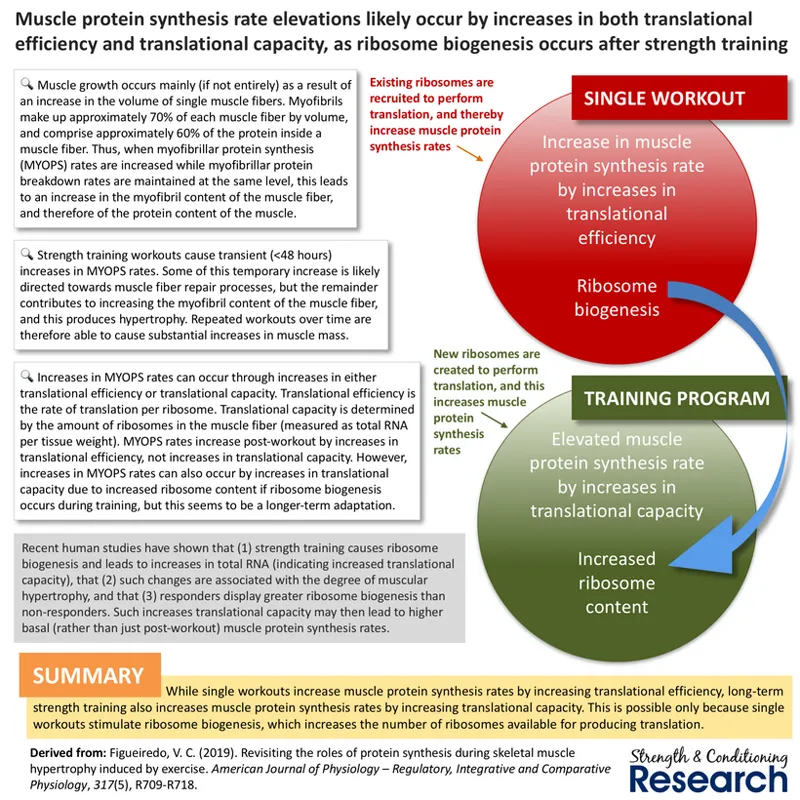
To the extent that a maximum stimulus for hypertrophy is reached at a certain number of sets in a workout, this could occur if previous sets have increased muscle protein synthesis rates to their maximum level (by increasing translational efficiency to its maximal rate). This hypothesis assumes that any additional increases in the number of sets do not increase the duration of time for which muscle protein synthesis rates are elevated, and only act to increase the rate itself.
.
#6. Why might there be an upper limit? (fatigue during the workout)
To the extent that a maximum stimulus for hypertrophy is reached after a certain number of sets in a workout, this could occur because the early sets in the workout cause fatigue that impairs the stimulus generated by the later sets. The main fatigue mechanisms that impair our ability to stimulate adaptations in later sets are CNS fatigue and excitation-contraction coupling failure (ECCF). CNS fatigue impairs the number of muscle fibers that receive an electrical signal in maximal efforts. ECCF impairs the the number of muscle fibers that are activated by calcium ions (even when an electrical signal is received). Thus, these fatigue mechanisms reduce the stimulus for hypertrophy by preventing muscle fibers from producing mechanical tension. Importantly, they both build up over a workout.
.
#7. Why might there be an upper limit? (fatigue after the workout)
To the extent that a maximum stimulus for hypertrophy is reached after a certain number of sets in a workout, this could occur because the higher volumes require longer recovery times. When a workout causes CNS fatigue and ECCF and when these fatigue mechanisms are still present in subsequent workouts, they reduce the stimulus for hypertrophy that can be achieved.
.
While it is contentious whether muscle damage itself can impair the ability of a muscle fiber to experience a stimulus for growth, it is the muscle damage that stimulates the CNS fatigue. Thus, producing more muscle damage in a workout by using higher volumes will create a larger amount of long-lasting CNS fatigue that reduces the stimulus generated by subsequent workouts.
.
#8. Why might there be an upper limit? (muscle damage repair)
When muscle fibers are damaged, they need to be repaired. This repair process has much in common with the process that causes increases in muscle fiber size (which is why it was believed for a very long time that muscle damage was a mechanism that stimulated hypertrophy).
Even so, the processes are separate and increasing muscle damage does not increase hypertrophy. In fact, it may reduce hypertrophy by drawing the increase in muscle protein synthesis rate away from increasing muscle fiber size and using it to repair the damaged muscle fibers.
.
#9. What is the upper limit?
Currently, it is not really possible to aggregate the available literature to identify an average number of sets per muscle per workout above which there is no additional benefit from performing more sets. The available studies are just too different, such that we would be creating an average that has no support from any one study. Thus, we really have to decide whether we think that the high volume studies (that do not show any plateau) are more likely to reflect what is going on, or the more moderate volume studies (that do show a plateau). IMO, it is physiologically more likely that there is a plateau somewhere between 6–9 sets per workout (with the number of sets per week being determined by the training frequency that can be achieved by the individual lifter). This then provides the following model.
.
Yet, if multiple exercises are used, this could alter the results observed, because some exercises train very different muscles within a group (for example, the knee extension focuses on the rectus femoris, while multi-joint leg exercises focus on the single-joint quadriceps) or major regions of a muscle. Therefore, in certain circumstances, the plateau might be reached at a higher number of sets.
.
Conclusions
Higher workout volumes are associated with faster rates of hypertrophy (indeed, it is unclear whether the maximum amount of muscle growth achievable with high volume training is actually greater, or if a plateau is simply reached earlier). Some studies have reported increasingly higher rates of hypertrophy up to and including very high volumes, while other studies have reported that a maximum rate of hypertrophy is reached at moderate workout volumes. Even so, it is evident that each additional set done in a workout for a muscle has a smaller stimulating effect than previous sets (such that there are diminishing returns). So it seems likely that there is some maximum training volume above which no further increases in the rate of hypertrophy occur. This might occur due to [A] muscle protein synthesis (MPS) rates being maximally stimulated by a certain level of workout volume, such that no further increases in muscle growth can be achieved, [B] the build-up of central nervous system (CNS) fatigue and excitation-contraction coupling failure (ECCF) over a workout, such that later sets in the workout have only minimal stimulating effects, [C] ECCF and CNS fatigue being present from a previous workout due to incomplete recovery, and [D] muscle damage needing workout-induced increases in MPS rates for repair instead of for hypertrophy.
Comments (3)
Chris, all those 6 to 9 sets per workout should be close to muscle failure?
Great article Chris - thanks - what would you recommend as the optimal duration/time of a workout? So if all of the above was put into a computer model how long would that average imaginary workout take? Thanks!
IMO, the mechanism that negatively affects the performance of the later sets in a workout is most likely determined by the number of reps and therefore the duration of the exercise itself, rather than the duration of the workout. So we would probably be better to measure the optimal duration in terms of the number of reps (or sets if we are using more or less the same number of reps in all sets).