








Active length-tension relationship
Some influencers have suggested that the central nervous system (CNS) takes the active length-tension relationship (LTR) plateau into account when deciding which muscle to activate at any point in the joint angle range of motion (ROM) of an exercise. They have argued that the CNS chooses to activate muscles in ROMs where they are working on the plateau of the active LTR. This is not correct. In fact, we can easily demonstrate that the location of the active LTR moves to whichever muscle length a muscle is repeatedly activated at as a result of its leverage (internal moment arm length) in accordance with the principle of neuromechanical matching (NMM).
.
#1. What is neuromechanical matching (NMM)?
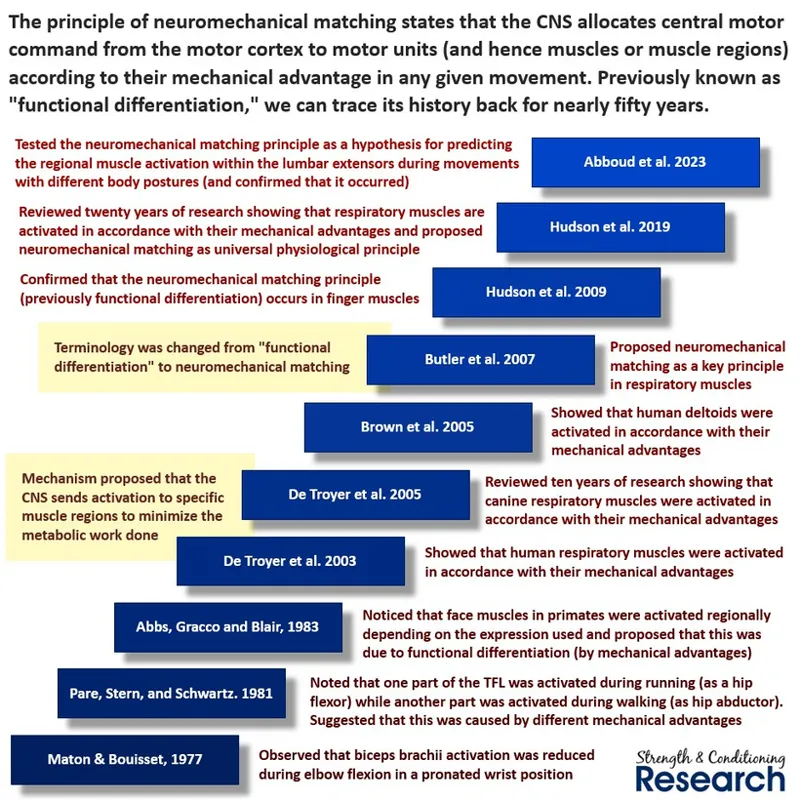
The terminology "principle of neuromechanical matching" was coined in 2007 and the first review paper was written in 2019. At first glance, this makes it a fairly recent idea. However, it is actually a long-standing element of exercise physiology. We can trace its existence back to 1977 if we realize that the same concept has been described under a number of different headings over the decades. For a more complete history, see this article (read more).
.
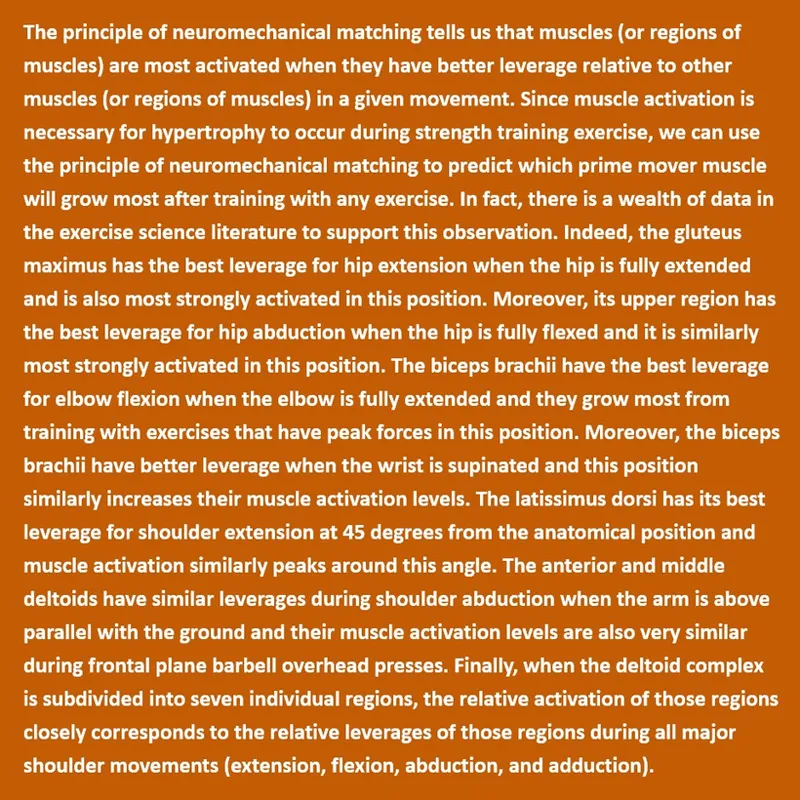
NMM tells us that muscles are preferentially activated when they have better leverage (i.e. longer internal moment arm lengths) than other muscles for a given movement through any given joint angle range of motion (ROM). Contrary to what fitness influencers will tell you, there is a lot of research showing that NMM works in strength training exercises (read more).
So, we see a close correspondence between the length of the internal moment arm possessed by a muscle region for a movement and its activation during that movement.
.
#2. What is the active length-tension relationship (LTR)?
The active LTR exists because of the way in which actin and myosin molecules overlap with one another inside the sarcomere of an activated muscle fiber. When all the available myosins are perfectly overlapping with actin, the maximum amount of active mechanical tension is generated (because all of the myosins are able to bind with actin). When some myosins go past one end of actin or the other (because we shorten or lengthen the sarcomere outside of a certain operating length range), the amount of active mechanical tension begins to reduce and we start to travel down either the ascending or descending limbs of the active LTR.
#3. How does sarcomere addition or loss alter the location of the active LTR plateau?
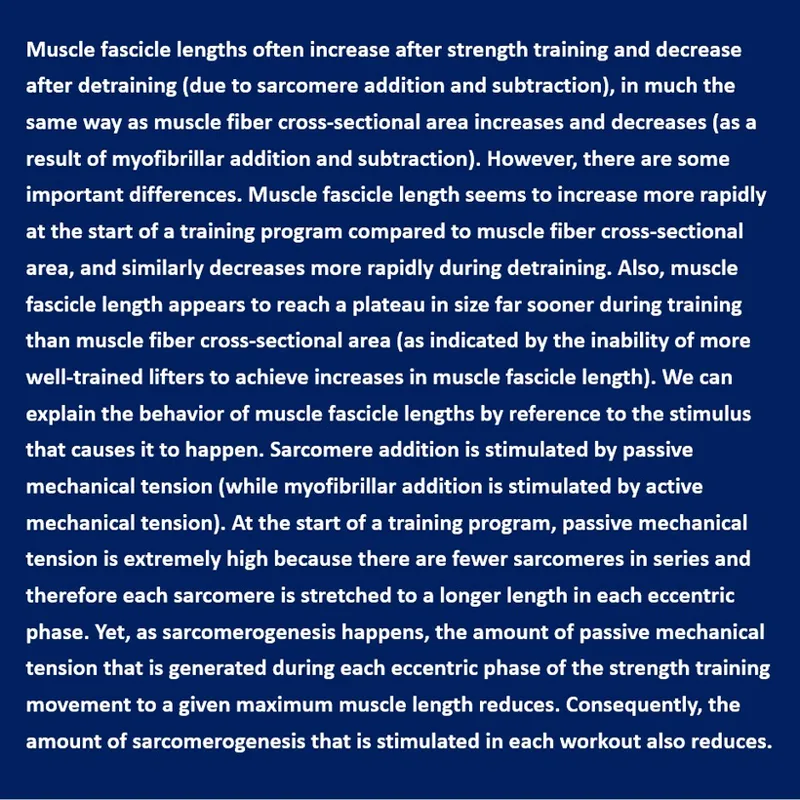
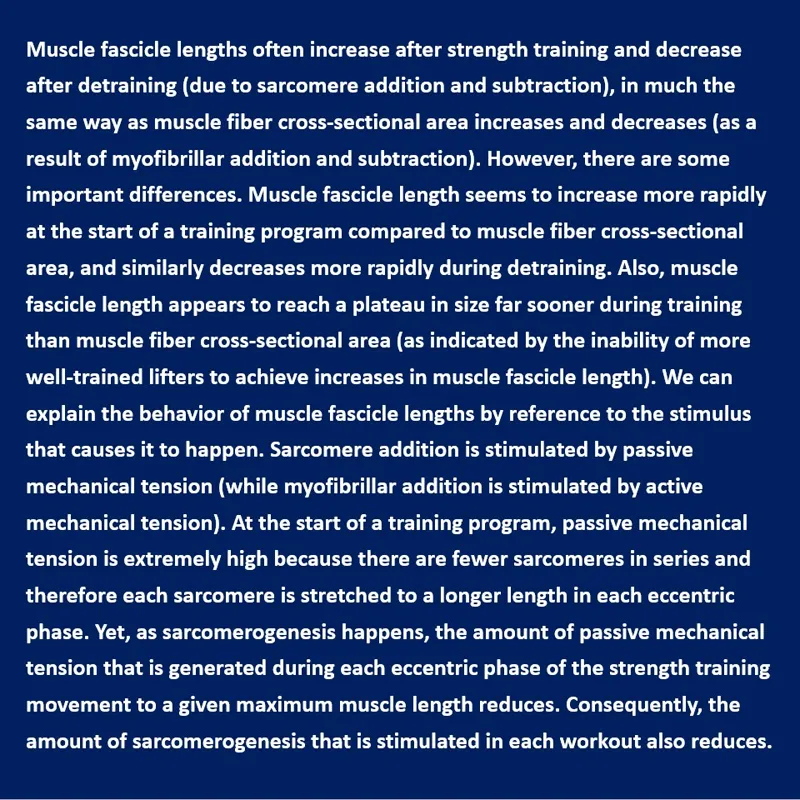
When we add sarcomeres to a muscle fiber, each sarcomere now stretches less over the same joint angle ROM. Consequently, the active LTR plateau now covers more of the total joint angle ROM and its location shifts towards whole longer muscle lengths. Conversely, when we subtract sarcomeres from a muscle fiber, each sarcomere now stretches more over the same joint angle ROM. Consequently, the active LTR plateau now covers less of the total joint angle ROM and its location shifts towards shorter muscle lengths.
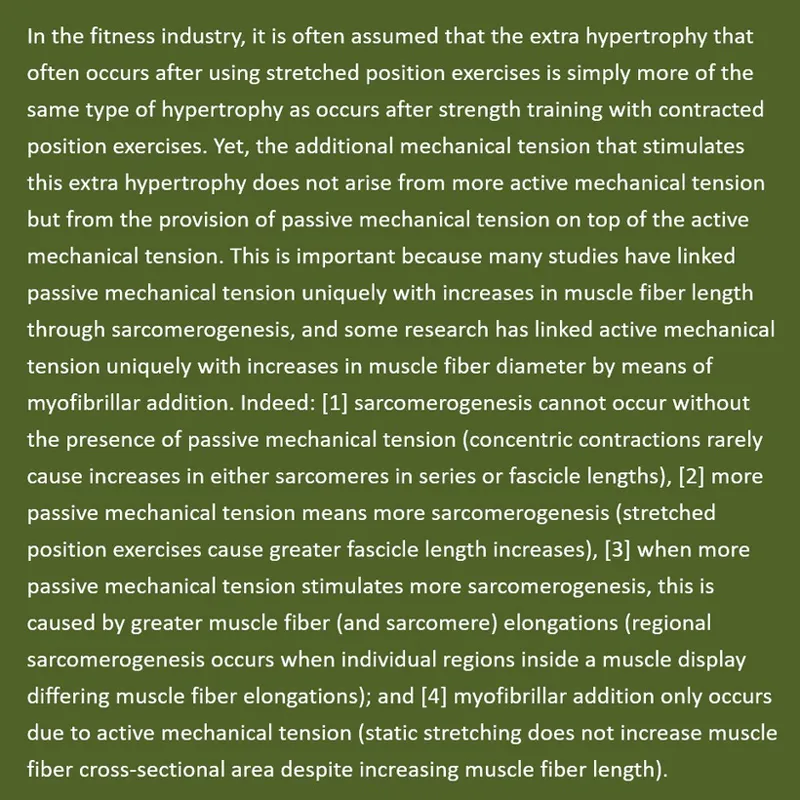
Sarcomere addition is produced by the detection of passive mechanical tension. During strength training, the sarcomeres of activated muscle fibers are elongated past a certain threshold and subsequently experience this passive mechanical tension, which causes sarcomerogenesis (read more).
For this reason, we can see that strength training will only produce the addition of sarcomeres in series until the sarcomeres inside the muscle fibers stop producing passive mechanical tension. In other words, once they are largely working on the plateau of the active LTR, there is no further sarcomerogenesis, which we conventionally measure as increases in muscle fascicle length (read more).
#4. How is the angle of peak torque (APT) related to the active LTR plateau?
The angle of peak torque (APT) is the joint angle at which a group of muscles working together at a joint are able to produce the largest amount of torque. The APT is largely determined by the lengths of the internal moment arms of the various muscles. However, changes in the APT are produced by alterations in the location of the active LTR plateau due to either the addition or loss of sarcomeres in series. The APT shifts to longer whole muscle lengths after adding sarcomeres, and it shifts towards shorter whole muscle lengths after subtracting sarcomeres.
#5. How does strength training change the locations of the APT and the active LTR plateau?
Strength training changes the locations of the APT and of the active LTR plateau by stimulating muscle fibers to either add or subtract sarcomeres in series. Isometric training at long muscle lengths (which stimulates the addition of sarcomeres in series as seen by increases in muscle fascicle length) shifts the angle of peak torque to longer muscle lengths, while isometric training at short muscle lengths (which causes the loss of sarcomeres in series as seen by the loss of muscle fascicle length) shifts the angle of peak torque to shorter muscle lengths.
Partial range of motion dynamic strength training at long muscle lengths (which stimulates the addition of sarcomeres in series) tends to shift the angle of peak torque to longer muscle lengths, while partial range of motion dynamic training at short muscle lengths (which causes the loss of sarcomeres in series) tends to shift the angle of peak torque to shorter muscle lengths.
Generally, eccentric-only training almost always shifts the angle of peak torque towards longer muscle lengths by adding sarcomeres in series, which we record as increases in muscle fascicle length.
Yet, eccentric-only training sometimes just lengthens the joint angle ROM to which the active LTR plateau corresponds, leaving the angle of peak torque unchanged. In contrast, concentric-only training typically causes just a small shift in the angle of peak torque towards shorter muscle lengths by the removal of sarcomeres in series.
Conclusions
Some influencers have argued that the central nervous system (CNS) refers to the active length-tension relationship (LTR) when deciding which muscle to activate at any given point in the joint angle range of motion (ROM) of an exercise. They argue that the CNS chooses to activate muscles in ROMs where they work on the plateau of the active LTR. This cannot possibly be true since it would prevent the addition or loss of sarcomeres during strength training. Indeed, for strength training to stimulate the addition or loss of sarcomeres in series, it must be able to activate muscle fibers that are NOT on the active LTR plateau. To add sarcomeres, muscle fibers must be activated while they are on the descending limb of the active LTR such that passive tension is experienced (and the loss of sarcomeres during exercise only occurs when muscle fibers are activated without passive tension being experienced). So, if the CNS were to choose to activate muscles preferentially in joint angle ROMs where they are working on the plateau of the active LTR, then neither sarcomere addition nor loss would occur (and angles of peak torque would not alter). Thus, it is more likely that addition or loss of sarcomeres in series occurs due to the activation of muscle fibers on either the descending or ascending limbs of the active LTR according to the joint angle at which the muscle is chosen to be activated by the CNS in accordance with the principle of NMM (i.e. in line with the relative length of its internal moment arm). This means that the active LTR moves to correspond with the joint angle at which the muscle has its best leverage.


Comments (1)
Hi Chris, in a recent episode you talked about achieving a 1.25 body weight dip and a 1 arm chin. I would be really interested to hear how trained to achieve these impressive feats I have currently got a triple with an extra 60% body weight added for the chin and 75% for the dip so any info you could provide to help with increasing this would be much appreciated. Thanks