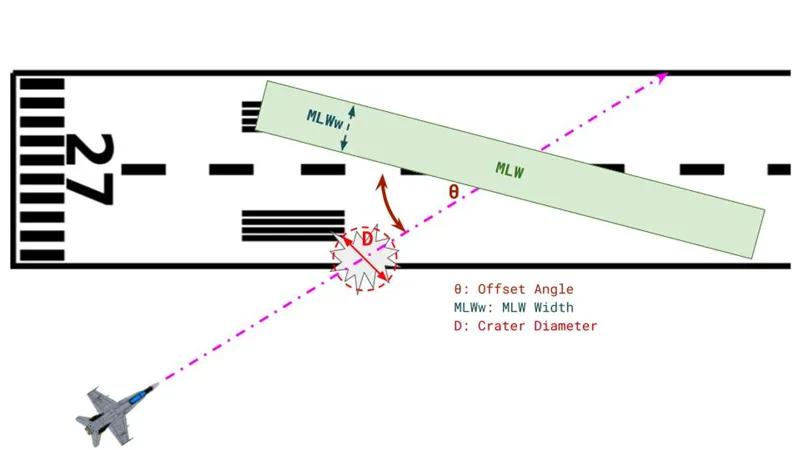
Last part of the mathematical study of optimal runway attack parameters, and conclusions!
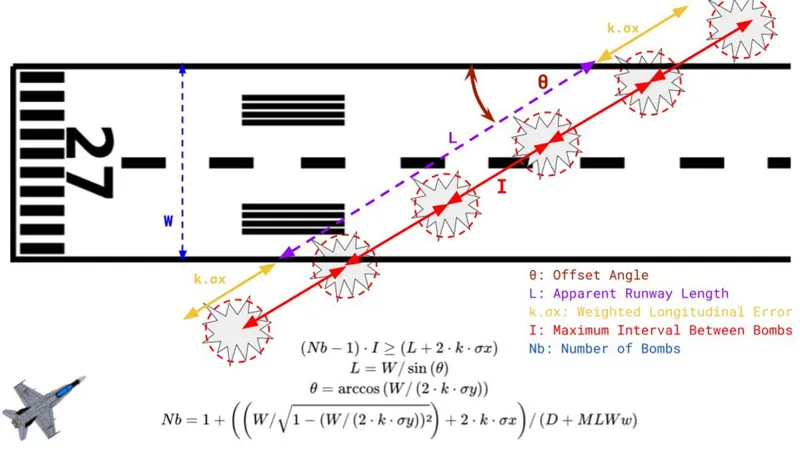
Following my previous explorations into calculating the optimal offset angle (θ) and bomb interval for runway attacks, let's take the time to make a short graphical study. I'll try to provide you visually with a more intuitive understanding of how key factors like lateral and longitudinal errors (σy and σx), runway width, and desired hit probability (k-factor) influence these crucial bombing parameters. Visualizing these relationships will offer a clearer grasp of their effects and aid in practical application.
1. Offset angle
Note: Keep in mind that in this part, we are studying probability of hit for a single bomb. The case of multiple bombs will be approached later.
Let's start from previous formula for offset angle : cos θ = (W/2)/(k*σy) .
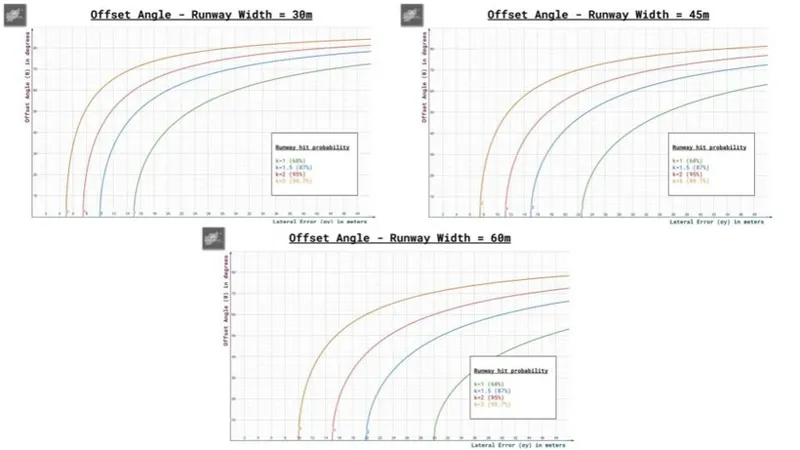
Offset angle depending on later error, runway width, and probability of hit (k factor).
These curves show a non-linear relationship. As lateral error (σy) increases, the required offset angle (θ) also increases. This reflects the need for a less direct attack with less accurate weapons. Under a given lateral error, offset angle is not required. After the threshold requiring offset angle, the offset angle increase quickly: a 10° offset angle is not sufficient to make a real difference with no offset angle. Offset angles above 20° are necessary to be significantly more efficient.
Note: This is in particular the case for PGMs (Precision Guided Munitions) with CEP up to 10 to 15 meters, that have a high probability of hit even with a single bomb from any attack direction. On the contrary, in that case, attacking with an attack heading parallel to the runway will compensate for the longitudinal error (σx).
Single PGM bomb impact on Aleppo runway.
Influence of Lateral Error(σy): Higher σy (less accurate weapons) necessitates an higher offset angle to maintain runway hit probability.
Influence of Probability of Hit (k-factor): Higher desired probability (higher k-factor) demands a higher offset angle for any given σy.
Influence of Runway Width: For wider runways (like 60m), offset angles are smaller than for smaller runway, given the same σy and k-factor. Wider runways are easier to hit laterally.
As a conclusion, you should keep in mind that the graphs visually demonstrate the trade-off between weapon accuracy, desired runway hit probability, and offset angle. Weapon accuracy is paramount, and higher probability requirements necessitate higher offset angles, especially with less accurate weapons and narrower runways.
2. Minimum Number of Bombs
Let's start from the formula introduced last time: Nb =1 + (Ls / I) = 1 + ( ( W / sin(θ) ) + 2.k.σx) / ( D + MLWw ).
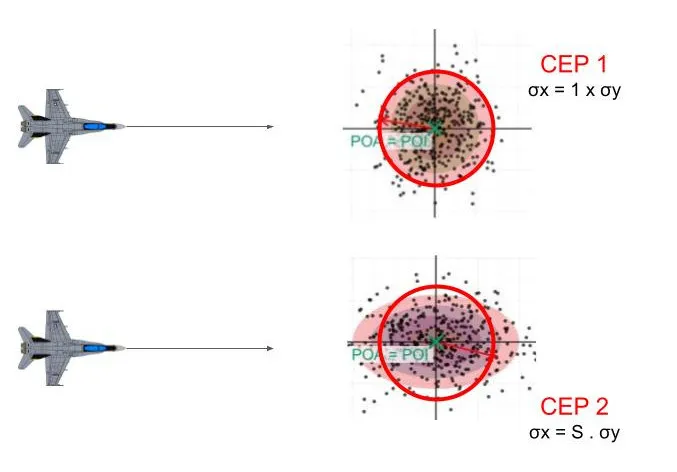
Keep in mind that we have cos θ = (W/2)/(k*σy) hence σy = W / (2.k.cos θ). Let's introduce a S factor such as S = σx/σy, or σx = S.σy . You can visualize this S factor below:
When S=1, the lateral error is the same as the longitudinal error: the pattern is circular. In general, S>1 and the error is greater along the attack heading.
We can now simplify the formula above and we end up with:
Nb = 1 + W ( (1 / sin(θ) + (S / cos(θ) ) / ( D + MLWw )
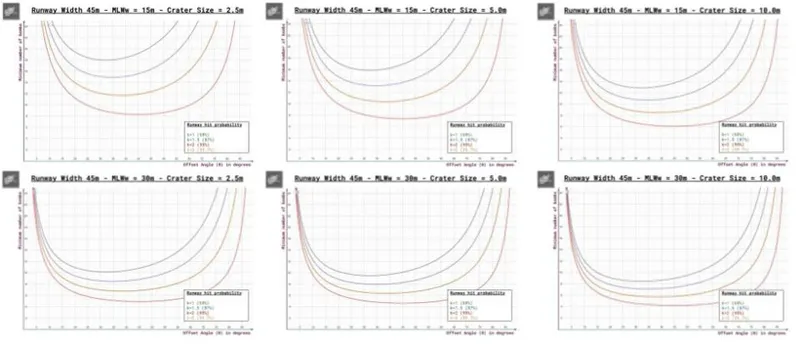
Minimum number of bombs depending on offset angle, depending on MLWw, bomb's crater size and the S factor (σx/σy) for a 45m runway. Note a small typo: the legend for the red and yellow curves has been swapped.
With this new formula, we can notice that:
the probability of hits (k factor) has no effect on the number of bombs;
there's a wide range of offset angles where the necessary number of bombs is constant. For example, on the MLWw = 30m and D = 5.0m curve, you see that you need at least 7 bombs and that this value is the same in the range of 25° to 55° offset angle;
the number of bombs increase greatly for very low and very high offset angles;
the number of bombs is minimum for a given offset angle that decrease when S increase. When S=1, this offset angle is 45°.
For those interested, the study of the formula Nb = 1 + W ( (1 / sin(θ) + (S / cos(θ) ) / ( D + MLWw ) gives us a minimum Nb value for θ = arctan( (1/S)^(1/3)).
Optimal offset angle to minimize required number of bombs for a given S factor.
As a conclusion of this part of the study, we can say that we have confirmation that both a parallel (0° offset) or a perpendicular attack (90° offset) are not optimal, because they require very large number of bombs to obtain the same efficiency as a more optimal offset.
Also, assuming that in the case of aerial bombs ballistics, we'll always have S = σx/σy ≥ 1, then we know that an offset angle lower than 45° is always necessary. The last figure above shows us that for most S values, an offset angle around 30° is optimal in terms of number of bombs.
The previous part of the study showed us that an offset angle above 20° is necessary.
We can therefore conclude here that in order to achieve a high probability of hit, and for every armament / weapon system pairing, an offset angle in the range 20° - 40° is optimal as soon as the lateral error is higher than 1/4 of the runway width. If your lateral error is lower than that, an offset angle in the range 0° - 10° is optimal.
In a next post, I'll try to summarize all these findings in a Mission Data Card to support your mission planning.