The (easy) maths behind successful runway attacks!
As you've seen it previously in historical examples, effectively disabling a runway is not a trivial task and precise application of mathematical principles to optimize attack parameters is required. I will try to explain you here the (simplified) core mathematical aspects of runway attacks, including aimpoint selection, calculation of the offset attack headings, bomb spacing, and the minimum number of bombs required for effective interdiction.
Note: I tried to keep the mathematical complexity at a fairly basic level, to keep it understandable to most virtual pilots, avoiding advanced statistical models and focusing on practical applications. I apologize in advance to anyone who finds this article too difficult...
1. Aimpoints Selection: Runway Cuts Below MLW
The selection of aimpoints on a runway is paramount to maximizing damage and achieving runway closure. The goal is to "cut" the runway, rendering it unusable for aircraft operations. Several key concepts guide aimpoint selection, and a central concept is the Minimum Launch Window (MLW).
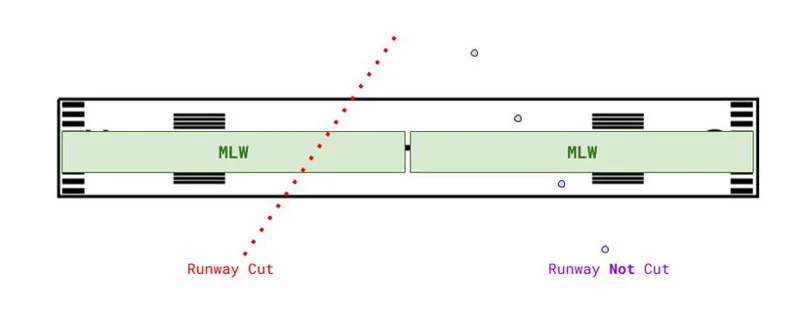
Minimum Launch Window (MLW): the MLW rectangular space on the runway required for launching fixed-wing aircraft. Runway closure is achieved when sufficient space to launch aircraft (an MLW-sized rectangle) no longer exists on the runway due to damage. The dimensions of the MLW rectangle would depend on the aircraft types operating from the airfield.
Description of the MLW concept.
Runway Cut (RC): a RC is said to occur when damage is inflicted at a specified aim points, effectively rendering the usable runway width smaller than the MLW width. If the runway is not cut, it means that an MLW-sized rectangular space still exists after the attack. The goal of runway attack planning is therefore to make enough RC to guarantee that no MLW remains.
Runway Cut (left) vs Runway Not Cut (right)
Aimpoint selection is therefore done so as to strategically placing runway cuts (lines of damage) to maximize the probability of damaging all runway sections sufficiently to prevent the existence of any MLW-sized rectangular space.
Particular Configurations:
Multiple runways: for airfields with parallel runways, aimpoints shall be chosen in a way to ensure that a single weapon release can result into cuts on all the runways.
Crossing runways: aiming at the intersection affects sections across both runways, potentially maximizing the probability of RC events across multiple runway directions.
Taxiways: if a taxiway is bigger than the MLW, it should be treated as a runway and be targeted.
Runway and taxiway intersections: targeting those intersections will both prevent ground maneuvers (like entering on the runway) and runway use, therefore preventing the access to a runway part larger than the MLW.
Mathematically speaking, aimpoint selection is more complicated and is a sophisticated optimization problem. It involves calculating probabilities of damage to individual sections based on weapon characteristics, CEP, and aimpoint locations, and then using set theory to determine the overall probability of the runway closure – that is, the probability that all sections are damaged enough to eliminate any MLW-sized rectangular area.
2. CEP: Quantifying Weapon Accuracy
Accuracy is paramount in runway attacks. Even the most potent anti-runway weapon is ineffective if it misses its aimpoint. Circular Error Probable (CEP) is a critical metric for weapon accuracy.
CEP is defined as the radius of a circle, centered at the aimpoint, within which 50% of weapons are expected to fall. It is a statistical measure of dispersion. A smaller CEP indicates higher accuracy.
Comparative CEP of guided (GBU-12 Paveway II) and unguided Mk 82 aerial bombs, delivered from an altitude of 15,000 ft. (Source: Raytheon, 2006).
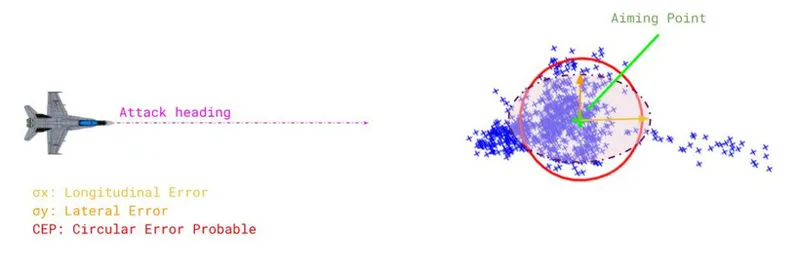
The CEP is often derived from two orthogonal error components: the longitudinal error (along the direction of attack, or σx) and the lateral error (perpendicular to the direction of attack, or σy). Assuming these errors are independent and normally distributed, CEP can be approximated. In general, due to the fact that the aircraft speed vector is mostly longitudinal, we often have σx > σy. Note: in the case σx = σy, we have CEP = 1.177σ.
Visualization of CEP, longitudinal error and lateral error. By definition CEP is the circle containing 50% of the bombs, even if the impacts pattern is generally spread along the longitudinal axis.
Several factors contribute to weapon inaccuracy and CEP:
Weapon system errors: these are inherent inaccuracies in the weapon's guidance system, launch platform, and ballistics. These errors can be due to manufacturing tolerances, sensor limitations, and aerodynamic uncertainties.
Environmental factors: weather conditions, particularly wind, can significantly affect weapon trajectory. Atmospheric density, temperature, and humidity can also play a role.
Navigation errors: these are inaccuracies in the aircraft's navigation system and target location information.
Human errors: reaction time will vary depending on individuals, or factors like stress condition and tiredness, and will result into additional errors.
CEP/σ values vary widely depending on the era, weapon type, and delivery platform. During World War II era, bombs CEP could be several hundreds of meters, while modern Precision-Guided Munitions (PGMs), like JDAM or laser-guided bombs, can achieve CEPs of a few meters, sometimes even below 5 meters.
Example of CEP figures for Mk-82 body variants. Sources: Raytheon, 2006; 2016; U.S. Navy, 1999; 2001.
Understanding CEP and its contributing factors is crucial for planning runway attacks, especially when the objective is to reliably eliminate MLW space. As we will see it later, a higher CEP necessitates an offset angle, and the use of more weapons.
3. Offset Angle: Enhancing Runway Hit Probability
Even if attacking a runway directly along its axis might seem intuitive, it is often suboptimal, especially when considering weapon accuracy and runway dimensions. Introducing an offset angle in the attack trajectory can significantly increase the probability of a runway cut.
When attacking along the runway axis, lateral errors (σy) are the most critical. If the lateral error is larger than half the runway width, the bomb might miss the runway entirely! By approaching at an offset angle, we effectively increase the probability of hitting the runway, even with these lateral errors.
The optimal offset angle (θ) depends on the lateral error (σy) and the runway width (W). A simplified approach to estimate a useful offset angle can be derived by considering only the lateral error and a right-angled triangle where:
Opposite side ≈ Distance along runway covered by lateral error, related to σy (e.g., a multiple of σy, depending on desired probability)
Adjacent side ≈ Runway Width (W)
Visualization of the offset angle, and its calculation using probabilities (k*σy).
A simplified formula for a useful offset angle can be approximated as:
cos θ = (W/2)/(k*σy) or θ = arccos( W / ( 2*k*σy ) )
Where:
θ is the offset angle;
W is the runway width;
σy is the lateral error;
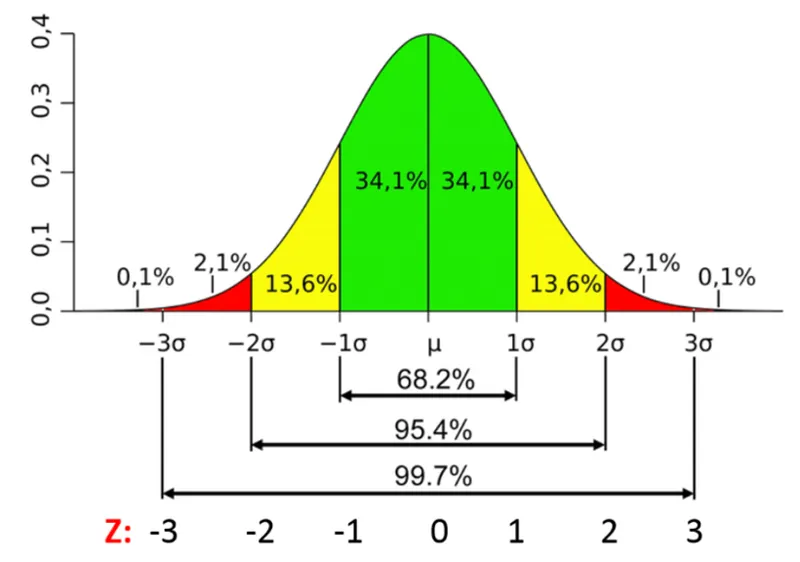
k is a factor related to the desired probability of hitting the runway laterally (e.g., k=2 for approximately 95% probability if errors are normally distributed). This 'k' value can be adjusted based on risk tolerance and desired certainty.
The normal distribution curve is the statistical model used to determine the "k" value: k = 2 means that we have 95.4% of chances of hitting the runway.
Examples of Values:
Runway width (W) = 45 meters
Lateral error (σy) = 25 meters
k = 1 (68% probability)
θ ≈ arccos (45 / (2 * 1 * 25)) = 25 degrees
In practice, offset angles between 20 to 45 degrees are often considered in runway attack planning. The calculation of the exact optimal angle would require more sophisticated modeling, considering the influence of σx and a refined statistical distribution model for the chosen shooter/weapon pair.
In the end, you have to understand that the offset angle is a crucial tactical consideration that leverages the statistical nature of weapon errors to improve the effectiveness of runway attacks, increasing the chances of creating runway cuts that eliminate MLW space.
Note: θ = 0° when k*σy < W / 2. The only case where an offset angle is not necessary is when the weighted lateral error is less than half the width of the runway: if you're able to aim at the exact center of the runway, you're sure to have a high probability of hitting the runway. But are you sure that you can aim for the exact center of the runway ? The offset angle combined with a ripple bomb release will compensate for the aiming error.
The only Youtuber who correctly addressed runway attacks is Spud Spike. I recommend you his excellent video, and as noted here, the offset angle calculation we made above is valid for any "elongated" target, like a runway, a bridge, or a very long building.
4. Anti-Runway Weapons: Crater Damage & Repair
Anti-runway weapons are specifically designed to inflict maximum damage to airfield pavements, creating large, disruptive craters that are time-consuming to repair.
Types of Anti-Runway Weapons:
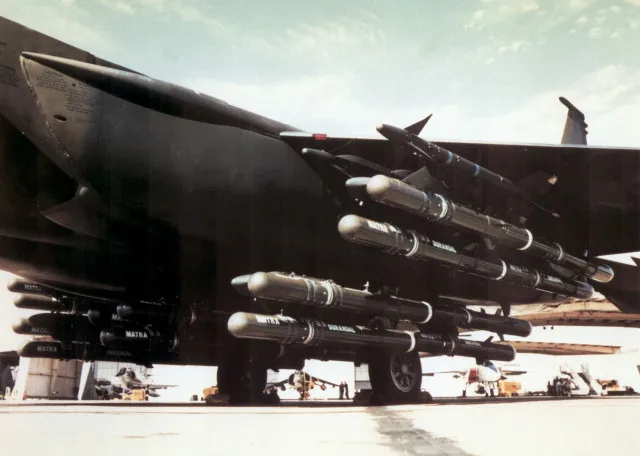
Runway cratering bombs: these are typically heavy, robustly constructed bombs designed to penetrate runway concrete and detonate below the surface, creating significant upheaval and large craters. Example: French Matra Durandal (a.k.a. BLU-107) or BAP 100.
F-15E equipped with BLU-107 "Durandal" anti-runway bombs.
Area denial weapons: Beyond cratering, some weapons are designed for area denial, scattering debris and unexploded ordnance across the runway to further complicate repair efforts. Cluster munitions, though controversial and often banned, have been used in this role historically. Example: British JP233.
Missile-Delivered Warheads: modern anti-runway capabilities increasingly rely on missiles, offering stand-off attack options. Example: French APACHE missile.
The APACHE cruise missile was carrying several KRISS (Kill Runway Improved Sub-System) anti-runway sub-munitions designed to penetrate the runway and explode after a preset time delay, from several hours to several days.
Note: general purpose bombs with a short delay (≈10ms) can also be used as a anti-runway weapons, even if their relative efficiency is obviously lower than dedicated weapons.
The resulting crater size is a critical factor determining the time required for runway repair. Crater dimensions depend on:
Weapon size and design: larger bombs and bombs with specialized penetration and blast characteristics create larger craters.
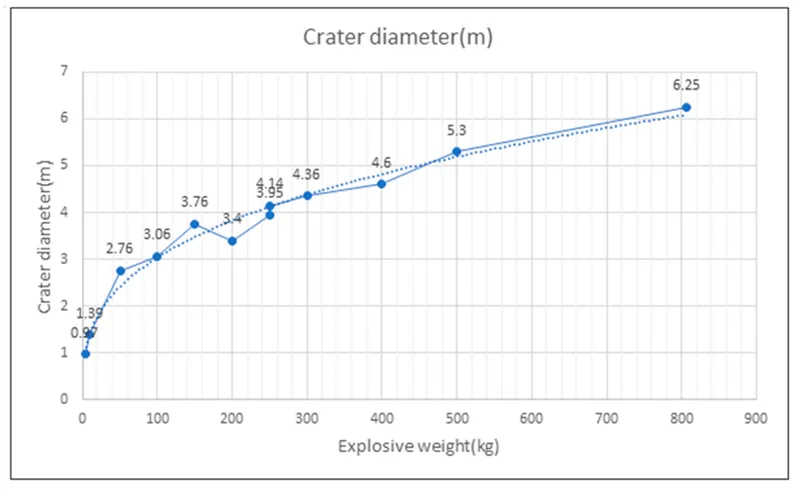
Estimated crater size on concrete runways for various explosive weights, for general purpose weapons.
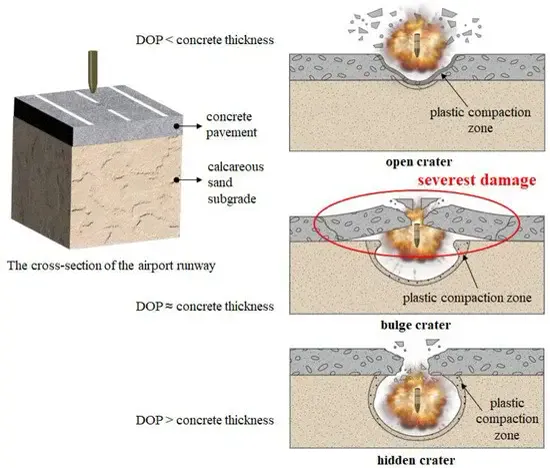
Runway pavement strength: the thickness and material properties of the runway pavement influence crater dimensions. Stronger pavements resist cratering better but still can be significantly damaged.
Depth of burial: for sub-surface detonations, the depth of burial affects crater diameter and depth. For example, a large anti-runway bomb might create a crater 10-15 meters in diameter and several meters deep. Modern missile warheads (e.g. ballistic missiles) could potentially create even larger craters.
Anti-runway weapons are often equipped with rockets that will increase their penetration speed, and therefore their burial depth. Here a Russian BetAB-500ShP.
The effects of anti-runway weapons go beyond just creating a hole. They include:
Cratering: it's the direct disruption of the pavement structure, creating an obstacle for aircraft.
Spalling and cracking: the blast effects can cause cracking and spalling (surface fragmentation) extending beyond the crater itself, weakening the surrounding pavement.
Uplift and deformation: subsurface detonations can uplift and deform large sections of pavement around the crater.
Damage to sub-base: severe detonations can damage the underlying sub-base and soil, further complicating and lengthening repair. This is especially true for runways accommodating heavy aircraft.
Example of craters and damages modeling on runways.
The question of repairability is also crucial, since runway repair is a race against time. Rapid runway repair techniques exist, but the size and complexity of the damage inflicted by modern anti-runway weapons can make quick repairs very challenging.
In addition to the number and size of craters themselves, the factors affecting repairability include the availability of repair materials and equipment (a rapid repair requires readily available materials (prefabricated pavement sections, specialized concrete) and heavy equipment, as well as trained professionals) and the enemy suppression, since the threats of new attack can disrupt repair efforts. If you are interested, you can have a look at the Rapid Airfield Damage Recovery (RADR)doctrine of the US Air Force.
A RADR team working on a runway during an exercise.
We can note that for a long time, the use of very long delayed fuzes, with explosion delays as long as several hours or days, could prevent repairs due to the fear of the future explosion. These weapons are nowadays considered as mines and have been removed from modern arsenal in order to comply with international treaties.
The effectiveness of anti-runway weapons lies in their ability to create damage that is both operationally disruptive and time-consuming to repair, thus achieving the goal of airfield denial by eliminating MLW space.
In my next post, l will detail the bomb interval calculation, and we'll see how to determine the minimum number of weapons that should be released for a single runway cut. Stay tuned!