When attacking a runway with multiple bombs, the bomb interval – the spacing between successive bomb impacts – remains a critical parameter for maximizing damage and achieving runway closure (eliminating MLW space), now understood in the context of damaging runway sections.
Proper interval selection ensures effective runway cutting and maximizes the probability of achieving the RC event (Runway Cut) across all runway sections.
Interval for Runway Hit (Basic, Non-Optimal):
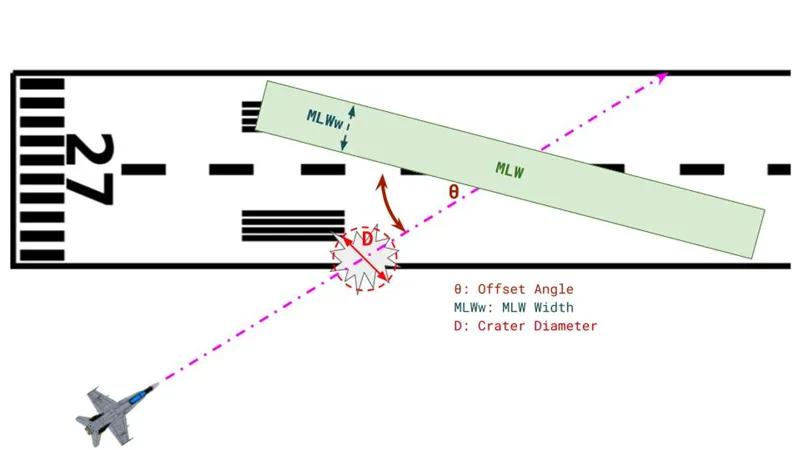
Let's first consider a very basic and non-optimal interval calculation. This simplified approach focuses solely on ensuring that at least one bomb in the salvo is likely to hit the runway, regardless of whether it creates an effective runway cut for MLW elimination. This calculation provides a maximum interval, beyond which we risk missing the runway entirely with individual bombs due to the offset angle and runway width. This simple calculation gives us a Maximum Interval I in relation to the runway width (W) and the offset attack angle (θ):
I = W / sin (θ)
If the interval I is set to this value, we can expect at least one bomb to impact somewhere on the runway. However, it is crucial to understand that this interval is NOT designed for effective runway damage or MLW elimination. It merely addresses the basic probability of a runway hit. A full MLW-sized space could easily remain undamaged even with bombs spaced at this interval. Therefore, this "at least one bomb on runway" interval serves only as a rudimentary starting point and is not recommended for effective runway attack planning.
If I is equal to the apparent length of the runway, we are sure that at least 1 bomb will hit the runway. However, we don't guarantee a Runway Cut since a full MLW might still fit in the remaining untouched runway.
Interval to Create Continuous Cuts and Eliminate MLW Space:
For the primary objective of runway closure by eliminating the Minimum Launch Window (MLW) space, a more sophisticated approach to interval calculation is required. To ensure the runway is cut effectively enough to eliminate any MLW-sized rectangular space and achieve the Runway Cut (RC) event across all runway sections, the bomb craters must be spaced and sized to create continuous lines of damage (cuts) that disrupt the entire runway width. This is the relevant criterion for effective runway attack planning.
Let's consider the Maximum Interval Between Bombs (I), Runway Width (W), Crater Diameter (D) and Minimum Launch Window Width (MLWw).
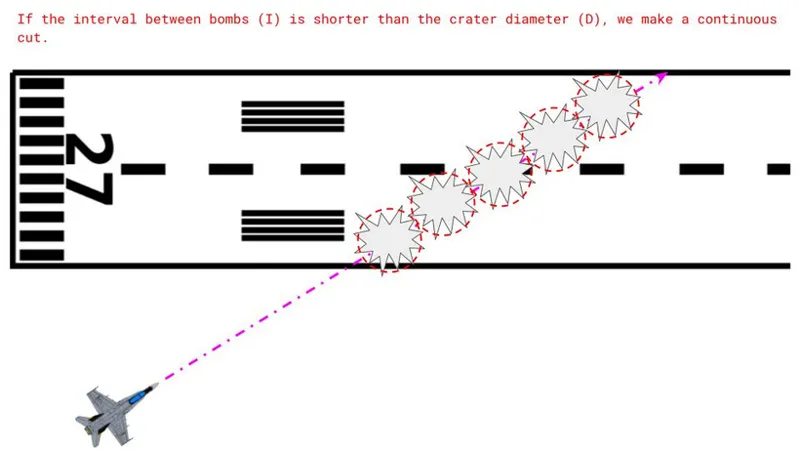
If we want to ensure that no rectangular area of size MLW remains undamaged along the bomb run, we need to consider the crater diameter and the dimensions of the MLW rectangle. Let's assume we want to create continuous damage that prevents any MLW-sized rectangle from fitting within the undamaged areas. If craters have diameter D, and we place them with interval I, then the undamaged section between craters is approximately I - D (if craters are assumed to be circular and placed in a line along the runway). To effectively eliminate MLW space, and assuming some overlap is needed for effectiveness and to account for crater shape variations, a conservative approach might be to aim for craters to be almost touching or slightly overlapping. In this simplified case, a bomb interval I approximately equal to the crater diameter D might be a starting point. In that situation I ≈ D.
The continuous cut with I≈D guarantees maximum damages, but requires a lot of bombs.
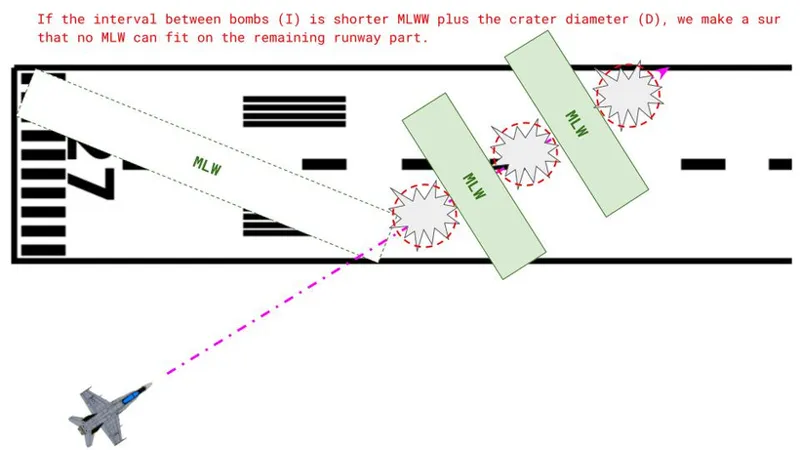
A more nuanced approach would consider the effective damaged width created by a crater, which might be larger than just the crater diameter due to spalling and cracthat we most be able to fit any MLW width between two craters on any direction. In that case, I ≈ D + MLWw.
Choosing a larger interval while still denying any MLW is possible with I ≈ D + MLWw.
In the end, the exact interval would be a trade-off between maximizing damage effectiveness (for MLW elimination) and minimizing the number of bombs used.
6. Minimum number of Bombs: Guaranteeing Runway Hits for MLW Elimination
Now that we know the maximum interval between our bombs, calculating the minimum number of bombs is easier: we just need to consider the number of bombs required to cover the apparent runway width, augmented with 2.k.σx (where σx is the longitudinal error, and k the weighting factor to reach the desired probability of success as seen earlier). The first σx will ensure that the first bomb will fall on or before runway, and the second σx that the last bomb will fall on or after runway.
We now have a total salvo lenght Ls = ( W / sin(θ) ) + 2.k.σx
The minimum number of bombs Nb will ensure that ( Nb - 1 ) * I > Ls, where I is the maximum bomb interval.
Hence: Nb > 1 + (Ls / I) = 1 + ( ( W / sin(θ) ) + 2.k.σx) / ( D + MLWw ) if we consider Crater Diameter (D) and Minimum Launch Window Width (MLWw).
Final calculation to determine how many bombs are required to achieve a Runway Cut with a P(k) probability.
Example: for W = 45 m, σy = 25 m, σx = 50 m, k = 2 and MLWw = 20 m (or twice the wingspan of the jet you are considering)
BLU-107: D = 5 m → Nb = 7.
BAP-100: D = 2.5 m → Nb = 8.
Note: due to their reduced weight and size, anti-runway weapons can be carried in larger numbers than general purpose weapons (3 to 6 per pylon for the BLU-107, up to 18 per pylon for the BAP-100), when GP bombs are often carried in smaller numbers.
7. HUD Cue and Release Decision
Achieving truly effective runway cuts demands a refined approach to release timing that moves beyond the simple accuracy metrics like CEP that I presented before. Other tactical considerations have to be considered, requiring a nuanced understanding of weapon system characteristics and operational context.
One crucial element is understanding how the aircraft's weapon system designates the aimpoint, especially in relation to bomb salvos. Knowing whether the aiming cue represents the first, middle, or center of a bomb salvo is essential for precise targeting. If the cue indicates the first bomb, a pilot should aim slightly short of the intended runway cut to ensure the salvo's damage pattern is correctly centered. Conversely, for cues representing the middle bomb or salvo center, direct aim is appropriate. Consulting specific weapon system documentation is therefore not just recommended, but necessary for effective employment.
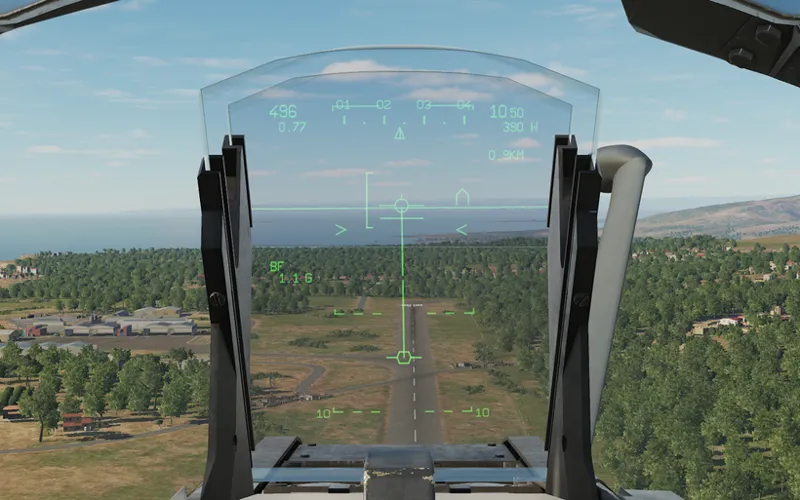
For the CCIP bomb release on the Mirage 2000C, the release cue is at the beginning of the bomb salvo: the correct aiming point is therefore before the runway.
Furthermore, tactical advantages can be gained by strategically adjusting aim, particularly when carrying more bombs than the calculated minimum. Aiming slightly short, especially with an excess bomb load, can intentionally extend the runway cut lengthwise. This technique enhances overall runway disruption and increases the probability of hitting tactical features located just beyond the runway centerline.
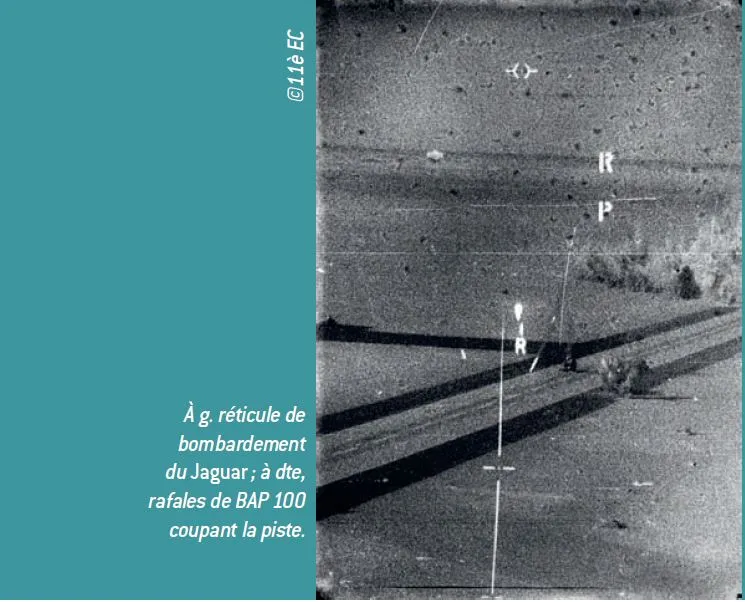
You can see on this picture taken a the time of trigger press that the aiming point is slighlty before the runway.
The method of weapon release – automatic or manual – also dictates release timing considerations. Automatic release systems offer high precision in ideal conditions, making accurate aimpoint designation the primary focus. However, for older weapon systems with a slow computer (only a few Hz in the 1980s), maintaining precise flight parameters — airspeed, altitude, and dive angle — becomes paramount. It is even more crucial for manual bombing at a selected piper depression angle. Consistent flight parameters ensure predictable weapon delivery, often outweighing the pursuit of absolute pinpoint aim at the runway centerline.
Conclusion
The mathematics of runway attacks is a multifaceted field, blending probability, geometry, and physics to optimize the effectiveness of airfield denial operations, specifically focused on runway closure defined by the elimination of any Minimum Launch Window (MLW)-sized rectangular area.
From aimpoint selection to calculating bomb intervals and release timing, a quantitative understanding is crucial for mission planning and execution, especially when the objective is to achieve runway closure in terms of MLW elimination.
Key takeaways include:
Aimpoint selection is strategic, focusing on runway cuts and exploiting airfield vulnerabilities, with the primary goal of eliminating any Minimum Launch Window (MLW)-sized rectangular space on the runway.
CEP is a critical measure of accuracy, influencing weapon effectiveness and the number of weapons required to reliably create runway cuts that contribute to MLW elimination.
Offset angles are a tactical necessity to leverage weapon error characteristics and increase hit probability, enhancing the effectiveness of runway cuts aimed at MLW elimination.
Anti-runway weapons are specialized for creating large, disruptive, and hard-to-repair damage, maximizing the chances of eliminating MLW space and achieving runway closure.
Bomb interval optimization is essential for creating continuous runway cuts without ordnance wastage, ensuring that the cuts are effective in eliminating any MLW-sized rectangular area.
Minimum and ideal weapon numbers are determined by probabilistic calculations and damage optimization models, now explicitly considering the spatial definition of runway closure as MLW elimination.
Release timing is a complex interplay of technology, human factors, and ballistics, all contributing to accurate weapon delivery essential for creating precise and effective runway cuts for MLW elimination.
By applying these mathematical principles,you can now develop more effective runway attack strategies, maximizing airfield disruption (runway closure) while minimizing weapon expenditure and collateral damage!