El Diablo's Story: The Mirage 2000D, Tail Number 666
Within the realm of military aviation, certain airframes acquire a significance that transcends their mere technical specifications. I already introduced two of them here: US Air Force "Lucky" F-15E and E/A-6B "Prowler" BuNo 161120.
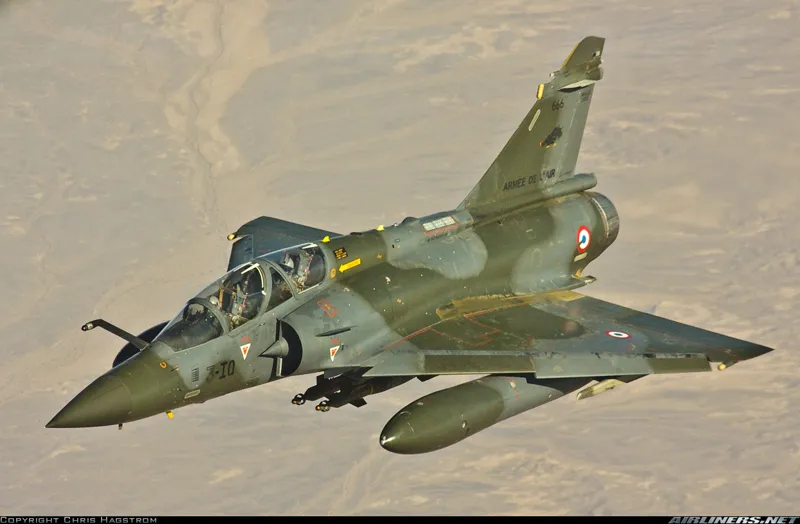
This particular status is often born from exceptional operational performance, a pivotal contribution to a conflict, or a unique characteristic that seizes the public imagination. For the Armée de l'Air et de l'Espace (French Air and Space Force), the Mirage 2000D, tail number 666, is a good example of this phenomenon. Dubbed "El Diablo," this particular aircraft, bearing a number laden with cultural connotations, carries a legacy of operational deployments, squadron pride, and a presence in artistic and modeling circles. This post explores the story of "El Diablo," examining the Mirage 2000D platform, the squadrons that operated it, and some of its combat record.
The Mirage 2000D: The Ultimate Mud Mover
The Mirage 2000D, a dedicated conventional strike variant of the highly successful Mirage 2000 family (including the Mirage 2000C we have in DCS World), represents a significant evolutionary step from its air-superiority predecessors. Unlike the Mirage 2000C and -5, optimized for air-to-air engagements, the 2000D was conceived from the outset for precision ground attack, capable of operating day or night, and under all weather conditions.
Design Philosophy: The 2000D (standing for Diversifié, or "Diversified") program emerged from the imperative to replace the aging Mirage IIIE and Jaguar fleets in the tactical strike role. In the Cold War context, the French Air Force made a requirement for a platform capable of penetrating contested airspace at low altitude, delivering a diverse range of ordnance with pinpoint accuracy, and maintaining operational effectiveness in high-threat environments. The 2000D, derived from the two-seat Mirage 2000N (originally designed for nuclear strike missions), provided the solution. The initial prototype took flight in 1991, with deliveries to the Air Force commencing in 1993.
View of the TFR mode in the Mirage 2000D: 200ft and 540kt by night or IMC is not a task for everyone, let alone in the mountains of Afghanistan...
The 2000D is distinguished by several key characteristics:
Tandem Seating Configuration: A pilot and a Weapon Systems Officer (WSO), known in French as a Navigateur Officier Système d'Armes (NOSA), collaborate in a tandem cockpit arrangement, enhancing situational awareness and optimizing workload distribution during complex mission profiles.
View from the WSO seat in the Mirage 2000D.
Sophisticated Navigation and Targeting Suite: For its generate (late Cold War era), the 2000D incorporates an advanced navigation and attack system, anchored by the Antilope 5 terrain-following radar. This radar facilitates low-altitude penetration (down to 200 feet) at high speeds (up to 600 kt), autonomously adapting to terrain contours to minimize detection probability. The system can also integrate a TGP.
Extensive Ordnance Payload: The 2000D possesses the capability to deploy a broad spectrum of air-to-ground munitions, encompassing laser-guided bombs (such as the GBU-12, GBU-16, GBU-24, and the French-developed AS-30L), unguided bombs, anti-runway ordnance (e.g., the BAP 100), and anti-ship missiles (including the AM39 Exocet in specific configurations). It also retains a self-defense capability with Magic 2 short-range air-to-air missiles.
Comprehensive Electronic Warfare Suite: To enhance survivability in contested airspace, the 2000D is equipped with a robust electronic warfare (EW) suite, incorporating radar warning receivers (RWR), jammers, and chaff/flare dispensers to counter enemy air defense systems. It's certainly one of its most powerful feature!
Distinction from the Mirage 2000N: While sharing a common airframe ancestry with the 2000N, the 2000D is unequivocally optimized for conventional strike operations. The 2000N, initially designed for the carriage of the ASMP nuclear missile, possesses a distinct mission profile and corresponding equipment suite, although certain 2000Ns were subsequently upgraded to the 2000N-K3 standard, conferring a limited conventional strike capability. The 2000D, however, was intrinsically designed for a wider array of conventional munitions.
A Mirage 2000N (in the front) and a Mirage 2000D (in the back) during combat operations in Libya. The external differences may be subtle (like the nose cone), but the overall capability is very different. Without a targeting pod, the Mirage 2000N is little more than a "bomb truck".
The Squadrons of "El Diablo": 1/3 "Navarre" and 3/3 "Ardennes"
Mirage 2000D number 666 served (and still serves) with distinction within two squadrons of the French Air Force: Escadron de Chasse (Fighter Squadron) 1/3 "Navarre" and EC 3/3 "Ardennes." Both squadrons boast rich lineages and traditions, and "El Diablo" became an integral part of their respective histories.
Escadron de Chasse 1/3 "Navarre": Stationed at Nancy-Ochey Air Base (BA 133), EC 1/3 "Navarre" holds a position as one of the oldest and most prestigious squadrons within the French Air Force. Its origins can be traced to World War I, and it has participated in every major conflict involving France since that era. "Navarre" transitioned to the Mirage 2000D in the 1990s.
The SPA62 insigna, one of the 1/3 squadron's "escadrille" was already seen during WWI.
Escadron de Chasse 3/3 "Ardennes": Also based at Nancy-Ochey, EC 3/3 "Ardennes" shares a similarly distinguished service record, dating back to World War I. The "Ardennes" squadron has cultivated a reputation for its operational flexibility and its proficiency in challenging operational theaters. Its emblem depicts a wild boar, a symbol of the Ardennes region of France. Paralleling "Navarre," "Ardennes" integrated the Mirage 2000D into its inventory slightly later, leveraging its capabilities across numerous deployments.
The Mirage 2000D "666" with the colors of the EC 3/3 squadron.
Squadron Culture and "El Diablo": Within these squadrons, "El Diablo" was more than just another airframe. Its readily identifiable tail number likely fostered a sense of mystique, perhaps even a degree of playful superstition. Pilots and ground crews may have developed a particular affinity for the aircraft, associating it with successful missions or particularly memorable experiences. Anecdotes concerning "El Diablo" would have circulated within the squadron environment, contributing to its unique standing. The aircraft's distinctive number would have rendered it a frequent subject of photographic documentation and informal discussions.
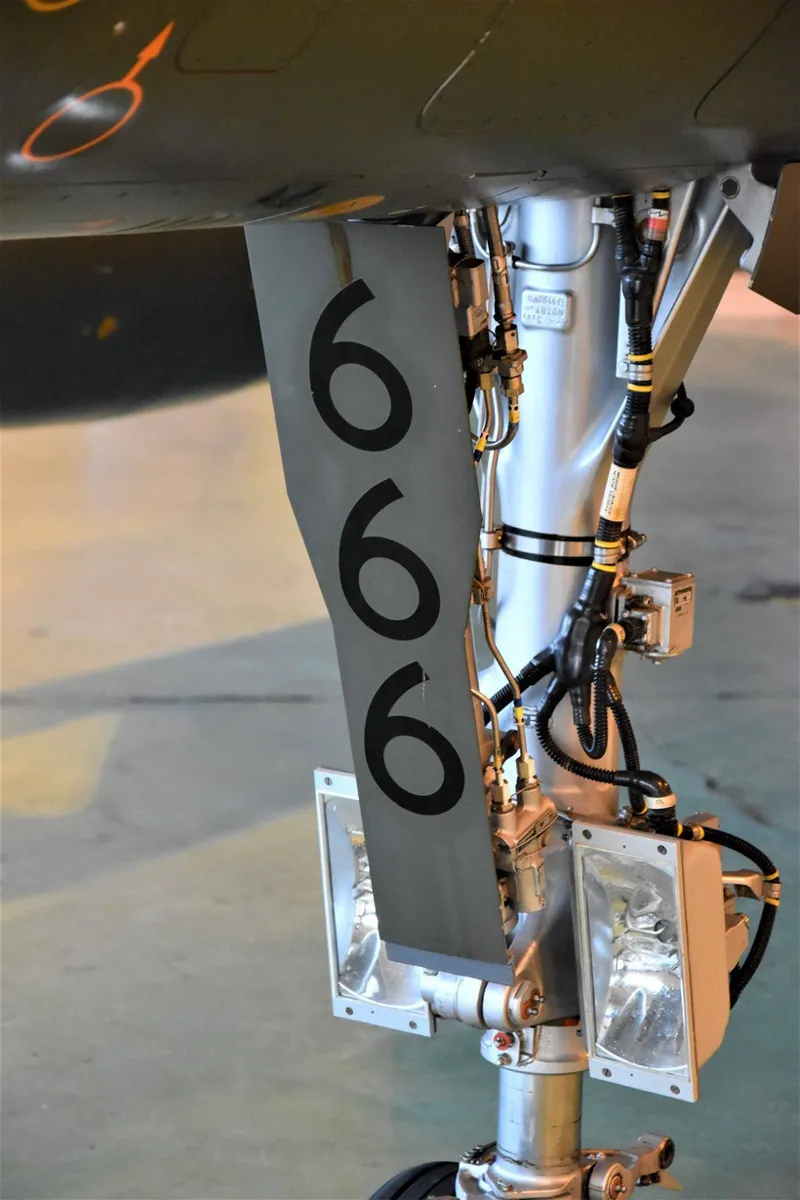
The aircraft number is also clearly visible on the front gear, in order to make it easier to identify without having to look at the tail number on the side of the aircraft.
Operational Deployments: "El Diablo" in Combat
The Mirage 2000D, including tail number 666, has served as a primary combat asset of the French Air Force, participating in a multitude of operations across the globe.
Operation Enfuring Freedom: While not maintaining a continuous presence comparable to later operations, the Mirage 2000D did deploy to Afghanistan during OEF as early as 2002, and came back later in 2005 under the auspices of the International Security Assistance Force (ISAF) until 2014. During these deployments the 2000Ds provided close air support and precision strike capabilities in support of coalition ground troops.
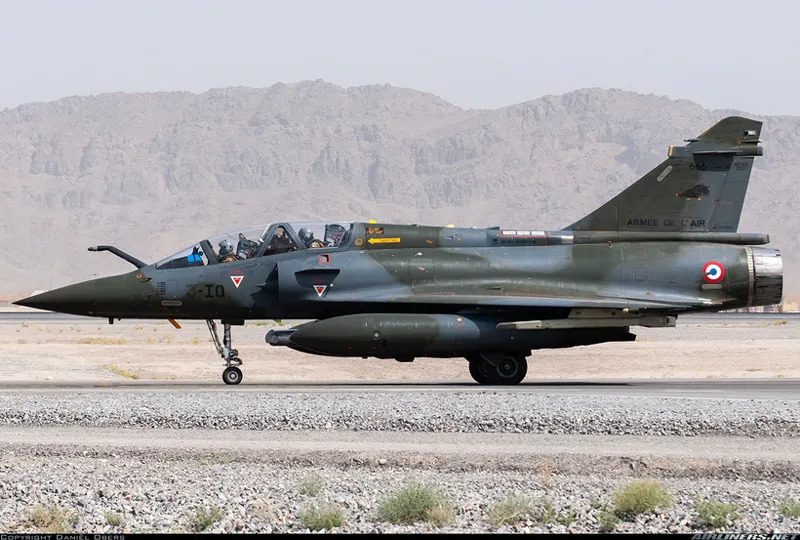
The Mirage 2000D "666" is seen taxiing at Kandahar. It's equipped with an ATLIS (day-only) targeting pod, and doesn't carry any Fox-2 Magic II missile despite being equipped with a DDM missile warning system on the missile rail.
Opération Harmattan (Libya, 2011): Within the framework of the NATO-led intervention in Libya, French Mirage 2000Ds played an instrumental role in enforcing the no-fly zone and prosecuting ground targets. They conducted numerous sorties, delivering laser-guided bombs and other ordnance against Libyan military assets, including command and control nodes, air defense installations, and armored formations. "El Diablo," as part of its squadron deployments, would have been at the forefront of these operations, contributing significantly to the coalition's objectives.
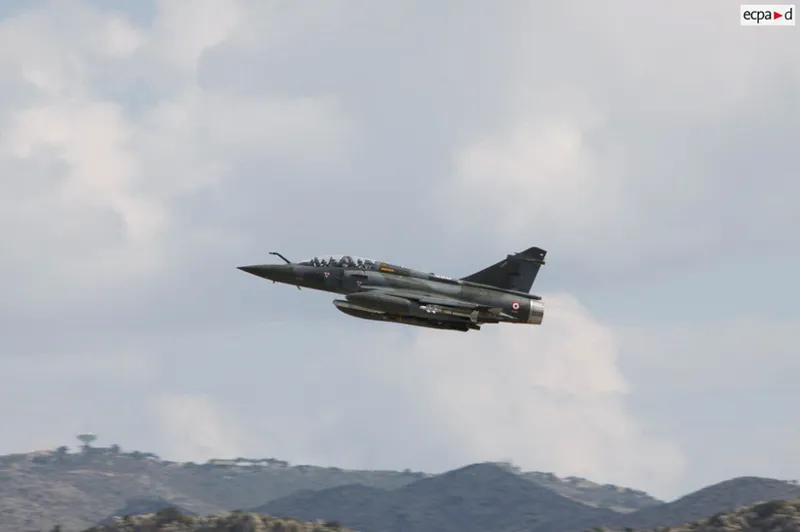
The Mirage 2000D "666" taking off from Solenzara in Corsica during the very early days of OUP.
The Mirage 2000D "666" taking off from Souda (Crete) during OUP. A live Magic II is clearly visible on the left wing.
Opération Serval (Mali, 2013-2014): During France's intervention in Mali to counter the advance of Islamist insurgents, the Mirage 2000D again assumed a prominent role. Operating from forward bases in neighboring countries, such as Chad and Niger, the 2000Ds provided critical close air support to French and allied ground forces.
Opération Barkhane (Sahel Region, 2014-2022): The successor to Opération Serval, Opération Barkhane encompassed a broader counter-terrorism effort spanning multiple countries in the Sahel region of Africa. Mirage 2000Ds continued to fulfill a vital function, conducting reconnaissance flights, providing close air support, and prosecuting targets associated with terrorist groups.
Opération Chammal (Iraq and Syria, 2014-Present): As a participant in the international coalition against ISIS, French Mirage 2000Ds have been deployed to the Middle East, operating from bases in Jordan and the United Arab Emirates. They have conducted airstrikes against ISIS targets in both Iraq and Syria, contributing to the degradation of the terrorist organization's operational capabilities. These missions frequently entail long-range sorties, necessitating in-flight refueling.
As in most air forces, combat sorties can be followed with bomb markings on the Mirage 2000D "666" sides. The markings are wiped out regularly after heavy maintenance, making it impossible to track its record precisely.
"El Diablo" in Artistic Representation: A Cultural Icon ?
The distinctive tail number of Mirage 2000D 666, coupled with its evocative "El Diablo" nickname, has propelled it beyond the confines of military service and into the realms of artistic expression and scale modeling. It has become a recognizable symbol of French air power.
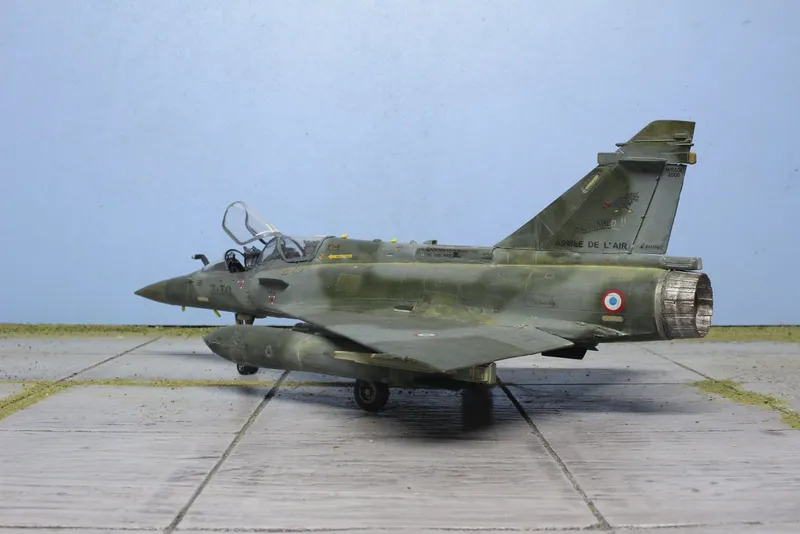
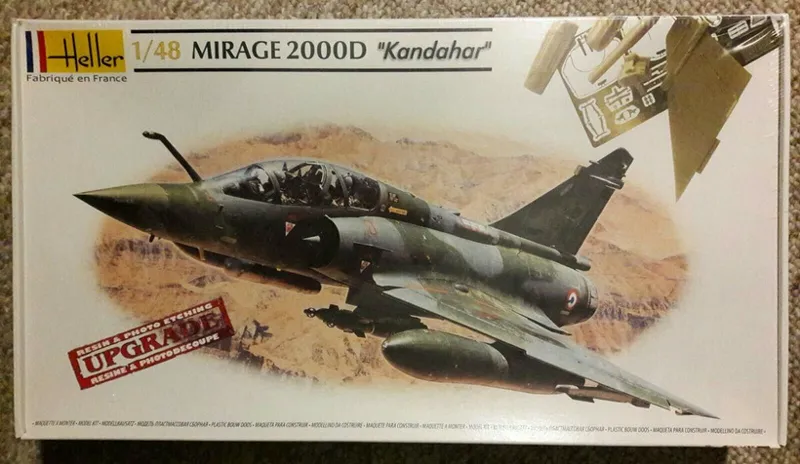
Scale Model Kits: several model kit manufacturers have produced renditions of the Mirage 2000D, decal options for tail number 666 have obviously been provided.
Heller's model kit with tail numer "666" as the primary option.
"El Diablo" has its own decals...
The Mirage 2000D "671" taxiing at Kandahar is covered with dirt. The sand always covered the aircraft body, and was sometimes used to leave more or less poetic "messages" on the aircraft (cf. the "SPA67 power above" supposed to be marked on the aircraft's dirt).
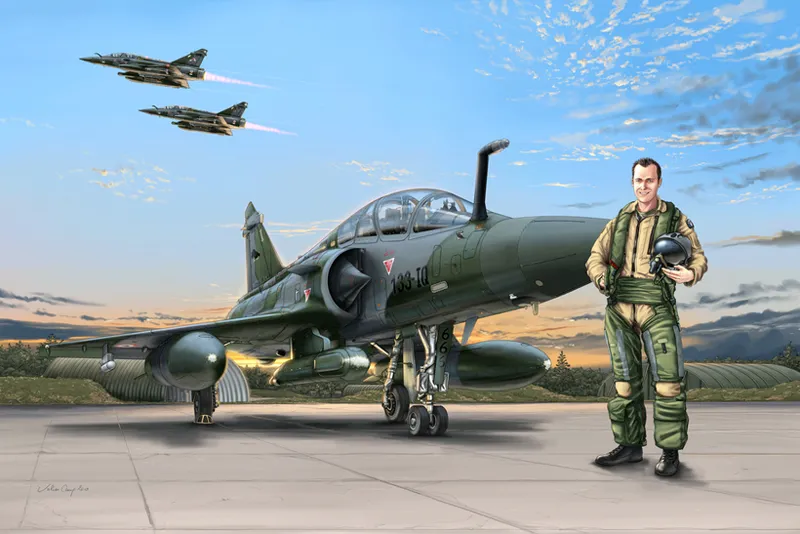
Artistic Depictions: The visually striking appearance of the Mirage 2000D, combined with the inherent mystique of "El Diablo," has rendered it a compelling subject for aviation artists. Posters, prints, and paintings featuring the aircraft, often prominently displaying its tail number, can be found in many instance.
The Mirage 2000D "666" in a custom artwork by Julien Camp.
Gaming: "El Diablo" also enjoys a presence within the digital sphere. It is in particular is featured as a selectable "skin" in War Thunder.
The Mirage 2000D "666" as featured in War Thunder.
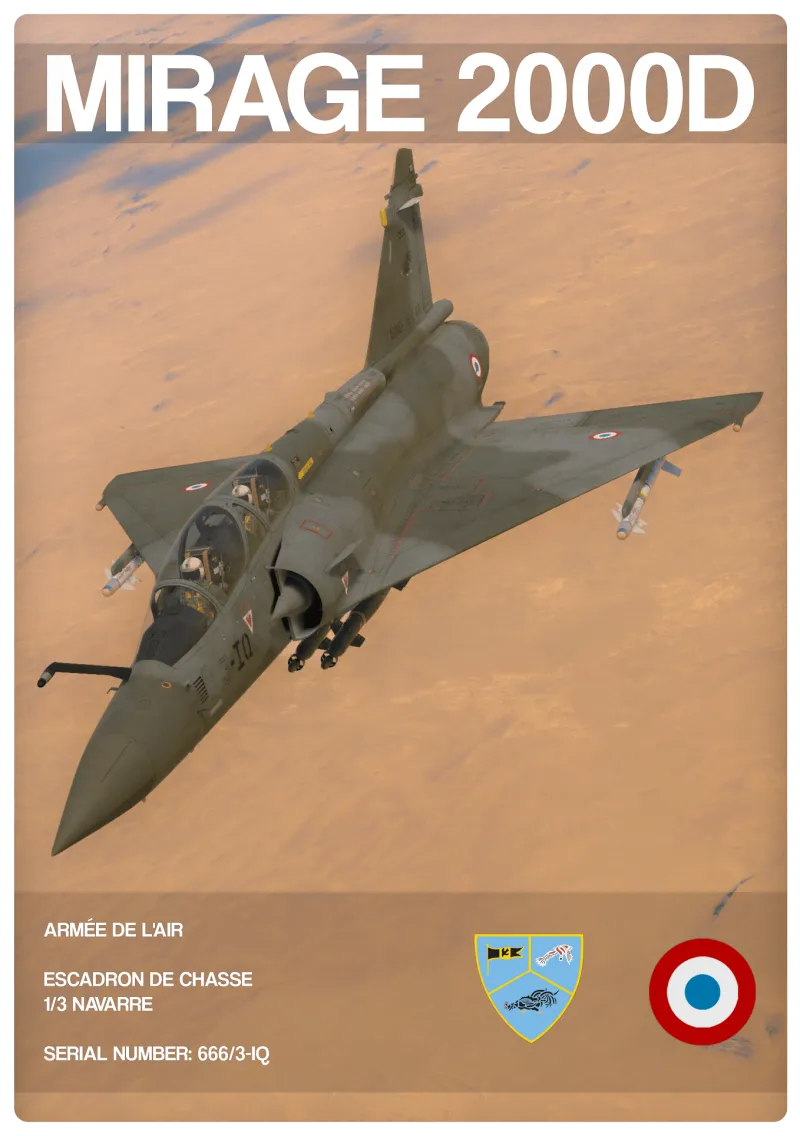
Also, we can not that even if at this stage no Mirage 2000D has been developed for DCS World, there's a very nice mod for the Mirage lovers: Split-Air DCS Team has released a beautiful Rafale and Mirage 2000N/D mod using the original Mirage 2000C mod.
Split-Air's Mirage 2000D mod in DCS World.
Even if we are far from a high fidelity module, it's still a very nice addition that must be encouraged. In the mean time, we can still hope and wait for a more serious module, "in the future", by Razbam or in a Falcon 5 version...
As you've understood it I'm sure, this "El Diablo" topic was just a nice opportunity to tell you more about the Mirage 2000D, a really unique and incredible aircraft! Don't hesitate to try (and buy) the Mirage 2000C, which is a really close cousin of the D variant that offers the very same amazing flight characteristics.