


Sagittal plane latissimus dorsi exercises
The best sagittal plane exercises for the latissimus dorsi are contentious. Nevertheless, we have data regarding internal moment arm lengths as well for muscle activation in this plane, which can enable us to reach a definitive answer.
.
#1. Internal moment arms
The latissimus dorsi regions have good leverage for shoulder extension in the sagittal plane as well as for shoulder adduction in the frontal plane. Yet, we need to note that in the sagittal plane, there is minimal leverage above 120 degrees of shoulder elevation. Therefore, any exercise that involves peak forces in the stretched position will not activate this muscle. Instead, it is likely that the pectoralis major costal region will be activated instead.
.
Indeed, we can see that the pectoralis major inferior region (costal region) has reasonably good leverage for overhead pulling motions in the sagittal plane. At least, it has twice as good leverage as the best region of the latissimus dorsi for the same movement in the same range of motion.
.
#2. Muscle activation
EMG studies confirm exactly what the internal moment arm data says about the behavior of the latissimus dorsi and of the pectoralis major (costal head). As the arms are elevated in the sagittal plane, latissimus dorsi muscle activation decreases and pectoralis major costal head muscle activation simultaneously increases.
.
Since the lying straight-arm pull-over exercise involves peak forces in the stretched position, it does not involve very much latissimus dorsi muscle activation. Instead, it involves much more pectoralis major muscle activation and triceps brachii (long head) muscle activation.
.
We can see the effects of range of motion on latissimus dorsi muscle activation even more clearly by comparing the lying straight-arm pull-over (which involves peak forces in a stretched position) with the standing straight-arm pull-over (which involves peak forces in a mid-range position). The lying variation involves less latissimus dorsi muscle activation and more pectoralis major muscle activation, exactly as we would predict based on the internal moment arm lengths.
.
#3. Stretch-mediated hypertrophy
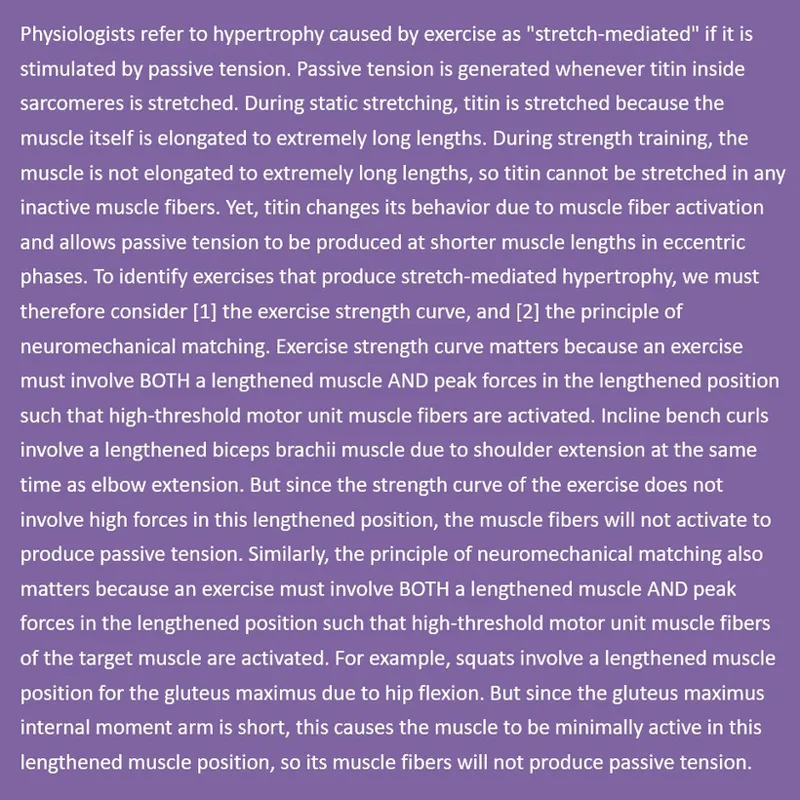
Importantly, during a strength training exercise, we can only apply passive mechanical tension to an activated muscle. Simply elongating a muscle does not apply passive mechanical tension to it unless the stretch is taken to maximum tolerable muscle length (as occurs during a static stretch). Therefore, sagittal plane exercises with stretched positions such as lying straight-arm pull-overs CANNOT produce hypertrophy in the latissimus dorsi either by way of active mechanical tension or by passive mechanical tension (read more).
.
Conclusions
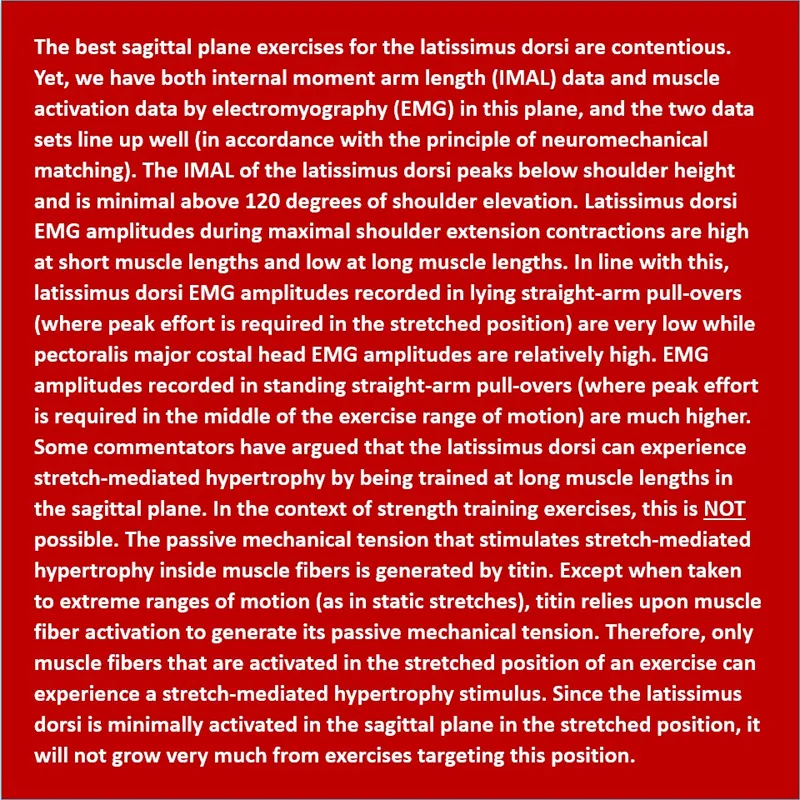
The best sagittal plane exercises for the latissimus dorsi are contentious. Yet, we have both internal moment arm length (IMAL) data and muscle activation data by electromyography (EMG) in this plane, and the two data sets line up well (in accordance with the principle of neuromechanical matching). The IMAL of the latissimus dorsi peaks below shoulder height and is minimal above 120 degrees of shoulder elevation. Latissimus dorsi EMG amplitudes during maximal shoulder extension contractions are high at short muscle lengths and low at long muscle lengths. In line with this, latissimus dorsi EMG amplitudes recorded in lying straight-arm pull-overs (where peak effort is required in the stretched position) are very low while pectoralis major costal head EMG amplitudes are relatively high. EMG amplitudes recorded in standing straight-arm pull-overs (where peak effort is required in the middle of the exercise range of motion) are much higher. Some commentators have argued that the latissimus dorsi can experience stretch-mediated hypertrophy by being trained at long muscle lengths in the sagittal plane. In the context of strength training exercises, this is NOT possible. The passive mechanical tension that stimulates stretch-mediated hypertrophy inside muscle fibers is generated by titin. Except when taken to extreme ranges of motion (as in static stretches), titin relies upon muscle fiber activation to generate its passive mechanical tension. Therefore, only muscle fibers that are activated in the stretched position of an exercise can experience a stretch-mediated hypertrophy stimulus. Since the latissimus dorsi is minimally activated in the sagittal plane in the stretched position, it will not grow very much from exercises targeting this position.

Comments (3)
1.what % of 1 RM starts to recruit the lower tier and medium tier of high threshold motor units? And when it is said that the last 10% of the motor units control half the muscle fibers in the muscle is that referring to just the highest HTMU or all tiers of HTMU collectively? 2. When the region of the muscle has the lowest IMAL for the action, will it just be sufficient to recruit the lower tier high threshold motor units only? Like in a row, the thoracic region will recruit all its motor unit but the lumbopelvic will recruit just the lower tier HTMU or also the medium tier HTMU?
Really enjoy reading these every Monday morning. Thank you!
Dear Paul, if u hear me: they say u gonna fund this transverse plain IMAL study for shoulders. I promise calling u The Professor Paul, if they check not just pecs for horizontal flexion, but lats for horizontal extension, as well. All three regions, please! Btw. I've tried db pullover (very shitty exercise, really). My triceps were as sore as f*ck. Definitely felt swelling in my chest. Nothing in the lats, really.