



Passive tension needs muscle activation
Stretch-mediated hypertrophy during strength training is widely misunderstood because the terminology is slightly misleading. Exercise physiologists refer to the muscle hypertrophy as "stretch-mediated" because it results from passive mechanical tension that is generated when titin molecules inside individual sarcomeres are stretched. And while such sarcomeres can be stretched when the muscle itself is stretched to extremely long lengths (as occur during static stretching), they are not typically stretched in this way during strength training.
.
#1. How is passive tension produced during a static stretch?
Static stretching involves elongating the muscle to very long lengths. This causes all of the muscle fibers to be elongated to very long lengths and consequently the sarcomeres of all of the muscle fibers will be elongated to very long lengths and passive mechanical tension will be produced, leading to sarcomerogenesis in all of the muscle fibers. The very long muscle length is necessary to produce those effects because of the way in which titin works. For most of the joint angle range of motion, the sarcomeres simply do not produce passive tension because it is the compliant parts of titin (the Ig domains) that are elongating. Only at very long muscle lengths are the sarcomeres stretched to sufficiently long lengths for the stiff sections of titin (the PEVK segments) to be stretched and produce passive tension.
.
#2. How is passive tension produced during a strength training exercise?
Strength training with a full range of motion typically never involves elongating the muscle to very long lengths. We talk about "stretched positions" but these joint angles do not actually involve stretching the muscle anywhere near as much as during static stretches. In fact, the passive mechanical tension is not being produced in the same way during strength training. Activated muscle fibers experience passive mechanical tension at relatively short muscle fiber lengths and relatively short sarcomere lengths because the compliant parts of titin (the Ig domains) are locked down by the activation process and the stiff sections of titin (the PEVK segments) can be stretched during the eccentric contraction to produce passive tension.
.
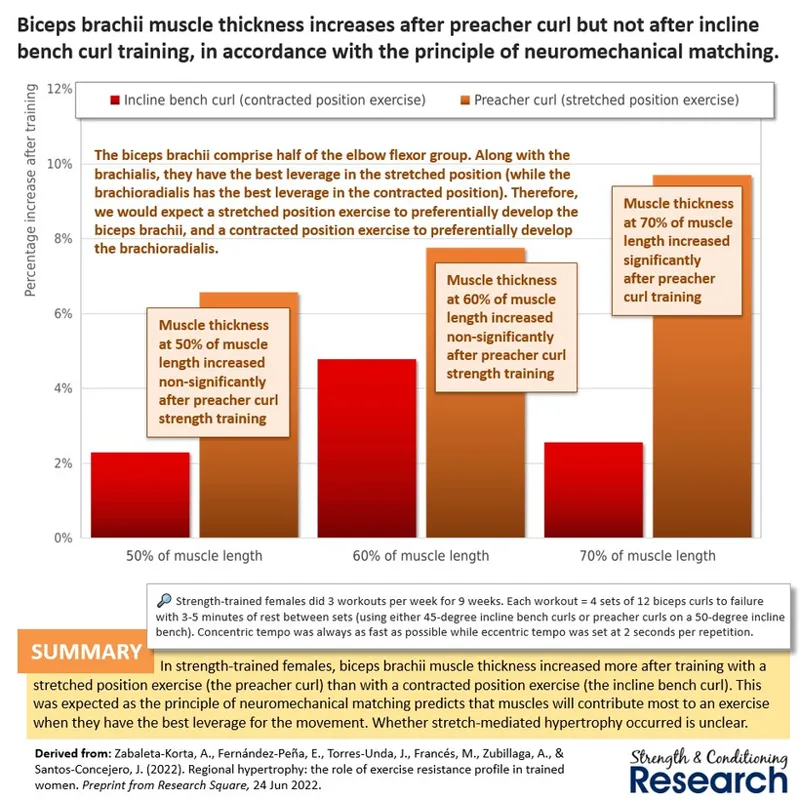
In practice, this means that strength curves are critical for determining whether a muscle experiences passive tension in a strength training exercise and therefore whether that exercise can be classified as a "long muscle length exercise." Whether a muscle is perceived to be stretched is not as relevant. For example, when we look at incline bench curls, the shoulder is extended at the bottom of the movement when the elbow is extended and this leads to the biceps brachii being more stretched. Yet, the strength curve of the exercise is such that the required joint torque is very low at this bottom position, so few muscle fibers are activated in this position. Since muscle activation is needed for passive tension to be generated in strength training exercises, the incline bench curl is not a "long muscle length exercise."
.
The principle of neuromechanical matching is also key for understanding if passive tension is being generated to produce sarcomerogenesis, even when the strength curve leads to peak force production at the start of the concentric phase. For example, it is often stated that the gluteus maximus experiences a lot of passive tension during squats because the muscle is stretched in that exercise. Strictly, the lengthening of the gluteus maximus during the squat is not really sufficient for us to describe it as stretched (as is the case for most muscles in most strength training exercises). For passive tension to be experienced, the muscle needs to be activated and whether this happens will be determined by the principle of neuromechanical matching. And since the adductor magnus has the best leverage for hip extension at the bottom of the squat exercise when the hip is flexed, the gluteus maximus is not very activated in this position. Thus, we should probably refer to the squat as a "long muscle length exercise" only for the adductor magnus and not for the gluteus maximus.
.
Conclusions
Physiologists refer to hypertrophy caused by exercise as "stretch-mediated" if it is stimulated by passive tension. Passive tension is generated whenever titin inside sarcomeres is stretched sufficiently. During static stretching, titin is stretched enough as the muscle itself is elongated to extremely long lengths. During strength training, the muscle is not elongated to extremely long lengths, so titin is not stretched sufficiently in any inactive muscle fibers. Yet, titin changes its behavior due to muscle fiber activation and allows passive tension to be produced at shorter muscle lengths in eccentric phases. To identify exercises that produce stretch-mediated hypertrophy, we must therefore consider [1] the exercise strength curve, and [2] the principle of neuromechanical matching. Exercise strength curve matters because an exercise must involve BOTH a lengthened muscle AND peak forces in the lengthened position such that high-threshold motor unit muscle fibers are activated. Incline bench curls involve a lengthened biceps brachii muscle due to shoulder extension at the same time as elbow extension. But since the strength curve of the exercise does not involve high forces in this lengthened position, the muscle fibers will not activate to produce passive tension. Similarly, the principle of neuromechanical matching also matters because an exercise must involve BOTH a lengthened muscle AND leverage in the lengthened position such that high-threshold motor unit muscle fibers of the target muscle are activated. For example, squats involve a lengthened muscle position for the gluteus maximus due to hip flexion. But since the gluteus maximus internal moment arm is short, this causes the muscle to be minimally active in this lengthened muscle position, so its muscle fibers will not produce passive tension.
Comments (7)
Hi Chris, do you agree with Paul that muscle damage can peak as late as 5-6 days after a workout, and if so, how do you keep that from getting in the way of your process while on full body or upper lower splits?
Hi Chris, thanks for the article. You stated that both the external moment arm and the internal leverage need to be high in the lengthened position in order to activate the high threshold motor units. It is my understanding that only the low threshold units, or at least slow twitch fibres, are activated during eccentric contractions, so are the high threshold motor units which you are referring to not the highest threshold ones, and consist of a lot of slow twitch fibres? And would they consist of relatively more, or stiffer titin than the low threshold units, or would they just respond better to eccentric loading because they aren't exposed to this stimulus during daily activities?
High-threshold motor units consisting of slow twitch muscle fibers, yes
Would love a list of exercises that check tick all these boxes! Thanks!
I agree
Hi chris, from this perspective we would expect gluteus maximum to not benefit from stretch mediated hyperthophy but in some studies the gluteus maximum grew better at full squat rathan the half squat, what do you think about this?
I imagine it’s because the full rep still involves 100% of the half squat therefore a full squat will get 100% of the hypertrophic benefit that as a half squat has, as well as any extra hypertrophic benefit from the other half of the squat that the half squat doesn’t perform