



Training frequency for hypertrophy
The optimal training frequency for hypertrophy is a very difficult topic because the data is fraught with apparent contradictions. Yet, if we look carefully at the various problems, we can see what is actually happening and ultimately draw some very useful conclusions.
.
#1. Evidence indicates that training frequency does not matter at the group level, if weekly volume (number of sets to failure) is equated
Currently, the exercise science literature shows that training frequency does not matter for hypertrophy, at least when we measure the effect at the group level (albeit there is definitely a trend for higher frequencies to produce superior hypertrophy).
.
#2. Yet, the optimal training frequency for each individual is very variable
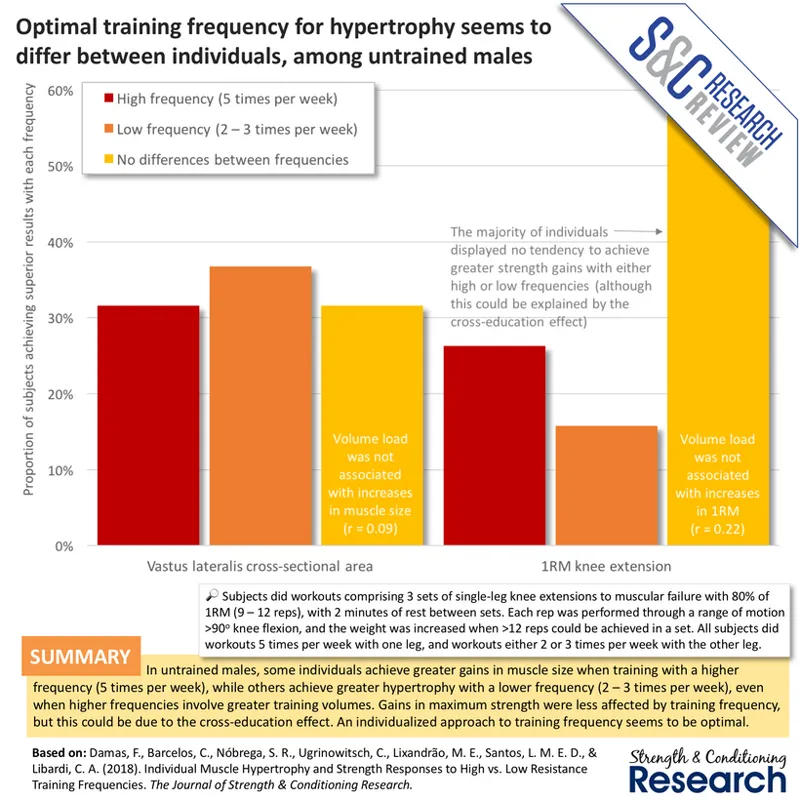
When training frequency is assessed on an individual level, it is clear that some lifters experience more hypertrophy when using a high muscle training frequency and other lifters get better results with a low training frequency. This suggests that when studies report results at the group level, they are disguising large advantages and disadvantages to individual lifters that are likely meaningful.
.
#3. Training frequency studies are incompatible with training volume studies
When meta-analyses of training volume studies are performed, they have shown that the first set of a workout produces much more hypertrophy than the later sets of the same workout. Specifically, the first set of each workout causes the same amount of muscle growth as the next five sets. This means that performing three sets per week in three separate workouts must necessarily cause much more hypertrophy than performing all three sets in the same workout, even ignoring the benefits associated with shorter atrophy periods between workouts. This suggests that something is happening in the training frequency literature that is stopping a higher training frequency from having a beneficial effect.
.
#4. Myofibrillar protein synthesis rate elevation durations occur both for hypertrophy and also for muscle damage repair
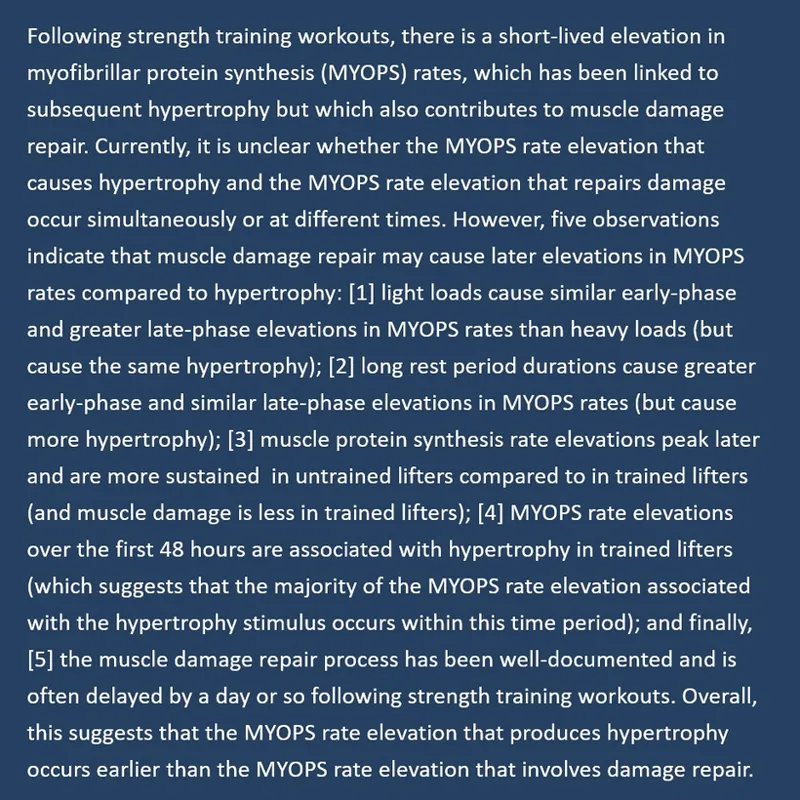
Historically, attempts to identify the optimal training frequency have focused on the exact duration of the post-workout myofibrillar protein synthesis (MYOPS) rate elevation. It has been proposed that performing workouts immediately after the MYOPS rate returns to baseline is an optimal strategy since otherwise the muscle fibers would leave the anabolic state, go into a catabolic state and thereby lose some of the gains achieved in the last workout. Indeed, this is inescapable logic. However, it seems likely that even when MYOPS rates are elevated for 48-72 hours, only the first day is related to hypertrophy. Later days are likely associated with muscle damage repair. This suggests that when muscle damage is minimised, the optimal training frequency for hypertrophy could even be daily (read more).
.
#5. Training frequency is likely limited by post-workout inflammation
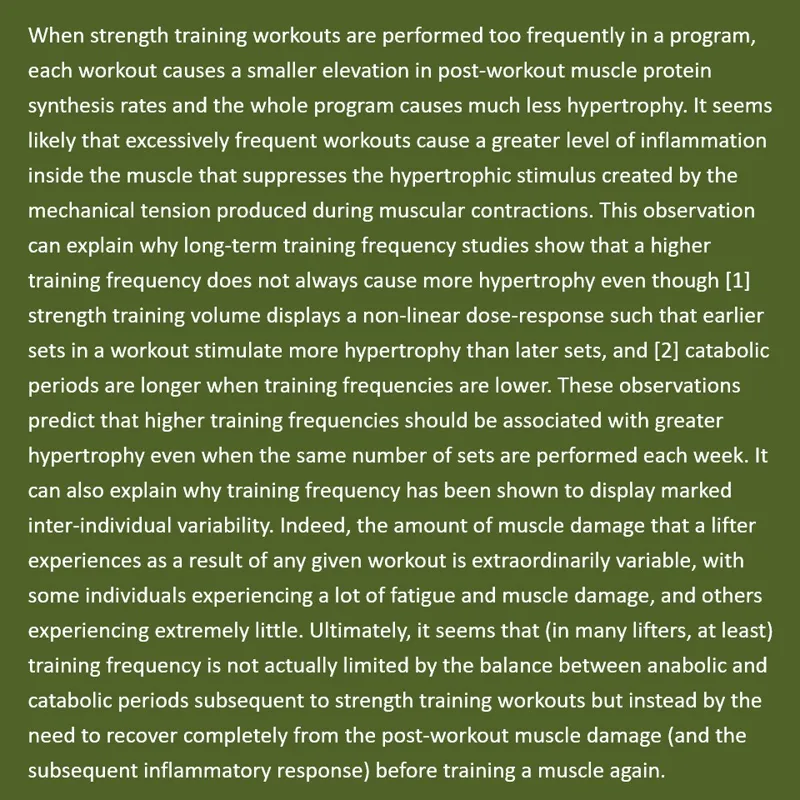
At this point, we have a difficult problem to solve. On the one hand, the long-term trials of training frequency indicate that hypertrophy is the same regardless of the number of workouts per week, so long as total training volume is equated. Yet, on the other hand, we have data showing that [1] the optimal training frequency can be very variable between individuals such that some lifters benefit from very high frequencies, [2] not all sets stimulate exactly the same hypertrophy, and the first set of each workout is worth more than all other sets, [3] post-workout MYOPS rate elevations that cause hypertrophy are probably quite short in duration. Yet, the reason why some lifters experience less hypertrophy with higher frequencies can be found in the post-workout muscle damage repair/inflammatory process. Indeed, when sequential workouts are performed while this inflammatory process is still underway, muscle growth cannot be stimulated (read more).
.
Conclusions
Training frequency is a difficult problem to solve. On the one hand, long-term trials indicate that hypertrophy is the same (at the group level) regardless of the number of workouts per week, so long as total training volume is equated. On the other hand: [1] some lifters benefit more from high frequencies while other lifters benefit more from low frequencies (this indicates that higher frequencies at least have the potential to be superior); [2] not all sets in a workout stimulate exactly the same hypertrophy, and the first set of each workout causes as much muscle growth as all of the next five sets put together (this predicts that higher training frequencies should always be superior); and [3] post-workout myofibrillar protein synthesis (MYOPS) rate elevations that relate to hypertrophy (rather than muscle damage repair) are likely very short in duration (which again predicts that higher training frequencies should be superior). How can we reconcile these data points? Well, research has shown that when workouts are done too soon after one another, the post-workout inflammatory process from the last workout inhibits the ability of the anabolic signaling process (which is stimulated by mechanical tension) to cause another elevation in MYOPS rates. In other words, higher training frequencies likely do have the potential to be superior but the presence of muscle damage and inflammation can prevent this potential from being realized. In practice, we can say that those lifters who are more prone to muscle damage after a workout are likely to benefit more from lower training frequencies, while those who are less prone to muscle damage will likely benefit from higher frequencies.

Comments (12)
Thank you for clearing that up for me.
"Specifically, the first set of each workout causes the same amount of muscle growth as the next five sets." - can someone please explain the corresponding info-graphic to me? The way I read it, set 2 produces almost the same amount of hypertrophy as set 1?
The graphic shows sets per week instead of sets per workout, so you have to divide everything by three to get the workout numbers
Hi Chris (posted previously under the wrong article, sorry, new to patreon) - question: are there any studies pointing to 'easy gainers' being more prone to muscle damage than 'hardgainers'? In my observation (and the observation of others such as Caset Butt, for example), easy gainers can benefit from lower frequency, while hardgainers need more frequency to see progress. Would this be a possible explanation for why frequency recommendations are so variable?
Several people (including myself) have hypothesized that a large part of the reason why we have inter-individual differences in the optimal training frequency is the amount of muscle damage that an individual experiences. Indeed, we have plenty of data showing that the amount of muscle damage that a person experiences after a workout is extremely variable. However, we do not yet have evidence connecting that variability in muscle damage susceptibility with the variability in training frequency, which suggests that the variability may be multi-factorial.
Chris do you agree with Paul that the isometric bracing that happens on other days is enough to forestall atrophy if you wait 4-7 days to train a muscle directly again?
Any muscular contraction for the muscle in question (whether isometric or dynamic) is sufficient to forestall atrophy, so long as the intensity is high enough. IMO, we should assess that on a case-by-case basis rather than providing a blanket recommendation, however.
I really struggle to reconcile all the things you say with how Paul Carter tends to program for the masses he trains. My takeaway for now is that It seems like for the FASTEST progress possible, higher frequencies are bette if you can manage it, BUT it seems really tough to have higher frequency programming dialed in without messing up recovery. So the most fool-proof way is to wait at least 3-5 days. Gains won't come as fast as possible but you'll get there and will more easily avoid recovery issues.
I think Paul is simply trading the slight downside of going to failure and doing slightly more sets (I count 3-4 sets per muscle group in a workout, spread over 2-3 exercises) with reducing training frequency, but many muscle groups are hit either directly or indirectly 2x/week on his programs. Like you said, perhaps the added recovery makes it worth it, atrophy from the lack of stimulus isn’t instant - it’s a slow decay (slower than the total amount of growth processed within 24-48hrs from a single workout).
Your 4-step strategy is basically exactly where I start, yes. Generally, beginners can make good progress on steps 1-3 and I tend to progress up to 3 sets per muscle group per workout for intermediates and even some advanced people. For advanced, I tend to reduce the rep ranges down to 4-6 reps/set to help minimise muscle damage.
I thought we would both be heading towards that conclusion, yes 😊 It’s what has been working well in my training groups for almost a year now, and those who it didn’t work well for ramped up their volume too fast (FOMO creep, as I call it), trained to failure too much (even 1 set can be too much for many at 3x/week), or had other lifestyle/nutrition limitations. I’ve gone through the same process myself, had amazing gains at 1-2 sets 3x/week (3 tended to be too much), then 2-4 sets on an alternating upper-lower split, and now a «bro-split» with 4-6 sets - but with some indirect work (eg close-grip bench on the arm day) - yielding gains still, but less than the higher frequencies. Confounded by dieting, but still very apparent. But there are some who do get better gains from it, and to me it seems as if it’s because they’re training to failure all the time and/or doing a lot of volume.
This is exactly the thought process I had after your seminar in Oslo and our discussions. The point you made about stimulus being one part of the equation, recovery of muscle damage being the other really hit home. So even if the stimulus is slightly less from 1. lower volumes 2. more RIR 3. reducing/avoiding stretch/longer-length ...there is still a stimulus, and the potential benefits from reducing (perhaps to a greater degree) the muscle damage is that we can sustain a higher training frequency. So - what if we assume that stimulus/growth processing will ALWAYS be short-lived, hence a higher frequency should be the default. By extension, we implement a strategy where we 1. start off with every-other-day or 3x/week fullbody (or even daily if doing an upper/lower or push/pull split...? but that might be difficult to recover from also)... 2. start off with 1 set with 2RIR and midrange-biased movements to minimise muscle damage? Then... 3. evaluate the progression, and... 4. gradually (after 3-4 weeks) add sets to 1-2 muscle groups at a time to see if that works better. This obviously makes it difficult to implement a Hepburn-type progression model, and perhaps my suggestion is overly conservative? 🤷🏻 Edit: The alternative hypothesis that comes to mind is that someone fast-twitch dominant, or the very advanced lifter, or for some other reason - might generate muscle damage regardless of stimulus, i.e. whatever triggers any stimulus, no matter how small, it also triggers muscle damage and inflammation. In this case, there is no other option than to lower frequency to ensure that damage is fully repaired between workouts. But then the conundrum is that this individual also needs a more potent stimulus to carry those gains over to the next stimulus, and to maximise the stimulus:fatigue ratio the above measures (1 set, 2RIR, midrange movements) as well as more exercises in a for that muscle group in a single workout (and also single-joint+limb, high stability movements for maximum recruitment). So ultimately, 1 set of 2-4 exercises in a workout, every 4-7 days (explains why the bro-split and Dorian Yates program works so well for some individuals such as Paul Carter).?...