



Training too frequently
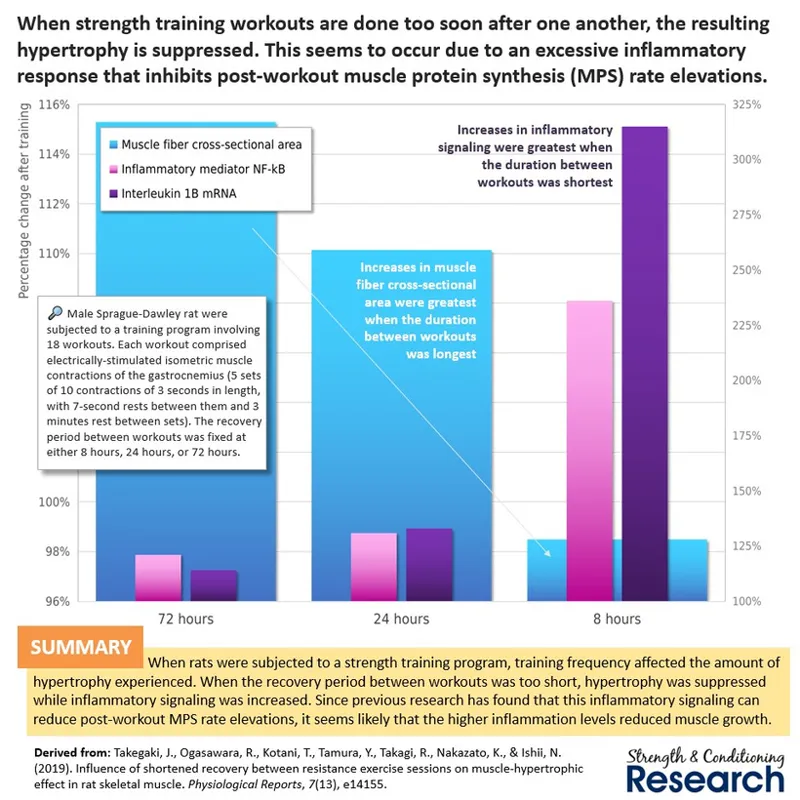
It is often assumed that there are no downsides to training more frequently other than perhaps a slightly inefficient use of time and energy. Nevertheless, some recent research indicates that an excessively high training frequency may cause less hypertrophy when it causes a pronounced inflammatory response that then interferes with the post-workout muscle protein synthesis rate elevations.
.
#1. Workouts that are done too soon after previous workouts involve a suppressed post-workout muscle protein synthesis response
When strength training workouts are performed too soon after one another, the second workout produces a suppressed muscle protein synthesis response. Importantly, this occurs even though there is a strong response in the common anabolic signaling pathways, which indicates that there is a suppressive effect of some other factor despite mechanical tension creating a hypertrophic stimulus.
.
#2. Excessive frequency reduces hypertrophy due to inflammation
When strength training workouts are performed too frequently within a program, the program produces much less hypertrophy. It seems likely that the greater inflammation that is generated during higher frequency workout programs suppresses post-workout muscle protein synthesis rate elevations, leading to a reduction in the amount of muscle growth caused by the training program.
.
#3. Solving the training frequency vs. training volume problem
Currently, there is a conflict between the training frequency and training volume literature insofar as the training volume literature indicates a dose-response that is non-linear (read more). This conflict suggests that high frequency training should be better for hypertrophy in most cases. Yet, if excessive post-workout inflammation suppresses the hypertrophy stimulus in higher frequency training, this would be able to explain this curious discrepancy between frequency and volume.
.
#4. Explaining why training frequency is highly individual
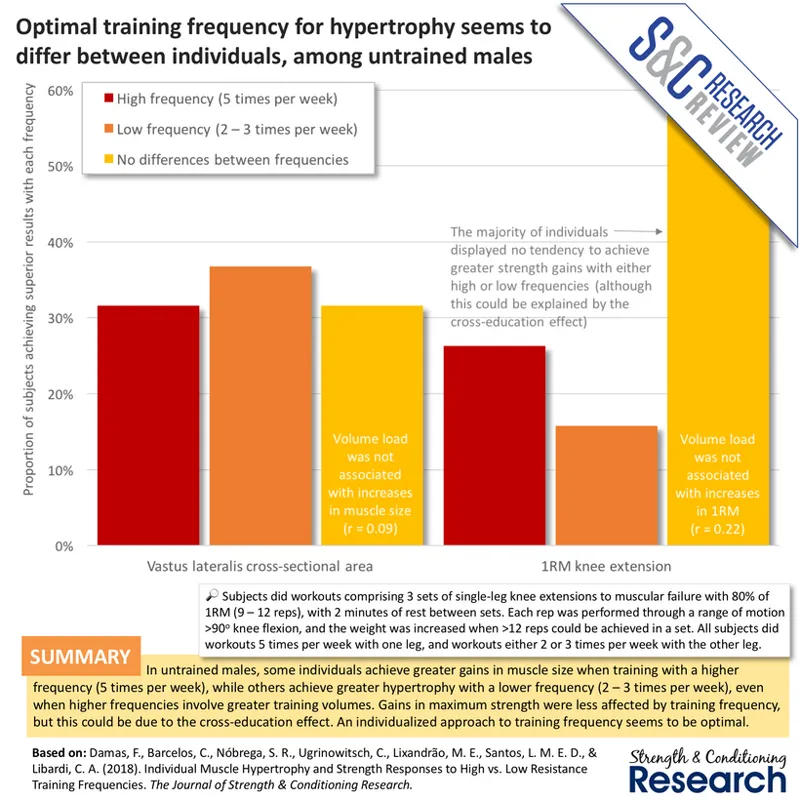
The benefits of high frequency training combined with the interference effects of fatigue may be able to explain why training frequency is highly individual, such that some lifters benefit more from higher frequencies (5 times/week) while other lifters benefit more from training with much lower frequencies (2-3 times/week).
.
Indeed, the amount of muscle damage that a lifter experiences after a strength training workout is extraordinarily variable, with some individuals displaying no muscle damage even after very intense workouts, and others experiencing a lot.
.
Conclusions
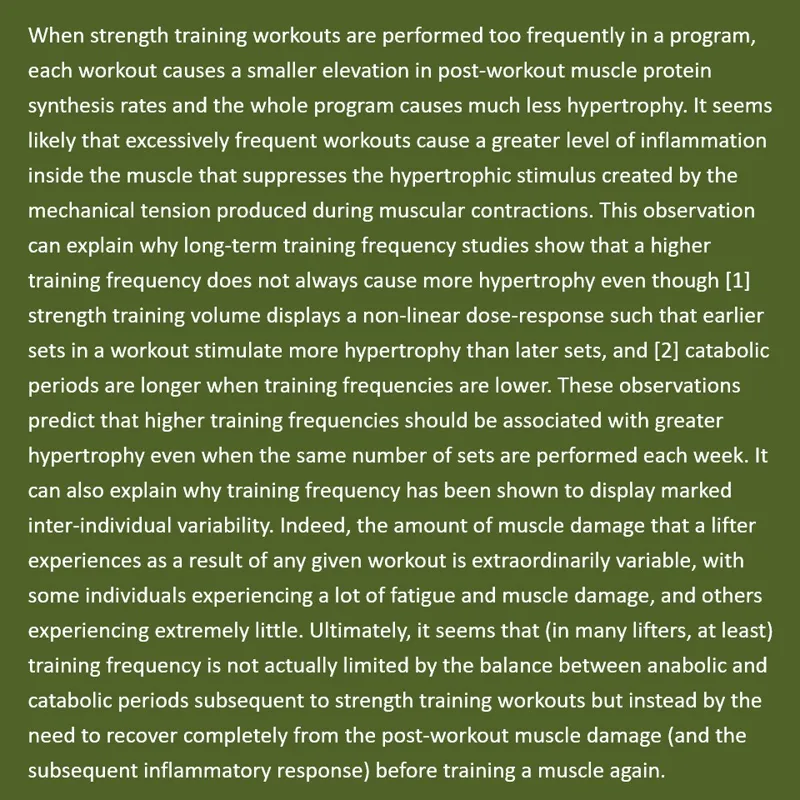
When strength training workouts are performed too frequently in a program, each workout causes a smaller elevation in post-workout muscle protein synthesis rates and the whole program causes much less hypertrophy. It seems likely that excessively frequent workouts cause a greater level of inflammation inside the muscle that suppresses the hypertrophic stimulus created by the mechanical tension produced during muscular contractions. This observation can explain why long-term training frequency studies show that a higher training frequency does not always cause more hypertrophy even though [1] strength training volume displays a non-linear dose-response such that earlier sets in a workout stimulate more hypertrophy than later sets, and [2] catabolic periods are longer when training frequencies are lower. These observations predict that higher training frequencies should be associated with greater hypertrophy even when the same number of sets are performed each week. It can also explain why training frequency has been shown to display marked inter-individual variability. Indeed, the amount of muscle damage that a lifter experiences as a result of any given workout is extraordinarily variable, with some individuals experiencing a lot of fatigue and muscle damage, and others experiencing extremely little. Ultimately, it seems that (in many lifters, at least) training frequency is not actually limited by the balance between anabolic and catabolic periods subsequent to strength training workouts but instead by the need to recover completely from the post-workout muscle damage (and the subsequent inflammatory response) before training a muscle again.

Comments (2)
Isn't theoretically higher frequency always better, despite the individual differences? Because if someone experiences more muscle damage, than it's a matter of training variables (volume;rep range;rir;resistance profile) which should be changed, rather than frequency, because if atrophy appears very quickly (in approximately less than 48 hours for sure, but possibly even in less than 36 hours) than it's better to keep it high cause of that.
"Ultimately, it seems that (in many lifters, at least) training frequency is not actually limited by the balance between anabolic and catabolic periods subsequent to strength training workouts but instead by the need to recover completely from the post-workout muscle damage (and the subsequent inflammatory response) before training a muscle again." Recovery also includes muscle glycogen storage. You taught me that, btw!