





Hypoxia
Some researchers and fitness industry commentators have proposed that hypoxia could be a stimulus for hypertrophy and that this justifies talking about metabolic stress as a secondary mechanism for muscle growth. But is this true?
.
#1. Systemic hypoxia does not cause hypertrophy
In general, the research has shown that systemic hypoxia (breathing in a low oxygen environment) has no material effects on hypertrophy. Recent meta-analyses of the long-term training studies have reported no obvious effects.
.
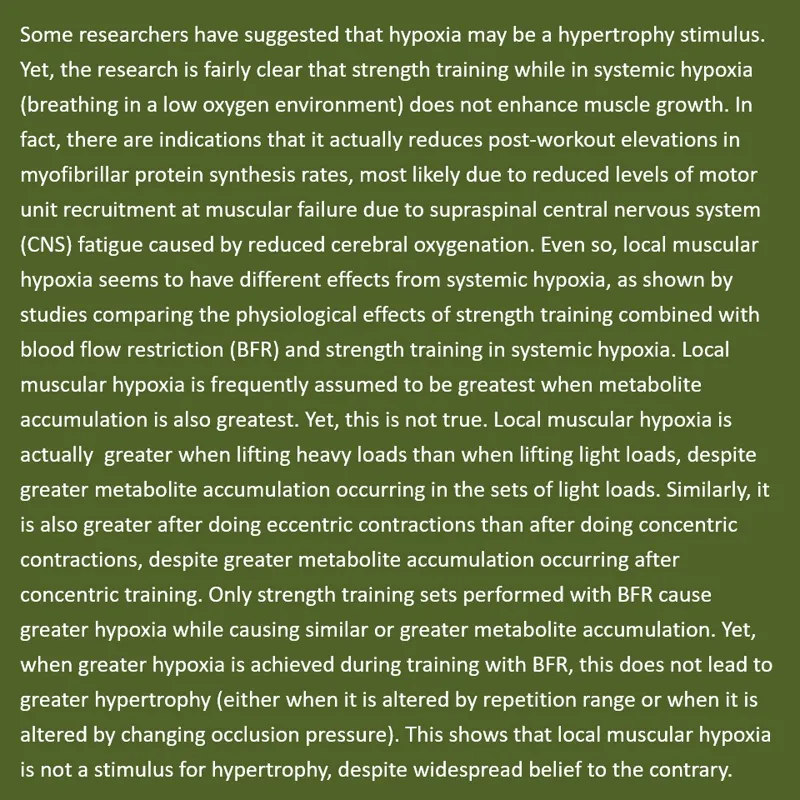
Yet, there are indications from acute studies of post-workout myofibrillar protein synthesis rate elevations that exercising in systemic hypoxia could actually reduce the amount of hypertrophy that is stimulated by a workout.
.
This makes sense because systemic hypoxia reduces the motor unit recruitment levels that correspond to maximal levels of effort. This supraspinal central nervous system (CNS) fatigue seems to occur due to reduced cerebral oxygenation.
.
Nevertheless, the same reduction in voluntary activation due to supraspinal CNS fatigue does not seem to occur after exercise that increases the local muscular hypoxia, such as blood flow restriction training. Therefore, we probably do need to consider local muscular hypoxia separately from systemic hypoxia.
.
#2. Muscular hypoxia does not occur in tandem with metabolite accumulation
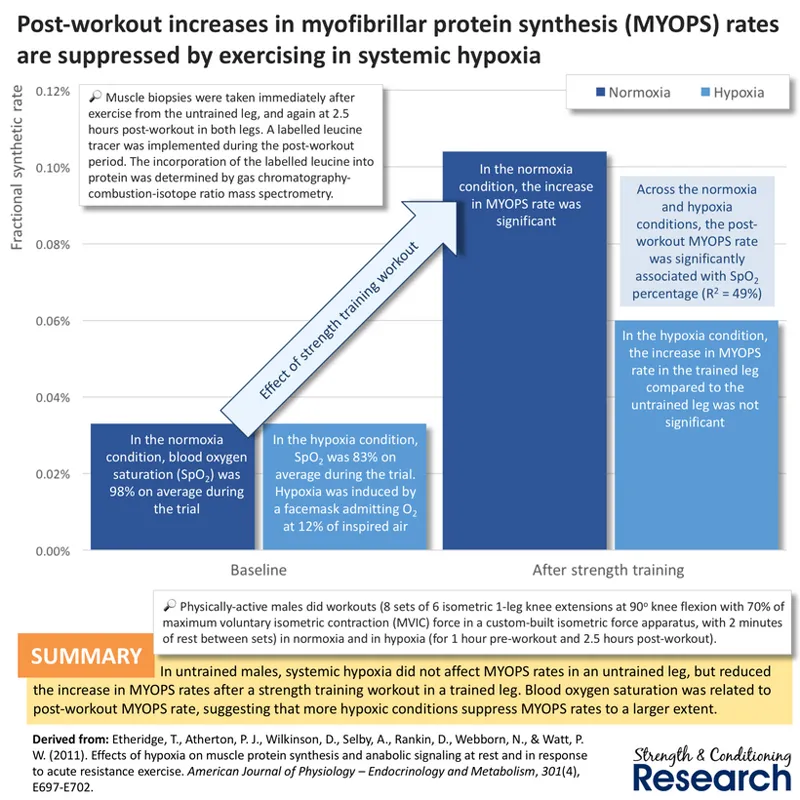
Often, it is assumed that hypoxia is always greater when metabolite accumulation is greater. Yet, this is not the case. For example, heavy load strength training causes greater hypoxia than light load strength training to failure despite causing less metabolite accumulation. Hence, hypoxia cannot be equated with metabolic stress and similarly cannot be a reason why light load strength training to failure causes the same hypertrophy as heavy load strength training.
.
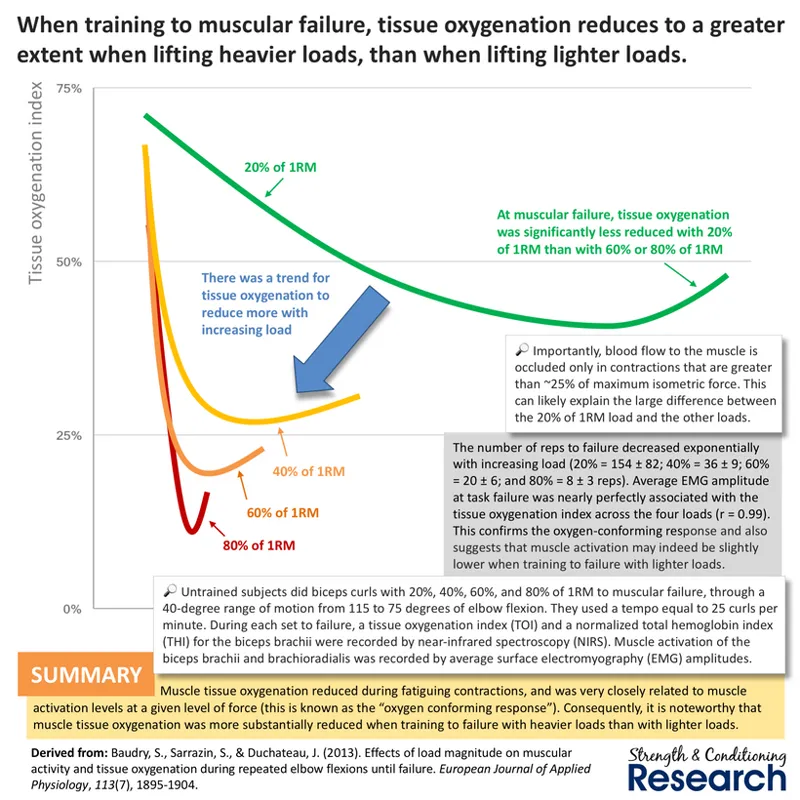
Similarly, we know that eccentric-only strength training causes greater hypoxia at muscular failure compared to concentric-only strength training despite causing less metabolite accumulation. Thus, again hypoxia cannot be a mechanism of metabolic stress, and it also cannot be a reason why concentric training causes the same hypertrophy as eccentric training.
.
Finally, when different duration isometric contractions are used to produce fatigue, the amount of hypoxia that occurs is the same at the end of the task although the rate of metabolite accumulation and the rate of fatigue development are very different. Again, this shows that hypoxia cannot be used as a metabolic stress mechanism because it is not actually directly linked to metabolites.
.
#3. Blood flow restriction (BFR) does increase muscular hypoxia
Although light load strength training to failure does not cause greater hypoxia than heavy load strength training, the use of BFR during strength training does cause more hypoxia. Nevertheless, the addition of BFR fails to enhance muscle growth during strength training to failure (or close to failure) despite causing this greater amount of hypoxia. This demonstrates quite clearly that hypoxia is not a stimulus for hypertrophy.
.
Interestingly, the same observations can be made when altering the level of hypoxia during BFR training solely by altering limb occlusion pressures.
.
Conclusions
Some researchers have suggested that hypoxia may be a hypertrophy stimulus. Yet, the research is fairly clear that strength training while in systemic hypoxia (breathing in a low oxygen environment) does not enhance muscle growth. In fact, there are indications that it actually reduces post-workout elevations in myofibrillar protein synthesis rates, most likely due to reduced levels of motor unit recruitment at muscular failure due to supraspinal central nervous system (CNS) fatigue caused by reduced cerebral oxygenation. Even so, local muscular hypoxia seems to have different effects from systemic hypoxia, as shown by studies comparing the physiological effects of strength training combined with blood flow restriction (BFR) and strength training in systemic hypoxia. Local muscular hypoxia is frequently assumed to be greatest when metabolite accumulation is also greatest. Yet, this is not true. Local muscular hypoxia is actually greater when lifting heavy loads than when lifting light loads, despite greater metabolite accumulation occurring in the sets of light loads. Similarly, it is also greater after doing eccentric contractions than after doing concentric contractions, despite greater metabolite accumulation occurring after concentric training. Only strength training sets performed with BFR cause greater hypoxia while causing similar or greater metabolite accumulation. Yet, when greater hypoxia is achieved during training with BFR, this does not lead to greater hypertrophy (either when it is altered by repetition range or when it is altered by changing occlusion pressure). This shows that local muscular hypoxia is not a stimulus for hypertrophy, despite widespread belief to the contrary.