



Fast twitch fibers and recovery
When a lifter possesses a greater proportion of fast twitch muscle fibers, they experience a longer period of post-workout fatigue after a given strength training workout. Why does this happen?
.
#1. Fast twitch muscle fibers experience longer post-workout fatigue
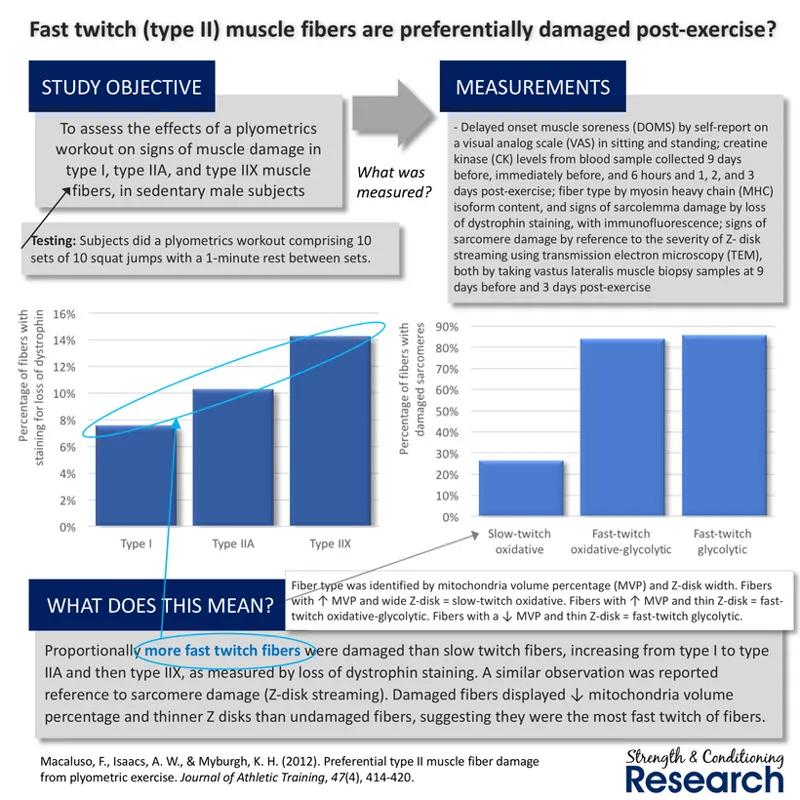
Researchers have known for a long time that fast twitch muscle fibers experience a longer period of sustained fatigue after exercise than slow twitch muscle fibers. This longer period of sustained fatigue has traditionally been attributed to fast twitch muscle fibers experiencing greater myofibrillar damage. This greater myofibrillar damage is sometimes attributed to the thinner cytoskeletal structures within the fast twitch muscle fibers, which might theoretically allow them to be more easily-damaged by the high levels of mechanical tension that occur during eccentric contractions.
.
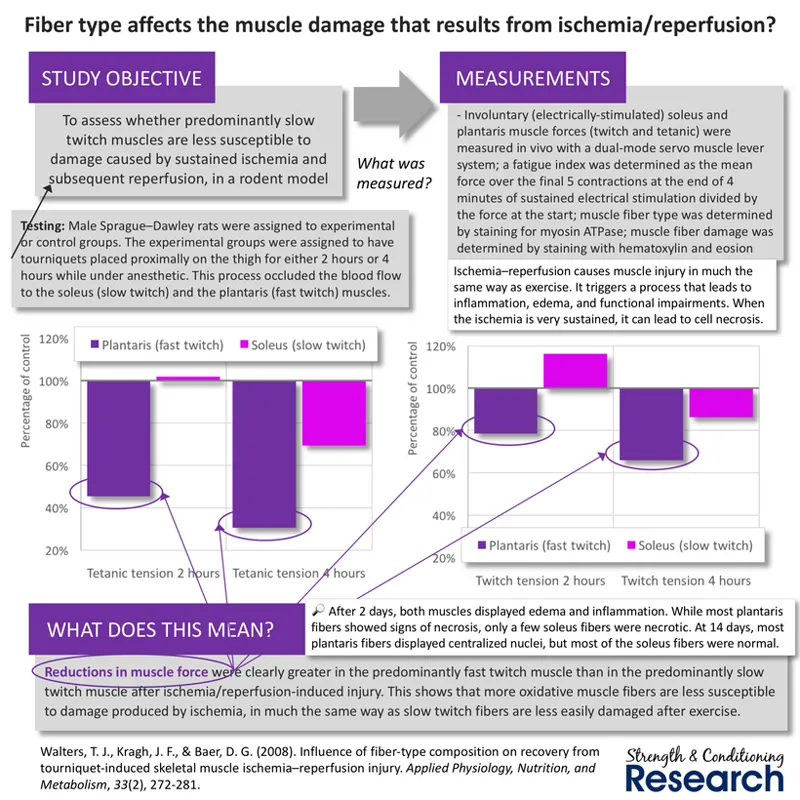
Even so, fast twitch muscle fibers are also more easily-damaged after types of exercise that involve no eccentric contractions, such as ischemia (blood flow restriction) and then reperfusion (blood flow back into the muscle). This suggests that the thinner cytoskeletal structures are probably not responsible for the greater sustained fatigue that the fast twitch muscle fibers experience.
.
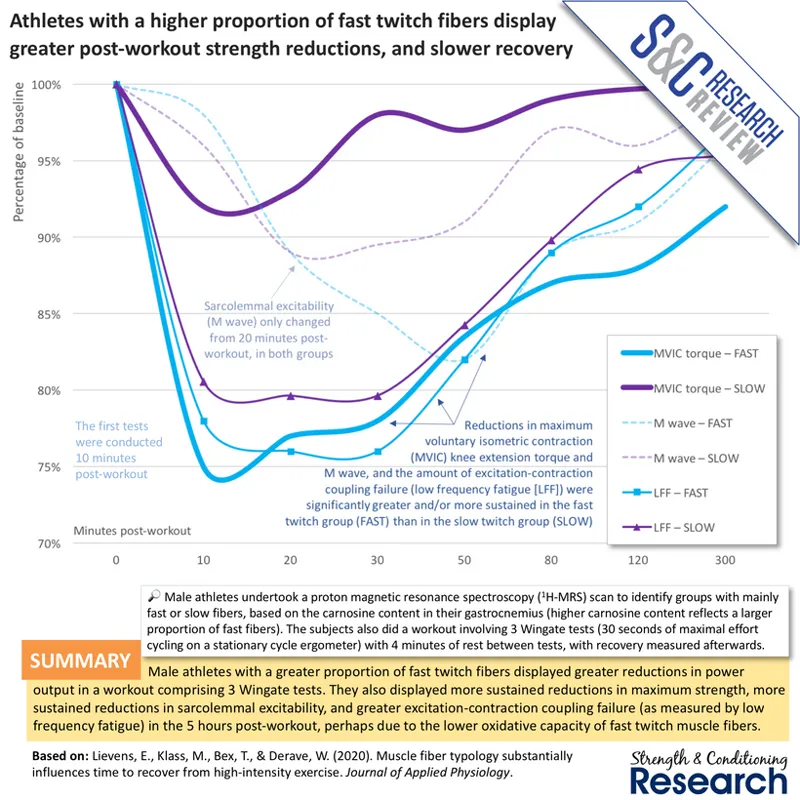
Indeed, recent research has shown that athletes with greater proportions of fast twitch muscle fibers display more low-frequency fatigue after exercise. Low frequency fatigue is typically taken as a marker of excitation-contraction coupling failure, which is caused by the release of proteases called calpains in response to the accumulation of calcium ions inside the muscle fiber cytoplasm.
.
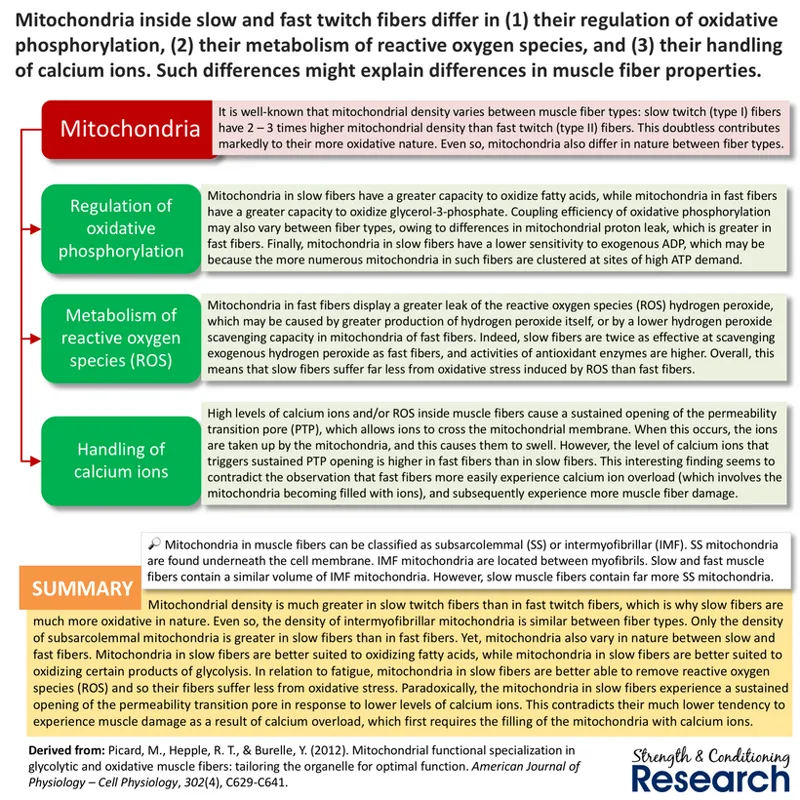
Therefore, it is likely that the real reason why fast twitch fibers sustain more prolonged post-workout fatigue than slow twitch muscle fibers is because of the differences in mitochondria between the two fiber types. Specifically, both the density and nature of the mitochondria differ between slow twitch fibers and fast twitch fibers. The larger number of mitochondria inside slow twitch fibers means that they can more easily deal with the calcium ions that are not taken back up into the sarcoplasmic reticulum after an excitation-contraction coupling process (which reduces the amount of excitation-contraction coupling failure and myofibrillar damage that occurs).
.
#2. Fast twitch athletes and muscles need longer post-workout recovery periods
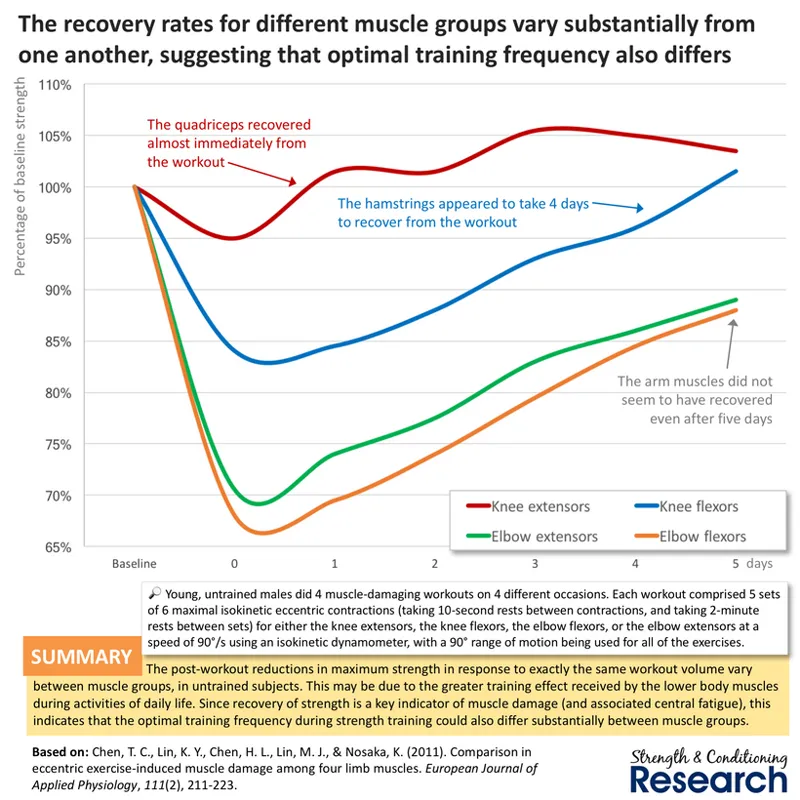
In practice, athletes who have a greater proportion of fast twitch muscle fibers will require longer to recover from a workout than athletes who have a greater proportion of slow twitch muscle fibers. In practical terms, those strength coaches working with sprint and power athletes may therefore benefit from using lower training frequencies than those strength coaches working with athletes with more of an endurance background. The same observation can be made in relation to different muscles, since the well-known fast twitch muscle groups of the upper body (biceps and triceps) take much longer to recover from a workout than the more slow twitch muscle groups of the lower body. This suggests that higher training frequencies may be possible for the lower body than for the upper body, on average.
.
Importantly, post-workout fatigue can accumulate over time and produce overreaching, which is defined as a period of time in which there is a sustained reduction in workout performance as a result of accumulated post-workout fatigue.
.
It is therefore unsurprising that this accumulated fatigue effect is more apparent in individuals with more fast twitch muscle fibers, who are much more susceptible to post-workout fatigue.
.
Conclusions
Lifters who have a larger proportion of fast twitch muscle fibers experience more post-workout fatigue and are also more susceptible to overreaching. Similarly, muscles with a larger proportion of fast twitch fibers (like the biceps and triceps) take longer to recover after a workout in comparison with the more slow twitch muscles of the lower body. Why are fast twitch muscle fibers more susceptible to post-workout fatigue? While some researchers have proposed that the structures inside fast twitch muscle fibers are more vulnerable to tearing forces, this cannot explain why [1] fast twitch muscle fibers are also more easily-damaged after ischemia or why [2] fast twitch muscle fibers are more likely to experience low frequency fatigue (a marker of excitation-contraction coupling failure) during the post-workout period. Therefore, it is more likely that fast twitch muscle fibers experience more post-workout fatigue because they are less able to defend themselves against calcium ion accumulation, which is an established mechanism of both muscle damage and excitation-contraction coupling failure. Indeed, fast twitch muscle fibers have fewer and weaker mitochondria, such that they are less able to remove the calcium ions from the cytoplasm while they are accumulating.
Comments (1)
Thanks Chris - you have probably covered this however I wonder what your thoughts on muscular hyperplasia are? I think I read once where you said even if it exists it is minimal. Any chance for your latest perspective? Thanks!