




Muscle swelling in trained lifters
Many fitness influencers have suggested that muscle swelling is minimal in trained lifters. This is not the case. Research has shown that post-workout fatigue, muscle damage, and muscle swelling all occur in trained lifters and are greater when training volumes are higher.
.
#1. What causes muscle swelling?
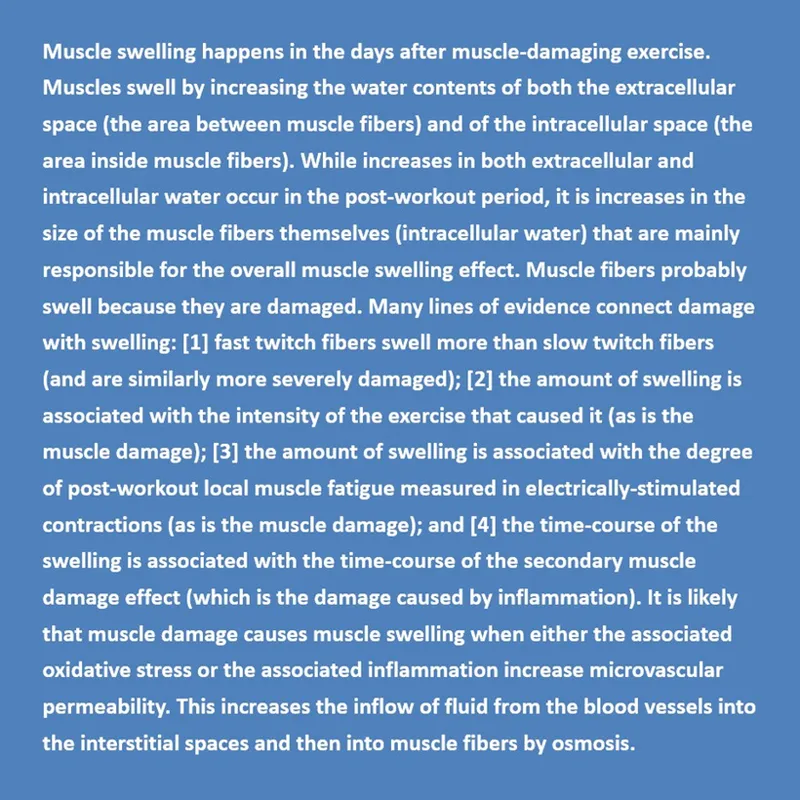
Muscle swelling is caused by muscle damage (read more). Therefore, it is not physiologically valid to state that muscle swelling is absent in strength-trained lifters if muscle damage is present. Muscle damage is a primary component of post-workout fatigue. Therefore, it is also invalid to state that muscle swelling will be absent in strength-trained lifters if post-workout fatigue is present.
.
#2. Muscle damage exists in trained lifters
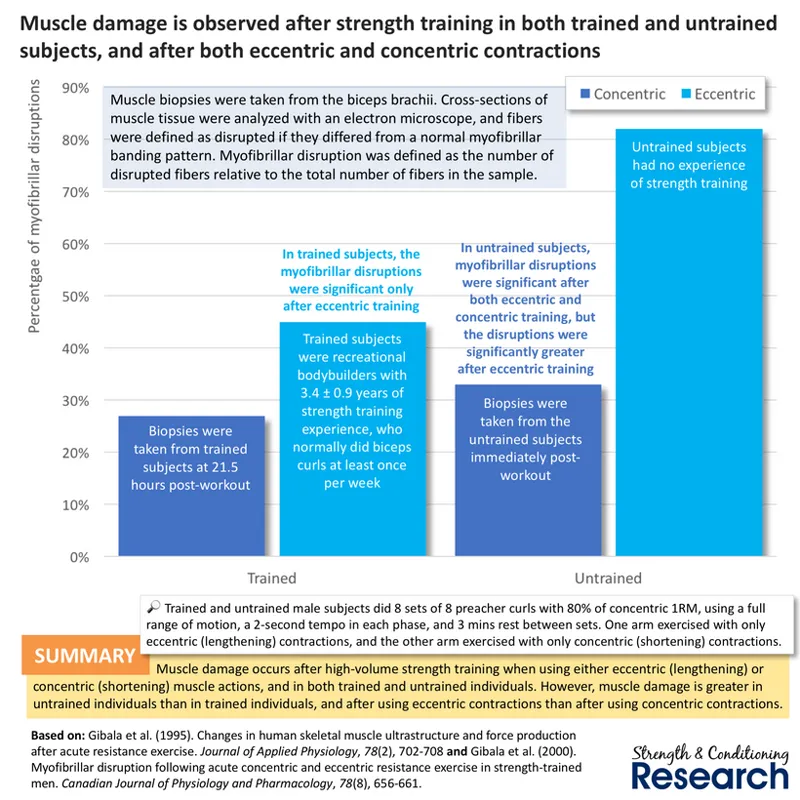
Muscle damage can be measured by taking biopsies and then examining muscle fibers under a microscope. While most studies measuring post-workout muscle damage have tested untrained subjects, there are some studies in people who have recently completed strength training programs showing the presence of muscle damage.
When comparing the amount of muscle damage between totally untrained people and trained lifters with multiple years of training experience, we can see that the amount of damage is approximately double in the untrained lifters (when only considering the eccentric contraction-induced damage).
Power-lifters display marked signs of muscle fiber damage despite generally performing exercise that does not produce a large amount of calcium ion accumulation. Even so, the damage is not indicative of strain injury as might be expected based on the extremely heavy loads that are typically lifted. Rather, it is clearly indicative of calcium ion-related fatigue and inflammatory processes, with signs of centralized nuclei, necrosis, and the loss of desmin.
.
#3. Post-workout fatigue exists in trained lifters
Post-workout fatigue has been measured very frequently in trained lifters and displays a very clear dose-response to training volume. The following studies were all carried out in trained lifters and involved normal strength training workouts with moderate loads (mostly to failure).
#4. Muscle swelling exists in trained lifters
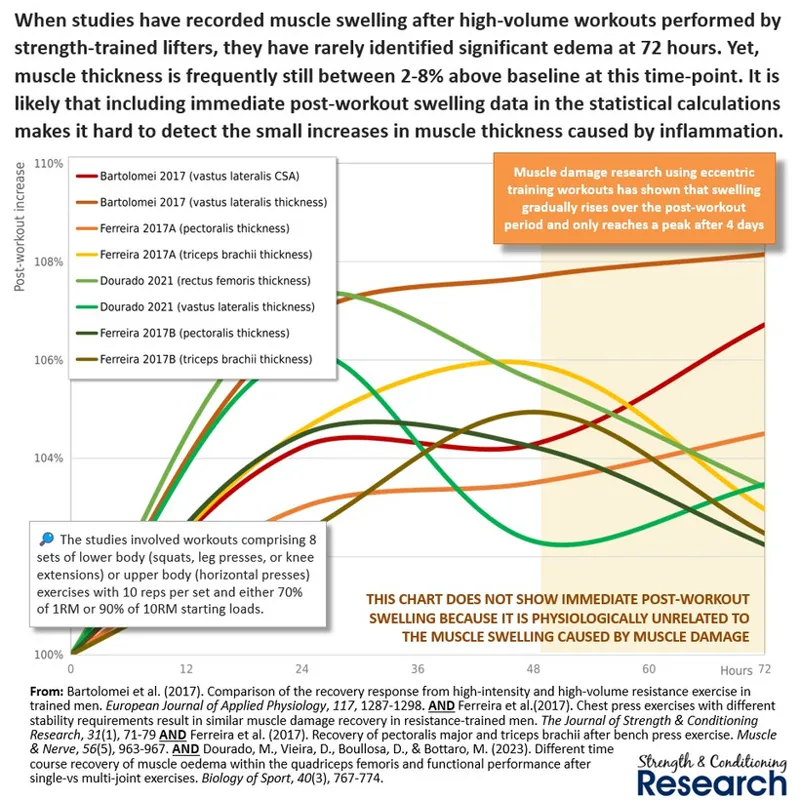
Studies in which high-volume workouts have been performed so that post-workout muscle swelling can be measured have rarely reported significantly swelling but numerically the swelling is clearly meaningful. In strength-trained lifters, training programs rarely produce more than 10% increases in muscle size and the differences between high and low volume training programs are usually around 5% which could easily be explained by swelling (here).
.
Additionally, studies in which high-volume training programs have been carried out by strength-trained lifters have recorded elevations in intracellular and extracellular water. Moreover, total body water and intracellular water are increased to a greater extent when training volumes are higher. Intracellular water is found inside damaged muscle fibers and is likely the main cause of post-workout muscle swelling. Hence, both the extracellular and the intracellular water need to be subtracted when calculating hypertrophy. When we do this, we see that the high-volume training block is actually much less effective than the low-volume block that preceded it. Putting this together with the previous observations regarding muscle swelling, there is more than enough reason to doubt the current hypertrophy measurements in high-volume training studies.
.
Conclusions
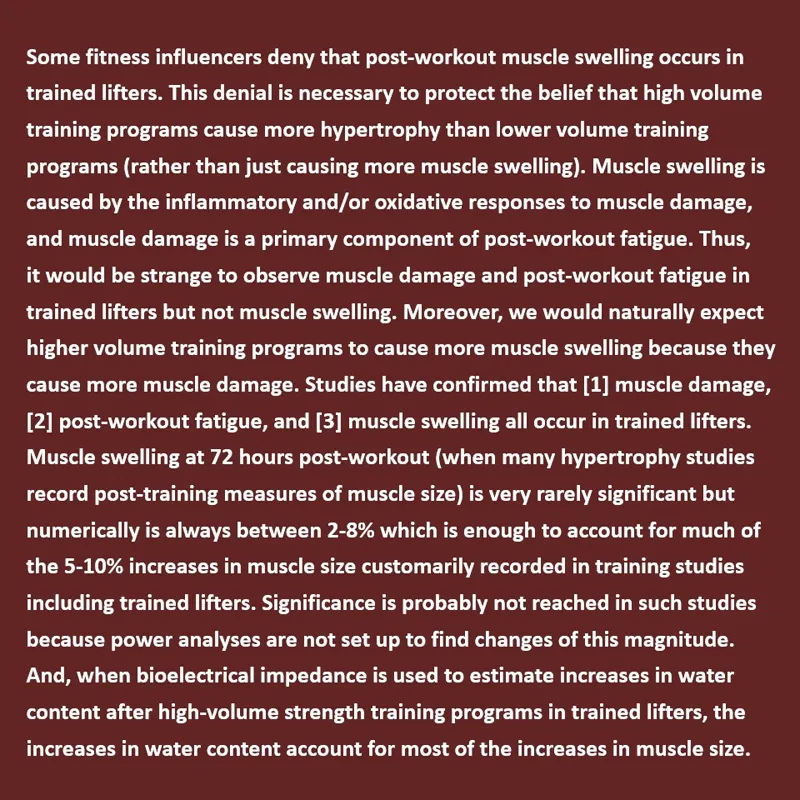
Some fitness influencers deny that post-workout muscle swelling occurs in trained lifters. This denial is necessary to protect the belief that very high volume training programs cause more hypertrophy than low and moderate volume training programs (rather than just causing more muscle swelling). Muscle swelling is caused by the inflammatory and/or oxidative responses to muscle damage, and muscle damage is a primary component of post-workout fatigue. Thus, it would be strange to observe muscle damage and post-workout fatigue in trained lifters but not muscle swelling. Moreover, we would naturally expect higher volume training programs to cause more muscle swelling because they cause more muscle damage. Studies have confirmed that [1] muscle damage, [2] post-workout fatigue, and [3] muscle swelling all occur in trained lifters. Muscle swelling at 72 hours post-workout (when many hypertrophy studies record post-training measures of muscle size) is rarely significant but numerically is always between 2-8% which is enough to account for much of the 5-10% increases in muscle size customarily recorded in training studies including trained lifters. Significance is probably not reached in such studies because power analyses are not set up to find changes of this magnitude. And, when bioelectrical impedance is used to estimate increases in water content after high-volume strength training programs in trained lifters, the increases in water content account for most of the increases in muscle size.


Comments (2)
In the "Powerlifters" infographic, does the splitting mechanism associated with muscle repair refer to fibers or myofibrils? And if it's an increase in the number of myofibrils, how can this not lead to hypertrophy? Is there some merge process that doesn't lead to a significant increase in the overall size of the muscle fiber? The same justification in the situation of increased number of fibers/hyperplasia?
The splitting refers to muscle fibers. Splitting of myofibrils would just be hypertrophy. Splitting of muscle fibers is typically regarded as a damage indicator.