




mTOR signaling means repair is happening
Hypertrophy researchers and fitness influencers often argue that the presence of [1] mTOR signaling, and/or [2] elevations in muscle protein synthesis (MPS) after a workout implies that hypertrophy is occurring. Yet, both mTOR signaling and MPS rate elevations can mean that muscle fibers are just being repaired.
.
#1. mTOR signaling happens after non-exercise injury
mTOR signaling is observed after non-exercise injuries in muscles. It is quite likely that such mTOR signaling is responsible for stimulating elevations in MPS rates that repair muscle damage, replace lost proteins, and hence bring about recovery from injury.
.
Indeed, we know that the mTOR pathway signaling is required to facilitate the recovery process after a muscle-damaging workout. When mTOR signaling is blocked after a workout, recovery from post-workout fatigue is arrested.
.
#2. MPS rates are elevated after non-exercise injury
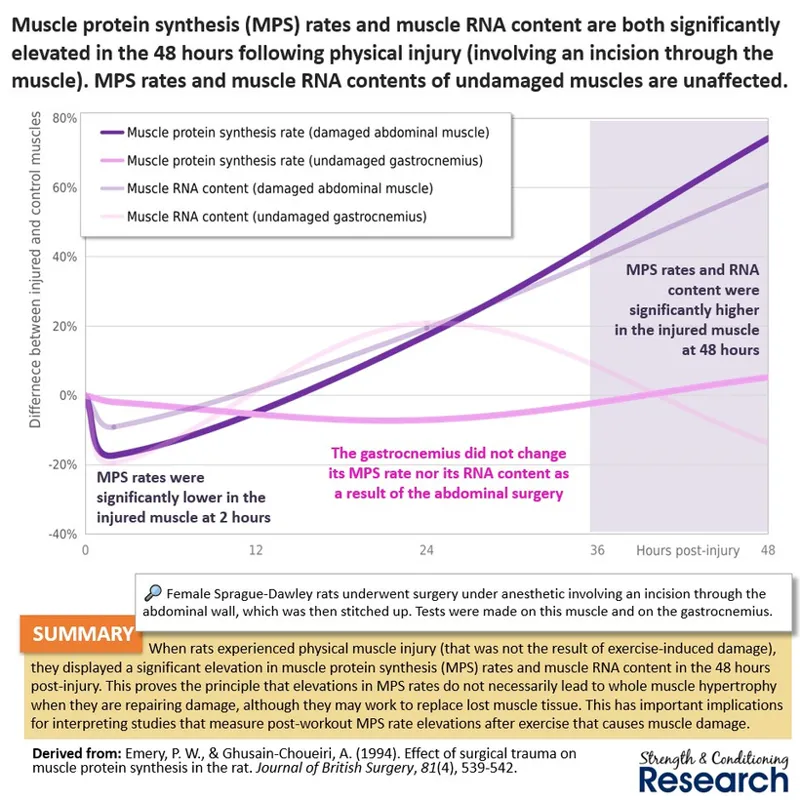
Similarly, MPS rates are elevated after non-exercise injuries to muscles. Such injuries cause very large increases in MPS rates, especially around 48 hours post-injury. It is quite likely that such elevations in MPS rates are necessary to bring about recovery from injury, in the same way as anabolic signaling in the mTOR pathway is necessary to cause recovery from post-workout fatigue.
.
Various studies have reported exactly the same finding, indicating that MPS rates are indeed elevated in order to fulfil muscle damage repair processes.
.
#3. Muscle damage produced by a non-exercise injury does not stimulate hypertrophy
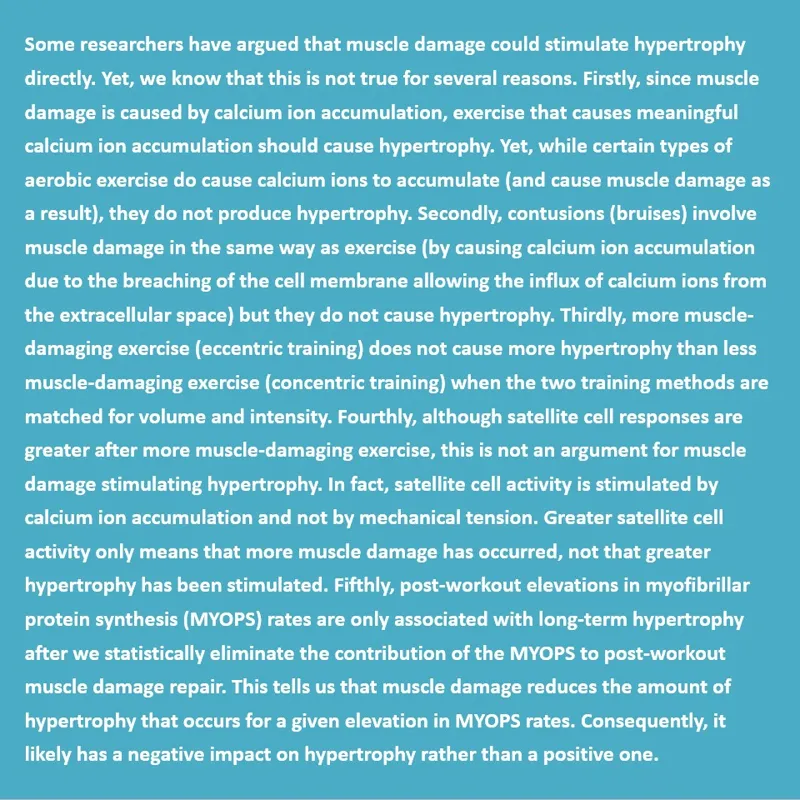
Although it should be obvious, researchers have confirmed that muscle damage that was produced by a non-exercise injury does not stimulate any hypertrophy.
.
Indeed, this is one of the key reasons why we can reject muscle damage as a stimulus that causes hypertrophy after exercise (read more).
.
Many fitness influencers incorrectly believe that muscle damage happens through different processes according to the type of injury. This is not true. Almost all muscle damage happens by means of proteases whose activity is stimulated by the entry of calcium ions into the cytoplasm. Exercise can put calcium ions into the cytoplasm through [1] the sarcoplasmic reticulum, and [2] the stretch-activated ion channels. Non-exercise injury typically causes the calcium ions to enter through holes in the muscle cell membrane (read more).
.
#4. mTOR signaling is greater after eccentric contractions despite not causing more hypertrophy
Importantly, many fitness industry influencers point to higher mTOR signaling after workouts involving maximal effort eccentric contractions (compared to maximal effort concentric contractions) to justify the claim that eccentric contractions can stimulate more muscle growth than concentric contractions.
.
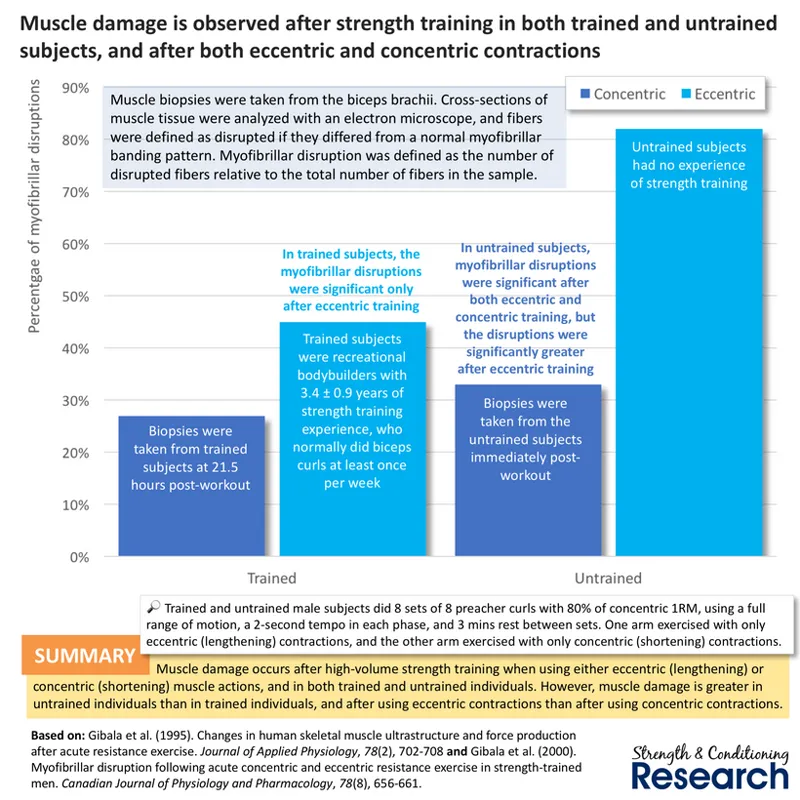
Yet, we know that eccentric contractions produce much more muscle damage than concentric contractions, as a result of the opening of stretch-activated ion channels and greater calcium ion accumulation. This muscle damage triggers its own mTOR signaling, which adds to the mTOR signaling that was intended to stimulate hypertrophy. Therefore, the greater mTOR signaling does not indicate the presence of a greater hypertrophy stimulus.
.
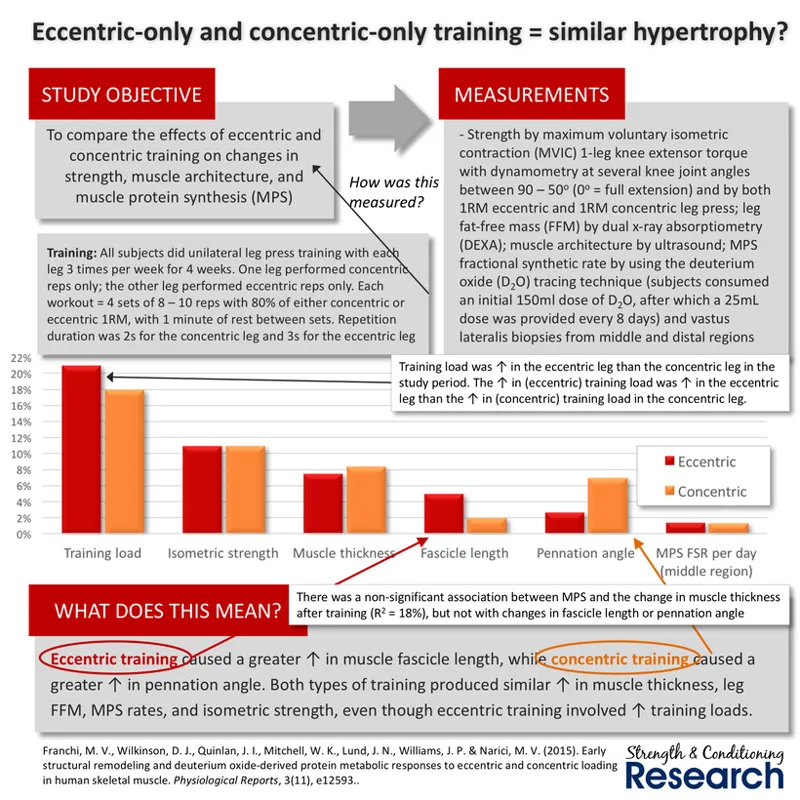
When we look at the most recent long-term training studies, we can see that matched-effort eccentric-only training and concentric-only training actually produce quite similar muscle growth despite the much greater mTOR signaling after workouts involving eccentric contractions.
.
That is not to say that matched-effort eccentric training and concentric training do not produce differences in the type of muscle growth that occurs. Naturally, there are greater increases in myofibrils in parallel after concentric training and greater increases in sarcomeres in series after eccentric training. However, the total increases in muscle volume are essentially more-or-less the same.
.
Conclusions
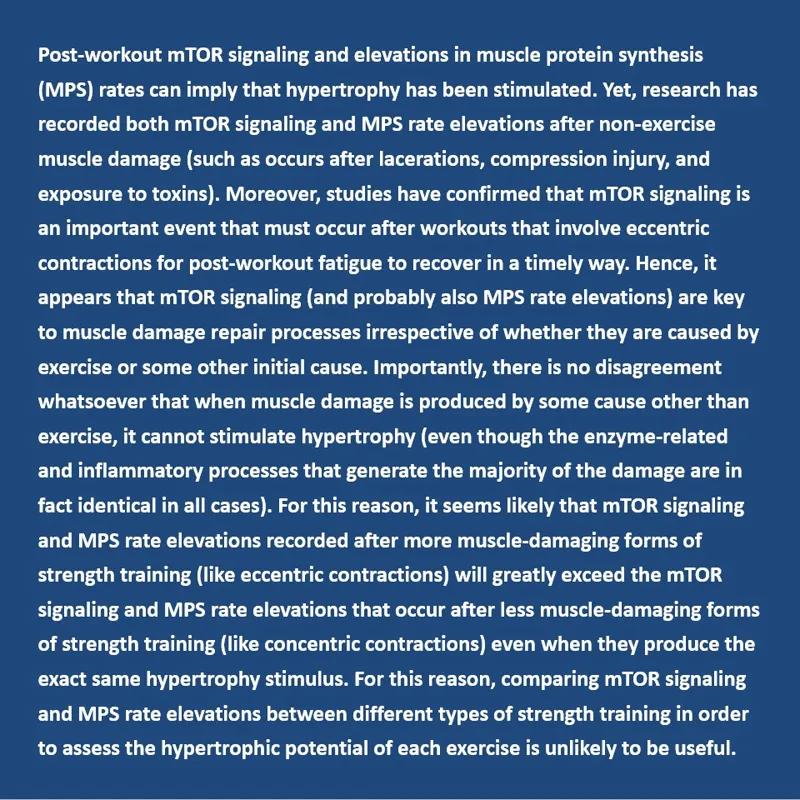
Post-workout mTOR signaling and elevations in muscle protein synthesis (MPS) rates can imply that hypertrophy has been stimulated. Yet, research has recorded both mTOR signaling and MPS rate elevations after non-exercise muscle damage (such as occurs after lacerations, compression injury, and exposure to toxins). Moreover, it has confirmed that mTOR signaling is an important event that must occur in order after workouts involving eccentric contractions for post-workout fatigue to recover in a timely way. Hence, it appears that mTOR signaling (and probably also MPS rate elevations) are key to muscle damage repair processes irrespective of whether they are caused by exercise or some other initial cause. Importantly, there is no disagreement whatsoever that when muscle damage is produced by some cause other than exercise, it cannot stimulate hypertrophy (even though the enzyme-related and inflammatory processes that generate the majority of the damage are in fact identical in all cases). For this reason, it seems likely that mTOR signaling and MPS rate elevations recorded after more muscle-damaging forms of strength training (like eccentric contractions) will greatly exceed the mTOR signaling and MPS rate elevations that occur after less muscle-damaging forms of strength training (like concentric contractions) even when they produce the exact same hypertrophy stimulus. For this reason, comparing mTOR signaling and MPS rate elevations between different types of strength training in order to assess the hypertrophic potential of each exercise is unlikely to be useful.