



Post-workout CNS fatigue duration
Post-workout central nervous system (CNS) fatigue is very poorly understood in the fitness industry despite being well-described in the exercise science literature. Influencers tend to assume that the CNS itself is somehow fatigued rather than understanding that the CNS just receives information about the state of muscle damage in the trained muscles and regulates our ability to recruit motor units accordingly. Even so, it is important for us to review the rate at which the CNS fatigue dissipates after exercise to inform our understanding of training frequency.
.
#1. Post-workout CNS fatigue is caused by the inflammatory response to muscle damage
Although it is widely assumed that exerting a high effort in a workout is what "strains the CNS," this is not remotely the case. The CNS just responds to information provided by the body. We know that the post-workout muscle damage causes an inflammatory response and that this inflammatory response leaks into the bloodstream where it is detected by the brain and causes an increase in our effort perception for a given level of corollary discharge, thereby preventing us from generating as much central motor command at maximum tolerable perception of effort. This means that muscle damage is what causes supraspinal CNS fatigue in the post-workout period. For this reason, we must expect CNS fatigue to track the development and recovery of muscle damage during the post-workout period relatively closely.
.
The influence of inflammatory mediators on supraspinal central nervous system fatigue have been well-described during exercise and likely apply similarly in the post-workout period as well.
.
#2. Post-workout non-local fatigue lasts for a similar amount of time as overall fatigue
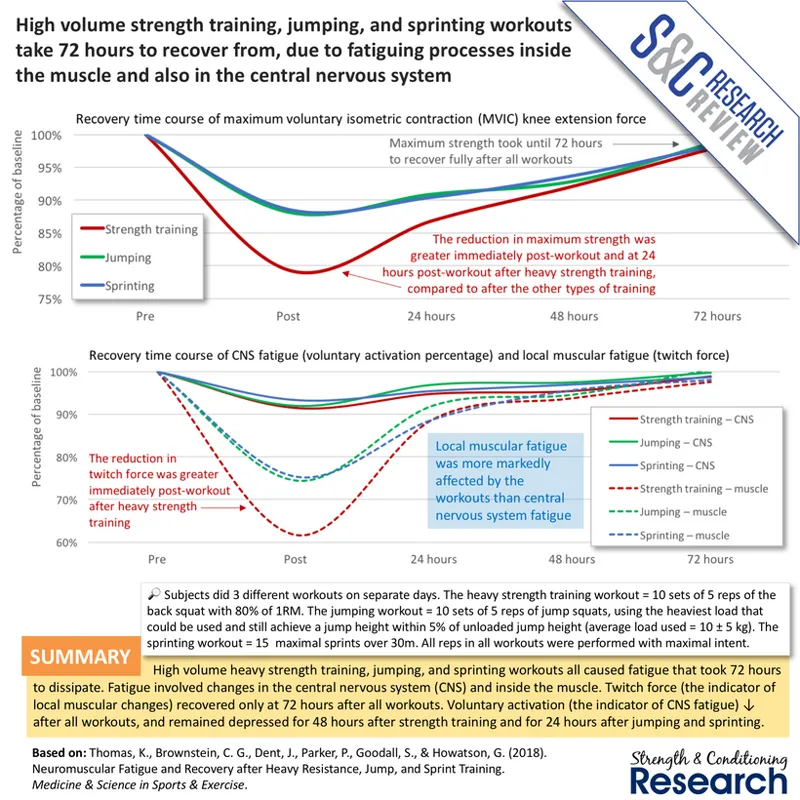
We can measure post-workout CNS fatigue by various methods. The two most common are [1] non-local fatigue (which is the presence of fatigue in an untrained muscle), and [2] reductions in voluntary activation (which is the presence of greater fatigue in voluntary contractions than in involuntary contractions). Interestingly, the time course of non-local fatigue in the post-workout period seems to be very similar to the time course of overall fatigue, albeit smaller in magnitude. This suggests that post-workout CNS fatigue lasts just as long as overall fatigue.
.
Indeed, this is a relatively universal finding with all studies reporting very similar time courses.
.
Every single study shows exactly the same result, with the duration of non-local fatigue in the untrained muscle being the same as the duration of the local fatigue in the trained muscle group.
.
#3. Post-workout voluntary activation reductions recover faster than overall fatigue
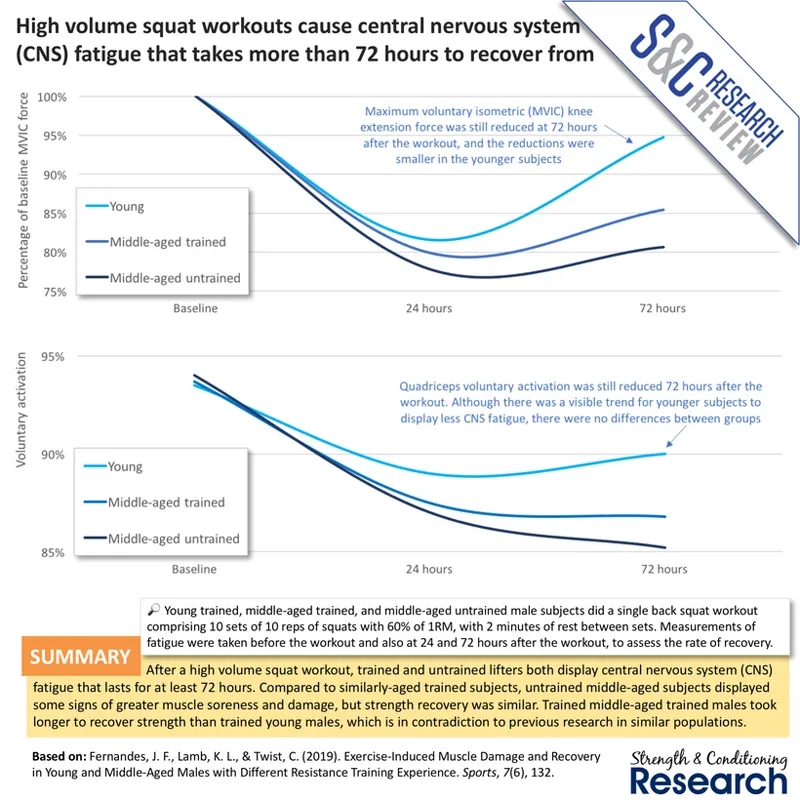
We can measure post-workout CNS fatigue by various methods. The two most common are [1] non-local fatigue (which is the presence of fatigue in an untrained muscle), and [2] reductions in voluntary activation (which is the presence of greater fatigue in voluntary contractions than in involuntary contractions). The time course of reductions in voluntary activation are often very different from the time course followed by overall fatigue since they recover much more quickly. Typically, when this happens, the CNS fatigue recovers a day earlier than the overall fatigue.
.
Similarly, in this example, the CNS fatigue also recovered a day earlier than overall fatigue when it was measured by reference to the voluntary activation decreases rather than non-local fatigue.
.
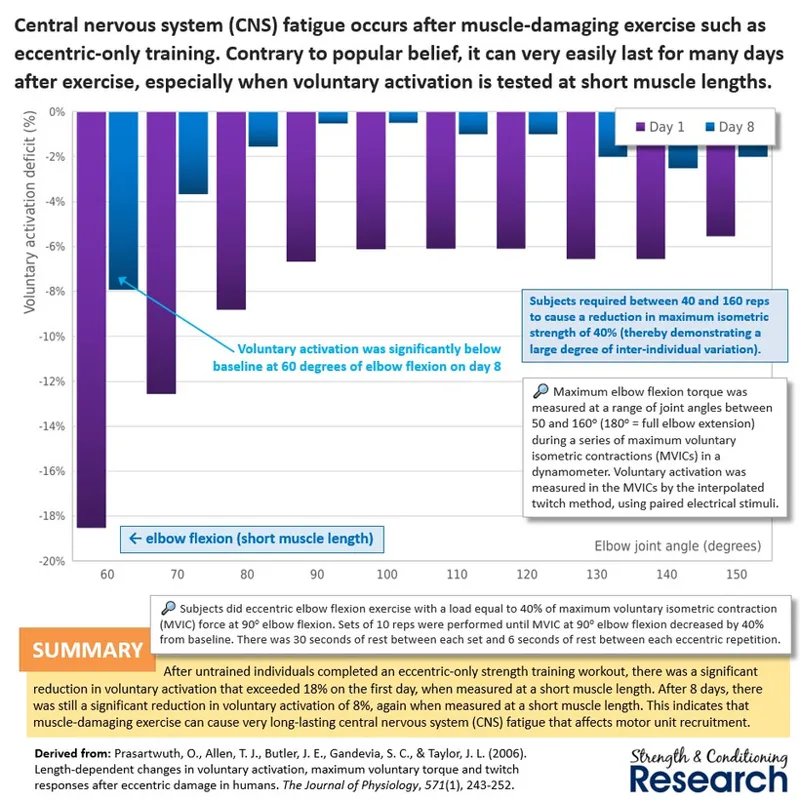
Nevertheless, it is not a uniform finding that voluntary activation recovers more quickly than the overall fatigue measurement. Some studies appear to show similar durations of post-workout CNS fatigue measured by voluntary activation and post-workout overall fatigue.
.
Even so, in such studies the final measurement tends to be before recovery has been recorded for either post-workout CNS fatigue or for post-workout overall fatigue, which makes it difficult to ascertain whether post-workout CNS fatigue has recovered faster or not.
.
Conclusions
Although it is often assumed that exerting a high effort in a workout causes central nervous system (CNS) fatigue during the post-workout period, this is not true. The CNS simply responds to information provided by the body. The muscle damage caused by the exercise generates an inflammatory response that leaks into the bloodstream, where it is detected by the brain, which then generates a negative feeling. This negative feeling causes an increase in our effort perception for a given level of corollary discharge, thereby preventing us from generating as much central motor command at our maximum tolerable perception of effort. Therefore, we can say that muscle damage is what causes CNS fatigue in the post-workout period. For this reason, we must expect CNS fatigue to track the development and recovery of muscle damage in the post-workout period relatively closely. Post-workout CNS fatigue can be measured in two ways: [1] non-local fatigue (the presence of fatigue in an untrained muscle), and [2] reductions in voluntary activation (the presence of greater fatigue in voluntary contractions compared to in involuntary contractions). The time course of non-local fatigue in the post-workout period seems to be very similar to the time course of overall fatigue, albeit smaller in magnitude. This suggests that post-workout CNS fatigue lasts just as long as overall fatigue. The time course of reductions in voluntary activation is less consistent and some studies appear to show a faster rate of recovery by approximately one day relative to the overall post-workout fatigue recovery rate.