




Light loads and hypertrophy
Some fitness influencers have argued that we should train in different rep ranges because lighter loads cause hypertrophy to occur in different ways from heavier loads. Yet, most of the time, sets of lighter loads do not cause hypertrophy to occur any differently from sets of heavier loads with the same exercise.
.
#1. Lighter loads do not seem to cause more sarcoplasmic hypertrophy
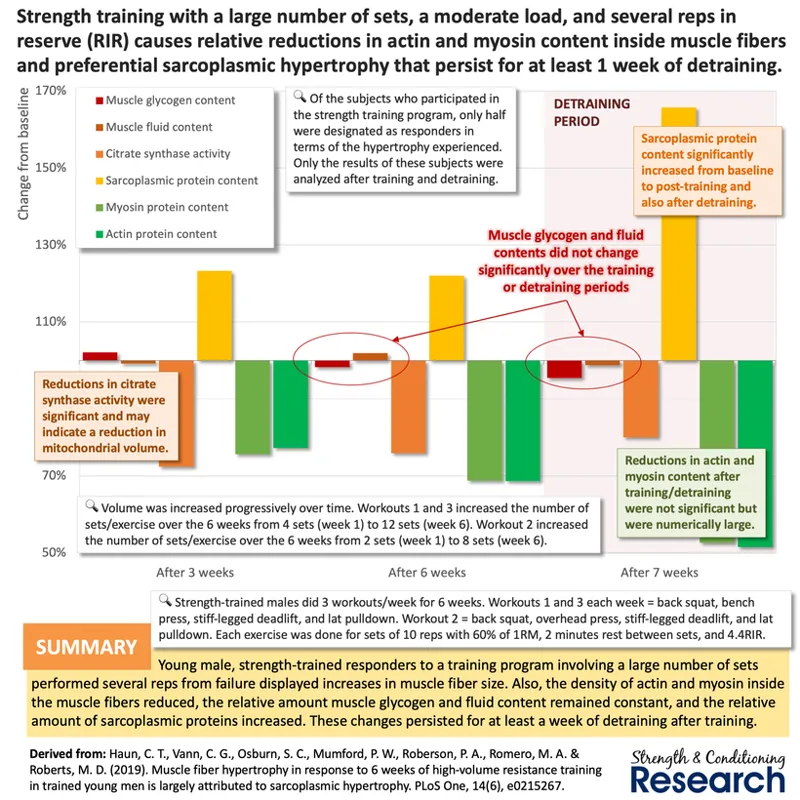
Historically, it was argued that lighter loads caused comparatively more sarcoplasmic hypertrophy, while heavier loads caused relatively more myofibrillar hypertrophy. Yet, we now understand that there is a tendency for both heavy and light loads to cause preferential sarcoplasmic hypertrophy at the start of a training program (for reasons that have yet to be understood, but there are several possible explanations). Indeed, here is a relatively recent study reporting preferential sarcoplasmic hypertrophy after training with moderately-light loads.
.
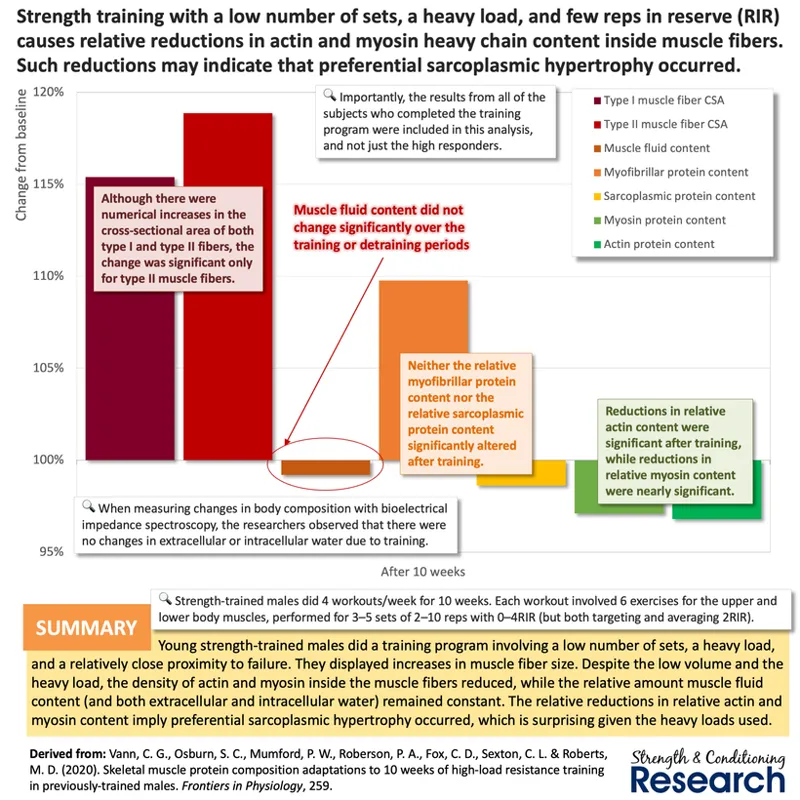
Similarly, here is a study from the same laboratory that also reported preferential sarcoplasmic hypertrophy after training with heavy loads. While we do not have a study of this quality that has compared two training programs (one heavy and one light), it does seem that there is a tendency for sarcoplasmic hypertrophy to predominate irrespective of repetition range.
.
Nevertheless, the tendency to display preferential sarcoplasmic hypertrophy seems to be a temporary one because cross-sectional studies looking at the differences between beginners and very well-trained subjects have reported preferential myofibrillar addition relative to the sarcoplasmic volume.
.
#2. Lighter loads do not seem to cause more slow twitch fiber hypertrophy
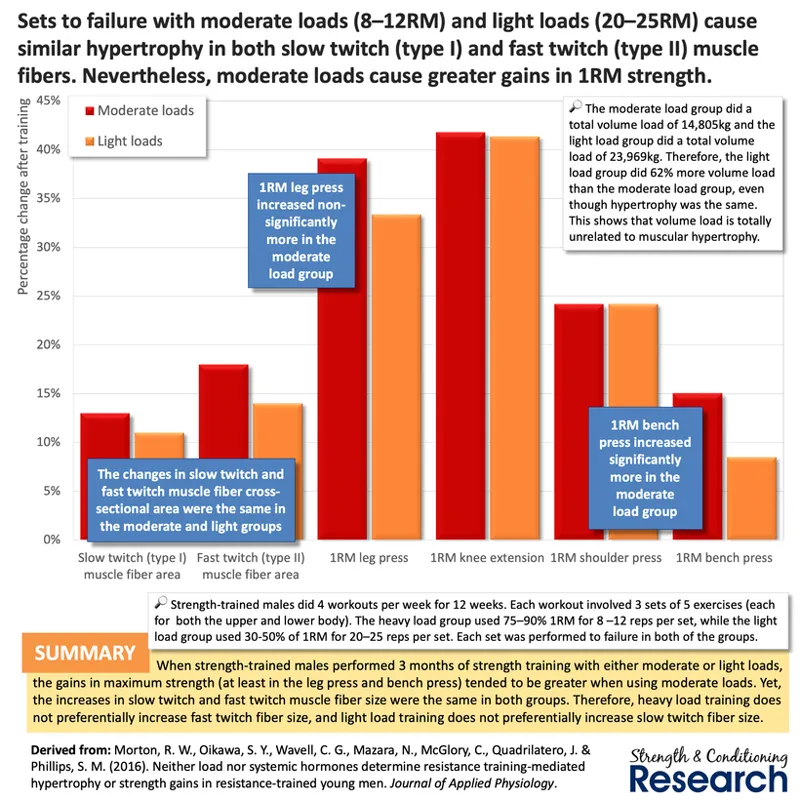
Historically, it was argued that lighter loads caused comparatively more slow twitch muscle fiber hypertrophy. Yet, the latest studies have reported that this almost certainly does not happen. In this study, the researchers looked at the growth of slow twitch and fast twitch muscle fibers of individual muscles and reported no differences resulting from repetition range.
.
And in this study, the researchers looked at the growth of a slow twitch muscle (the soleus) and the growth of a comparatively fast twitch muscle (the gastrocnemius) after training the overall calf muscle complex using a variety of appropriate exercises. There was no effect of repetition range.
.
#3. Lighter loads probably do cause more muscle swelling
Fitness influencers often report anecdotes that light loads cause more muscle growth. However, in many cases, this greater muscle growth is probably just greater muscle swelling. Indeed, we know that training with light loads does cause a lot more muscle damage (and therefore muscle swelling) than training with heavier loads (read more).
.
#4. Lighter loads may well cause hypertrophy to occur in different muscle regions when training with multi-joint exercises
There is one way in which light loads can cause different hypertrophy from heavy loads when training with the same exercise. Changing the load in multi-joint exercises (most likely especially in barbell exercises) alters the relative contributions of the muscles working at a joint and also alters the relative contributions of the joints to the exercise itself. This modelling study reported that light loads involve a greater relative contribution of the adductor magnus relative to the other hip extensors during squats. Other analyses have shown that squats with light loads are more quadriceps-dominant while squats with heavy loads are more hip extensor-dominant. Whether we can similarly alter the region in which hypertrophy occurs in single-joint exercises is unclear.
.
#5. Lighter loads cause greater fatigue resistance adaptations
We must also recognize that training with lighter loads causes greater fatigue resistance adaptations than training with heavier loads. Whether this has any impact on hypertrophy, however, is unclear. For example, there is literally no data to support the claim that we need to perform blocks of training with lighter loads in order to produce capillarization adaptations to support subsequent hypertrophy. Indeed, capillarization typically occurs in tandem with an increase in muscle fiber size rather than prior to it happening.
.
Conclusions
Some fitness influencers have argued that we should train in different repetition ranges in order to maximize hypertrophy. Yet, it bears repeating that there seems to be no difference in the nature of the muscle growth stimulated by sets of light loads and sets of heavy loads. Training with light loads does not appear to cause either more sarcoplasmic hypertrophy or more slow twitch fiber hypertrophy than training with heavy loads. Nevertheless, by causing more muscle damage, it is entirely possible that training with lighter loads might be perceived as causing more hypertrophy (or hypertrophy that looks different) owing to the greater muscle swelling that accompanies this muscle damage. However, when training with multi-joint exercises (especially barbell multi-joint exercises), regional hypertrophy could differ between repetition ranges because of differences in the relative contributions of [1] the individual muscles at the joints, and [2] the joints to external force production. For example, it is very likely that squats with lighter loads are relatively more quadriceps-dominant while squats with heavier loads are more hip extensor-dominant. Whether this similarly applies to machine or single-joint exercises is unclear. Finally, it is often noted that training with lighter loads causes greater fatigue resistance adaptations. Nevertheless, we have no reason to believe that such adaptations are necessary for maximizing hypertrophy, as is often claimed. For example, there is no need to seek increases in capillary content prior to stimulating hypertrophy since the two adaptations seem to occur very readily concurrently.

Comments (1)
How much muddying of the waters is there do you think from swelling with lighter loads and higher volumes? I used to believe increasing volume = increased hypertrophy as I would always "look bigger" when I added sets... even with no strength gains