




Training frequency (low volume)
Currently, the widely-accepted position in the fitness industry is that training frequency does not matter so long as the same number of sets per week are performed. The idea is that these sets can be allocated across any number of workouts and it will not affect hypertrophy. But does this idea make sense? If not, then why do the current data suggest that it is true?
.
#1. Training frequency meta-analyses
Currently, the meta-analyses of training frequency show that training frequency does not matter so long as the same number of sets per week are performed.
#2. Dose-response of hypertrophy to workout volume
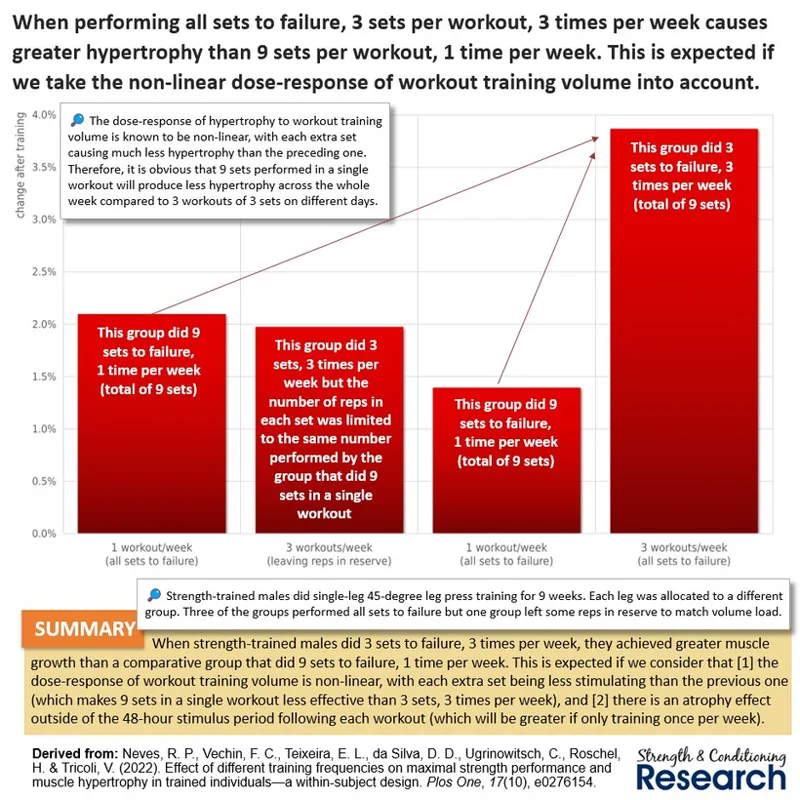
The idea that training frequency does not matter is difficult to accept when we acknowledge that training volume does not display a linear response. Instead, the effects of each extra set in a workout follow a strongly non-linear pattern. Therefore, we really want as many "first sets" per week instead of adding additional sets onto the end of each workout.
#3. Atrophy effects of time outside of stimulus periods
The idea that training frequency does not matter is difficult to accept when we acknowledge that muscle atrophy occurs between workouts whenever we are outside of a post-workout stimulus period. We can see this happening by looking at the maintenance literature.
#4. Recovery from workouts in strength-trained lifters
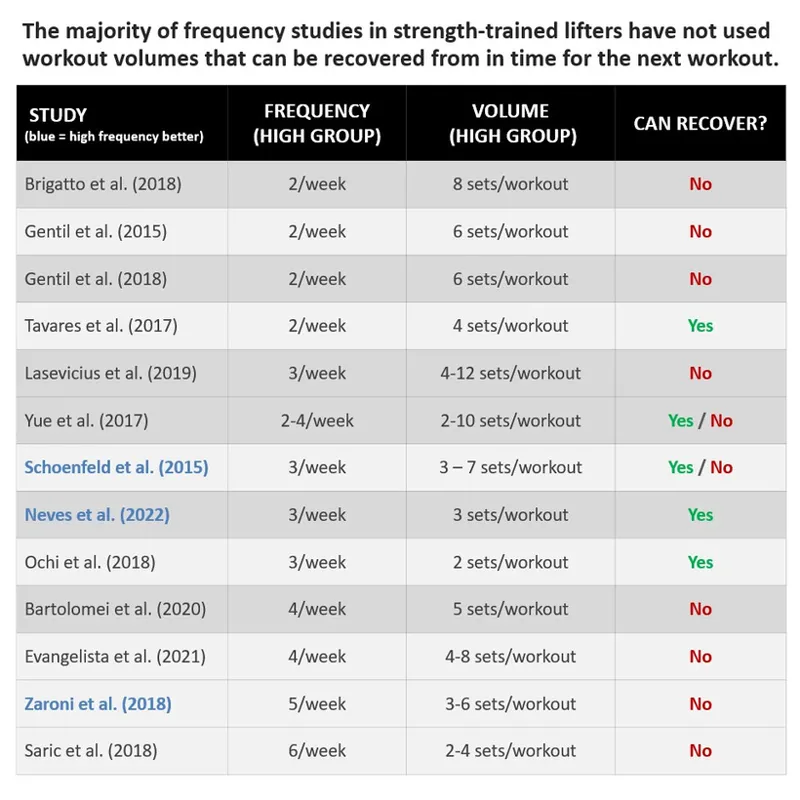
The most obvious explanation for why the frequency literature shows us this unexpected outcome is that the higher frequency groups are not recovering between workouts. In the frequency literature, when higher frequency groups train muscles 4 times per week, they typically do 4-6 sets per workout. When they train muscles 2-3 times per week, they typically do 4-8 sets per workout. This is too much.
The recovery literature regarding strength-trained lifters tells us that such workout frequencies do not permit the dissipation of post-workout fatigue from one workout to the next.
.
#5. Training frequency studies with recoverable volumes
When we exclude all of the training frequency studies that use workout volumes that require recovery periods that are longer than the duration of time between the programmed workouts, we end up with a very small pool of available literature. For example, here is a study that used only two sets per workout, three times per week (which is a workout volume that we know is feasible when performed with moderate loads). It strongly indicated that training with a higher frequency is better for hypertrophy (while the higher frequency group only displayed a non-significantly greater amount of muscle growth, it did display significantly greater gains in isometric strength and this occurred despite training much further from muscular failure).
By way of another example, here is a study that used only one set per workout, three times per week (which is a workout volume that we know is feasible when performed with moderate loads). It strongly indicated that training with a higher frequency is superior for hypertrophy. Again, while there was no significant difference between the groups, the strength gains were astronomically greater in the higher frequency group and the differences in lean body mass were numerically huge (the higher frequency group achieved eight times more growth).
And here is a study that tested slightly higher workout volumes (but which are still probably within the scope of recoverability since they were done with moderate loads (8-12RM).
Conclusions
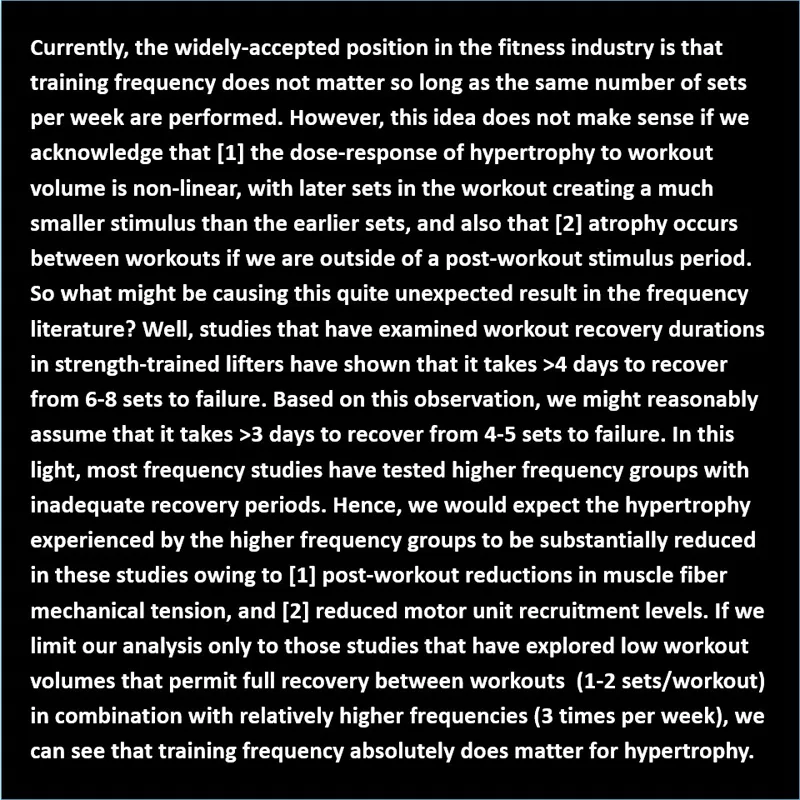
Currently, the widely-accepted position in the fitness industry is that training frequency does not matter so long as the same number of sets per week are performed. However, this idea does not make sense if we acknowledge that [1] the dose-response of hypertrophy to workout volume is non-linear, with later sets in the workout creating a much smaller stimulus than the earlier sets, and also that [2] atrophy occurs between workouts if we are outside of a post-workout stimulus period. So what might be causing this quite unexpected result in the frequency literature? Well, studies that have examined workout recovery durations in strength-trained lifters have shown that it takes >4 days to recover from 6-8 sets to failure. Based on this observation, we might reasonably assume that it takes >3 days to recover from 4-5 sets to failure. In this light, most frequency studies have tested higher frequency groups with inadequate recovery periods. Hence, we would expect the hypertrophy experienced by the higher frequency groups to be substantially reduced in these studies owing to [1] post-workout reductions in muscle fiber mechanical tension, and [2] reduced motor unit recruitment levels. If we limit our analysis only to those studies that have explored low workout volumes that permit full recovery between workouts (1-2 sets/workout) in combination with relatively higher frequencies (3 times per week), we can see that training frequency absolutely does matter for hypertrophy.
Comments (7)
makes me wish for studies done with a sets:day ratio set up to compare. the trend seems to point towards high frequencies being better, but its interesting how the 4-6 day group is all-together worse than the 3 day per week group. this could either be because of too high of frequencies being worse, or just the minimal data. but it raises interesting questions! i think that, either, an every other day training approach generates the highest rate of growth or that an every day approach does. in both scenarios you are always within a state of hypertrophy, there are no atrophy periods since your training is much more frequent. all it would come down to is recovery at that point. lower frequencies have a theoretically lower upper limit to their maximum recoverable rate of stimulation (arbitrary units/day), this is likely the reason why they don't seem as effective as higher frequencies. the theoretical highest possible recoverable rate of stimulation would be 1 unit a day, achieved through training a single set every single day. this is intuitive, but if recovery (especially since it is variable amongst individuals) isn't actually able to consistently recover from daily training then the actual net stimulus and subsequent rate of growth could be blunted. thus enters every other day frequencies. their theoretical maximum recoverable volume allows for up to a rate of 0.8 arbitrary units a day, which is still high. if too high of frequencies see detriments to their rate of progression due to recovery concerns, then higher frequencies may be better. a study like so would give us those answers: -1/1 day frequency, 1 set -1/2 day frequency, 2-3 sets -1/3 day frequency, 4-5 sets regardless, higher frequencies seem to be the path forward (unless there's other variables unfounded) awesome post!
I remember in a previous post you said that the first 24hr of MYOPS *may* be when NEW hypertrophy happens. If true, could this potentially suggest that 1 set of 5-7RM 1RIR done daily would be superior to 2 sets of 5-7RM 1RIR done every 2 days?
This article, I think. https://www.patreon.com/posts/myofibrillar-83239198
Chris, I didn't understand the relationship you made in the last post. I mean the relationship, between the meta-analysis of frequency having found no difference when the volume is equalized and the higher frequency groups not recovering between workouts, I didn't understand exactly what you meant by the "unexpected outcome" and the relationship with recovery. Could you clarify?
Does this article help? https://www.patreon.com/posts/training-for-83416419
Does the muscle fully recover in 2 days with 3 sets close to failure using moderate to low loads (5-10 repetitions)?
Yes