






Strength training recovery
High-volume strength training programs are very popular at the moment. However, we know that post-workout fatigue mechanisms reduce our ability to produce both [1] maximum levels of muscle fiber mechanical tension and [2] maximum levels of motor unit recruitment. This means that if we perform another workout while post-workout fatigue is still present from our previous workout, the hypertrophy stimulus in that second workout will be much reduced. So how long does post-workout fatigue last in strength-trained lifters after bodybuilding-style workouts and how does this vary depending on workout volume (as well as other factors)?
.
#1. How long does it take to recover from eight sets?
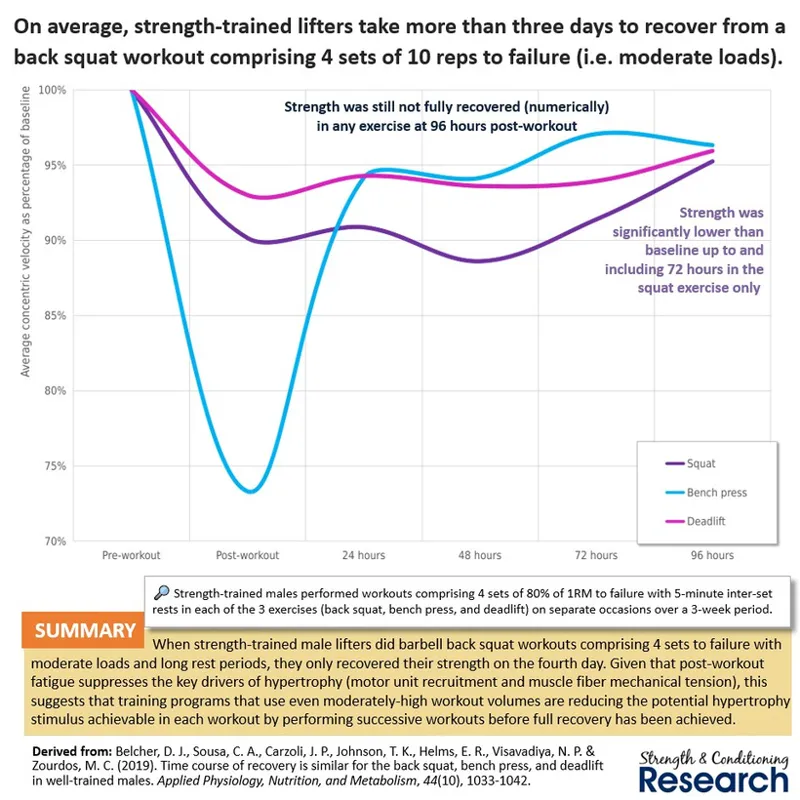
When strength-trained lifters perform eight sets to failure with a moderate load, recovery from post-workout fatigue takes more than four days to happen. Although no further measurements were taken in this study, we might guess that full recovery occurred on day five or six. This suggests that eight sets to failure can only be done once per week if we want to train with maximum levels of muscle fiber mechanical tension and full motor unit recruitment.
.
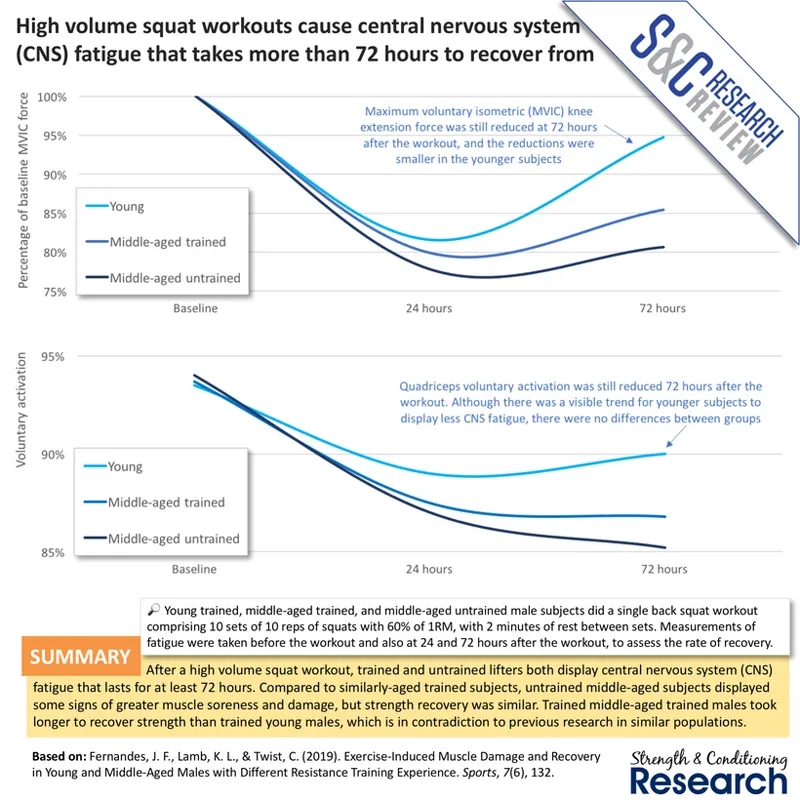
Similar data have been reported in strength-trained subjects who did ten sets with a moderate load without training to failure, albeit the measurements were terminated at only three days. While the exact proximity to failure was unclear, 60% of 1RM is probably somewhere around a 15-20RM which implies that many of the sets at the start of the workout were done with >5RIR. Since rest periods were only 2 minutes, the later sets were probably taken closer to failure, albeit the primary fatigue mechanism would have been supraspinal central nervous system fatigue due to the heavy cardiovascular component. Thus, the calcium ion accumulation that is needed to produce post-workout fatigue would have been greatly suppressed.
#2. How long does it take to recover from six sets?
When female strength-trained lifters did six sets (of which only one set was taken to failure) with a moderate load, recovery from post-workout fatigue took longer than three days to happen. Moreover, given that strength measures were still >15% below baseline at this point, it is highly likely that we can extrapolate and say that there would still be post-workout fatigue at four days as well (especially if more of the sets were taken to failure). This in turn indicates that workouts comprising six sets to failure can only be done once per week.
#3. How long does it take to recover from four sets?
When male strength-trained lifters did four sets to failure with either light or moderate loads, recovery from post-workout fatigue took longer than two days to happen. Moreover, given that strength measures were still >10% below baseline at this point, it is highly likely that recovery would have also been incomplete at three days as well. Even so, we can say with confidence that it is impossible to perform workouts comprising four sets to failure every other day, as is the case with full-body strength training programs. Therefore, if we wish to train with four sets, then we must do either upper-lower splits, push-pull-legs, or bro splits.
Some research suggests that the recovery process might take even longer. This study showed that recovery after four sets of back squats to failure with moderate loads was only accomplished on the fourth day after a workout. Even so, this result was not observed for all exercises, which suggests that only stretched-position exercises may suffer from this extended recovery time.
.
#4. How long does it take to recover from two sets?
In this unique study, strength-trained subjects did workouts comprising either light (27RM) or moderate (15RM) loads. The light-load condition involved doing a single set to failure while the moderate-load condition involved an average of two sets (of which the first was performed to failure). Post-workout fatigue was still present after two days in the light-load condition, which is an incredibly important finding. It suggests that we cannot train a muscle three days per week with light loads. In contrast, it was absolutely feasible to recover from two sets with a moderate load within two days (statistically, within one day but numerically within two days).
#5. How can we use this data in practice?
In practice, we can summarize the above data in a single chart and just read off the time it takes to recover from a standard moderate load workout to failure depending on set number.
.
#6. What factors affect recovery rate from the workout?
There are five key factors that govern the amount of post-workout fatigue that we experience: [1] rep range, [2] volume, [3] proximity to failure, [4] maximum muscle length of the exercise, and [5] the contraction mode. Assuming that we only do normal strength training and not supra-maximal eccentric-only training and assuming that we only program stretched-position exercises for specific purposes, then the only modifiable factors are [1] rep range, [2] volume, and [3] proximity to failure.
Since there is no hypertrophy benefit from using light loads in comparison with moderate loads, we might simply discard them from our hypertrophy programming toolbox. They stop us from training as frequently and with as much volume (remember, volume is counted in the hypertrophy literature by the number of sets to failure irrespective of the rep range). Moderate loads are better than light loads and heavier loads are better than moderate loads. Indeed, one study comparing the effects of eight sets of moderate or heavy loads clearly showed that the moderate load workout caused post-workout fatigue that lasted longer than three days, while the heavy load workout recovered in less than two days.
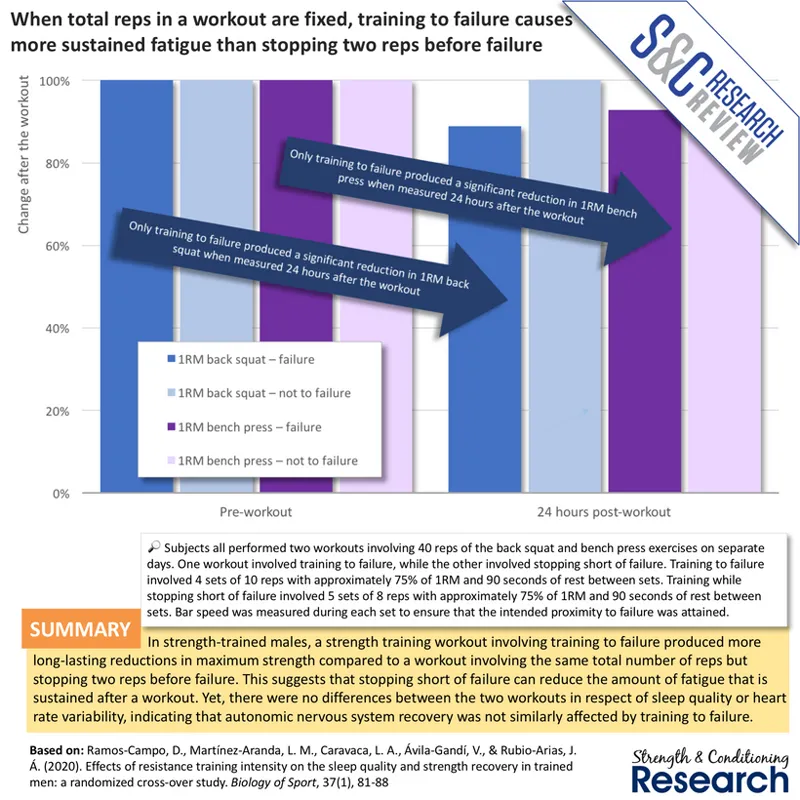
Similarly, training to failure is known to be more fatiguing and more muscle-damaging than training with a couple of reps in reserve. When using moderate loads, the final two reps appear to be the most fatiguing.
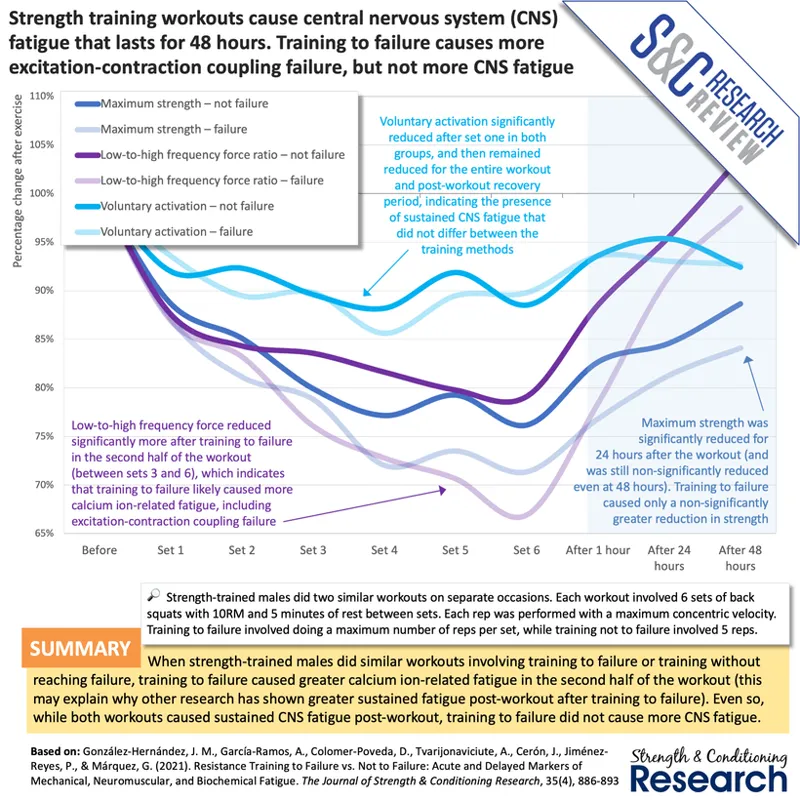
Indeed, when researchers have analysed the exact fatigue mechanisms that are responsible for causing more fatigue when training to failure, they have shown that calcium ion-related fatigue is greater when training to failure. This makes sense given that calcium ion accumulation is increased with longer durations of fast twitch muscle fiber activation.
Conclusions
High-volume training programs are very popular at the moment. Yet, post-workout fatigue mechanisms reduce our ability to produce [1] maximum levels of muscle fiber mechanical tension, and [2] maximum levels of motor unit recruitment. If we do another workout while post-workout fatigue is still present from our previous workout, the hypertrophy stimulus in that second workout is reduced. Training volume affects the amount of post-workout fatigue. When strength-trained lifters do bodybuilding-style workouts with moderate loads (6-15RM), it takes >4 days to recover from 8-10 sets (even when we leave some reps in reserve), >3 days to recover from 6 sets (again, while leaving some reps in reserve), and >2 days to recover from 4 sets to failure. We can definitely recover in <2 days if we perform just 2 sets to failure. Training with light loads (16-30RM) increases the required recovery times substantially such that even 1 set to failure requires >2 days. Thus, full-body programs cannot be done with 4+ sets per muscle group per workout, since they require full recovery after 2 days. They can probably be done with 1-3 sets per workout. And upper-lower splits cannot be performed with 6+ sets per muscle group per workout since they require full recovery after 3 days. They can probably be performed with 3-5 sets per workout.
Comments (16)
Hello Chris, when you say "2 days to recover from 4 sets" are you are talking about 48 hours ? For example i workout on monday rest tuesday and wednesday i workout again? Or is It 72hr? Train - Rest-Rest-Train Thanks for all this useful information you upload💎
Yes, 2 days is 48 hours
If this is a dumb question I apologize for my ignorance, but in a true full body split done 3x per week (like I’d imagine most are), are all muscles trained every session (quads, hamstrings, glutes, pecs, biceps, triceps, delts, etc) or can some muscles be hit less because of cross over from training other muscles (triceps from pressing, rear delts from rowing, hamstrings/glutes depending on hinge movement done, etc) ? Apologies if that was worded in a confusing way, but I see varying ways of doing it all the time.
I still have no words to express gratitude for everything I learn.
In the penultimate infographic Chris states: "training to failure is known to be less fatiguing...". Isn't it the opposite?
Typo, fixed
Great article!!!
Great article ! That makes so much sense
Should we consider the fatigue dissipation capacity of each muscle? The data you provided are general. As you mentioned, muscles with a higher proportion of fast-twitch fibers take longer to recover. Thanks for everything, and greetings from Spain.
Yes, see this FAQ: https://www.patreon.com/posts/recovery-rates-62989969
Regarding compound exercises, how much fatigue can they produce in smaller agonist muscles, such as the triceps in a bench press or the biceps in pull-ups? Would two sets of pull-ups count as one set for the biceps, for example? It’s difficult to determine, but it’s interesting to consider in order to avoid excessive fatigue accumulation.
I think that it really depends if you get your biceps near failure doing Pull UPS or if your lats are paired with you bíceps and they fail first If your biceps is +3-4 reps from failure that is a very low-fatigue set
Therefore, to maximize muscle hypertrophy with minimal fatigue, it would make sense to perform 1-3 sets per muscle per session every 2 days (since the hypertrophy process seems to last this long, after which atrophy occurs), with a repetition range of 4-8 and rest periods of at least 3 minutes.
Yep
Does the caloric surplus or deficit influence the quicker dissipation of fatigue?
There are studies showing that inadequate protein intake can delay the recovery process. However, I do not know of any studies that show a relationship between caloric intake and recovery rate.