




Focus of attention
Focus of attention refers to where we are consciously directing our thoughts while we are performing a movement or an exercise. Typically, focuses of attention are either external (directed towards a location in the environment such as a point on the wall or the floor) or internal (directed towards a part of our own body). An internal focus of attention is also called a mind-muscle connection in bodybuilding communities. External and internal focuses of attention display opposing physiological characteristics that make them useful for enhancing our ability to stimulate certain specific adaptations.
.
#1. Coordination
When we use an external focus of attention, our coordination is immediately enhanced. In contrast, using an internal focus impairs coordination. We know this from studies examining horizontal jump distance. In horizontal jumps, the angle of take-off is a critical determinant of jumping distance and it is immediately enhanced when using an external focus of attention.
It seems likely that the use of an external focus of attention does two things. Firstly, it provides information to our subconscious mind about the nature of the movement to be performed. By directing our conscious mind to look in the direction of travel during the horizontal jump, we are providing information to the brain that is useful and relevant to the movement. Secondly, it stops our conscious mind from interfering with motor control and permits our subconscious to make use of the principle of neuromechanical matching to perform the movement in the most efficient way possible. Since an internal focus of attention puts our conscious mind in control of our body, it impairs our ability to control the movement normally with the subconscious. Achieving a superior motor program during exercise workouts is a key stimulus for improving coordination long-term, which makes using an external focus of attention essential for anyone wanting to improve their coordination in any movement.
#2. Antagonist coactivation
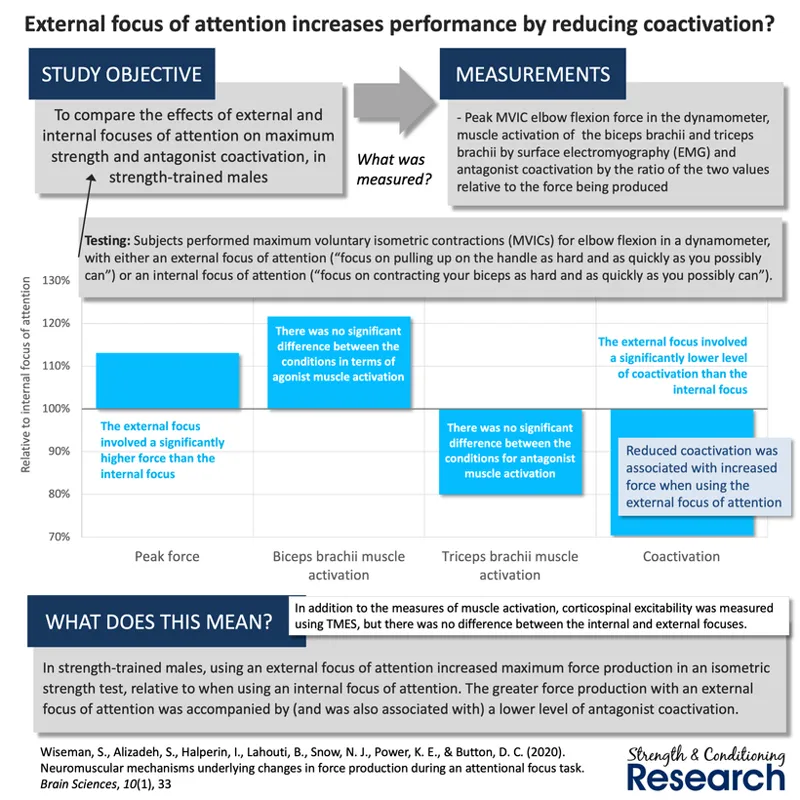
When we use an external focus of attention, our antagonist coactivation levels are immediately reduced. In contrast, when we use an internal focus, the opposite is the case. It is thought that achieving a lower level of antagonist coactivation than normal is the key stimulus for reducing antagonist coactivation levels during long-term training programs. Hence, we might expect that training with an external focus of attention would lead to greater gains in exercise performance over time in part by means of greater reductions in antagonist coactivation.
#3. Agonist motor unit recruitment
When we use an internal focus of attention (which is also called a mind-muscle connection), our levels of agonist motor unit recruitment are immediately enhanced. In contrast, using an external focus reduces these levels. We know this from studies examining maximal effort strength training exercises and simultaneously measuring muscle activation levels. Agonist muscle activation levels are reduced with an external focus of attention (despite better exercise performances measured by AMRAP) and increased by an internal focus of attention (despite worse exercise performances measured by AMRAP).
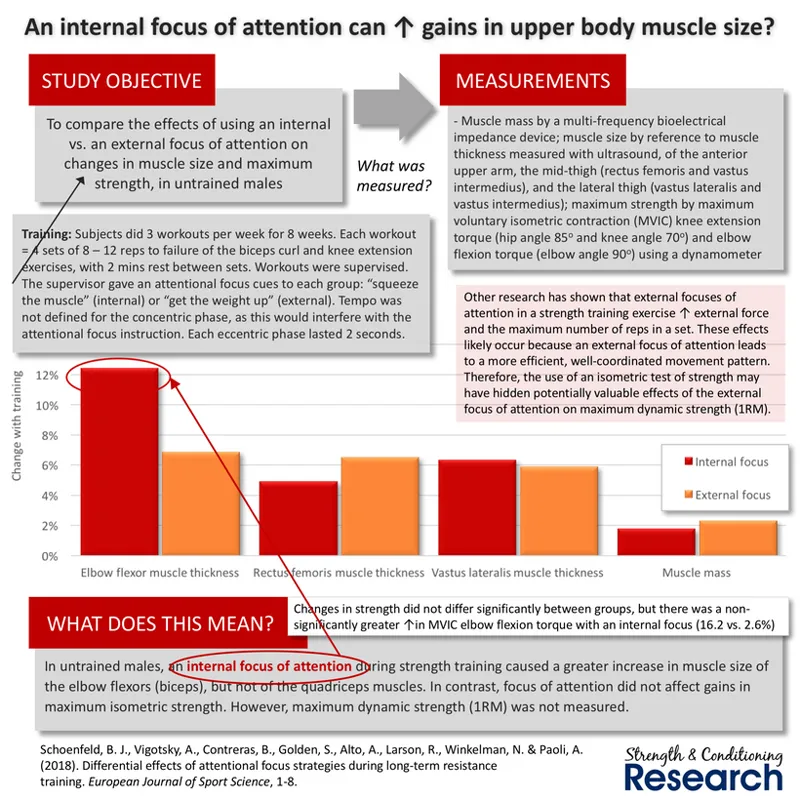
This can explain why internal focuses of attention lead to more hypertrophy (because greater agonist motor unit recruitment means more activated muscle fibers) while simultaneously very commonly causing smaller exercise performance gains (because reduced coordination and reduced antagonist coactivation during exercise means smaller adaptations in coordination and antagonist coactivation, which are key to changes in efficiency).
Also, since we know that achieving a high level of agonist motor unit recruitment is the key factor driving adaptations in motor unit recruitment, we might expect an internal focus of attention to be superior for causing this adaptation as well. Indeed, research has shown that heavy loads (which involve higher levels of motor unit recruitment) are far better at triggering gains in motor unit recruitment than lighter loads.
Conclusions
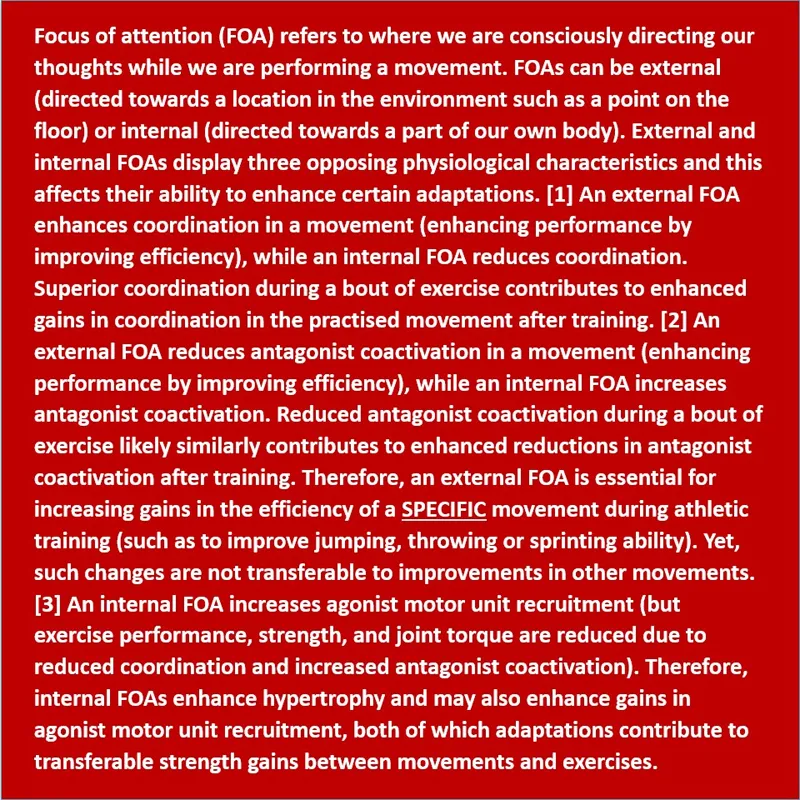
Focus of attention (FOA) refers to where we are consciously directing our thoughts while we are performing a movement. FOAs can be external (directed towards a location in the environment such as a point on the floor) or internal (directed towards a part of our own body). External and internal FOAs display three opposing physiological characteristics and this affects their ability to enhance certain adaptations. [1] An external FOA enhances coordination in a movement (enhancing performance by improving efficiency), while an internal FOA reduces coordination. Superior coordination during a bout of exercise contributes to enhanced gains in coordination in the practised movement after training. [2] An external FOA reduces antagonist coactivation in a movement (enhancing performance by improving efficiency), while an internal FOA increases antagonist coactivation. Reduced antagonist coactivation during a bout of exercise likely similarly contributes to enhanced reductions in antagonist coactivation after training. Therefore, an external FOA is essential for increasing gains in the efficiency of a SPECIFIC movement during athletic training (such as to improve jumping, throwing or sprinting ability). Yet, such changes are not transferable to improvements in other movements. [3] An internal FOA increases agonist motor unit recruitment (but exercise performance, strength, and joint torque are reduced due to reduced coordination and increased antagonist coactivation). Therefore, internal FOAs enhance hypertrophy and may also enhance gains in agonist motor unit recruitment, both of which adaptations contribute to transferable strength gains between movements and exercises.
Comments (1)
In the text attached to the infographic «An internal focus of attention can ↑ gains in upper body muscle size?» could it be that where it appears “reduced coordination and reduced antagonist coactivation”, it should refer to “reduced coordination and increased antagonist coactivation”? I apologize if I'm wrong.