




Muscle fiber size plateaus
It is widely accepted that beginners achieve more rapid hypertrophy than intermediate and advanced lifters. Indeed, the exercise science literature has confirmed this belief. Even so, it is contentious exactly why this happens.
.
#1. Hypertrophy is greater in untrained lifters partly because of an absence of distal region muscle growth (and an absence of fascicle length increases)
Importantly, hypertrophy differences between untrained and trained lifters are not identical along the entire length of a muscle. Trained lifters display zero increases in distal region muscle size, but untrained lifters display substantial growth in this area. Distal region hypertrophy is often caused by an increase in muscle fascicle lengths due to an increase in muscle fiber lengths (which is called sarcomerogenesis).
.
Sarcomerogenesis is caused by passive mechanical tension during eccentric contractions and contractions at long muscle lengths. Even so, the ability to generate this passive mechanical tension is dependent upon training status because adding more sarcomeres reduces the stretch experienced by each sarcomere. Thus, one of the key differences between untrained and trained lifters that affects the amount of hypertrophy that is experienced during training is this ability to produce sarcomerogenesis. Indeed, this is why muscle fascicle lengths very rarely increase after strength training in trained lifters (unless they are unfamiliar with the exercise being used).
.
Indeed, muscle fascicle lengths always reach a plateau after only a few months of strength training.
.
#2. Hypertrophy is greater in untrained lifters partly because of the presence of muscle growth in the lower high-threshold motor units
Recently, it has become clear that only the action potentials of high-threshold motor units increase after strength training. In contrast, the action potentials of low-threshold motor units do not. This likely reflects increases in muscle fiber diameters of only the high-threshold motor units. The fibers of the low-threshold motor units very likely do not grow.
.
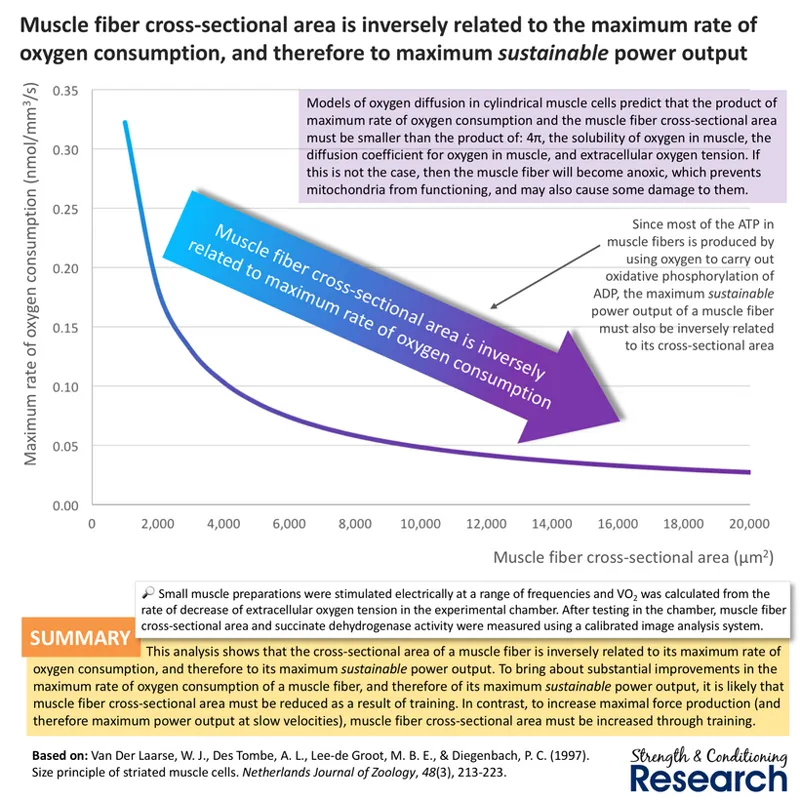
The lack of growth in the muscle fibers of the low-threshold motor units has been ascribed to the size principle of striated muscle. A corollary of this principle states that muscle fibers will only increase in size up to a certain diameter dependent upon their oxidative capacity. The greater the oxidative capacity, the smaller the maximum possible size. This explains why the muscle fibers of low-threshold motor units are unable to grow after strength training even though they are usually much smaller than the muscle fibers of high-threshold motor units. They have reached a plateau and cannot grow any further.
.
The same phenomenon likely occurs in the muscle fibers of the high-threshold motor unit pool. In the high-threshold motor unit pool, there are motor units at the lower end of the pool that mainly contain slow twitch muscle fibers. These muscle fibers will stop growing at smaller maximum sizes than the muscle fibers of the higher high-threshold motor units. Therefore, it seems very likely that the slower rate of growth in trained lifters is partly caused by the absence of growth of some of the more oxidative high-threshold motor unit muscle fibers.
.
Indeed, when looking at the growth in muscle fibers of different fiber types, there is a substantial difference in the amount of hypertrophy that occurs over several months of strength training between type I, type IIA, and type IIX muscle fibers. The growth in the type I muscle fibers is very much smaller than the growth in the type IIA and type IIX muscle fibers and this seems to be linked to their size at the start of the strength training program, indicating that plateaus are occurring.
.
Conclusions
It is well-known that untrained lifters typically display faster muscle growth than trained lifters. However, exactly why this happens is contentious. One possible contributor is the absence of sarcomerogenesis in trained lifters. When studies have compared hypertrophy in trained and untrained lifters, they have noted an absence of distal region growth in the trained group despite robust increases in the size of this area in the untrained group (distal region hypertrophy is often an indicator of fascicle length increases). In support of this, many studies have shown that fascicle lengths do not increase in trained lifters after strength training, and studies tracking changes in fascicle length throughout a strength training program always show plateaus occurring after only a few months of training. Another possible contributor is reduced growth in the lower high-threshold motor units of trained lifters due to fiber type-specific plateaus in muscle fiber size being reached. In support of this, we know that the muscle fibers of low-threshold motor units cannot grow after strength training due to reaching their maximum possible size. The maximum possible size of a muscle fiber is likely determined by the size principle of striated muscle, which also tells us that more glycolytic muscle fibers can reach larger maximum sizes than more oxidative muscle fibers. From these observations we can see that both [1] the size of a muscle fiber at the start of a strength training program, and [2] its oxidative capacity will influence its ability to grow after strength training. In line with this, long-term training studies have shown that muscle fibers do indeed display much more hypertrophy when they are [1] smaller, and [2] more glycolytic at the start of a training program.