




Weekly Net Stimulus
The hypertrophy of a muscle is maximised when we achieve the highest Weekly Net Stimulus across multiple workouts. Let us consider exactly how to calculate this metric in this article.
.
#1. What is the Weekly Net Stimulus?
The Weekly Net Stimulus can be defined as the sum of the Workout Hypertrophy Stimuli less the Weekly Atrophy Effect. The Workout Hypertrophy Stimulus is the amount of muscle growth (expressed in arbitrary units) that is stimulated by the sets performed for the relevant muscle group. Various factors can affect the size of this stimulus but we are going to focus mainly on the impact of training volume (the number of sets to failure or the equivalent in terms of the number of stimulating reps). The Weekly Atrophy Effect is the amount of muscle mass that is lost (again, expressed in arbitrary units) in the time outside of post-workout stimulus periods caused by the individual workouts. Importantly, the Weekly Net Stimulus can only be calculated for training programs that do not involve fatigue accumulating. To see whether a volume-frequency combination is possible without fatigue accumulating, refer to the following chart, which shows how long it takes to recover from a certain workout volume (assuming moderate loads to failure).
.
#2. How can we calculate the Workout Hypertrophy Stimulus?
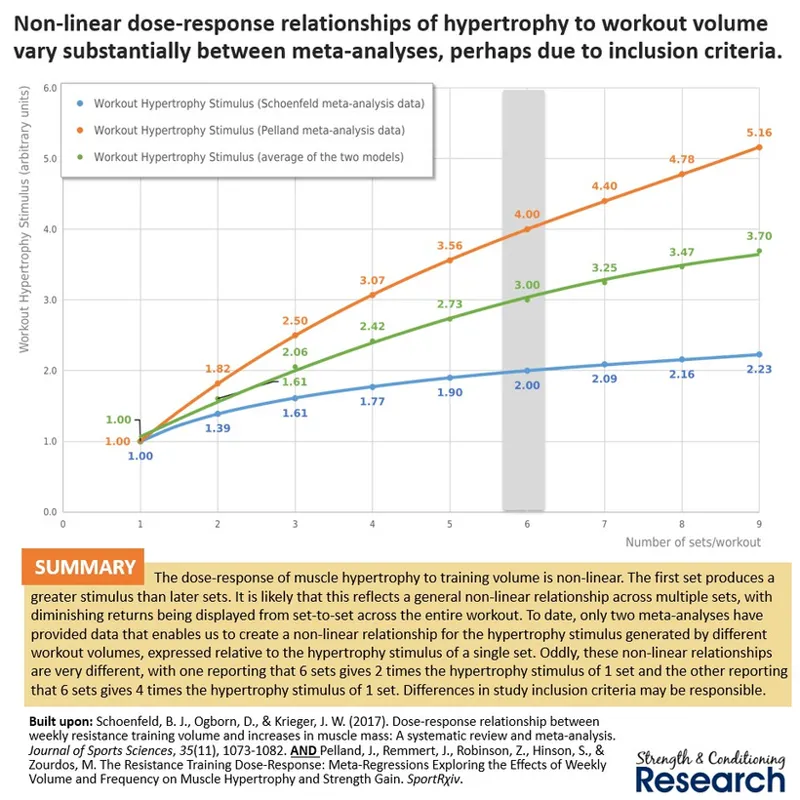
The Workout Hypertrophy Stimulus is the amount of muscle growth (expressed in arbitrary units) that is stimulated by the sets performed for the relevant muscle group. We can calculate the magnitude of the Workout Hypertrophy Stimulus in arbitrary units where one arbitrary unit is the amount of hypertrophy stimulated by one set at the start of a workout in an unfatigued state. Dose-response meta-analyses can then be used to quantify the hypertrophy stimulus of all of the other sets in the workout, following a non-linear curve. If we choose, we can add in a term to represent the negative impact of muscle damage, which reduces the hypertrophy that is produced by the highest workout volumes. Nevertheless, in most cases, this adds a great deal of complexity and uncertainty without really affecting the calculations that much.
Bear in mind that as new meta-analyses are performed that provide new data, we can update the values for the Workout Net Stimulus. Recently, researchers produced a new meta-analysis with a much steeper curve (likely due to the different selection criteria for the studies included). You can use whichever numbers you prefer (in reality, the practical results do not vary so long as there is a diminishing returns effect).
.
#3. How can we calculate the Weekly Atrophy Effect?
The Weekly Atrophy Effect is the amount of muscle mass that is lost (again, expressed in arbitrary units) that occurs in the time outside of post-workout stimulus periods caused by the individual workouts. The maintenance literature can be used to help us quantify the exact quantity of muscle mass that is lost in arbitrary units because maintenance only occurs when muscle mass gained by the weekly workouts equals muscle mass lost between workouts.
The maintenance literature shows us that a single workout comprising three sets to failure performed once per week is sufficient to maintain our current hypertrophy. In practice, this means that muscle mass equivalent to three sets to failure of stimulus is lost over a 5-day period of time (a week comprises 7 days but 2 of those days are within a stimulus period).
Conclusions
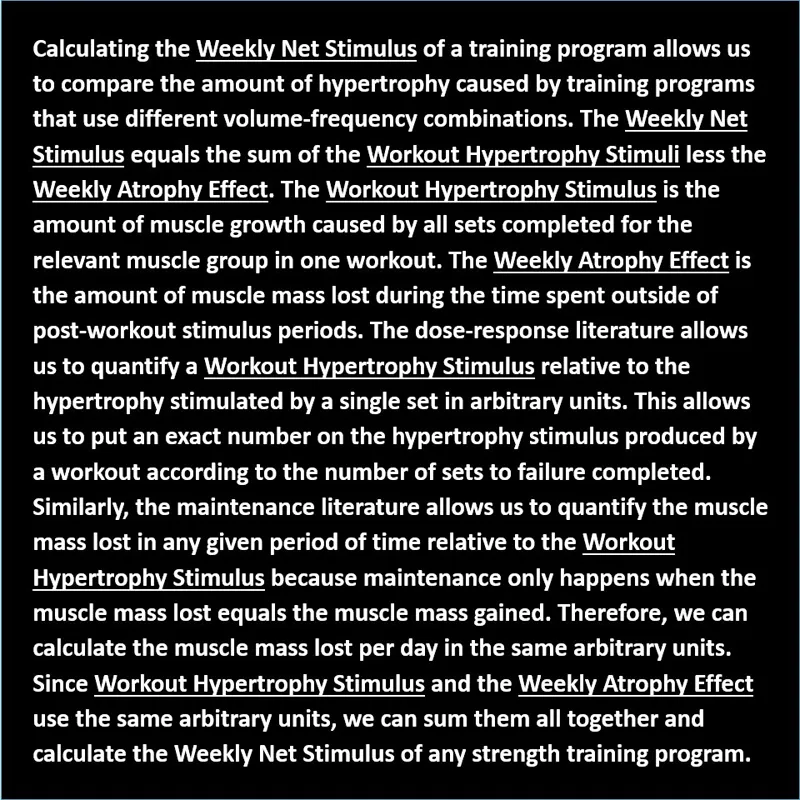
Calculating the Weekly Net Stimulus of a training program allows us to compare the amount of hypertrophy caused by training programs that use different volume-frequency combinations. The Weekly Net Stimulus equals the sum of the Workout Hypertrophy Stimuli less the Weekly Atrophy Effect. The Workout Hypertrophy Stimulus is the amount of muscle growth caused by all sets completed for the relevant muscle group in one workout. The Weekly Atrophy Effect is the amount of muscle mass lost during the time spent outside of post-workout stimulus periods. The dose-response literature allows us to quantify a Workout Hypertrophy Stimulus relative to the hypertrophy stimulated by a single set in arbitrary units. This allows us to put an exact number on the hypertrophy stimulus produced by a workout according to the number of sets to failure completed. Similarly, the maintenance literature allows us to quantify the muscle mass lost in any given period of time relative to the Workout Hypertrophy Stimulus because maintenance only happens when the muscle mass lost equals the muscle mass gained. Therefore, we can calculate the muscle mass lost per day in the same arbitrary units. Since Workout Hypertrophy Stimulus and the Weekly Atrophy Effect use the same arbitrary units, we can sum them all together and calculate the Weekly Net Stimulus of any strength training program.
Comments (12)
Hello Chris, how would you calculate the difference between 3x1 Sets per week at 0RIR against 3x1 Sets per week at 1RIR? I now understand the Logic behind your calculation, but i dont know how to calculate with Reps un Reserve. Thank you very much!
The effective repetitions model suggests that we should do at least 25 effective repetitions per muscle group per workout. However, the current suggestion, for a Full Body workout, is 1 to 3 sets per muscle group, with 5 to 7 maximum repetitions, with 1 repetition in reserve, this will generate between 4 and 12 effective repetitions and this, over three workouts a week, will generate between 12 and 36 effective repetitions a week. Is it more important to worry less about generating effective repetitions and keeping myofibrillar protein synthesis high or for longer (less atrophy) or to worry more about generating effective repetitions and maintaining less myofibrillar protein synthesis time (more atrophy)?
"the effective repetitions model suggests that we should do at least 25 effective repetitions per muscle group per workout" - I have no idea where that idea comes from but my stimulating reps model just says that hypertrophy is caused by the combination of [1] muscle fiber activation, and [2] single fiber mechanical tension. It's an explanation of how muscle growth happens, not a training program template.
Hola Chris, me pregunto, cuando se le pauta a una persona (principiante) series con un RIR, tomamos en cuenta solos las repeticiones estimulantes? en dos series con un RIR 2, tomaría solo las estimulantes, es decir 6 repeticiones estimulantes aproximadamente? lo que sería aprox a una serie efectiva?
Hi Chris. I wonder how we could connect this with the decline of the growth rate troughout the years. I guess, we gonna see less gains from sets with time. Which means atrophy can be very very detrimental and critical for advanced trainees. Instead of chasing stimulus they should really minimize fatigue and train as frequently as possible. Or, if the data is built upon advanced lifters, then we gonna see more gains in novices and intermediates. Am I right to conclude so? Thank u for the post and amazing podcast on the topic!
"atrophy can be very very detrimental and critical for advanced trainees" - yes I agree, this is exactly what I explain in my mentorship course (I don't think there is yet an FAQ on the topic)
I know muscle damage is an important factor in this model. Would a set of 2 reps 0RIR cause similar muscle damage to a set of 5-6 reps 0RIR? In other words, for recoverability only, can we consider these 2 equivalent?
2RMs probably do not cause any muscle damage. 6RMs probably do cause muscle damage. IMO, I think that 1-4RM can be done to failure without causing muscle damage, while 5-7RMs probably need at least 1RIR and 8-12RMs need 2RIR. Higher than that and the necessary RIR starts to look a bit pointless given the very low stimulus per set being achieved.
Im in paul carters Yoke Squad program and he programs two static rest days every weekend. According to this as well as the frequency data just below, if im training a maximum of two sets per muscle and using low reps and monitoring my intensity are those two rest days necessary? Wouldn't doing an upper lower rest repeat with alternating rest days be better as the weekly net stimulus would be greater? Or do i need to program more restdays in order to combat something other than fatigue (Im assuming i can recover in two days given the post under this)
I would expect that the 2 rest days are being programmed because most people want a program that runs throughout one week. This post shows how long it takes to recover from each volume of sets (assuming moderate loads, not heavy loads). https://www.patreon.com/posts/strength-102633917
Great work Chris! I think the interesting follow up question to all this would be, how much less effective are later sets in a workout when training DIFFERENT muscles compared to earlier sets. For example, Upper/Lower or Full Body splits mean that it is harder to program all of the muscles in the beginning of the workouts. The answer to this problem is probably just using different mesocycles to specialize different muscle groups. However, if possible, it would be interesting to know the difference of the stimulus (in arbitrary units for example), to help with creating these higher frequency programs.
The exercise order effect, yes. Very difficult to quantify at the moment given the small number of studies that have assessed it. https://www.patreon.com/posts/exercise-order-86133376