


Sadie Gets a Life 0.3.0 Dev Log, 2026-03-05
Release 0.2.7 is now in the books. That was a big one, as it involved wrapping up Act II and moving forward the plot. I haven't received any bug reports on the new content (yet?), though if you do find any bugs, please do report them and I'll aim to get them fixed as soon as I can.
Now, 0.3.0. There are no two ways about this: it's going to be a huge release, to the point where I might have to delay its official release date. More on that next week as I have a better feeling for whether it will be good enough to ship on the four-week schedule or if it needs two more weeks to bake. But let's talk about some of the reasons why I'm having this inner debate.
The Combat System
My vision for this game is to have thoughtful combat, where there are explicit trade-offs in going all-in on specific skills or trying to keep a variety of skills at roughly similar levels. My first go at it wasn't awful, but it was obvious that I didn't have the play balance right. Combat basically devolved into "Use 52-Card Pickup and Cheerlead at the beginning of combat, then spam Double Attack, Blizzard I, Axe Sweep, and Psychic Strike/Seduce until enemies go away." I think there were three main reasons why that became a dominant strategy:
Enemies had no relative strengths or weaknesses. Yeah, different enemies have different physical and magical defense rates, but at the end of the day, the damage formulas meant that how you did the damage rarely mattered. Near the end of Act II, I started getting a bit cleverer around making certain enemies strong or weak against certain elements, but it was obvious that this wouldn't be enough.
Certain skills were overpowered. They do a lot more damage per MP/TP than others, whether directly or as an enabler. It's okay for some skills to be somewhat more successful than others, but there has to be a reason to spread usage around.
Skill leveling was overpowered. The idea of skill leveling is one that I love: you can improve your characters by leveling them up, but also by practicing specific skills. I think it's a clever way of mixing a bit of quiet storytelling in with the combat system. The problem is that I didn't have a great feel for how things actually scale, and it turns out that my growth multipliers overwhelmed natural growth, so it incentivized people to narrow in on a very small number of skills. There's a corollary that I'll get to in the next major section around spellcasting as well, but for now, I'll focus on combat.
Thinking through these problems, the solutions that I've come up with are:
Make skill types more relevant. In the game so far, we basically had five major categories. The first was Physical attacks, which covers pretty much everything non-magical. In addition, we had Ice, Water, Fire, and Lust magic. In 0.3.0, I can announce that there will be 14 separate skill types. 14 is a lot, and you won't see all 14 for quite some time. In practice, the revamped Acts I and II will introduce to you eight skill types.
On the magic side, it's the same set: Fire, Ice, Water, Lust.
On the physical attack side, I'm introducing three types of attack: Blunt, Slash, and Pierce. I'm replacing the standard Attack with a choice of those attack types, with skill names depending on the character. For example, Sadie's set of core attack skills are called Claw Jab (pierce), Elbow Slam (blunt), and Gouge (slash). Neemar has Poke (pierce), Smash (blunt), and Slash (slash). Mages like Karin only have one physical attack type: blunt damage. But Karin now has three skills that combine Ice magic with physical attack types, so she has Ice + Pierce, Ice + Blunt, and Ice + Slash at her disposal.
Sadie also has a Psychic skill type. Her Psychic Strike has been broken out into three separate skills. One does Psychic + Blunt, one Psychic + Pierce, and one Psychic + Slash.
Importantly, enemies will be relatively stronger or weaker against certain skill types. Some enemies will be strong against Blunt but weak against Pierce. Others will be strong against all physical attacks but weak against Ice magic. And so on. If you're wondering how you could possibly know who's strong or weak against what, stay tuned and I'll get to that in the next Dev Log!
Provide benefits to using more skills. The only reason to use Attack was to build up enough TP to perform the cool skills. To counter that, I will introduce small benefits to using the attack skills. Pierce attacks have a chance of reducing enemy defenses by 20%. Slash attacks have a chance of making an enemy bleed (5% damage per turn). Blunt attacks have a chance of stunning an enemy for a turn. Now, these effects only happen about 3-5% of the time, but I think they add a bit of variety to the game. Additionally, I'm introducing skill cooldowns for the most powerful and important skills. Want to perform a double strike? Great. But it has a one-turn cooldown, so you'd better pick something else the next turn.
In addition to making enemies relatively stronger or weaker against specific skills, I need to keep skill levels from blowing out of proportion. The idea of skill levels is great, but the formulas were too skewed. And that's where I'm going next.
Combat Calculations
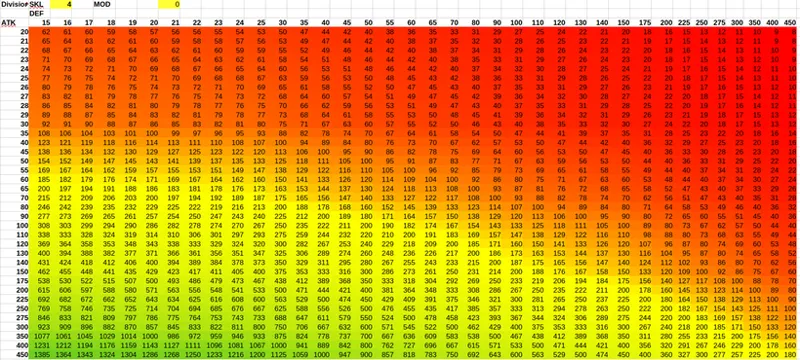
The default combat formula in RPG Maker is linear in nature: 4 x Attack - 2 x Defense. It's an easy formula to understand, but has some significant negative characteristics. This is what the formula looks like in practice.
You're welcome to squint and pick out the exact values, but the colors tell the story. You can kind of break this out into four zones. In the top-left, you have weak against weak, which the conditional formatting makes orange. Once you get to about 40 defense or so, you start getting into the red wall, where you do almost no damage. There's a band of yellow that starts off almost flat, but then gets squeezed further and further as our attack and defense values increase. And the green zone is the very bottom of the chart.
With a chart like this, the strategy is less about defense and more about offense. Sadie's Cheerlead, which increases Attack by 25%, has a huge advantage for players. Picking an arbitrary point on the curve, let's say Attack = 40 and Defense = 35. A normal attack would expect to do 90 points of damage. With Cheerlead boosting attack by 25%, you now do 130 points of damage. With two rounds of Cheerlead giving a 50% Attack boost, that's now 170 damage per turn, almost doubling the effective power. Add in two rounds of 52-Card Pickup and you're looking at 60 Attack vs 18 Defense, or an expectation of 204 points of damage per turn.
Now, in practice, I didn't use this same formula for everything. Skill levels come into play, re-weighting things differently. I also used somewhat different weights for certain skills, so the answer isn't quite this trivial. But it's close enough to follow along.
The new base formula for attack is very different in nature: it's multiplicative rather than additive. For a basic attack, it's (4 x Attack) / ( 1 + 0.025 x Defense). This leads to a combat curve that looks more like the following.
Importantly, the formula I'm showing in this chart is not exactly the same as what I listed above, as I have tweaked it a little bit during playthrough. But what we see is a somewhat different-looking visual. We have four bands: a red band along the top and right, feeding into an orange band, then a yellow band, and finally a green band. In each band, both attack and defense matter. Using the examples from before, 40 attack vs 35 defense would net us an expected 94 points of damage, very close to the original. With Cheerlead, we get to 50 Attack, or 118 expected damage. With double Cheerlead and the 50% attack buff, 60 Attack would give us 141 expected points of damage. In practice, we have sub-linear growth in benefits from increasing Attack. A 25% attack boost gets us ~91% of the benefit that we got in the prior system. A 50% attack boost nets us about 83% of what we could have gotten before. In other words, we're reducing the incentive to double up on buffs.
At the same time, defensive buffs are a bit more powerful. With double Cheerlead and double 52-Card Pickup, we're looking at 60 Attack vs 18 Defense, or an expectation of 176 points of damage per turn. That's about 86% of the damage that we could do before, and just under double damage versus no buffs.
Looking at defense reduction, one round of 52-Card Pickup at 40 Attack vs 35 Defense gets you roughly 14% more damage, and two rounds get you 25% more damage. Buffing Attack is still more important than debuffing Defense (Cheerlead gives you 25% and 50% more damage, respectively), but those debuffs are a bit better now.
When you factor in skill levels, here's how things look in general, with the caveat that certain skills can place status effects or have other reasons to be relatively weaker or stronger in terms of sheer damage output.
For a basic attack like Sadie's Claw Jab: Attack x (4 + (0.05 x Skill Level)) / (1 + 0.025 x Defense)
For a skill that uses Technique Points like Neemar's Quick Pierce (pierce two random foes): Attack x (4 + (0.15 x Skill Level)) / (1 + 0.02 x Defense). The skill level bonus is 3x a normal attack because you'll be using normal Attacks a lot more often and level them up faster. The bonus to defense is slightly lower than what you see on a basic attack because I want skills to be just a little bit better than equivalent attacks.
The Magic System
Magic is a special case here. The default way that RPG Maker handles magic is to start with a constant, like 100, and then take magic attack and magic defense into account. For example, the formula to Ice I is 100 + 2 x Magic Attack - 2 x Magic Defense. This formula means that magic is very powerful when players and enemies are weak, but gets relatively weaker as magical attack and defense grow.
But I threw in a curveball with skill levels. It turns out that, by pushing specific skills (e.g., Blizzard I or Recover I) hard, you could get to the point where Blizzard I or Recover I is more powerful than Blizzard II or Recover II. At that point, what's the actual benefit of Blizzard II?
That's why I eliminated the I/II/III nomenclature for magical skills. There's one Heal, one Recover, one Ice, one Blizzard, etc. The way you increase its power is simple: increase the skill level.
Additionally, the formula for magic has changed a bit.
For single-target magical spells, the basic formula is: (100 + (4 + 0.15 x Skill Level) x Magic Attack + Player Level ^ 1.25) / (1 + 0.02 x Magic Defense)
For multi-target magical spells, the basic formula is: (75 + (2.6 + (0.15 x Skill Level) x Magic Attack + Player Level ^ 1.25) / (1 + 0.02 x Magic Defense). The magic attack multiplier drops, as does the base damage amount. This is to balance out the fact that these are multi-target spells intended to hit multiple foes.
For healing spills, the basic formula is: 250 + 20 x Player Level^1.25 + (0.75 x (1 + Skill Level) x Magic Attack). This starts off at a nice floor so early heals aren't too punishing, but it scales with the team.
An important thing to note is that player level comes into play for spells. This helps keep spells relatively competitive, as that fixed bonus of 75-250 doesn't mean much when everybody has 2500HP. In practice, my playtesting indicates that healing spells are quite generous (and I might actually nerf it a little bit before the 0.3.0 release), whereas magic spells keep up with attack skills pretty well.
Conclusion
Whew! That was a lot, and it's a small fraction of what's already in my early build of 0.3.0. In practice, my experience is that combat is a bit trickier in some parts of the game, and I think it ends up being more rewarding as you don't just spam the same two or three moves over and over.
Also, Cheerlead just got nerfed as I was writing this conclusion. After doing the math above, I had to increase the TP cost from 10 to 20. It's just too good.
In the next post, I'm going to show off some quality of life improvements coming in 0.3.0.