
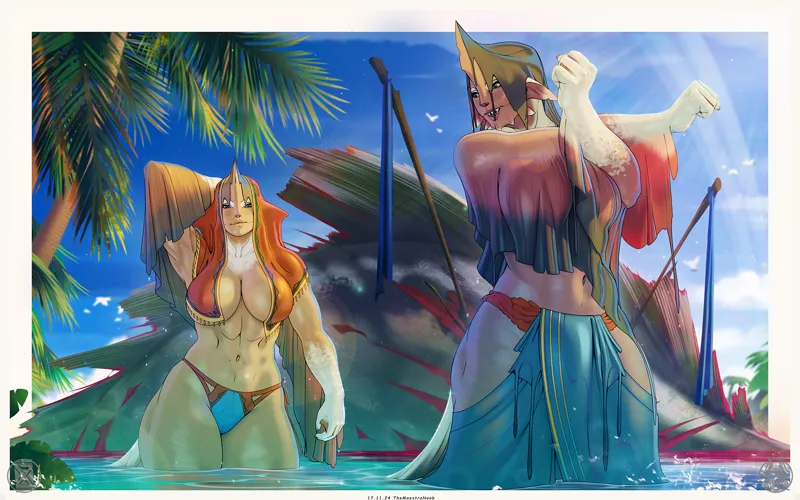
Dova / Resolute but Reckless
Typically, a biological affinity with aquatic creatures is frowned upon by most people, but today the Dova are known as the Sea People and the Ghosts of the Ocean – and not in a foul way. Even so they openly display predatory aggression toward less intelligent species, the Dova are actually one of the kindest tribes towards the others: cheerful and blithe in mind, holding their heads high, altruistic, and the first to sacrifice themselves for another kin. Almost motherly, they are especially protective of smaller sistren. Whence, it often feels as if they treat us as children, disregarding our opinions as immature and viewing all our actions as mere child's play. They even perceive hostility as easy as a game – as soon as you declare a Dova an enemy, they will undoubtedly consider themselves your enemy, but they will not see you as their enemy, and it is so facile it is to end such a conflict simply by accepting their friendly mighty hand.
As the Dova population grew, some clans decided to venture elsewhere, spreading along newly discovered seas and isles. Other tribes and nations claim to have been the first to settle on various coastlines, but the eroded sites of primal villages built by the Doven ancestors can still be discovered in many secluded areas. With no traces of burial grounds or mass extinctions, the Dova themselves believe that their ancestors didn't find these beaches inspiring enough to stay, so they returned until the Meority grew large enough to re-settle again.
A great deal remained on the shores of the Waist and Thigh Regions to “watch over” other tribes, but a considerable number settled on the Tail Continents, and especially the Tail Archipelago. This was Her Gorgeousness that had been Crumbling for the longest period, accompanied by many emerging problems. Aside from foraging native wild stubborn trees, continuous large-scale agriculture was barely possible on soil so unstable; no town would stand for long before the ground beneath it crack; and while fishing near these islands was already dangerous, it became even more challenging when the Serpent's spawn began making lairs there. Other tribes adjourn any attempts to settle the Tail Archipelago even in the current era, as we now recognize its perilous proximity to the Ocean of Mud... except the Dova: they are people of action and obstinate courage, yearning for risks and unpredictability, especially when it comes to protecting others. The Doven spirit is stubborn, made of contest and rivalry with the nature and existence itself, they challenge the tremendous or die while trying – “The worth of our lives should be measured by scars”, they say, and fortunately for them, there is no greater challenge now than the Ocean… and what slumbers deep beneath it… Besides, they deserve hunting grounds they can have entirely to themselves.
The Dova of Tail Archipelago organized a nomadic culture: a few villages were build, inhabited by a small number of permanent families who tended the shores, while the rest moved regularly between these villages following the seasonal fish migrations, the fruiting of the forests, and the occurrence of the Envasions.
Besides the fact that even mainland Dova prefer to live on the salty shores of the open seas, where other tribes rarely bother them, they are culturally somewhat removed from the rest of Meority: they have no interest in most technology or science, utilizing only very few items that are most useful to them, like diving gear, watercraft, simple tools, or weapons. However, the most visible difference and a way to understand the Dova mindset is to become aware of their manner of dress. The only time you see a Dova wearing anything tangible is if it's profession-related, but they're not interested in many of the “peaceful” professions of normal society, nor there is a tendency to remodel uniform designs for them. Dova make their own clothing from tanned and dyed fish skin or kelp fabric, which are very light but durable in water; its primary functionality is to shade the gills from dirt while swimming, serve as a means of self-designation, maintain moisture on land, and display trophies. These clothes are so minimalist and unseemly revealing in their structure because Dova do not understand the concepts of indecency – they dismiss it, thinking that other tribes just don’t appreciate the muscles and physical strength at their true value, because we will never be as physically powerful as Dova. For that, they can regularly be seen nearly naked in public, oblivious to what smaller sistren will sight. And when their futales start getting their blood pumping while bodybuilding... there is a lot to witness...
Nevertheless, during the early Age of Crumbling, the Dova made a significant contribution to the lives of the people who lived around the Sea of Birth, and the other tribes commend them for this. In those times, when survival was harsh and people began to indulge into superstition, parents told their children stories of ghosts emerging from the sea, so that they would not be afraid to seek aid from them – the Sea People who came to the rescue. They could protect against evil creatures of the deep ocean, feed the hungry, help rebuild after disasters, and impose peace on sworn enemies. Parables and myths about their deeds have survived to this day, and many folklore figures are based on the ancient achievements of Dova kin.
One of such legendary folklore figures would be the generous Ghost of Grandma Zanada Graza, the gift-giving emissary of the Allmother. On the last night of every month, she rewards virtuous kids who obey their parent: emerging from the ground as if from the ocean itself, she leaves gifts under the beds where they sleep. But those children who dare to stay awake disappoint her the most and are dragged into a bottomless abyss for punishment. Thus arose a long-standing tradition whereby parents reward their children under the guise of Grandma Zanada, and, of course, the more helpful and obedient the kids are, the great are “her” presents.
***
The massive frills, for which the Dova are called “Ghosts”, are very light and have a natural implementation in the water: they use their arms mostly to grab and hold prey before biting into it with the deadly jaws, and at the moment of such an attack, the frills lag behind the body’s movements, concealing their limbs and disorienting the prey. Additionally, Dova can propel themselves through the water at high speed using rapid, undulating, mirrored movement of their twin tails, and these motions, together with their frills, make Dova appear visually longer and bigger, deceiving other predators as to where to bite… before it is already too late.
On land, Dova secrete an oily sweat to protect their dermis and scales from drying out. As they require regular skin moisturization to stay comfortable on land for extended sessions, the Dova tribe does not live in areas where they are not guaranteed to get access to saline water on demand, or at least where the humidity is high or rains are regular. Temperature is not major concern for them – the blubber layer can easily lose or gain fat to adapt to different biomes and seasons.
Dova do have a set of gills, but they're used only to help them stay submerged longer, not to live underwater, as some believe. They can swim freely at depth for over an hour without relying on gills, and almost three hours if they actively use them (but with modern diving equipment, they can stay underwater indefinitely). Dova are capable of this because their bodies maintain high amount of myoglobin and a larger blood volume than it actually seems. Since Dova depend on their twin tails for active swimming, these muscles accumulate more myoglobin to stay fresh for prolonged periods.
As a protection to their powerful circulatory system, Dova have developed a strong immunity against many natural toxins, paralyzers, and unnatural-made poison. Some ancient text claim that Dova could consume raw Umbral Flesh and survive. The veracity of this claim cannot be confirmed, as the consumption of the Serpent's offspring was forbidden long ago... but no one has ever seen Dova to become Hellgrafted. It’s as if not just their minds reject the Evil, but their physique as well.
***
Having mention that, the same production of antitoxins inside the body of the Dova wields a side-effect in the form of a long-term overdose of the organ with hormones, which, as expected, forces sharply different psychological behavior between futales and females.
Futales experience a rising urge to demonstrate the quality of own might, to prove themselves to be the ultimate hunters and protectors. When hormone levels are low, they only flex their muscles, test the limits of own physiques, or spar with each other; of course, they are not eager to challenge othertribe sistren, as they do not consider any of us sufficiently “dangerous” or “powerful” compared to the Dova’s perfect anatomy. However, when hormone levels are really high, Dova futales depart their homes to hunt. They may swim for weeks and hundreds of kilometers to find the biggest ocean monster, then tote its carcass back to shore to flaunt their accomplishment. But if another futale secures a greater game, go off again to hunt for even larger prey, disappearing for several more weeks or dying deep in the Ocean, which the Dova still accept as a fitting result to their own weakness and inability to protect others from future dangers.
Females are prone to hunt sea creatures themselves, but under the hormonal highs, they feel an unstoppable desire to be mothers and nurture children. However, if a female Dova is still childless, her brain will be rewired to treat smaller othertribe sistren as her own children. In this state, she will mentally cling to one or two and be protective of them… very protective… too protective. If such a Dova chooses you, her watch over your life will never stop until it is as perfect as she deems it, and then she will stay there forever to make sure everything remains perfect. She will be extremely obsessive and jealous if you associate with anyone else, perhaps with the exception of your spouse, and even then she may not like her and will try to drive away the unworthy one. The worst happens when hormones are at their highest – she won't cosset you, but will rather chain you to a wall in a hidden room somewhere in the forgotten lands, where no evil can find you and you can’t harm yourself; never leaving you alone, constantly looking at how nothing hurts you, feeding you profusely so that you don’t get hungry, warming you with the embrace of their blood-hot body so you don't shiver from the cold. Their motherly treatment will never end, but if it does – it is only temporarily, because when the next hormonal overdose hits, she will seek for you and only you, in fear of of losing her only dear “child”. None of this are theories, given a few infamous known cases... and who knows how many more unknown ones.
Sober-headed Elders try to convince youngsters to reproduce first, and only then to care about bravery and challenges. Yet, due to frequent and irregular hormonal surges, when a substantial number of young futales are absent during the females’ estrus cycles or die hunting before passing down their genes, while the females themselves disappear somewhere to care for the othertribe “children”, the Doven population not only stagnated but has also dwindled over the past eight centuries due to the exponential increase in Envasions of the Tail Archipelago and the extinction of the Dova who inhabited it. Today, they are the smallest of the Eight Sacred Tribes. In fact, their numbers would already be lower than those of some subservient tribes if not for the Military Entente between the Feet Republic and the Free States of the Tail Continent.