
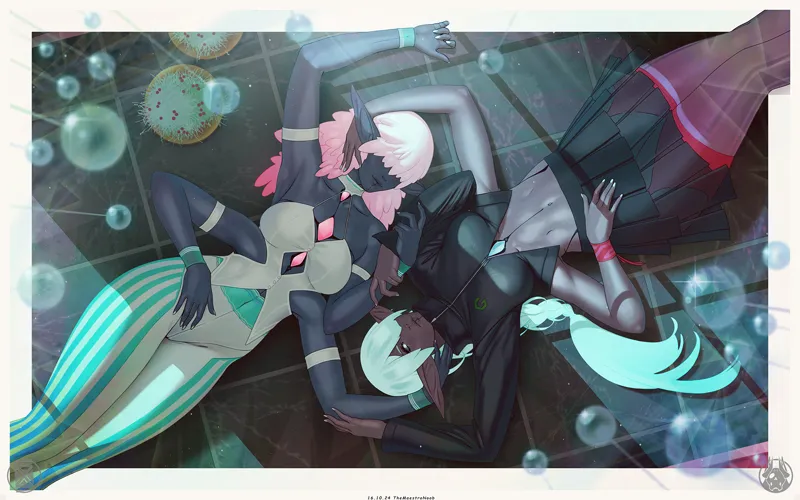
Ralamians / Inquisitive but Aloof
The history of the Ralamians does not show any particular migration pattern: families would travel with sistren tribes and settle among sistren tribes. Although, they prefer a perfect balance of temperature, humidity, atmospheric pressure, and windiness, to ensure comfortable conditions for their unique physiology. If one of these meteorological variables is too low or too high, the others should compensate for that. Additionally, Ralamians choose regions where continuous and extensive cultivation of silica-rich plants is possible for most of the year; and plenty suitable soil is found in the Eastern Feet Region.
At birth, the cells in a Ralamian’s body are still soft and carbon-based, but after a couple of months they get hungry and begin actively absorb enormous amounts of silica, minerals, and metals (the latter are needed in significant quantities for bone formation). Hence, after infancy, the diet of a Ralamian consists mainly of the aforementioned silica-rich plants. They can still consume carbon-based products, but because the Ralamians digestive system can’t easily dissolve them, they do so in lesser quantities and not as a source of nutrients, but just to add flavor to the bland and meager selection of products on which they actually depend.
After several more months, gem-like structures develop on the wrist joints and rib cage (primarily in the sternum area). While the former serve decorative purposes, the gems located on the sternum are external organs crucial for eliminating respiratory and hydration waste products from the silicon-rich bodies of the Ralamians. Crystalline (mostly quartz) formations grow on these gemorgans throughout the day, and every nights the Ralamians scrape off these outgrowth as part of a hygiene procedure, similar to brushing teeth. If left untreated for a couple of weeks, this can cause serious physical damage to the body; and if left unsupervised for even longer, it can result in death from intoxication.
The scalp produces homogeneous substance made of hydrogen-abundant radioloria-like cells; wet to the touch, soft and elastic, luminescent, harmless; functionally comparable to the hair of other tribes. It can retain a desired shape under the influence of a weak electric current. Chunks of the mass can be detached and reabsorbed again before the cells begin to die. The coloration of this substance, as much as that of the gemorgans, is genetically determined and is permanent, yet skin color is largely depends on consistent dietary choices and can changed in just a few months depending on the type and part of silica-rich plants regularly consumed. Thus, it is also easy to discern when Ralamians are ailing or malnutritioned – their skin looses its hue and turns more ashen and pale.
With a specific diet followed from birth, the gemorgans of Ralamian can transform into genuine precious crystals, valuable enough to be turned into gemstones. After this became widely known towards the end of the Age of Crumbling, Ralamian lives became a valuable resource for the [REDACTED] cruelty of the Hegemony... but these lives would last short, filled with suffering, serving as livestock for the sole purpose of mass-producing jewelry. For that, Ralamians generally avoid such diets, feeling detest towards the past, but some still following them for the sake of their own beauty.
***
Ralamians grow really quickly until their bodies are fully develop to a certain peak, after which they appear eternally young, as their aging process differs from that of purely carbon-based beings. Always their skin is smooth, and movements are elegant, yet there comes a time when they begin to wither just as quickly as they grew. In fact, Ralamians have one of the shortest lifespans among all the tribes – less than forty Meorenellian years at best. Though, it is theorized that they perceive time much more slowly that other tribes, based on the speed of cognitive processes and the reaction time of the Ralamian’s brains.
Whilst the cells of their bodies continuously consume and process silicon atoms, they gradually become heavier and more brittle, until suddenly they fail to sustain themselves as an organic being. The first visible sign of final months of a Ralamian’s life always starts with the eyes – they begin to fade and loose the inner glow, eventually crystallizing; then come the optic nerves; the skin and flesh become hoary as well; then the crystallization process reaches the brain and nervous system, by which point the rest of the body is already cracking, and eventually crumbling into sand. The Ralamian dies as a person, but the body partially remains alive: the cells of some organ tissues (lungs, heart, liver, and bone marrow) continue to grow as symbiotic colonies, creating lustrous crystalline and metallic structures for several more decades before completely mineralizing into an inanimate state naturally or under the influence of natural factors.
It is very easy to identify Ralamian cemeteries: they are fields of crystal formations surrounded by ash and dust. Nowadays, these crystals may find value for technological application, but it is illegal and immoral to collect and use them without the Ralamians’ bequeath, which some of them grant, proudly following the ancient words of Meora:“Take my body and prosper. Take my skin, my flesh, my bones, my tears – use them to flourish. As your mother, I command you, my children. As your mother, I sacrifice myself for your thrive, my children.” Alike She allowed us to exploit Her being and not be ashamed nor feared, these Ralamians wish to aid Meority after their own deaths in Her honor.
***
Thanks to a powerful natural bioelectrical field, Ralamians have the ability to exchange thoughts and memories with each other (and, at least somewhat, to read othertribe’s emotions) by linking their nervous systems. Children inherit the memories their mothers received during pregnancy period, hence Ralamians become ready and experienced for the world much earlier than representatives of sistren tribes. Coupled with accelerated growth, Ralamians regard each other as fully-fledged adults by the age of six.
It is not uncommon to hear Ralamians gently singing and humming; for a long time, even they themselves were obscure to why they do this, but later it was discovered that humming boosts the Ralamians’ cognitive abilities, and the changes in the tune are directly dependent on the present thoughts.
Other tribes characterize Ralamians as solitary, stoic and imperturbable, or even sullen and morose, with a tendency to keep secrets and refuse communicate or cooperate. They are indeed described as individualists, and their core values are family-oriented at best. In truth, many Ralamians experience an existential fear of their minds amalgamating and the personalities stagnating within the entire tribe as an outcome of the ability to share thoughts, even if they reject to use this potentiality for most of their lives. In conjunction with a shorter lifespan, this shapes a specific loner mentality: very personally, they are shy and timid, even docile, keeping to themselves and reserved, because sometimes the idea of mental homogenization is so horrid that they hermit themselves even from othertribe sistren, afraid of losing their uniqueness and the worldviews they have acquired. With such, achieving any close relationships with Ralamians means earning their absolute trust in your values and intentions.
Besides their regular names, Ralamians have Inner Names, which are revealed only to their closest confidants as proof of absolute trust. Ralamians always refer to themselves in the third person, but this is the only time they speak about themselves in the first person, something you might never hear. These names are so sacred to them that very often spouses and their children do not know the Inner Names of each other, because it is the last tear of individuality that they never want to lose. Those who know the Inner Names of others whisper them as intercessor in prayers to Meora while alone, even from the people to whom these names belong, for the sake of their common well-being.
In time, many Ralamians spend their final years amongst their Elder Communities, where, through the excessive use of the bioelectrical field faculties, they advance the ideas accumulated during their short lives, dedicating themselves to science, philosophy, experiments, and inventions; passing down the combined knowledge of decades from generation to generation, often never to be seen outside but of their joint minds, kept secret and eventually forgotten anyway, until someone else reinvents these ideas again. Still, many scientific breakthroughs and discoveries, technological advancements and achievements, owe their existence to the commitment of the Ralamian Elders who strive for the betterment of Meority. As their philosophers say:“Enjoy the life you've been given, but accept the inevitable end. Even if you live for yourself, sacrifice your death for others”.
Comments (3)
The worldbuilding for these Ralamians is honestly pretty cool! I've not seen a similar race before, they are very unique I think. Very cool stuff!
Not as Cool as YOU!
📖✍🤔 me likey