




Book Review: Operation Enduring Freedom, September 2001 - March 2002, The US Army in Afghanistan
If you fly in DCS and you care about realism, you’ll eventually realize that flying isn’t the hard part. The hard part is understanding why you’re flying: what you’re supposed to achieve inside a much bigger system.
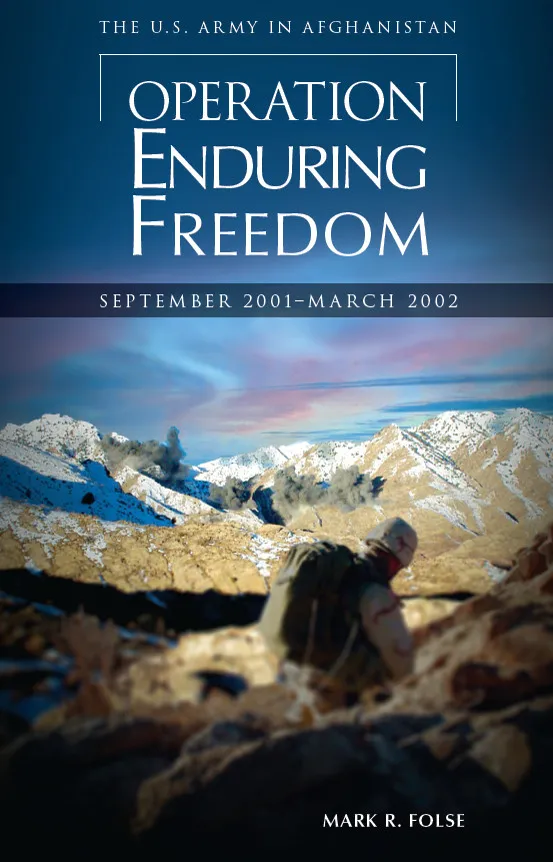
That’s where reading books like Operation Enduring Freedom: September 2001–March 2002 (attached at the end of this post) can be interesting: they show you what the war looked like from the ground perspective, and how airpower was used when it played a supporting role.
What’s striking is that even though the early days of the war in Afghanistan were all about gaining ground, airpower was always essential for small, scattered ground forces operating in impossible terrain. Whether through CAS and AI missions, logistics, ISR, MEDEVAC, or even PSYOPS, early OEF was a soldier’s war sustained by pilots.
Reading this book gives you a better understanding of the first battles of OEF, and plenty of real examples of how airpower was actually employed. I hope that you'll find here examples that might inspire your next mission designs.
I. About the Book
Operation Enduring Freedom: September 2001–March 2002 is a concise but dense historical study published by the U.S. Army Center of Military History and written by Mark R. Folse, a Marine infantry veteran with service in both Afghanistan and Iraq, but also a military historian specialized in modern U.S. operations.
It covers roughly the first six months of the Afghan campaign, from the immediate aftermath of the 9/11 attacks in September 2001, through the first airstrikes in October, and up to the end of Operation Anaconda in March 2002.
It’s a short book, but it’s dense and well structured. It is divided into several short chapters that follow a logical flow (strategic level, operational level, some examples at the tactical level, analysis).
The introduction sets the tone, explaining the political shock of 9/11 and how the U.S. military started planning for a war in a landlocked country with no friendly neighbors, no bases, and almost no intelligence.
The Strategic Setting chapter gives an overview of Afghanistan itself: its terrain, weather, and lack of infrastructure, and explains why every operation, from logistics to combat, depended on airpower. The next two chapters, The Taliban and Al-Qaeda, describe the enemy: who they were, how they fought, and why they were difficult to target from the air. The section on the U.S. Strategic Context then describes what kind of force the United States had available in 2001, how it was organized under CENTCOM, and why special operations and long-range precision strike became the backbone of the campaign.
The chapter "The United States Goes to War" is the transition from planning to execution. It’s followed by "The Ultimatum", which shows the political dimension: Washington’s attempt to get the Taliban to surrender bin Laden before launching the first strikes. These chapters explain how policy and strategy turned into actual missions and deployments, how bases were negotiated in Pakistan and Uzbekistan, and how the air campaign was built almost overnight...
The large central part of the book, "Operations", is where most of the useful material lies. "War in the North" covers the partnership between U.S. Special Forces and the Northern Alliance. This is where you meet Alpha Team 595, the “horse soldiers,” who were air-inserted deep inland to link up with General Dostum’s cavalry and guide B-52 and B-1 bombers against Taliban lines. This chapter shows how that mix of small teams on the ground and heavy aircraft overhead became the model for the rest of the campaign.
Next comes "War in the South", centered around Kandahar. It follows the Pashtun campaign led by Hamid Karzai and U.S. SOF teams, supported mostly by carrier aviation flying from the Arabian Sea. Kandahar was not just a symbolic objective but also the main airfield in southern Afghanistan, Mullah Omar’s home base, and the key logistics node of the region.
"The Bonn Conference" marks the political shift that accompanied military progress, while "The Fall of Kandahar" describes how the last major Taliban stronghold collapsed under sustained air and ground pressure. The next chapter, "Tora Bora", moves east into the mountains for the hunt for bin Laden. It is a case study in how airpower can dominate a region yet still fail to seal it off without enough troops on the ground. This is the same area you’ve seen in my earlier posts about the 2017 MOAB strike.
The following two chapters, "Operation Anaconda" and "Roberts Ridge" cover the first large-scale conventional battle and the most famous close-air-support action of the war. In Shahi Kot Valley, thin troop numbers underestimated enemy strength, and complicated command relations forced U.S. units to depend completely on airpower for artillery and observation. At Takur Ghar, the loss of a helicopter and the desperate defense by small special-operations teams led to a day of danger-close CAS from AC-130s, F-16s, and F-15Es, directed under extreme conditions.
"Clearing the Valley" ends the operational part, describing the final sweeps in Shahi Kot and the return to a slower tempo of raids and overwatch. By March 2002, organized resistance had ended, and the Taliban leadership had escaped into Pakistan.
As any serious military book, it finishes with an "Analysis" section, divided into short thematic paragraphs. Folse comments on the mismatch between war aims and available resources, and the ad-hoc nature of Command and Control structure.
This chapter connect with my earlier "masterclass" on C2 structure, and how to read such diagrams... The analysis also touches on local tribal culture, Pakistan’s ambiguous role, and the coming distraction of the Iraq War.
After the analysis, the appendices provide reference material: a chronology and C2 diagrams for different periods (October 2001, December 2001, and Operation Anaconda).
II. The Roles of Airpower in Early Operation Enduring Freedom
Using the doctrinal UK’s air-power framework, we can read the first Afghan campaign described in this book through four main roles: Control of the Air, Attack, Intelligence, Surveillance and Reconnaissance (ISR), and Air Mobility. Each of these roles appears clearly in the U.S. Army’s official history of the period. Together they show how airpower became the backbone of the war effort rather than being "just" a supporting element.
II.1 - Control of the Air
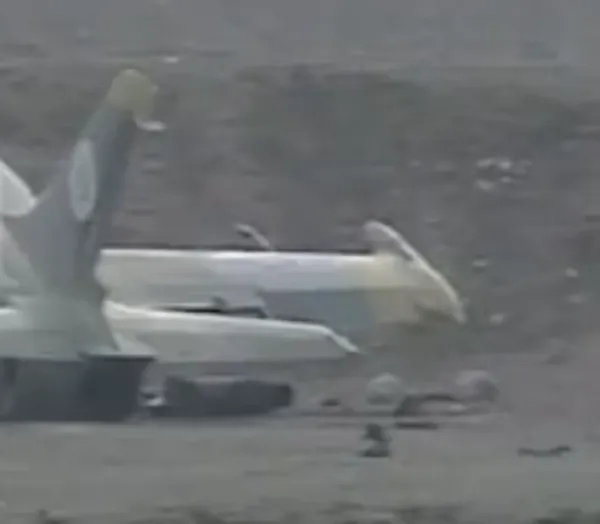
From the very beginning, the coalition achieved complete control of the air. The Taliban and al-Qaeda possessed neither modern aircraft nor an integrated air-defense system. The few helicopters and fighter jets available were no match to the coalition forces, and they were all quickly destroyed on the ground.
We can note that heavy bombers (B-52 and even B-2) and frigates in the Indian Ocean struck air defense nodes and key command links so that follow-on sorties could operate with freedom.
“U.S. Navy and Royal Navy ships launched fifty Tomahawk missiles against communication and radar stations.”
"B–2 Stealth bombers from Whiteman Air Force Base, Missouri, struck targets around Kandahar, including Mullah Mohammed Omar’s residence."
The result was an operating environment where coalition aircraft could sustain daily sorties, insert special operations teams, and later bring in conventional forces with little interference from organized Taliban air defenses.
Thanks to this supremacy, every other air function (attack, reconnaissance, mobility, and contribution to joint effects like Info Ops) could proceed without interference. The skies over Afghanistan became an open corridor through which the coalition projected power, moved forces, and gathered information.
II.1 - Attack: Attack (strategic effect, CAS and AI)
The “Attack” role spans from high level, strategic deliberate strikes and to dynamic response with tactical effects. Early OEF used both. The initial bomber/carrier packages delivered strategic shock and removed key nodes, while day-to-day fighting relied on CAS and armed interdiction in support of small ground elements.
The account of Alpha Team 595 is certainly the clearest example.
“On 19 October, pilots and aircrews from the 2d Battalion, 160th SOAR, flew in the dead of night through a 3.2-kilometer-high dust storm to insert Capt. Mark D. Nutsch’s Operational Detachment Alpha (Alpha Team) 595 in the Suf River Valley, some 80 kilometers south of Mazar-e-Sharif.”
"Once inserted, Alpha Team 595 did not wait for large formations; instead it fought with local allies" and “in each engagement, the Alpha Team called in air strikes from B–52s and AC–130s to destroy the Taliban’s small arsenal of tanks and armored vehicles and obliterate its defensive positions.”
That combination of small, mobile advisers and heavy airstrike produced decisive results: by 10 November 2001, Mazar-e-Sharif became the first city the Taliban lost.
The book also links the tactical demand for persistent fire to platform choices during larger battles. In Operation Anaconda the commander found delays between CAS requests and weapons on target unacceptable, so air tasking was adjusted.
“Central Command added five A-10 Thunderbolt IIs. Much less vulnerable to ground fire than other aircraft, the hardy A-10s could loiter over the battlefield in broad daylight and deliver precision strikes without the assistance of Air Force tactical air controllers.”
We can note that the last sentence (without the assistance of Air Force tactical air controllers) describes the Air Interdition role.
II.2 - Intelligence, Surveillance, and Reconnaissance (ISR)
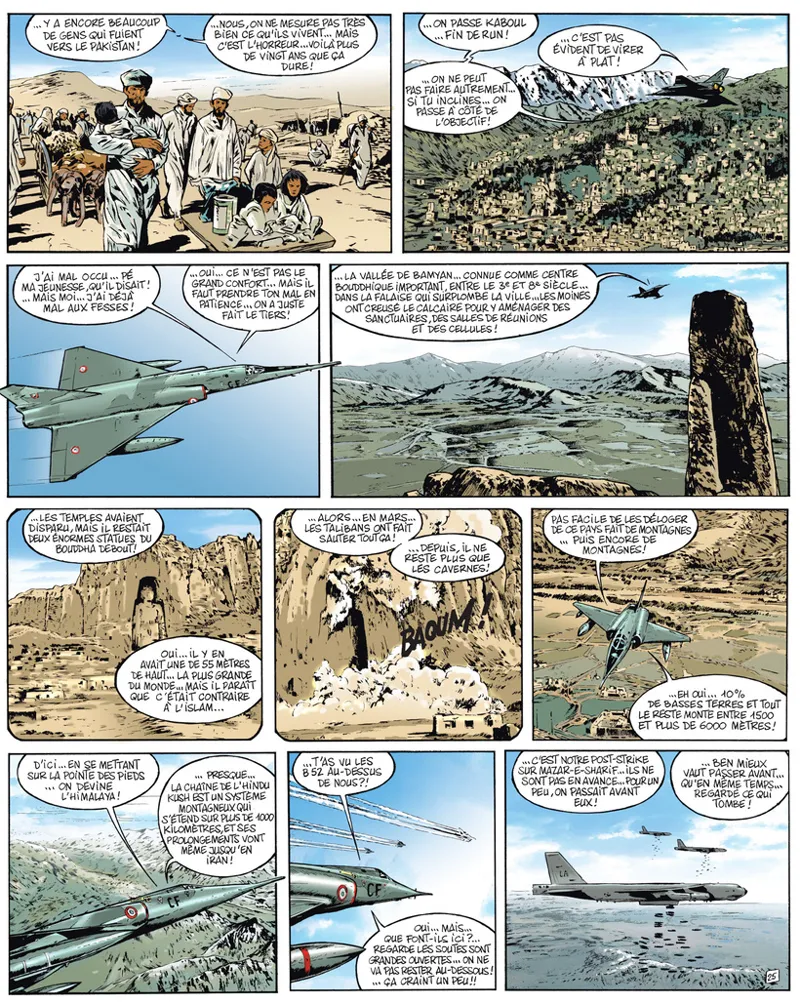
In Afghanistan the campaign began only after a deliberate effort to gather and fuse intelligence at every level. As the book makes it clear, the civilian (CIA) and special-operations intelligence community was central to planning, but satellite imagery was also widely used. Some countries, like France, also resorted to more traditional air reconnaissance missions with the Mirage IVP. At the strategic level, Afghanistan was clearly not a priority before 9/11 and the imagery collection had to be run quickly in order to elaborate the first targeting folders.
Tactical and near-real-time ISR, a real novelty, also gets documented in the study. Unmanned systems and aircraft provided imagery and targeting that enabled small teams to call in accurate fires. We can note the presence of overhead video on key events, including the fight on Takur Ghar, with “declassified Predator drone footage” referenced in the endnotes: real-time unmanned video was already part of the fight!
II.3 - Air Mobility
Nothing in early OEF happens without aircraft moving people and materiel across long distances and into austere strips.
First of all,, during the build-up phase, the U.S. secured an inland hub.
“The State Department convinced Uzbekistan’s President Islam A. Karimov to allow the U.S. military the use of Karshi Khanabad Air Base.”
Units then flowed in: 5th Special Forces Group deployed there, followed by elements of the 3d Battalion, 75th Ranger Regiment; the 160th SOAR; and the 10th Mountain Division’s 1st Battalion, 87th Infantry.
As the footprint grew, forward operating bases and airfields inside Afghanistan became the logistics backbone. We can note that one of the Marine Task Force 58 task was to "secured the airstrips while engineers and contractors improved the runways.”
By December 2001, the supply chain demanded a full air bridge and distribution system.
“More troops required more rations, ammunition, clothing, medical supplies, water, and fuel. Commercial and military planes had to fly all of this material into Afghanistan, where support personnel would store and distribute it as needed.”
Helicopters enabled tactical movement in terrain that blocked ground convoys, but the risk was real (cf. the book’s account of Takur Ghar, that begins with the air insertion attempt).
The scale of these movements, from inter-theater cargo flights to night helicopter lifts, proves one simple truth: every success on the ground in early OEF depended on aircraft moving men and materiel. Without the long-range air bridge, there would have been no forces in theatre. Without rotary-wing lift, there would have been no mobility inside Afghanistan itself. Literally nothing in this campaign would have been possible without air mobility...
III.4 - Command and Control
All of the roles described above depended on one thing: coordination.
The command-and-control network during early OEF was improvised. There was no permanent headquarters inside Afghanistan, and each service brought its own command chain. The Combined Air Operations Center (CAOC) in Saudi Arabia managed air tasking orders, while SOF teams in the field talked directly to bombers via satellite radio.
“Operation Enduring Freedom began without General Franks’s staff having a set campaign plan.” It was simply “it’s how fast you can get to Afghanistan and start doing something.” An officer admitted that “there was no master plan.”
“The opening operations, therefore, fell to special forces units, who essentially answered directly to General Franks, not Central Command’s special operations component command, and not U.S. Special Operations Command.”
This structure was messy but flexible. It allowed missions to adapt in real time but also caused confusion in many instances, especially during Operation Anaconda, when ground commanders and air controllers had different pictures of the fight. The various C2 diagrams in the book illustrate how control lines evolved between October 2001 and March 2002.
Conclusion
Looking at all these functions together, you realize that airpower was not just support: it was the allies' center of gravity for the entire campaign.
Without airlift, no troops. Without ISR, no targets. Without CAS, no advance on the ground. Without MEDEVAC and PR, no risk taking. The ground war simply could not exist without constant air activity above it.
This dependence shaped how the U.S. planned every operation afterwards, and many lessons identified in Afghanistan shaped current doctrine. It also shows us, as DCS pilots, that true realism is not just about mastering radar modes or weapon employment, but about understanding how each sortie fits into a wider system of movement, logistics, and control. For this reason, the release of a new platform like the C-130J is logical, and will enable us to approach airpower even more globally!