Study of the GBU-43/B "Massive Ordnance Air Blast Bomb", or "Mother of All Bombs", use in Afghanistan.
The GBU-43/B "Massive Ordnance Air Blast Bomb", also nicknamed "Mother of All Bombs", has apparently been used only once in combat, and that only time was in Afghanistan, in April 2017. Let's try to understand what happened there, that might justify the use of such an extraordinary weapon.
The MOAB: A Weapon of Sheer Destruction
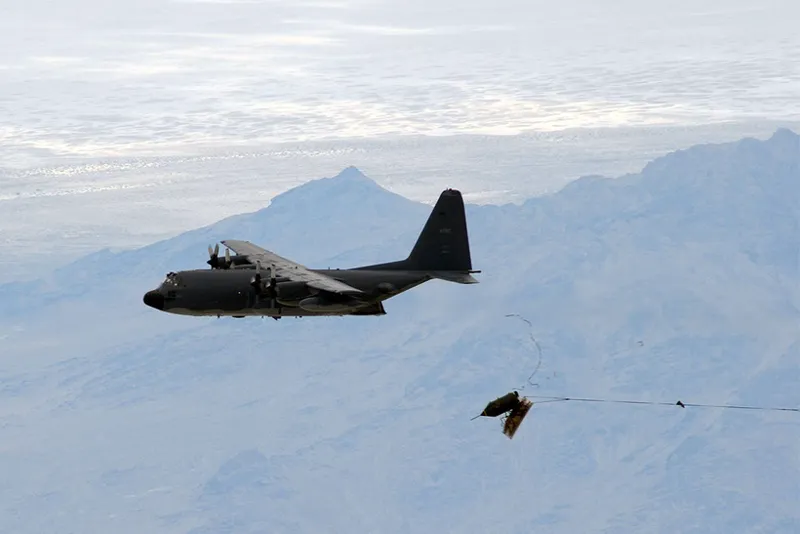
The GBU-43/B MOAB is renowned as the largest non-nuclear bomb in the U.S. arsenal (and maybe in any arsenal, the Russian FOAB or ODAB-9000 having never been officially used in operations so far...), weighing approximately 9,850 kg (21,715 lbs) and delivering a blast yield equivalent to 11 tons of TNT. Designed primarily as a psychological weapon and for clearing out entrenched enemy positions, the MOAB is delivered by an MC-130J aircraft and detonates just above the ground ("air burst") to maximize its destructive radius.
MOAB description in "The Times".
Unlike precision-guided munitions that strike specific targets with pinpoint accuracy, the MOAB functions more as an area-denial weapon, creating a shockwave that not only destroys enemy positions but also demoralizes and disorients surviving combatants. The bomb utilizes a GPS guidance system to ensure it detonates at an optimal altitude, allowing its shockwave to maximize overpressure. Its intended role includes eliminating deeply fortified cave complexes, destroying enemy morale, and providing a strategic show of force.
External view of the GBU-43B.
The external design of the GBU-43/B is notable for its use of grid fins as flight control surfaces, rather than traditional planar fins. This design choice likely reflects several engineering considerations. Grid fins offer advantages in terms of the force required to alter the trajectory of such a heavy weapon, potentially requiring less torque from the actuation systems. Furthermore, grid fins can be designed to be more compact or retractable, which is crucial for maximizing efficient loading and transport within the confines of an aircraft's cargo bay.
GBU-43/B with retracted fins.
For those interested, you'll find here a video of a release test of the GBU-43/B, clearly showing the initial sequence and the opening of the grid fins (at 00'08").
Historical Precedent: The BLU-82B "Daisy Cutter"
To fully appreciate the context of the MOAB's deployment, it is important to consider its predecessor, the BLU-82B "Daisy Cutter." During the early stages of Operation Enduring Freedom (OEF) in Afghanistan, U.S. forces encountered significant challenges posed by Taliban and Al-Qaeda fighters utilizing the rugged terrain along the Afghanistan-Pakistan border. These fighters employed a network of caves and tunnels, providing them with protection from aerial bombardment and conventional artillery strikes.
The BLU-82B, while not as powerful as the MOAB, was deployed in 2001 in the Tora Bora region, an area suspected of harboring Osama bin Laden and his forces. This weapon was employed on multiple occasions during the campaign, including notable uses on December 9 and 10, 2001.
While the BLU-82B proved effective in its psychological role, its limitations in terms of precision and destructive power against hardened underground targets became apparent. The experience gained during these early operations highlighted the need for a more potent weapon capable of collapsing entire tunnel networks with a single strike. This operational requirement drove the accelerated research and development efforts that eventually led to the creation of the GBU-43/B MOAB. By 2003, a total of 15 GBU-43/B units had been produced.
The last BLU-82 "Daisy Cutter" was dropped during training at UTTR in 2008.
The 2017 MOAB Strike in Achin
The operational debut of the MOAB occurred on April 13, 2017, in the Achin district of Nangarhar province, Afghanistan. The target was identified as an extensive network of tunnels and caves used by militants associated with the Islamic State Khorasan Province (ISKP), the regional affiliate of the Islamic State (ISIS), sometimes referred to as ISIS-K. ISKP had established a significant stronghold within this region.
Official USFOR statement following MOAB's employmenin April 13 2017.
Official reports indicated that the MOAB strike resulted in the deaths of numerous ISKP militants, possibly including key leaders, and the destruction of critical infrastructure that had enabled their operational effectiveness. The initial count of ISIS fighters killed was reported to be around 30, but later reports from Afghan army sources increased this number to over 90.
However, the reported results of the strike and the justification for employing such a powerful weapon have been subject to considerable scrutiny and debate. Concerns were raised regarding the accuracy of the casualty figures, with some observers suggesting that the reported number of fatalities appeared low in relation to the destructive power of the MOAB.
Furthermore, the proximity of several villages to the target area raised fears of collateral damage and civilian casualties. Reports emerged of potential damage to civilian houses in the vicinity of the strike. Access to the area was restricted to civilians and journalists, further fueling concerns and limiting independent verification of the strike's effects.
Example of pre-strike and post-strike imagery comparison.
Independent assessments of the strike's impact were conducted using pre-strike and post-strike satellite imagery (exact impact point here). These analyses revealed significant destruction within a radius of approximately 400 meters from the impact site. Man-made structures were largely obliterated, and vegetation showed signs of being burned or destroyed.
At a distance of approximately 500 meters from the impact site, some buildings within compounds appeared to be destroyed, while walls and other structures remained standing. The impact on vegetation at this distance appeared less severe compared to the immediate impact area. Further observations indicated patchy destruction of buildings, with some structures showing the loss of roofs and damage to trees.
Damages observed 500m from the impact site.
Ground-level observations of the strike site provided further insight into the extent of the damage. The small hamlet targeted by the MOAB was reportedly completely destroyed.
Without entering into lengthy debates to know if the strike was proportionate, or necessary, we can still try to figure out what pushed to the decision of employing that weapon in particular.
Justifying the Use of MOAB
The decision to employ the MOAB in this particular instance was officially attributed to the objective of eliminating ISKP fighters and destroying their entrenched positions in the region. ISKP had established a substantial presence in Nangarhar province, and the tunnel network provided them with a strategic advantage, offering shelter and facilitating their operations.
The targeted position was described as a heavily fortified stronghold, and previous U.S. military operations in the area had failed to achieve decisive results. Notably, just five days prior to the MOAB strike, a U.S. Special Operations Command (SOCOM) operative, Staff Sgt. Mark R. de Alencar, was killed during an operation against ISIS in the same area.
It is highly probable that the MOAB strike was intended to serve a dual purpose: the destruction of a heavily fortified position and the projection of a clear message to ISKP and other militant groups regarding the United States' willingness to employ overwhelming force in combating terrorism.
The anticipated psychological impact of the weapon was also likely a significant factor in the decision-making process. The scale of the destruction was expected to disorganize and demoralize enemy fighters, creating opportunities for effective follow-up operations in the area. This strategy aligns with historical precedents, such as the use of the BLU-82 "Daisy Cutter" during Operation Desert Storm, where its deployment against entrenched Iraqi soldiers contributed to the collapse of defensive positions.
The use of BLU-82 "Daisy Cutter" as a tool for information Opeartions, as described in AFDD 2-7 (2005).
Resource Control: A Critical Contextual Element
The deployment of the MOAB in Achin district, Nangarhar province, occurred within a region known to possess significant mineral resources. This geographical context introduces a critical layer of complexity to the analysis of the strike.
Nangarhar province, and particularly the Achin district, is known to contain deposits of talc, chromite, and marble. These minerals possess substantial economic value and represent a potential source of revenue for those who control their extraction and trade.
The presence of these resources introduces an economic dimension to the conflict in Afghanistan. Control over these resources becomes a strategic objective for various actors, including insurgent groups seeking to finance their operations and expand their influence.
The Islamic State of Khorasan Province (ISKP), the target of the MOAB strike, has demonstrated a strong interest in controlling Afghanistan's natural resources. Control of mineral-rich areas provides ISKP with a crucial source of income, enabling them to sustain their activities and expand their territorial control. The Taliban also maintain a significant presence in the mining sector, generating substantial revenue from the talc trade in certain districts. Illegal mining and associated corruption further complicate the situation, depriving the government of significant revenue and contributing to instability.
The "cave complex" that was targeted was indeed talc mines controlled by ISIS fighters.
More broadly, Afghanistan as a whole is a nation with vast untapped mineral wealth, representing a potential source of economic prosperity. However, the exploitation of these resources has historically been a source of conflict, instability, and corruption, rather than a catalyst for sustainable development.
Afghanistan possesses significant deposits of a wide range of minerals, including iron ore, copper, gold, and rare-earth minerals. The Ministry of Mines and Petroleum of the Islamic Republic of Afghanistan has conducted extensive assessments of the country's mineral resources, revealing the potential for Afghanistan to become a major player in the global mining industry.
Official map ofnatural resources in Afghanistan, showing in particular Achin as "inactive". If there is no official mining activity there, the actual mining activity is very high, clearly visible on satellite imagery, and is considered as the primary source of wealth for insurgent groups.
For those interested, there's a very detailed analysis about the importance of mineral resources like talk in the Achin region, and their importance in ISIS activities in the region: "At Any Price We Will Take The Mines": The Islamic State, the Taliban and Afghanistan's White Talc Mountains,with a full report here.
Conclusion
The deployment of the MOAB in Afghanistan is particularly interesting, since it underscores the complex dynamics of modern warfare, where military force intersects with strategic objectives, ethical considerations, and economic factors like resource control. The Achin district strike serves as a critical case study in understanding these multifaceted challenges.
In a next post, we will discuss its simulated representation in DCS World. i will try to introduce the Anubis Mod for the MC-130, and how it can allow you to engage with the MOAB!
Hi Gaby, will we get some more input on the mission itself? Maybe this would be a good .miz to provide to the users with the C-130 coming in (hopefully) the next few months.
G
Graveyard of Empires · November 9, 2025
I'm not sure there are many details available freely, but we can still definitely invent a plausible scenario!