Let's leverage the previously released runway strike mission as a practical example to illustrate the mission planning process. This process, which can be adapted for virtually any Air-to-Ground (A/G) mission, generally follows these steps:
Feasibility Analysis
Tactical Analysis
Target Analysis
Flight Plan Design
Fuel Management
Mission Data Card
Given the varying performance and capabilities of different aircraft, we will use the F/A-18C as our reference platform for calculations. Remember to perform your own calculations tailored to the specific aircraft you will be operating.
1. Feasibility
This initial phase is both straightforward and critical. Its purpose is to avoid investing significant planning time in a mission that is ultimately unachievable. You need to address these fundamental questions:
Reachability: can the aircraft physically reach the target and return to base (or a designated alternate)?
Time Constraints: are the mission's time objectives achievable within the given schedule?
Weather Suitability: is the anticipated weather favorable to a successful attack?
1.1 - Reachability
Let's quickly assess the target's location relative to our departure airfield. A direct route from Kandahar to Farah is approximately 200 Nautical Miles (Nm).
Direct track from Kandahar to target area.
We will begin with 13,000 lbs of fuel. Our return fuel requirement at Kandahar is estimated at 2,400 lbs, with Camp Bastion as an alternate. We will also allocate 1,000 lbs for taxi and takeoff. This leaves us with a usable fuel load of 9,600 lbs for the mission.
The operational environment suggests that roughly half of the total distance will be flown within "enemy" airspace. Therefore, we can estimate 100 Nm of transit in a combat environment and another 100 Nm in a more "friendly" environment (outbound and inbound for each).
To conduct a conservative fuel estimate, we'll apply demanding performance parameters for each phase:
Combat Environment (Low Level, Max Performance): 540 knots (kt) ground speed (9 Nm/minute), fuel consumption of 250 lbs/minute.
We can now make the math: we need around (250*200/9)+(150*200/7.5)= 9.600 lbs which is exactly the fuel available. Therefore, we can reach the target, but we must be mindful of not deviating significantly from the planned route to avoid fuel exhaustion.
Note: If this initial calculation reveals insufficient fuel, this early stage of planning is the ideal time to conduct a more detailed fuel analysis. Generally, your options are limited: flying at higher altitudes and/or slower speeds in "friendly" airspace, or flying at higher altitudes in "enemy" airspace (flying slower in a combat environment is generally not advisable). If these adjustments are insufficient, consider requesting a different aircraft configuration (e.g., external fuel tanks) or coordinating with a tanker aircraft for in-flight refueling.
1.2 - Time feasibility
The previous analysis allows us to estimate transit times. The first 100 Nm in friendly airspace will take approximately 14 minutes (100 Nm / 7.5 Nm/min), and the subsequent 100 Nm in the combat environment will take around 11 minutes (100 Nm / 9 Nm/min), totaling approximately 25 minutes for a one-way trip.
Our Time Over Target (TOT) window ends at 08:21, and our scheduled takeoff is at 07:52, providing a total flight time to the target of 29 minutes. This is slightly longer than our estimated one-way transit time of 25 minutes, leaving us with a margin of approximately 4 minutes. This margin can be used to strike earlier in the TOT window (1 minutes if aiming for the middle), transit slightly slower in friendly airspace to conserve fuel, or hold before the push to create a time buffer for navigation refinement and time management before engaging the target.
Time constraints.
Now, let's consider the ground operations timeline. The mission begins at 07:30, with taxi scheduled for 07:46 and takeoff at 07:52. The 16-minute startup time and the 6-minute taxi to Runway 23 appear reasonable. However, similar to our fuel situation, the time margins are tight.
We should also briefly consider the landing time. Generally, this is not a rigid constraint unless there is significant inbound air traffic, or specific recovery procedures are in effect (e.g., Instrument Meteorological Conditions (IMC) recovery requiring a specific time over the Initial Approach Fix (IAF), coordination with airfield air defense, Emission Control (EMCON) procedures, etc.). In this scenario, with roughly 30 minutes to reach the target and another 30 minutes for the return, and no specific constraints on the return leg, we should be able to land on time.
Note:it's generally advisable to have a 5 to 10-minute time buffer, particularly to accommodate unforeseen events during transit, such as traffic avoidance or unexpected weather (e.g., deviating around thunderstorms). This is even more critical for missions involving multiple aircraft requiring precise coordination. Remember the aviation adage: lost time is never recovered; it's better to be early than late.
1.3 Environment analysis
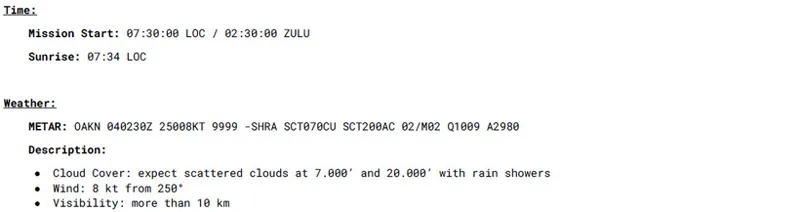
Target visibility is paramount for our mission involving the visual delivery of unguided ("dumb") bombs. Given a sunrise time of 07:34 and a TOT of approximately 08:20, we anticipate sufficient daylight for target acquisition. However, an eastbound approach should be avoided to prevent potential sun glare. Moreover, even with overcast skies, ambient light levels are expected to be adequate for visual engagement.
Time and weather information.
Regarding the actual weather conditions at the target, uncertainty exists regarding potential localized precipitation. We understand that absent a rain or snow shower directly over the target during the attack, visibility should be excellent. Since predicting the precise location of such showers in advance is impossible, we must proceed with the assumption of suitable weather on target, while acknowledging the need for a real-time decision if adverse conditions are encountered upon arrival. Importantly, we know that visibility is the primary weather concern, as the cloud base (FL 070) is significantly higher than the target's altitude (2,210 ft AMSL), mitigating the risk of inadvertently entering clouds.
The initial analysis of these fundamental physical constraints is now complete and indicates feasibility. Therefore, we will now move on to a tactical analysis, considering both threats and friendly forces.