Evolution of the ATO Cycle from Vietnam War to Desert Storm
A short study of the historical evolution of the ATO cycle from Vietnam War to Operation Desert Storm.
A while ago, following my first posts about the Air Tasking Order (ATO), I was asked to detail the historical aspect and try to find information regarding the Cold War era, in preparation for the incoming "Cold War Germany" theater by Ugra Media.
The Air Tasking Order Cycle: Brief Reminder
The Air Tasking Order (ATO) is the backbone of modern military air operations. It is a document that outlines which aircraft will be used, their assigned missions, target locations, fuel requirements, weapon loadouts, and necessary support assets. In essence, the ATO is the final product that embodies the will to ensures that air power is applied in a coordinated, efficient, and effective manner.
Over time, the ATO process has evolved to match the complexity of warfare. Early versions of the ATO were slow and cumbersome, requiring days to process and distribute. By the Cold War period (1970-1989), efforts were made to improve response time and flexibility in anticipation of a large-scale war between NATO and the Warsaw Pact. These improvements laid the foundation for modern air operations.
To understand how the ATO developed, we can examine its use in previous conflicts, notably the Vietnam War, and its transformation leading up to Desert Storm in 1991. However, the most significant period of change occurred during the Cold War, which will be the main focus here.
Description of the ATO cycle during Operation Desert Storm.
The Air Tasking Order in the Vietnam War
During the Vietnam War, the United States relied on a heavily centralized ATO system that struggled with the fast-paced nature of ongoing combat operations. The process of creating and distributing an ATO took between 24 and 72 hours, making it nearly impossible to react quickly to changing battlefield conditions.
The approval chain was overly complex, involving multiple levels of command. The final authority rested with the Seventh Air Force, which issued ATOs based on requests from ground commanders and intelligence assessments. The sheer number of missions—thousands of sorties daily—further complicated the process. This led to inefficiencies, as pilots often found that their targets had moved or that weather conditions had changed, rendering their missions ineffective.
Number of sorties per year, in thousands, during the Vietnam War. In 1968, it's around 2000 sorties a day in average!
Additionally, air planners struggled with integrating intelligence into the ATO. Reconnaissance flights provided valuable data, but due to slow processing times, much of the intelligence was outdated before it could be used. This led to wasteful missions, ineffective strikes, and missed opportunities to target North Vietnamese forces effectively.
Another major issue was the rigidity of the ATO process. Once issued, changes were difficult to make. This meant that even when an urgent situation arose—such as a high-priority enemy movement or an opportunity to strike a strategic target—the ATO had to be followed as written. Pilots had little flexibility to adjust their missions.
Example of fragmentary ATO for operations in Vietnam on December 24th, 1968. We see that the level of details is fairly basic, compared to modern ATO: MSN number, unit designation, call sign, number and type of aircraft (here F-100 and A-37 "Dragonfly"), ordnance, localization, TOT and remarks.
The Air Tasking Order during the Cold War (1970-1990)
During the Cold War, the ATO process underwent significant improvements to address the shortcomings seen in Vietnam. Military planners anticipated a high-intensity conflict between NATO and the Warsaw Pact, where thousands of sorties would need to be coordinated daily. This required a more efficient, flexible, and responsive system.
One of the first major changes was the adoption of automated systems to speed up ATO generation and distribution. By the late 1970s, the U.S. and NATO began developing computerized systems that could process large amounts of data, reducing the time required to produce an ATO from 72 hours to less than 24 hours.
Another significant development was the AirLand Battle Doctrine, introduced in 1982. This doctrine emphasized deep strikes behind enemy lines, targeting logistics hubs, command centers, and reinforcements before they could reach the front. The ATO process had to adapt to ensure air support was properly synchronized with ground operations. Instead of being reactive, airpower was now planned as an integrated part of offensive and defensive operations.
The Theater Battle Management Core System (TBMCS) was one of the most important advancements in Cold War-era ATOs. This computerized system allowed air planners to rapidly adjust missions based on real-time intelligence. Unlike in Vietnam, where changes to the ATO were nearly impossible, Cold War-era systems allowed for mid-mission adjustments. If new intelligence indicated a higher-priority target, missions could be re-tasked on short notice.
Another important aspect was the increasing focus on Suppression of Enemy Air Defenses (SEAD). Given the sophisticated radar networks and surface-to-air missile (SAM) systems of the Warsaw Pact, neutralizing enemy air defenses became a top priority. ATOs now included dedicated "Wild Weasel" missions—aircraft specifically tasked with hunting and destroying enemy radar sites. This ensured that strike aircraft could operate with a lower risk of being shot down.
Additionally, electronic warfare and intelligence-gathering assets played a more significant role in the ATO cycle. Platforms like the E-3 AWACS and RC-135 provided near real-time battlefield intelligence, allowing planners to adjust ATOs dynamically. This was a revolutionary shift compared to the Vietnam era, where air planners relied on outdated reconnaissance data.
Corsair IIs from US Air National Guard deployed at RAF Wittering in July 1983 for exercise "Coronet Mail".
The Transition to Desert Storm and the Modern ATO
By the time of the Gulf War in 1991, the ATO system had reached a new level of sophistication. Desert Storm was the first conflict to use a fully digital ATO system, allowing for rapid coordination of thousands of daily sorties. The success of this system demonstrated how far the ATO process had come since Vietnam.
One of the most notable improvements was the ability to update ATOs in real-time. Unlike in previous conflicts, where mission plans were fixed for an entire day, Desert Storm allowed for mid-mission re-tasking. If a high-priority target was identified, aircraft could be redirected almost instantly.
Another major advancement was the widespread use of precision-guided munitions (PGMs). Instead of carpet bombing, ATOs now integrated precision strikes, allowing planners to assign specific targets with minimal collateral damage. This shift was made possible by the Cold War-era improvements in intelligence gathering and data processing.
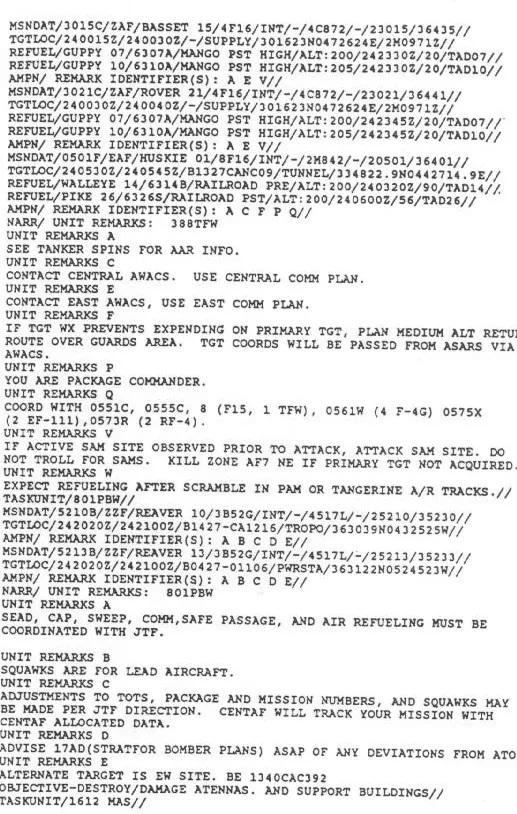
Example of ATO during Desert Storm. We can note the 10' to 15' TOT windows on targets, as well as the alternate target (EW site) and "dump" target (Kill Zone AF7). We can see that it's very close to modern ATOs.
However, we can note that despite the ability to manage around 2000 sorties per day during around 5 weeks, several failures emerged as lessons from the conflict. One of the biggest shortcomings was the lack of transmission systems to some of the front-line units, and the difficulty to disseminate tasking to some coalition partners due to the lack of secured networks.
But the most important lesson was the necessity to make the ATO a really comprehensive tool applicable to all the components: the ATO is not just an "air force" tool, it has to be applied to all components, even to the Special Operations forces, since the ATO has the flexibility to cover details of "secret" operations.
The previous issue emerged from the fact that until the mid-1990s, what was sometimes called a "black ATO" was in use: it was a classified and separate air tasking process employed to manage highly sensitive air operations, that was not shared to all, even within US forces. These operations typically involved the aircraft from secret programs (like the F-117) or missions conducted by Special Operations Forces (SOF). Unfortunately, this "black ATO" process led to several incidents, the most notable one being certainly the 1994 Black Hawk shootdown.
The stealth F-117 of the 37th Tactical Fighter Wing during Operation Desert Storm.
Conclusion
We can say that the Cold War was a turning point for the ATO process, bridging the gap between slow, rigid planning and the modern, highly flexible air operations of today. Many of the innovations developed during this period, such as computerized mission planning, real-time intelligence integration, and SEAD operations, remain fundamental nowadays.
Today, ATOs are generated and updated in near-real time. The advent of artificial intelligence and short loop satellite-based reconnaissance will make this process even more dynamic. The basic principles, however, were established during the Cold War, proving that even in times of relative peace, military exercises enabled a continuous evolution in preparation for future conflicts. The success of the Desert Storm campaign, shortly after the end of the Cold War, proved the validity of NATO's ATO and tasking cycle concepts.