Tactical analysis: enemy SAM and A/A threat, friendly SAM and A/A support, final attack profile.
The preceding feasibility analysis having confirmed the mission's feasibility, we can now dive into the tactical analysis. We will examine here the enemy and friendly situation, with particular attention to the SAM and A/A threat.
2. Tactical Analysis
2.1 Enemy Situation Analysis
The Iranian forces have established a layered defense network comprising SAM systems and fighter aircraft, posing a real threat to our operations.
Enemy SAM Threat
Long-Range SAM: the SA-5 systems are capable of engaging aircraft at extended distances and high altitudes. These systems can force early defensive maneuvers and disrupt ingress routes. However, the SA-5 has limitations, including poor low-level tracking and engagement capabilities.
Medium-Range SAM: the SA-6 systems, deployed near Farah airport and other locations, might employ mobile ambush tactics: we approximately know their location, but we might discover it at the last moments, seconds before being actually engaged. Its main weakness is its SARH guidance system and ability to engage only one aircraft at once.
Short-Range SAM: as usual, the potential for MANPADS such as SA-7/14 and AAA like ZSU-23-4 and ZU-23-2 around airfields and garrisons necessitates caution during low-altitude operations. We will need to make a particular analysis of our behavior on target area, since it's a know concentration of forces that will likely be defended by such systems. More generally, we will avoid flying over cities and main roads.
Enemy SAM threat as described in the mission briefing.
Counter-SAM Tactics:
To mitigate the SAM threat as described above, we can follow these tactics:
Avoid detection: low-altitude ingress routes and terrain masking to minimize radar detection. Against IR missiles, keep the sun in your back as much as possible.
Avoid tracking: utilize EW systems and employ trajectory techniques (like beam maneuvers) to complicate enemy tracking. Against IR missiles on target, preemptive use of flares is advised.
Minimize time in range: reduce exposure time within SAM engagement envelopes by maintaining high speeds during critical phases of the mission. Do not re-attack, the surprise effect will only work once!
Defeat engagements: if fired upon, use break lock maneuvers, chaff, and EW to defeat semi-active radar homing (SARH) missiles. If possible, leave the kinematic range of the SAM (against the SA-5, dive low level and in any case keep it at your 6 o'clock).
Enemy A/A Threat
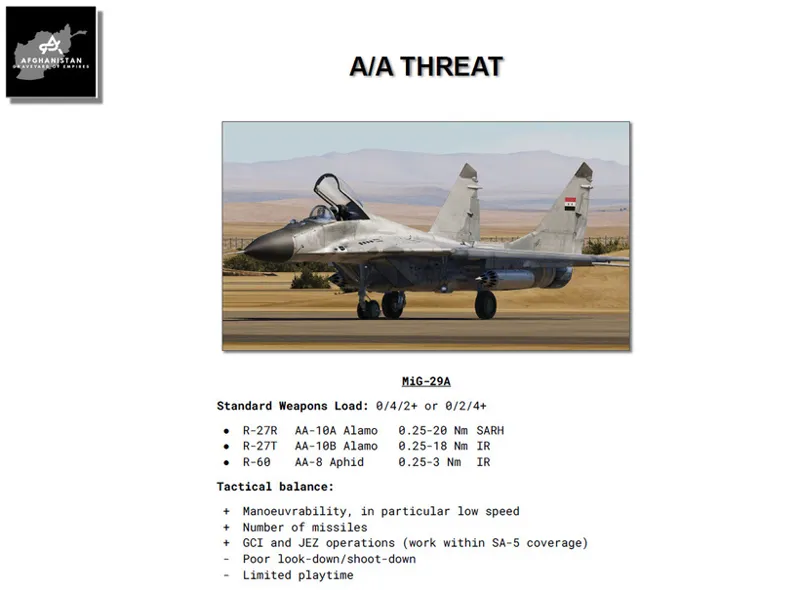
MiG-29A: it's the primary A/A threat. They conduct CAP missions and are known for aggressive intercepts. They are armed with medium-range R-27R/AA-10A (SARH) and R-27T/AA-10B (IR) missiles, as well as close-range R-60/AA-8 (IR) missiles.
Su-25: Su-25 ground attack aircraft are observed at Farah airfield. They will not be a major concern, but until we've reach the target we should avoid WVR encounters (below 10 Nm).
Enemy A/A threat as described in the mission briefing.
Counter-A/A Tactics:
Low-level approach: exploit the MiG-29A's poor look-down/shoot-down capability by flying at low altitudes.
Cloud cover: utilize cloud cover to prevent visual acquisition: fly below clouds as long as the MiGs are above, or fly IMC if they dive below the cloud cover to intercept you .
R-27R/AA-10A (SARH): defeat SARH missiles by employing break lock maneuvers, chaff, and EW.
R-27T/AA-10B (IR): be aware of the lack of Radar Warning Receiver (RWR) indication for IR missile launches. In case of intercept, visually scan for missile contrails and be prepared to use IR countermeasures (flares, engine RPM modulation) and seek cover in clouds.
2.2 Friendly Situation Analysis
The following forces are taking part into the air superiority role:
Friendly SAM: Hawk batteries are deployed at Kandahar, Camp Bastion, and Dwyer, providing medium-range, medium-altitude coverage. Strike aircraft can utilize Hawk coverage for protection, especially against MiG-29 intercepts.
Friendly A/A: the F-15C deployed at Kandahar and airborne during our mission possesses superior A/A capabilities compared to the MiG-29A. Coordinating with them to get support in case of enemy intercept is paramount.
Friendly situation as described in the mission briefing.
2.3 Tactical Conclusions and Flight Profile
Based on the analysis of enemy and friendly situations, a High-Low-High (H-L-H) flight profile is suitable for this mission.
Transit: we can fly at medium altitude to conserve fuel. If we are intercepted early, we will seek cover within Hawk range.
Hold: we will hold at low altitude within Hawk SAM coverage to avoid early detection by enemy radar (EW, SA-5 and MiG-29A).
Ingress and egress to target area: we will fly at very low altitude and maximum speed to minimize detection by SA-6 and MiG-29s. It will also prevent any engagement by the SA-5. We particularly study terrain masking and relief on target area to further avoid SA-6 detection.
RTB: after egress, we can climb back to medium altitude for the return flight to Kandahar, ensuring to remain East of Hawk sites and clear of A/A threats.
As an additional tactical considerations: we should keep in mind that synchronization with the CAP flight is a main concern. We want to make sure that they are airborne when we take-off, and that they are established on their CAP station before we push to target area.
Note: the mission briefing provided many analysis and several hints in order to help you with the tactical choices. You should be take the habit to make a "tactical balance" by yourself, and eventually make these enlightened choices without external guidance.
Conclusion
We can now say that the tactical analysis, building upon the foundational feasibility assessment, firmly establishes a High-Low-High flight profile as the optimal choice. This profile effectively mitigates the identified threats from SAMs and enemy aircraft while maximizing the strike aircraft's effectiveness on target area.
With the tactical framework now defined, the subsequent phase of mission planning necessitates a detailed target analysis. This analysis will be structured around the "4 Ts" principle (Task, Target, Threat, Tactics).