
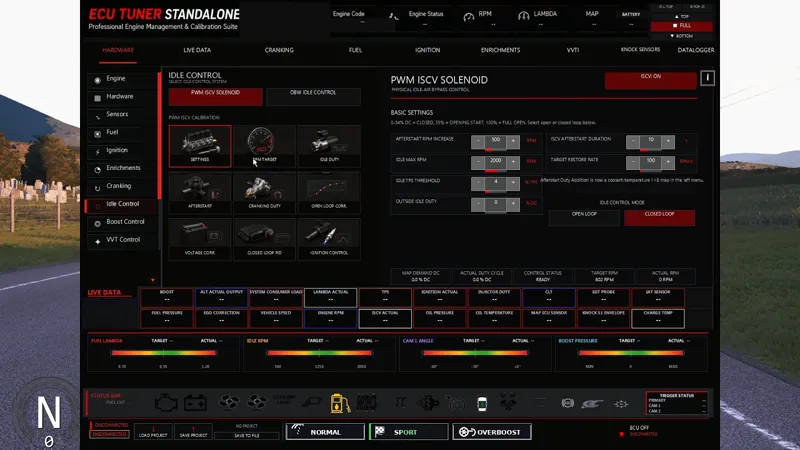
ECU Tuner Standalone – First Public Release
Toyota Supra MK4 Only | Built for Serious Tuners
The first public version of ECU Tuner Standalone is finally here.
Before purchasing, please understand one thing:
This software is not for everyone.
This is not a simple “add power” application, an arcade tuning menu or a collection of sliders that automatically creates a working setup.
It is intended for people who genuinely want to understand, build, diagnose and calibrate a complete engine-management system in depth.
A detailed PDF User Guide is included. Please read it before purchasing and decide whether this type of simulation is really suitable for you.
Do not purchase it by accident simply because it looks interesting. Digital purchases are non-refundable. I do not offer refunds because someone bought the software without first checking what it is, how complex it is and which vehicle it supports.
By purchasing, you accept the current scope, supported vehicle and Early Access state of the software.
Who is ECU Tuner Standalone made for?
Standalone is designed primarily for:
real tuners and engine builders,
experienced users who understand engine-management fundamentals,
people who want to learn how individual ECU systems interact,
users who enjoy diagnosing problems instead of pressing an automatic “fix” button,
sim racers looking for something much deeper than conventional vehicle setup,
anyone who wants to build and calibrate an engine from the hardware level upward.
A completely blank ECU calibration is included for experienced users who want to configure and tune the entire engine from zero.
That means configuring the engine, triggers, sensors, injectors, fuel system, starting calibration, idle control, fuel maps, ignition, boost control, VVT, knock control, protections and other systems yourself.
This is the closest experience to beginning with an empty standalone ECU and gradually bringing the engine to life.
Included blank map and basic startup map
The release includes two starting options:
Blank Map
A completely empty starting point intended for experienced tuners who want to build the full ECU configuration themselves.
Basic Base Map
A basic map with the essential sensor configuration and required startup maps already prepared.
This map is intended primarily to help the engine start and to provide a foundation for further calibration.
The base map is not a finished tune.
It should not be treated as a safe full-load, high-boost or competition calibration. Fuel, ignition, boost control, VVT, idle, knock protection and all other relevant systems still need to be checked and tuned for the actual engine and hardware configuration.
The user remains responsible for verifying the calibration before applying significant load.
Standalone Membership Also Includes Dyno Room
Access to our Dyno Room is included in the Standalone membership.
Dyno Room becomes an especially useful tool when combined with ECU Tuner Standalone because it includes:
a load-bearing chassis dyno,
controlled engine-loading capability,
live torque monitoring,
live power monitoring,
repeatable testing conditions,
the ability to hold or sweep through operating areas while monitoring ECU behaviour.
This allows users to work through fuel, ignition, boost, VVT and other systems in a much more controlled environment than ordinary road driving.
The load-bearing dyno can help expose problems that may not be obvious during a quick acceleration run, including:
unstable boost control,
incorrect fuel delivery,
weak ignition,
knock-sensitive operating areas,
temperature-related behaviour,
fuel-pressure limitations,
airflow restrictions,
torque irregularities.
Used together, ECU Tuner Standalone and Dyno Room provide a comprehensive environment for building, testing, diagnosing and calibrating the vehicle.
Dyno Room is still a simulation tool, not a replacement for professional real-world safety procedures or measurement equipment, but it greatly expands what can be tested inside Assetto Corsa.
This Is Not a Generic Tuning Game
ECU Tuner Standalone is not a universal AI-generated application where every vehicle uses the same hidden equations, the same sliders and the same shallow behaviour with a different engine name placed on top.
The software is built around a deeply connected simulation of:
physical engine hardware,
individual cylinders,
four-stroke combustion cycles,
airflow and cylinder filling,
manifold pressure,
fuel delivery,
injector behaviour,
ignition timing,
coil charging and spark capability,
mixture and combustion quality,
turbocharger operation,
temperatures and pressure changes,
cranking and starting behaviour,
idle airflow and load response,
trigger and cam synchronization,
VVT operation,
knock detection and ignition retard,
battery, alternator and electrical loads,
mechanical wear and engine damage.
Each combustion cycle contributes to the resulting engine behaviour. Air, fuel, ignition, pressure, temperature, hardware condition and ECU configuration are interconnected.
A hardware problem cannot always be repaired with a map. A badly configured ECU can prevent good hardware from working correctly. An incorrect tune can create realistic starting problems, unstable idle, weak combustion, knock, excessive temperatures, fuel-pressure problems or physical engine damage.
This is not an AI-slop “slider changes horsepower” system.
The software is based on approximately 17 years of real experience with building, modifying, diagnosing and tuning car engines, combined with extensive development of the simulation itself.
It remains a simulation and is not a replacement for a real dyno, professional tuner or proper measurement equipment. However, the goal is to reproduce the relationships, complexity and consequences of engine tuning as authentically as possible.
Toyota Supra MK4 Only
The first Standalone release works exclusively with the supported Toyota Supra MK4 configuration.
Support for additional cars will not begin until the core Standalone platform is substantially complete.
I am deliberately not making this a universal system.
Every future supported vehicle should receive its own authentic implementation, including its:
engine configuration,
trigger system,
ignition arrangement,
available hardware,
engine-building process,
sensors,
physical limits,
mechanical behaviour,
tuning requirements.
I would rather support fewer cars properly than release a generic system that behaves almost identically on every vehicle and never goes into meaningful depth.
Additional vehicle support will begin only after the Standalone version itself contains the required systems and reaches the necessary level of completeness.
Current Early Access State
This is the first public Standalone release.
It is already a large and highly detailed application, but it is not yet the final completed version.
Some menus, controls or planned items may still be incomplete, partially functional or subject to further adjustment. Bugs can also appear because of the number of systems interacting with one another.
Planned future versions will focus first on:
completing currently unfinished functions,
adding further tuning systems,
making existing systems even more realistic,
expanding diagnostics,
improving interactions between systems,
further developing Engine Workshop,
usability improvements,
fixes based on real user feedback and testing.
If there is enough interest and support, development will continue and these areas will be progressively completed.
Only after the Standalone platform is ready will work begin on proper support for additional vehicles.
The Original ECU Tuner Is Not Being Abandoned
Users who prefer the original ECU Tuner do not need to switch to Standalone.
The original version will continue to receive updates.
Selected systems and improvements developed for Standalone can also be transferred into the original ECU Tuner, but in a simplified and more accessible form, with:
considerably simpler physics,
fewer interconnected systems,
easier configuration,
faster tuning,
a lower learning requirement.
The original ECU Tuner will remain the better choice for users who want an enjoyable and understandable tuning experience without managing the full complexity of Standalone.
Standalone is the specialist version for users who actively want that complexity.
Please Read the Included PDF Guide
A detailed PDF User Guide is included with the release.
It explains:
interface controls,
ECU power states,
saving and loading,
ECU memory, presets and project files,
engine configuration,
physical hardware,
sensors,
fuel and ignition systems,
cranking, starting and Afterstart,
idle control,
boost control,
VVT,
knock control and Knock Scope,
Live Data,
Diagnostics,
Datalogger,
Engine Workshop,
damage,
recommended tuning workflow,
troubleshooting.
Please read the guide before deciding to purchase.
There is an important difference between:
editing the current working calibration,
saving a quick preset,
saving a project file,
using SAVE TO ECU,
changing physical engine hardware.
The application intentionally does not hide every mistake or automatically correct an invalid configuration.
Possible AI Tuning Assistant in the Future
If there is enough interest, I would eventually like to integrate an optional AI assistant directly into the application.
Its purpose would not be to tune the engine automatically with a magic button.
It would help users:
understand complex tuning problems,
interpret logs and diagnostic data,
identify conflicting settings,
explain why the engine behaves in a particular way,
suggest a logical diagnostic process,
navigate the increasing number of interconnected systems.
The underlying simulation would remain physics- and system-based. AI would be an assistant for interpreting the information, not a replacement for the actual simulation or the tuner.
This feature would be considered only after the core Standalone systems are ready.
Read This Before Purchasing
Performance and Display Requirements
ECU Tuner Standalone is significantly more demanding than the original ECU Tuner.
The application continuously performs detailed calculations for individual engine cycles, cylinders, airflow, fuel delivery, ignition, combustion, temperatures, pressures, turbocharger behaviour, electrical systems and mechanical condition. Diagnostics, Datalogger, Knock Scope and Engine Workshop add further processing and rendering load.
Because of this, Standalone is a performance-hungry application and requires a reasonably powerful PC. Performance will depend on the car, track, CSP configuration, graphics settings and the number of active diagnostic systems.
A minimum display resolution of 1920 × 1080 — Full HD is required. Lower resolutions are not officially supported and can cause parts of the interface to overlap, become cropped or remain inaccessible.
Users with older or lower-performance systems should consider this before purchasing.
Please purchase ECU Tuner Standalone only when all of the following are acceptable to you:
You understand that it currently supports only the Toyota Supra MK4.
You understand that this is a complex engine-management and tuning simulation.
You are prepared to read the included documentation.
You accept that this is an evolving Early Access release.
You understand that some functions will be completed or expanded in future updates.
You understand that the included base map is only a starting point.
You understand that the blank map requires genuine tuning knowledge.
You understand that incorrect calibration can cause poor operation or simulated engine damage.
You accept that digital purchases are non-refundable.
This software rewards patience, testing, logging and understanding.
It can also punish careless configuration and calibration.
That is intentional.
Thank you for supporting the project.
Enjoy building, diagnosing, dyno testing and tuning the car.
Comments (1)
WOW