
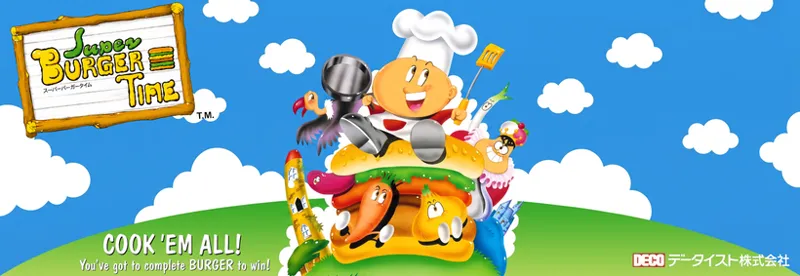
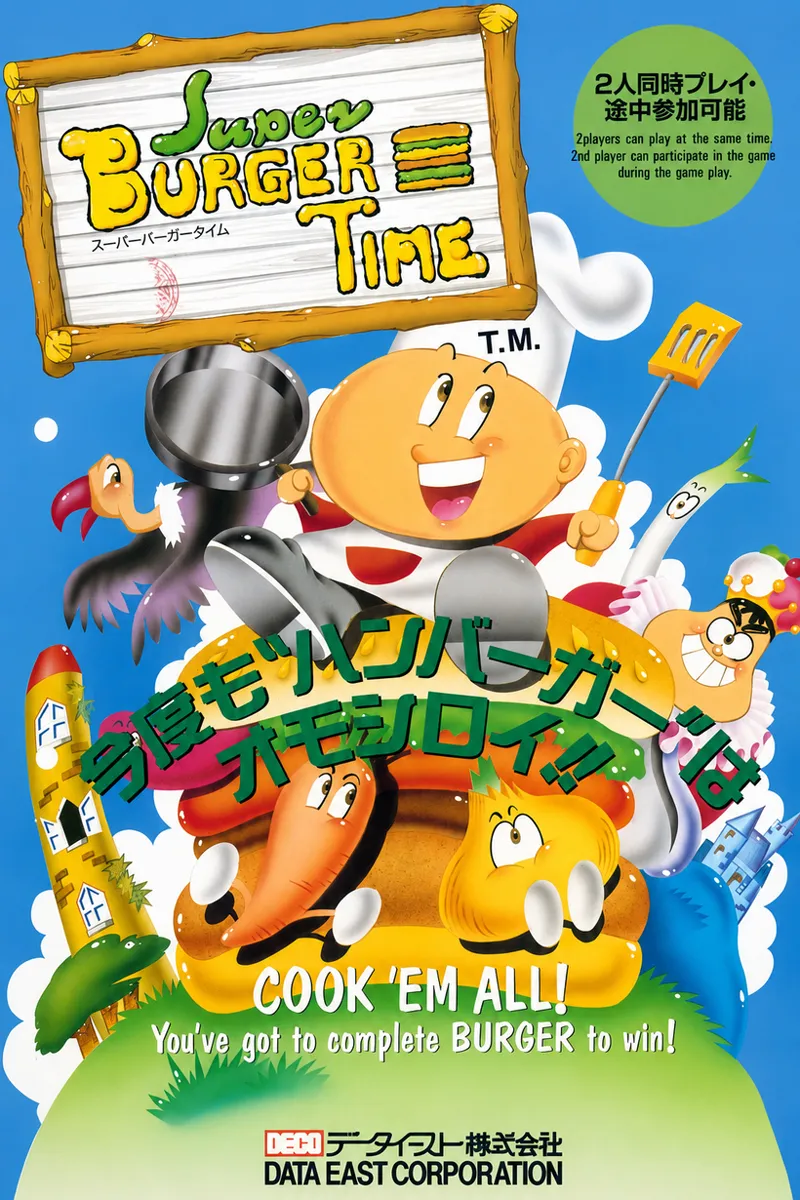



Coin-Op Collection Presents: DECO-16 (Super Burger Time)
Tonight's release for the Analogue Pocket and MiSTerFPGA platforms is the next entry on the DECO-16 platform. Super Burger Time is Data East's 1990 arcade sequel to the 1982 classic BurgerTime, a single-screen game of stacking hamburgers while dodging walking food, now with a jump button and two-player co-op, built on Data East's 16-bit custom hardware.
Kuhga / Vapor Trail (1989)
Crude Buster / Two Crude (1990)
Dark Seal / Gate of Doom (1990)
The Cliffhanger: Edward Randy (1990)
Super Burger Time (1990)
Death Brade / Mutant Fighter (1991)
Tatakae Genshijin: Joe & Mac / Caveman Ninja (1991)
Robocop 2 (1991)
Thunder Zone / Desert Assault (1991)
Wolf Fang: Kuhga 2001 / Rohga (1991)
Tumble Pop (1991)
Dark Seal II / Wizard Fire (1992)
Funky Jet (1992)
Gun Ball / Nitro Ball (1992)
Diet Go Go (1992)
The Great Ragtime Show / Boogie Wings (1992)
Double Wings (1993)
Super Burger Time runs on one of the most stripped-down boards on the platform, the same DE-0343 hardware as Tumble Pop. It has no protection chip at all, its program runs from plain unencrypted ROM, and a single tilemap generator and a single sprite engine feed the screen, with a HuC6280 driving one FM chip and one sampler. Where the later DECO-16 games layer on encryption, protection silicon, and second sprite engines, this one sits close to the bare platform, in a two-player cabinet.
This post covers a technical overview of Super Burger Time on DECO-16, the work the board required, and the game itself.
Overview:
Super Burger Time runs on Data East's DECO-16 hardware (PCB DE-0343), driven by a Motorola MC68000 (DECO Custom 59) at 10.738 MHz, with no second processor on the main bus and no encryption on its program ROM. The sound system uses a HuC6280 (DECO Custom 45) at 8.055 MHz driving a YM2151 (OPM) at 3.58 MHz and a single OKI M6295 ADPCM sampler at 1.007 MHz. There is no YM2203 and no second OKI on this board, and there is no sample-bank switching. Audio output is mono.
The video system outputs 320x240 in a horizontal orientation at 57.445 Hz. Graphics are rendered by a set of Data East custom ICs: a single DECO 55 tilemap generator drives two playfields, each four bits per pixel, and a single DECO 52 sprite engine draws one sprite layer. The board carries no protection or I/O custom, so the processor reads its controls and settings directly. The palette holds 1024 entries in 12-bit RGB, four bits per channel.
Development Challenges:
With no protection to reverse and no encryption to crack, the work on Super Burger Time is in the details, reproducing the board faithfully down to its original flaws. The clearest case is the title screen. On the real board the color cycle that animates the word Super does not run the first time the screen comes up, a genuine bug in the 1990 game.
Some emulators have quietly worked around it, pre-loading the palette with a stand-in pattern so the effect never looks broken, while MAME hasn't. The core does not paper over it either. It starts from the same blank palette the hardware powers up with, so the title behaves exactly as it does on a real cabinet, first pass and all. A few of the board's other rough edges come along the same way, sprites and scrolling that clip at the screen edges and a burger that can form in the wrong color when an enemy is crushed, kept because that is how the original behaves. The drastic slowdown present in the core matches the PCB as well.
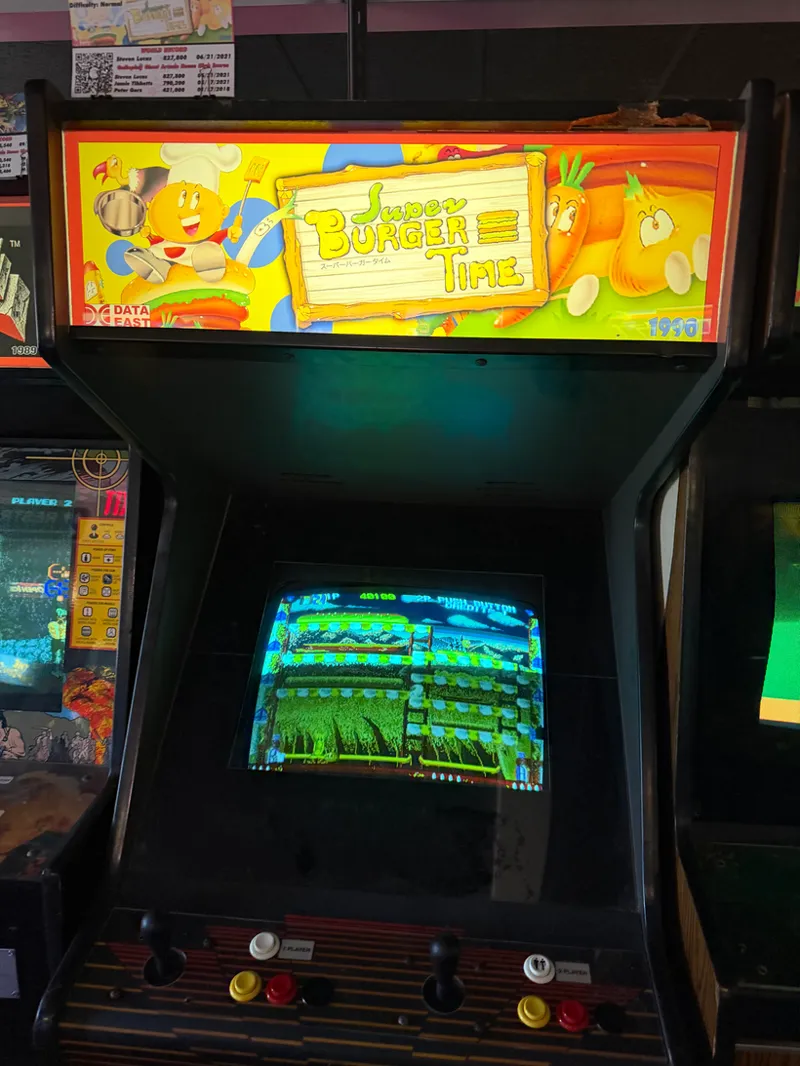
These behavior were verified against a PCB. In May of 2026 I traveled to Galloping Ghost Arcade in the Chicago area to playtest Super Burger Time and several other DECO titles on location, and met with a few local collectors to acquire some of the DECO-16 and DECO-32 PCBs still being worked on.
(Super Burger Time, Galloping Ghost Arcade)
Core Options:
The MiSTer core includes video settings for aspect ratio, vertical scaling and cropping, scandoubler effects, and H/V positioning and sync adjustments.
Audio settings provide separate OPM and M6295 PCM toggles, each with its own volume control, covering the board's two sound chips. Arcade dip switches are directly accessible from the OSD. Game settings include per-player auto-fire with adjustable rates, mapping options for Player 1 and Player 2, and a synced mapping mode that mirrors Player 1's layout to Player 2.
Cheats are accessible from the OSD and include per-player infinite lives, infinite pepper, and invincibility, along with a starting world and stage select. That world and stage select are custom additions, derived from the program code as these cheats did not exist previously.
The Pocket core provides auto-fire with per-button targeting and adjustable rates. Its cheat set is a single-player subset: starting world and stage select, infinite lives, infinite pepper, and invincibility. Arcade dip switches available on Pocket are No. of Lives, Game Difficulty, Continue Mode, and Attract Mode Sound.
The core supports three sets, two World revisions and the Japanese release.
History, Gameplay, and Regional Information:
Super Burger Time reached Japanese arcades in December 1990, developed and published by Data East, with a limited overseas run the same year. It was designed by Koji Akibayashi, with a soundtrack from Data East's in-house sound team Gamadelic, scored by Tatsuya Kiuchi and Tomoyoshi Sato. The game is a sequel to Data East's 1982 arcade classic BurgerTime, arriving eight years later, and this time the chef is Peter Pepper Jr., the son of the original's hero.
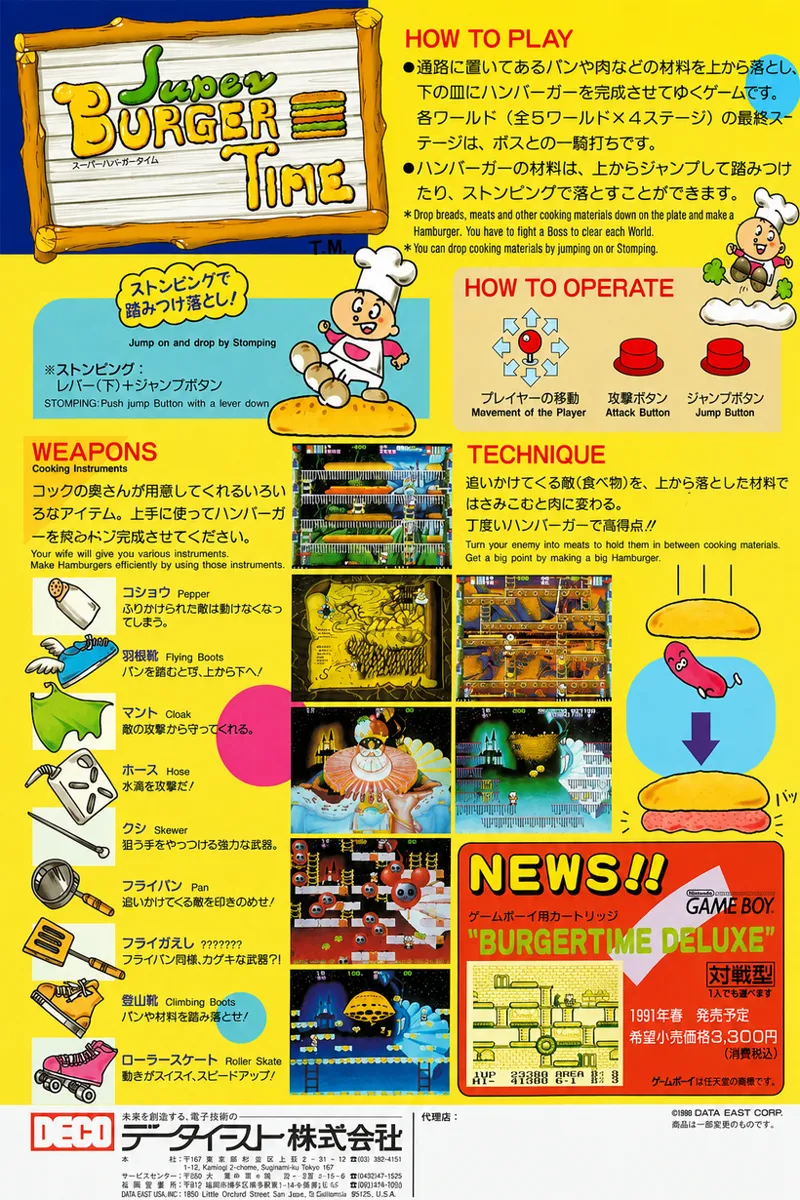
The core loop is the one from 1982. Each single-screen stage is a lattice of platforms with the pieces of several hamburgers laid across them, and the goal is to send every piece dropping to the layer below, stacking bun, patty, and lettuce onto the plate at the bottom of the screen. Clearing every burger clears the stage. Walking food gives chase, a hot dog, an egg, and a pickle among them, and a shake of pepper stuns them long enough to slip past, or to drop a burger on their heads.
What Super Burger Time adds is mostly scale and a jump button. Two players can work a stage at once, the levels are larger and busier, the burgers come in different sizes, and the chef can pick up power-ups, a frying pan, a spatula, a cape, to deal with the tougher enemies, some of which now take several hits to stun or throw projectiles of their own. Each run of stages ends with a boss, fought by hurling the burgers you have just assembled at it.
Across regions the game is the same, kept under the Super Burger Time title everywhere, unlike the 1982 original, which was renamed from Hamburger for its overseas release. The sets differ only in their program code, though one of the World revisions ship without the stage backgrounds on most levels, a quirk confirmed as genuine across several boards rather than a fault. The game barely shipped, a very limited conversion-kit run that left it rare and largely unseen next to the ubiquitous original. It has surfaced since on modern collections, reaching the Switch in 2018 and PC in 2021, and it keeps a small following as a faithful, better-looking sequel that most people never had the chance to play.
Updates:
Super Burger Time is the next public release in wave 2 for Data East's DECO-16 platform. It shares the DE-0343 board with Tumble Pop, the leanest hardware in the family, and the DECO 55 tilemap generator and DECO 52 sprite engine it runs are the base graphics parts the rest of the platform builds on.
The remaining wave 2 titles are:
Thunder Zone / Desert Assault (1991)
Wolf Fang: Kuhga 2001 / Rohga (1991)
Dark Seal II / Wizard Fire (1992)
Funky Jet (1992)
The files have been pushed to GitHub, update_all, and pupdate for distribution. Please allow the updaters time to sync. Other update information shared in the previous posts can be found in their update sections at the links below:
https://www.patreon.com/posts/165187605
https://www.patreon.com/posts/165401081
https://www.patreon.com/posts/165413183
https://www.patreon.com/posts/165417337
Disclaimer: All product names, trademarks, and registered trademarks mentioned are the property of their respective owners. "Analogue", "Analogue Pocket", "MiSTer", "MiSTerFPGA", "OpenFPGA", "Data East", "NEC", "Hudson Soft", "Motorola", "Yamaha", "OKI", "Galloping Ghost Arcade", and all derivative works are trademarks, registered trademarks, or copyrighted materials of their respective holders. Use of these names does not imply endorsement or association with this post. All rights reserved to their respective owners. This post is for educational and research purposes only.

Comments (2)
This games is so much fun! Thanks team!
Beautiful game, thanks!!!