


Coin-Op Collection Presents: DECO-16 (NitroBall / GunBall)
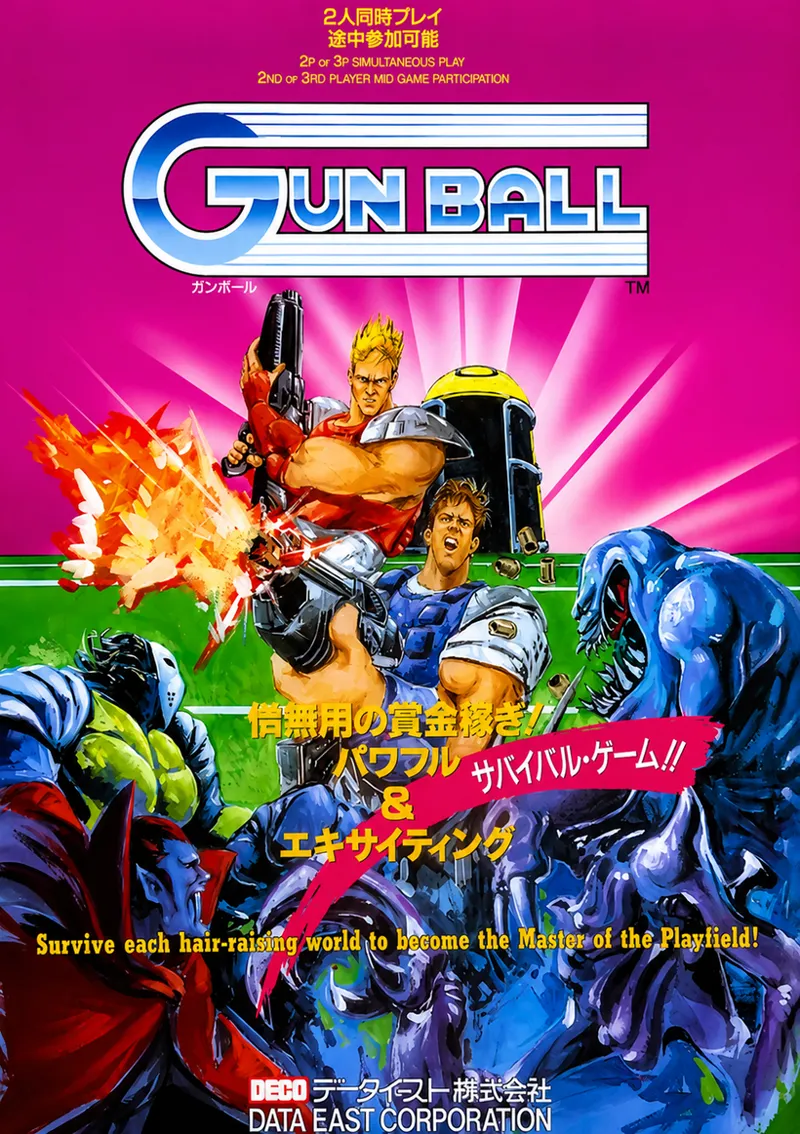
Today's release for the Analogue Pocket and MiSTerFPGA platforms is the next entry on the DECO-16 platform. Nitro Ball, known in Japan as Gun Ball, is an overhead run-and-gun shooter crossed with pinball, built on Data East's 16-bit custom hardware.
Kuhga / Vapor Trail (1989)
Crude Buster / Two Crude (1990)
Dark Seal / Gate of Doom (1990)
The Cliffhanger: Edward Randy (1990)
Super Burger Time (1990)
Death Brade / Mutant Fighter (1991)
Tatakae Genshijin: Joe & Mac / Caveman Ninja (1991)
Robocop 2 (1991)
Thunder Zone / Desert Assault (1991)
Wolf Fang: Kuhga 2001 / Rohga (1991)
Tumble Pop (1991)
Dark Seal II / Wizard Fire (1992)
Funky Jet (1992)
Gun Ball / Nitro Ball (1992)
Diet Go Go (1992)
The Great Ragtime Show / Boogie Wings (1992)
Double Wings (1993)
Nitro Ball is one of the most graphically involved boards on the platform. It runs two tilemap generators, one of them folding its pair of playfields into a single eight-bit-per-pixel layer, alongside two sprite engines, one of which is alpha-blended, with a DECO 146 handling protection and I/O. It also supports up to three players at once.
This post covers a technical overview of Nitro Ball on DECO-16, the work the board required, and the game itself.
Overview:
Nitro Ball runs on Data East's DECO-16 hardware (PCB DE-0358-3), driven by a Motorola MC68000 (DECO Custom 59) at 14 MHz with no second processor on the main bus. The sound system uses a HuC6280 (DECO Custom 45) at 8.00 MHz driving a YM2151 (OPM) at 3.579 MHz and two OKI M6295 ADPCM samplers, one at 1.000 MHz and the other at 2.000 MHz. There is no YM2203 on this board, and the YM2151's CT1 and CT2 pins select the sample bank on each OKI. Audio output is mono.
The video system outputs 320x240 in a vertical orientation at 57.445 Hz. Graphics are rendered by a set of Data East custom ICs: two tilemap generators, a DECO 56 and a DECO 74, drive the playfields, with the DECO 74 combining its two layers into a single eight-bit-per-pixel layer, while two DECO 52 sprite engines draw two sprite layers, one of them alpha-blended against the scene. A DECO 146 handles the board's protection and I/O. The palette holds 2048 entries in 24-bit RGB, eight bits per channel.
Development Challenges:
Nitro Ball's graphics are the most involved on the platform. Two tilemap generators drive the playfields, a DECO 56 and a DECO 74, with the DECO 74 wired to fold its two layers into a single eight-bit-per-pixel layer rather than draw them as two. The tile ROMs are encrypted, the character and first tile set under the DECO 56 scheme and the second set under the DECO 74 scheme, and the core undoes both at the loader so the tile data reaches the generators already in the clear.
Above the tiles sit two DECO 52 sprite engines, each reading its own display list from DMA live instead of once per frame, so the sprite data each chip sees is not latched, and read live just like the actual hardware. One of the two sprite layers is alpha-blended, mixing its pixels into the scene behind it to produce the translucent effects that show up through the game, and the two sprite outputs and the tile layers are composited together through the board's priority register.
Boogie Wings is the platform's other board that mixes translucency into the scene, and it gets there a different way. Boogie Wings routes its layers through a dedicated compositor, the DECO 99 that Data East branded the ACE, blending them at the end of the graphics chain. Nitro Ball has no such chip; its blending lives in the sprite engine itself, on the single sprite plane that mixes at half strength into the scene below it. The two boards share the same dual DECO 52 sprite path, but Nitro Ball keeps its blending contained in one sprite layer where Boogie Wings hands the whole frame to a compositor.
The sound section is the standard DECO-16 stack without the YM2203, a HuC6280 driving a YM2151 and two OKI M6295 samplers. The board uses the YM2151's CT1 and CT2 output pins to switch the sample bank on each OKI rather than dedicating an I/O port to it, and the core mirrors that, following the CT pins out to the sampler bank registers.
Core Options:
The MiSTer core includes video settings for aspect ratio, vertical scaling and cropping, scandoubler effects, and H/V positioning and sync adjustments. Nitro Ball runs vertically, so a screen rotation toggle is included for HDMI displays.
Audio settings provide separate OPM and two M6295 PCM toggles, each with its own volume control, covering the full sound section. Arcade dip switches are directly accessible from the OSD. Game settings include per-player auto-fire with adjustable rates, mapping options for Player 1 through Player 3, and a synced mapping mode that mirrors Player 1's layout to two or three players depending on the cabinet.
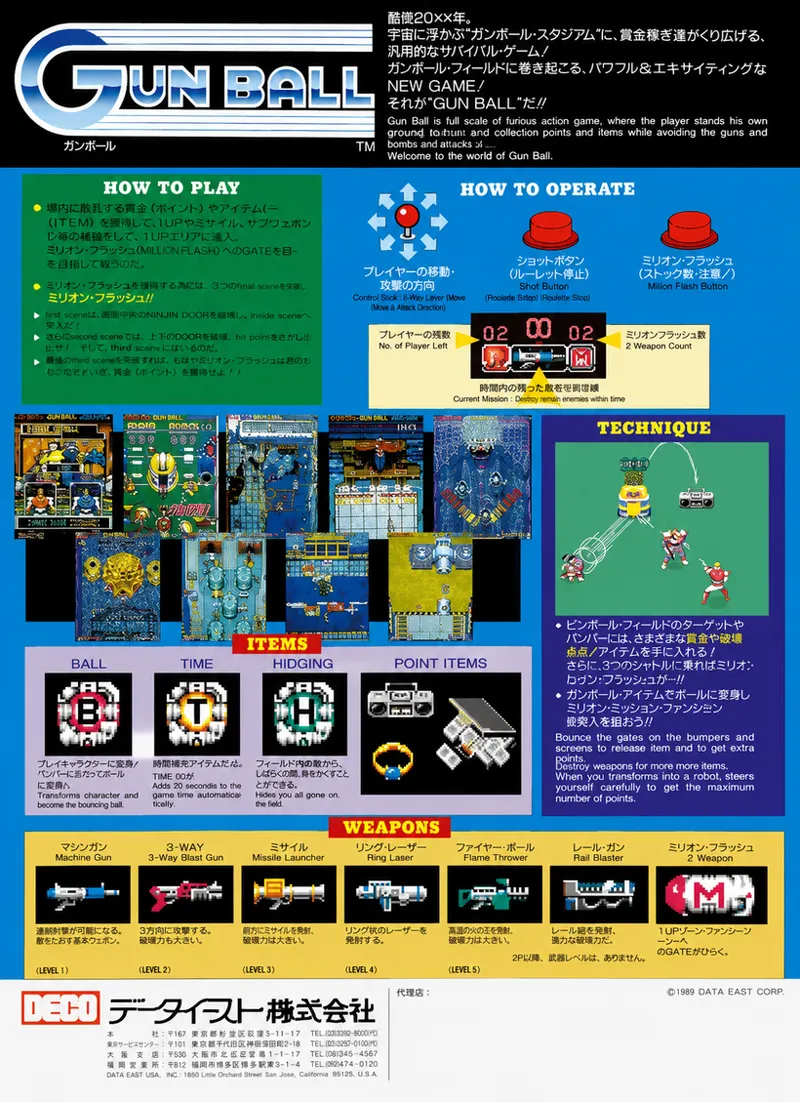
Cheats are accessible from the OSD and include a stage select for any of the game's five stages, a roulette select, infinite credits, infinite time, and infinite event time. Each of the three players also has infinite lives, invincibility, rapid fire, infinite weapon time, and infinite Z-weapons, along with a weapon select that switches the active weapon between the Missile Launcher, Ring Laser, Flame Thrower, and Rail Blaster.
The Pocket core provides auto-fire with per-button targeting and adjustable rates. Its cheat set is a single-player subset: stage select, invincibility, infinite weapon time, infinite Z-weapons, and weapon select. Arcade dip switches available on Pocket are No. of Lives, Game Difficulty, and Attract Mode Sound.
The core supports four sets, three World versions and the Japanese Gun Ball release.
History, Gameplay, and Regional Information:
Nitro Ball was developed and published by Data East, reaching Japanese arcades in September 1992 as Gun Ball and overseas as Nitro Ball. It was directed by Jinbo, with a soundtrack from Data East's in-house sound team Gamadelic, scored by Hiroaki Yoshida and Akira Takemoto.
The gameplay is an overhead run-and-gun crossed with a pinball table, for up to three players at once. Each stage is laid out like a pinball field, full of bumpers, ramps, holes, and lettered targets, and the pinball furniture is a scoring tool rather than decoration: shooting an enemy knocks its body into the bumpers and targets to rack up points and shake loose power-ups. A signature pickup turns the player into an invincible, momentum-driven ball that ricochets through the table and reaches places a walking character cannot. You start each life with a weak machine gun and a stock of screen-clearing Z-weapons, and collectible main weapons escalate through several tiers, a Ring Laser, a Flame Thrower, a Missile Launcher, and the Rail Blaster at the top. There is no blocking or shielding; survival is pure movement.
The setting frames all of this as a televised survival game show, a Smash TV-style death-match staged in a stadium out in space, with an announcer and game-show sound bites over the action. The run covers five themed stages, Strange Football, Combat Field, Ghost Town, Aliens World, and Space Station, each closing on a large boss, and the boss designs lean on horror and science-fiction pastiche, from a hockey-masked hulk to a Dracula and a robot overlord.
The main regional difference is the stage order. The Japanese Gun Ball opens on Combat Field and then Strange Football, while the overseas Nitro Ball swaps the two so it opens on Strange Football, with the remaining three stages in the same order. There are no content cuts between the versions, and the Japanese title, literally guns and steel balls, is the more descriptive of the two.
Nitro Ball is genuinely obscure, a rare board that left little contemporary record and is remembered mostly through later enthusiast coverage, where it holds a reputation as a hidden gem.
Updates:
Nitro Ball is the next public release in wave 2 for Data East's DECO-16 platform. The dual DECO 52 sprite path and the tilemap work this board required carry directly over to Wolf Fang and Wizard Fire, which run the same sprite and tile architecture, so the boards still ahead follow from here.
The remaining wave 2 titles are:
Super Burger Time (1990)
Death Brade / Mutant Fighter (1991)
Thunder Zone / Desert Assault (1991)
Wolf Fang: Kuhga 2001 / Rohga (1991)
Dark Seal II / Wizard Fire (1992)
Funky Jet (1992)
Diet Go Go (1992)
As covered in the last DECO-16 update post, Funky Jet still carries the known DECO 146 issues that keep it from a public release for now. I'll take a look at it over the weekend again and see what happens.
Based on feedback from some members since the last two posts, if you've like to manually update you can always grab the releases from their distribution repos on GitHub. To keep things less confusing for those who prefer not do a manual install, files will be available on our Discord in the news channel. If you are an active member and Discord user and not in the server please review the following link on how to connect:
https://support.patreon.com/hc/en-us/articles/212052266-Getting-Discord-access
Disclaimer: All product names, trademarks, and registered trademarks mentioned are the property of their respective owners. "Analogue", "Analogue Pocket", "MiSTer", "MiSTerFPGA", "OpenFPGA", "Data East", "NEC", "Hudson Soft", "Motorola", "Yamaha", "OKI", "Midway", "Smash TV", and all derivative works are trademarks, registered trademarks, or copyrighted materials of their respective holders. Use of these names does not imply endorsement or association with this post. All rights reserved to their respective owners. This post is for educational and research purposes only.
Comments (1)
WoW! 🤩