





Coin-Op Collection Presents: DECO-16 (Double Wings)
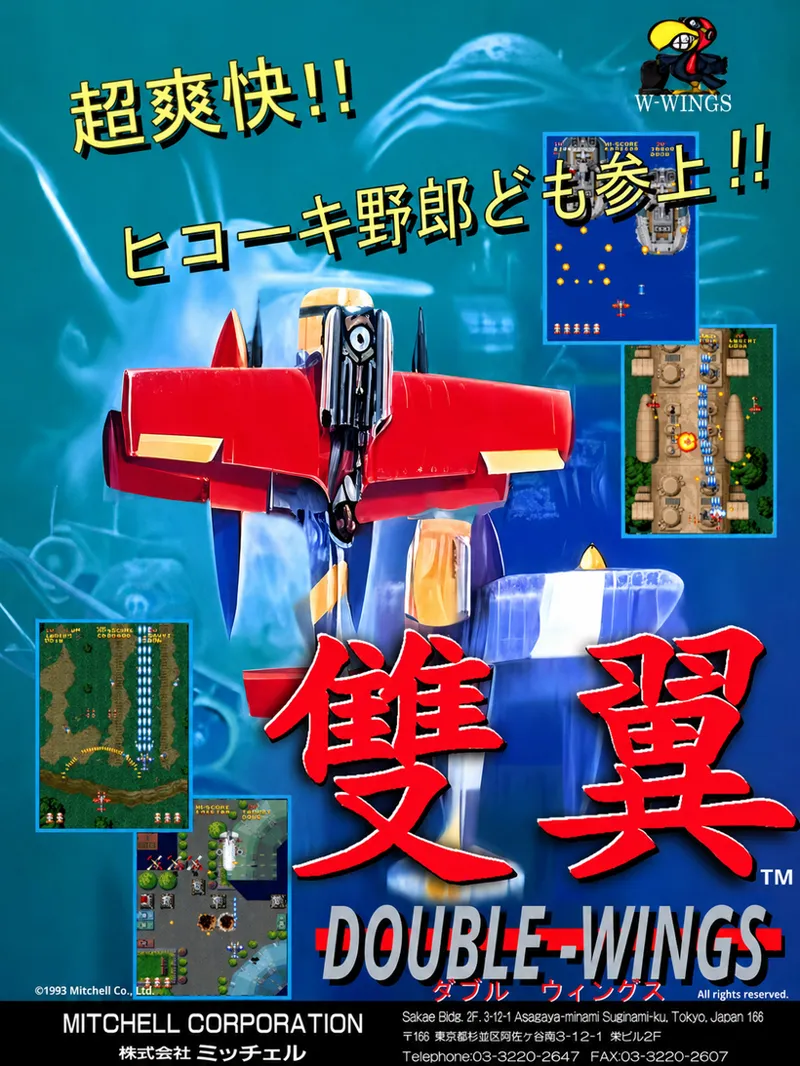
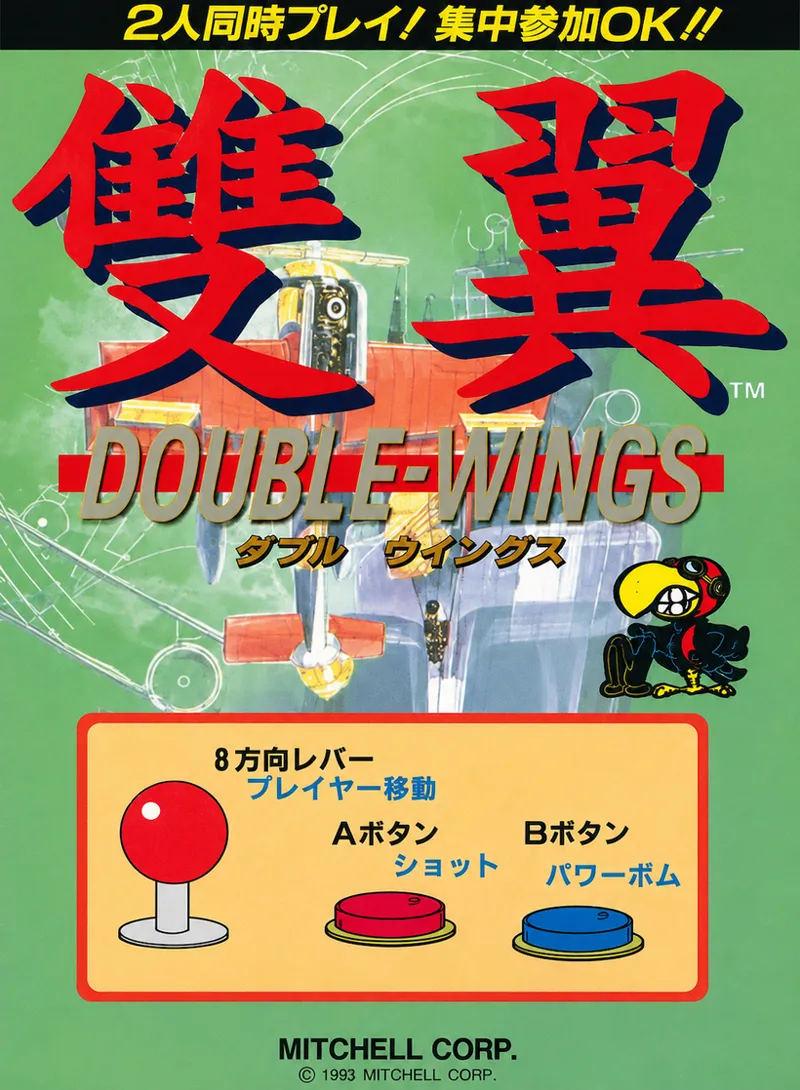
Today's release for the Analogue Pocket and MiSTerFPGA platforms is the next entry on the DECO-16 platform. Double Wings is a vertically scrolling shoot-'em-up built on Data East's 16-bit custom hardware, published by Mitchell in 1993.
Kuhga / Vapor Trail (1989)
Crude Buster / Two Crude (1990)
Dark Seal / Gate of Doom (1990)
The Cliffhanger: Edward Randy (1990)
Super Burger Time (1990)
Death Brade / Mutant Fighter (1991)
Tatakae Genshijin: Joe & Mac / Caveman Ninja (1991)
Robocop 2 (1991)
Thunder Zone / Desert Assault (1991)
Wolf Fang: Kuhga 2001 / Rohga (1991)
Tumble Pop (1991)
Dark Seal II / Wizard Fire (1992)
Funky Jet (1992)
Gun Ball / Nitro Ball (1992)
Diet Go Go (1992)
The Great Ragtime Show / Boogie Wings (1992)
Double Wings is a later addition to the platform than the titles above, arriving in December 1993 on the same Data East silicon but published by Mitchell rather than Data East. It is the only board in the family to run its sound section on a Zilog Z80 instead of the HuC6280, and one of only two to ship an encrypted 68000 program.
This post covers a technical overview of Double Wings on DECO-16, the work the board required, and the game itself.
Overview:
Double Wings runs on Data East's DECO-16 hardware (PCB DEC-22VO / S-NK-3220), driven by a Motorola MC68000 at 14 MHz, shipped with encrypted instructions on the custom DECO 102. The sound section is the one place Double Wings departs from the rest of the platform: instead of a HuC6280, a Zilog Z80 at 3.58 MHz drives a YM2151 (OPM) at 3.58 MHz for FM and a single OKI M6295 ADPCM sampler at 1.0 MHz. Audio output is mono.
The video system outputs 320x240 in a vertical orientation at 57.445 Hz. Graphics are rendered by a set of Data East custom ICs: a DECO 141 tilemap generator drives two playfields, a DECO 52 handles sprites at 16x16, and a DECO 104 carries the board's inputs and protection. Layer priority is fixed, with the sprites drawn on top of both tile layers. The palette holds 1024 entries in 12-bit xBGR format.
Development Challenges:
The sound section is where most of the work went. Double Wings is the only board in the family that does not run its audio on a HuC6280, so its Z80 sound path had to be stood up on its own, and its mix is completely different from the rest of the platform.
The single OKI carries both the sound effects and the percussion that plays under the YM2151, and the way those sit against each other on the board comes from its own audio filtering rather than a flat sum of the channels. The core reproduces that filtering, so the effect samples and the music hold the same balance they do on the PCB. This is the first DECO-16 core that models audio filtering, each title will receive an update in a future release.
The DECO 104 handles the board's I/O, and Double Wings reads its DIP switches back through it rather than from a direct port. Those reads depend on the exact cycle the protection latch clears on, so reading them back correctly meant clearing the latch on the leading edge of each read, the behavior this board's sequence expects. None of this is in the emulation source.
Double Wings uses a five-bit color select rather than four, so the sprite palette addressing and the palette were widened to match the requirement for the DECO 52, and layer transparency was fixed so the second playfield and the sprites read pen zero as transparent and the backdrop shows through where nothing is opaque. The core also latches the sprite list once per frame at vertical blank rather than reading it live, which the emulation leaves as an open question, sprites are double buffered.
Core Options:
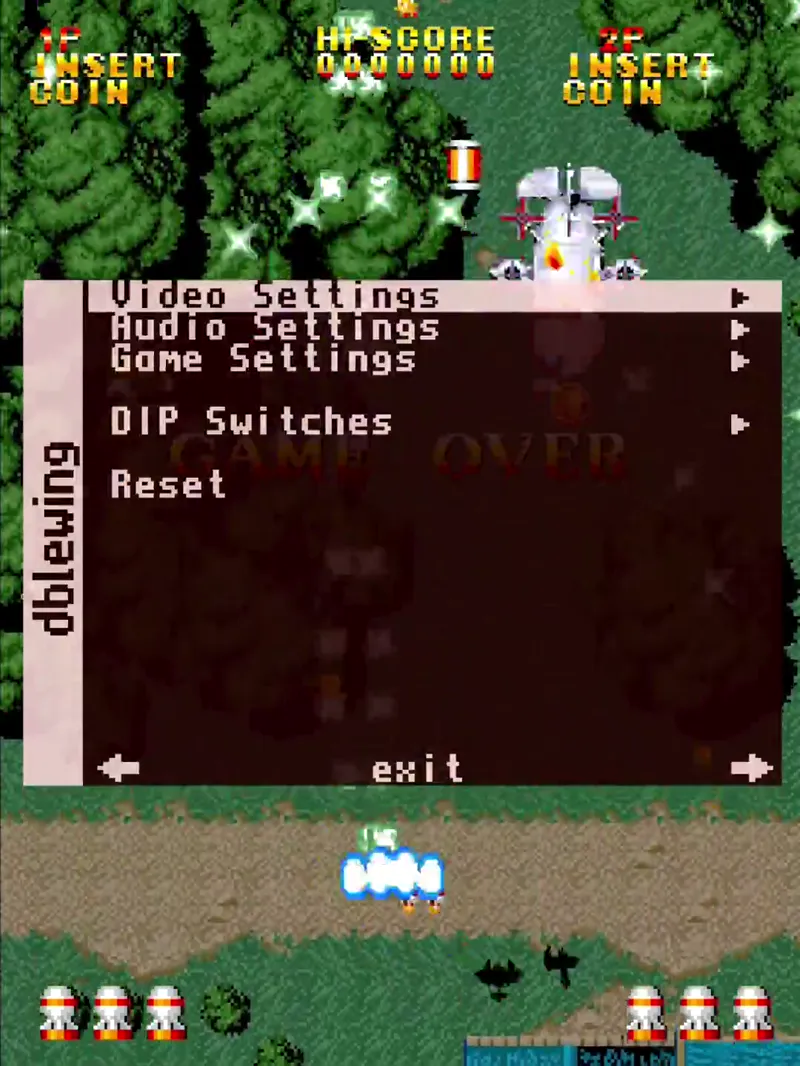
The MiSTer core includes video settings for aspect ratio, vertical scaling and cropping, scandoubler effects, and H/V positioning and sync adjustments. Double Wings runs vertically, so a screen rotation toggle is included for HDMI displays.
Audio settings provide separate OPM and OKI M6295 PCM toggles, each with its own volume control. Arcade dip switches are directly accessible from the OSD. Game settings include per-player auto-fire with adjustable rates, mapping options for Player 1 and Player 2, and a synced mapping mode that mirrors Player 1's layout to Player 2.
Cheats are accessible from the OSD and include a stage select for any of the game's eight stages, infinite credits, and per-player infinite lives, infinite bombs, invincibility, and rapid fire. Each player also has a max shot power and a max sub weapon power toggle, a weapon select that locks the main weapon to Vulcan, Laser, or Break Vulcan, and a sub weapon select that locks it to Missile or Homing.
The Pocket core provides auto-fire with per-button targeting and adjustable rates. Its cheat set is a single-player subset: stage select, invincibility, infinite bombs, max shot power, max sub weapon power, and the weapon and sub weapon selects. Arcade dip switches available on Pocket are No. of Plane, Game Difficulty, and Bonus Plane.
The core supports three sets, the World / Japanese version, an alternate World / Japanese revision, and the Asia version.
History, Gameplay, and Regional Information:
Double Wings reached Japanese arcades in December 1993, published by Mitchell on Data East's hardware. The graphics ROMs carry Data East's own mask-ROM labels and the board is built entirely from Data East customs, so the game is generally understood to be a Data East collaboration with Mitchell as the publisher, though no credit spells the split out. Double Wings credits its team only through an in-game staff roll, and even there the names are gag handles rather than real ones, split into sprite design and programming with no music or sound credit listed at all. No composer for the game is documented anywhere.
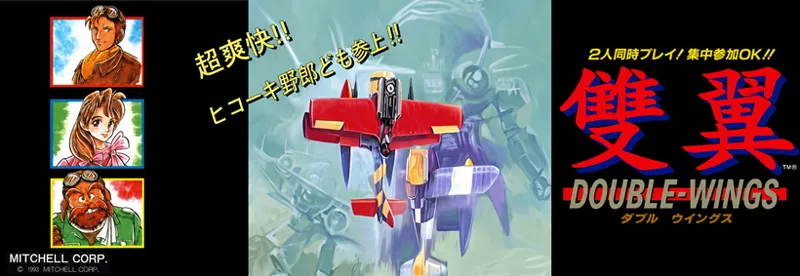
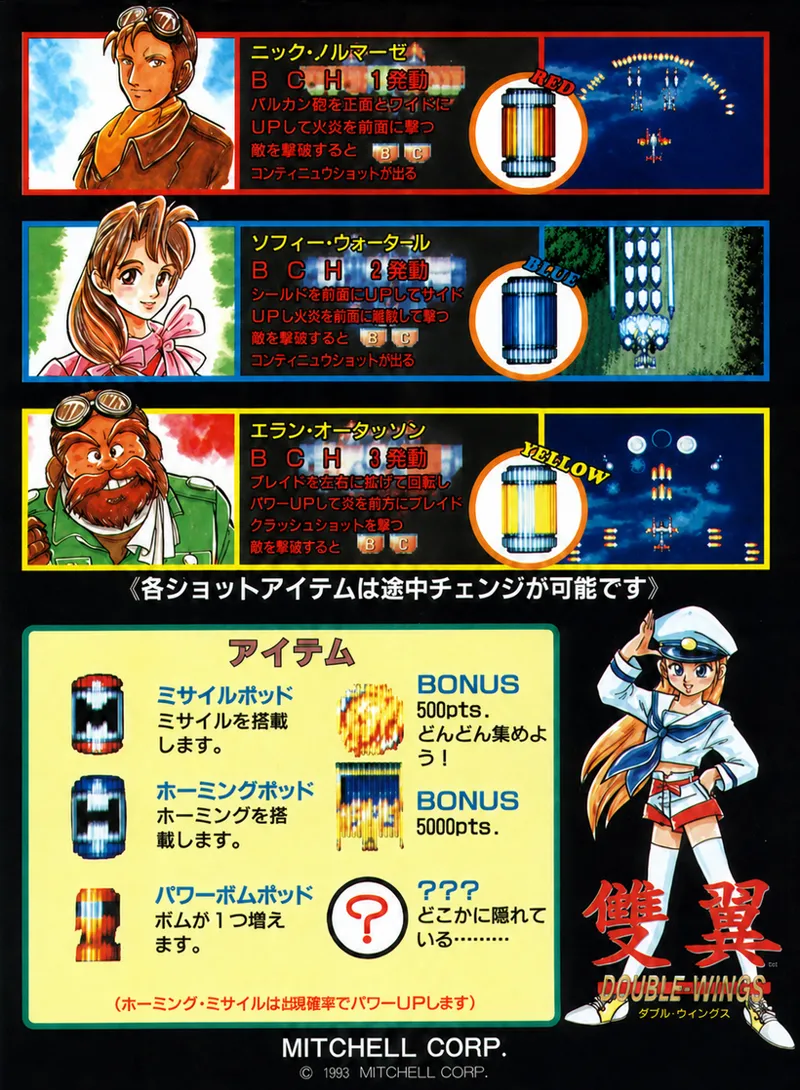
The game is a vertically scrolling shooter with a First World War aviation theme, playable by one or two at once. Each player picks one of three biplane pilots, Nick Nolmarse, Sophie Dior, and Elan Auckbetz, each flying with a different weapon character. An eight-way stick moves and aims, one button fires the main weapon, and another drops a limited stock of bombs that clear the screen. Power-ups from downed enemies raise the main weapon, which can be locked to a spread Vulcan, a Laser, or a Break Vulcan, alongside a sub weapon that fires Missiles or Homing shots. The run covers eight stages against an anachronistic mix of planes, airships, tanks, ships, and gun emplacements, with a boss closing each.
Across regions the game is the same eight stages and the same three pilots, with the pilots' Western names kept everywhere. The one mechanical difference is in the Asia version, which drops the checkpoint system the Japanese sets use and respawns the player in place on death, easing the game considerably. The region setting on the board is a dip switch the manual tells operators not to change.
Double Wings drew little attention on release and left no chart or review record, overshadowed by the bigger shooters of its year. Its reputation grew later and narrowly, among vertical-shooter enthusiasts who treat it as a hidden gem, a competent Twin Cobra-style shooter with dense early bullet patterns and a distinctive international look. That reputation, and its rarity, have left it a curio rather than a widely known title.
Updates:
As we begin rolling out the public release of wave 2 for Data East's DECO-16 platform, additional modules used in the DECO-16 core will be added to development-modules repository.
DECO-16 Wave 2 will include the following titles:
Super Burger Time (1990)
Death Brade / Mutant Fighter (1991)
Thunder Zone / Desert Assault (1991)
Wolf Fang: Kuhga 2001 / Rohga (1991)
Dark Seal II / Wizard Fire (1992)
Funky Jet (1992)
Gun Ball / Nitro Ball (1992)
Diet Go Go (1992)
Double Wings (1993)
As covered in the last DECO-16 update post for wave 1, Funky Jet is the one title in this wave still carrying known issues. Its DECO 146 protection has a continue-coinage problem and sprite corruption on the stage 2 boss that I have not been able to resolve, so it may release as a beta with those in place until the DECO 146 is decapped and traced and I can work from the die directly.
All DECO-16 wave 1 releases from the 29th have been pushed to the OpenFPGA library and should populate soon. Double Wings has been added to update_all and pupdate, please remember it can take up to an hour for the updaters to sync with new files. We'll see more games from the DECO-16 platform release later this evening.
Disclaimer: All product names, trademarks, and registered trademarks mentioned are the property of their respective owners. "Analogue", "Analogue Pocket", "MiSTer", "MiSTerFPGA", "OpenFPGA", "Data East", "Mitchell", "NEC", "Hudson Soft", "Motorola", "Zilog", "Yamaha", "OKI", and all derivative works are trademarks, registered trademarks, or copyrighted materials of their respective holders. Use of these names does not imply endorsement or association with this post. All rights reserved to their respective owners. This post is for educational and research purposes only.
Comments (3)
Awesome! Thanks team!
Beautiful Game!!! Thanks !!!
🔥Great job guys!