


Coin-Op Collection Presents: DECO-16 (Mutant Fighters / Death Brade)
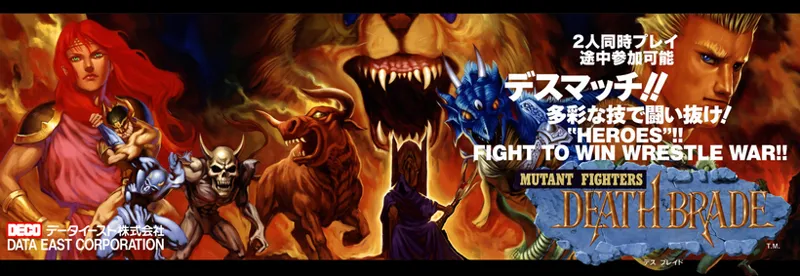
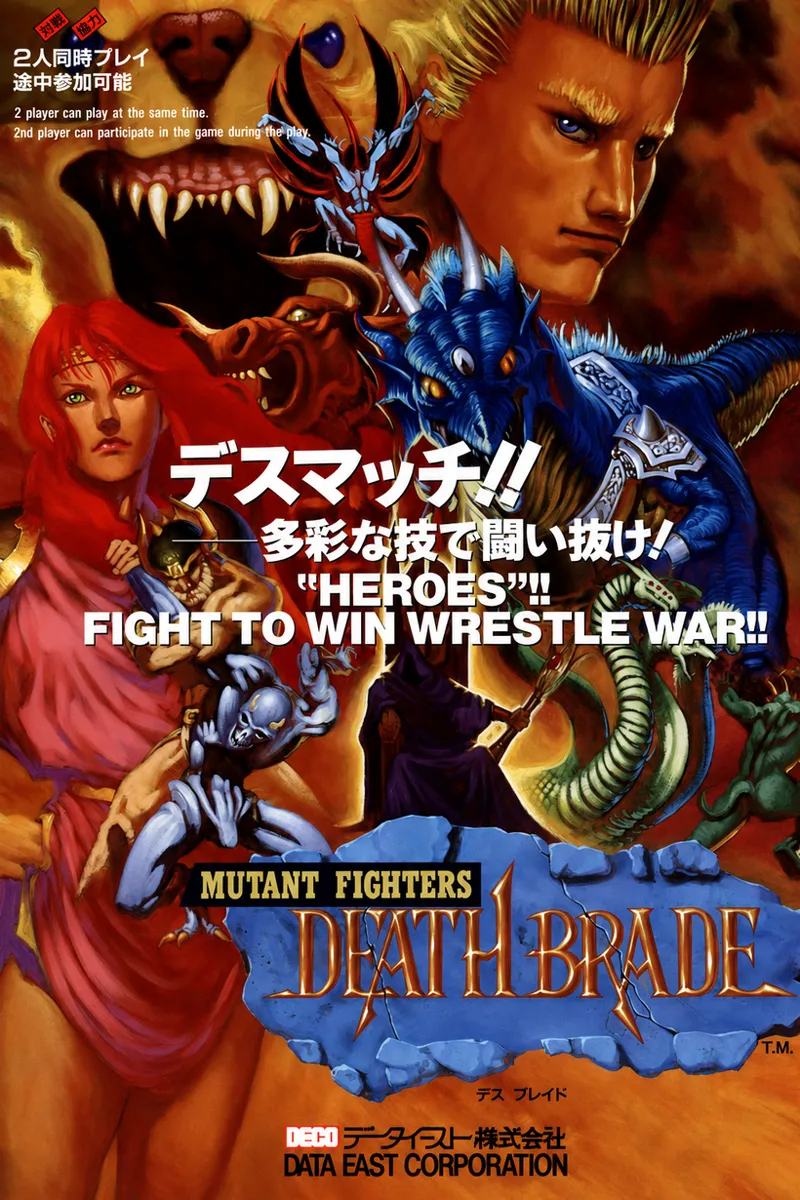
This evening's release for the Analogue Pocket and MiSTerFPGA platforms is the next entry on the DECO-16 platform. Mutant Fighter, known in Japan as Death Brade, is a one-on-one fighting game with a pro-wrestling core and a cast of fantasy monsters, built on Data East's 16-bit custom hardware.
Kuhga / Vapor Trail (1989)
Crude Buster / Two Crude (1990)
Dark Seal / Gate of Doom (1990)
The Cliffhanger: Edward Randy (1990)
Super Burger Time (1990)
Death Brade / Mutant Fighter (1991)
Tatakae Genshijin: Joe & Mac / Caveman Ninja (1991)
Robocop 2 (1991)
Thunder Zone / Desert Assault (1991)
Wolf Fang: Kuhga 2001 / Rohga (1991)
Tumble Pop (1991)
Dark Seal II / Wizard Fire (1992)
Funky Jet (1992)
Gun Ball / Nitro Ball (1992)
Diet Go Go (1992)
The Great Ragtime Show / Boogie Wings (1992)
Double Wings (1993)
Mutant Fighter is the earliest board in the family to blend graphics layers rather than stack them flat. Its translucent effects, drawn on a dedicated sprite plane, are the same technique that later turns up on Nitro Ball and Boogie Wings, and Mutant Fighter is where it first appeared on the platform, in 1991. It runs two tilemap generators and two sprite engines through a DECO 66, in a two-player cabinet.
This post covers a technical overview of Mutant Fighter on DECO-16, the work the board required, and the game itself.
Overview:
Mutant Fighter runs on Data East's DECO-16 hardware (PCB DE-0346), driven by a Motorola MC68000 (DECO Custom 59) at 14 MHz with no second processor on the main bus. The sound system uses a HuC6280 (DECO Custom 45) at 4.0275 MHz driving a YM2151 (OPM) at 3.58 MHz and two OKI M6295 ADPCM samplers, one at 1.007 MHz and the other at 2.013 MHz. There is no YM2203 on this board, and the YM2151's CT1 pin selects the sample bank on the second OKI. Audio output is mono.
The video system outputs 320x240 in a horizontal orientation at 57.445 Hz. Graphics are rendered by a set of Data East custom ICs: two DECO 55 tilemap generators drive four playfields between them, and two DECO 52 sprite engines draw two sprite layers, one of which is alpha-blended against the scene. A DECO 66 handles the board's protection and I/O. The palette holds 2048 entries in 24-bit RGB, eight bits per channel.
Development Challenges:
Mutant Fighter is the board that brought alpha blending to the platform, and its translucency is the centerpiece of the work here. It carries two DECO 52 sprite engines, and one of the two sprite planes is drawn as a half-strength overlay, mixing its pixels into whatever sits behind it rather than replacing them.
The blend is a fixed fifty percent averaged against the layer below, so the core captures the pixel behind each blended sprite and mixes the two rather than keying against a flat color, which is what gives the fighters their translucent shadows and the arena its haze. One detail carries straight over from the board: those shadows jitter a little as the fighters move, a quirk of the original hardware rather than the core, and the core reproduces it the way the board does.
The rest of the graphics path is the platform's usual parts run in pairs. Two DECO 55 tilemap generators drive four playfields between them, and the two DECO 52 sprite engines each read their own display list, with a priority register selecting which of the two sprite planes sits in front and the layers composited back to front around the blended one.
The sound section is the standard DECO-16 stack without the YM2203, a HuC6280 driving a YM2151 and two OKI M6295 samplers. The board switches the sample bank on the second OKI through the YM2151's CT1 output pin rather than a dedicated I/O port, and the core follows that pin out to the sampler's bank register.
Core Options:
The MiSTer core includes video settings for aspect ratio, vertical scaling and cropping, scandoubler effects, and H/V positioning and sync adjustments.
Audio settings provide separate OPM and two M6295 PCM toggles, each with its own volume control, covering the full sound section. Arcade dip switches are directly accessible from the OSD. Game settings include per-player auto-fire with adjustable rates, mapping options for Player 1 and Player 2, and a synced mapping mode that mirrors Player 1's layout to Player 2.
Cheats are accessible from the OSD and include infinite time, along with per-player infinite energy and infinite super.
The Pocket core provides auto-fire with per-button targeting and adjustable rates. Its cheat set is infinite time, infinite energy, and infinite super. Arcade dip switches available on Pocket are Timer Decrement, Game Difficulty, Per Stage Life, Continue Mode, and Attract Mode Sound.
The core supports six sets, the World Mutant Fighter revisions, a World build retitled Heroes, and the Japanese Death Brade release.
History, Gameplay, and Regional Information:
Mutant Fighter reached Japanese arcades in July 1991 as Death Brade, with the overseas release following in 1992 as Mutant Fighter. It was designed by Wizard Solomon and led in programming by Min5, with a soundtrack from Data East's in-house sound team Gamadelic, scored by Hiroaki Yoshida and Akira Takemoto. The game is a follow-up to Data East's 1989 arcade title Hippodrome, sharing its fantasy setting and carrying a couple of its characters over, and it went on to be the more popular of the two.
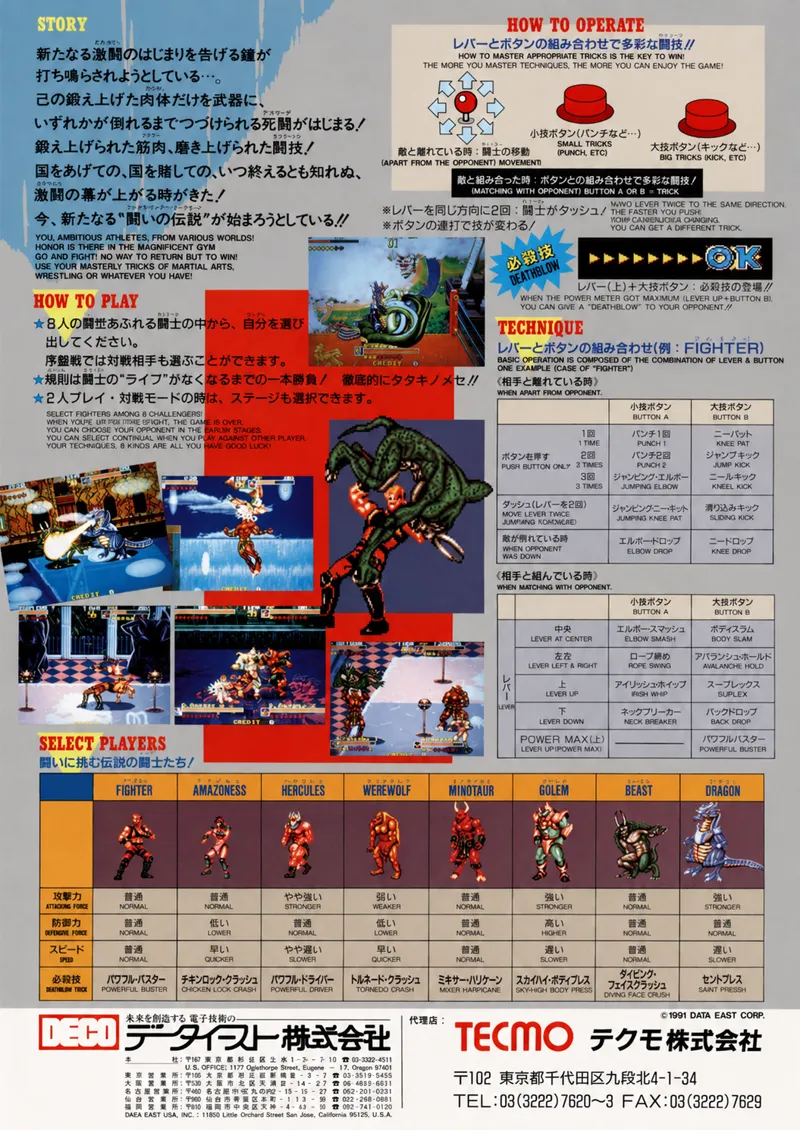
The game is a one-on-one fighting game built around pro-wrestling rather than trading punches. A two-button layout covers a light and a heavy attack, pressing both guards, and a direction with an attack throws, so most of the damage comes from grapples, suplexes, and Irish whips rather than strikes. A meter fills as a fighter lands and absorbs blows, and when it is full it unleashes a spectacular Super Throw, one of the earliest super meters the genre put on screen. There is no pin, so a match ends when one fighter's health runs out.
Eight fighters are selectable, three human champions and five monsters, from a werewolf and a minotaur to a golem and a dragon, each with its own power, speed, and set of throws. The game is a run up a twelve-fight ladder to be crowned the new king, with the player choosing the order of the early opponents before a fixed run of bosses, a doppelganger, a demon, and the sorcerer Arch-Mage at the end. The player's stamina bar grows a little with each stage as the opponents get tougher.
The overseas Mutant Fighter and the Japanese Death Brade are the same game under different names, and a UK location test ran briefly under a third title, Heroes. The home conversions stayed in Japan. Ports reached the Sharp X68000 and the FM Towns in 1992, and a Super Famicom version followed in 1993, though that one cut the roster from eight fighters down to five and lost much of the arcade's animation.
Death Brade was a strong earner at home. Game Machine listed it as the second most-successful new table arcade unit in Japan in its August 1991 issue, and it placed well in the West too, around eighteenth on RePlay's chart. The arcade press liked its presentation, with praise for the graphics, animation, and sound. It has kept a cult reputation since, an earnest and distinctive fighter that arrived the same year as Street Fighter II and was largely overshadowed by it, remembered now as one of Data East's more charming oddities.
Updates:
Mutant Fighter is the next public release in wave 2 for Data East's DECO-16 platform. The dual DECO 52 sprite path this board runs carries over to Wolf Fang and Wizard Fire, which share the same sprite architecture, so the boards still ahead follow from here.
The remaining wave 2 titles are:
Super Burger Time (1990)
Thunder Zone / Desert Assault (1991)
Wolf Fang: Kuhga 2001 / Rohga (1991)
Dark Seal II / Wizard Fire (1992)
Funky Jet (1992)
Diet Go Go (1992)
The files have been pushed to GitHub, update_all, and pupdate for distribution. Please allow the updaters time to sync. Other update information shared from the previous posts can be found in it's section from the links below:
https://www.patreon.com/posts/165187605
https://www.patreon.com/posts/165306904
https://www.patreon.com/posts/165401081
Disclaimer: All product names, trademarks, and registered trademarks mentioned are the property of their respective owners. "Analogue", "Analogue Pocket", "MiSTer", "MiSTerFPGA", "OpenFPGA", "Data East", "NEC", "Hudson Soft", "Motorola", "Yamaha", "OKI", and all derivative works are trademarks, registered trademarks, or copyrighted materials of their respective holders. Use of these names does not imply endorsement or association with this post. All rights reserved to their respective owners. This post is for educational and research purposes only.
